
Puget Sound · Washington
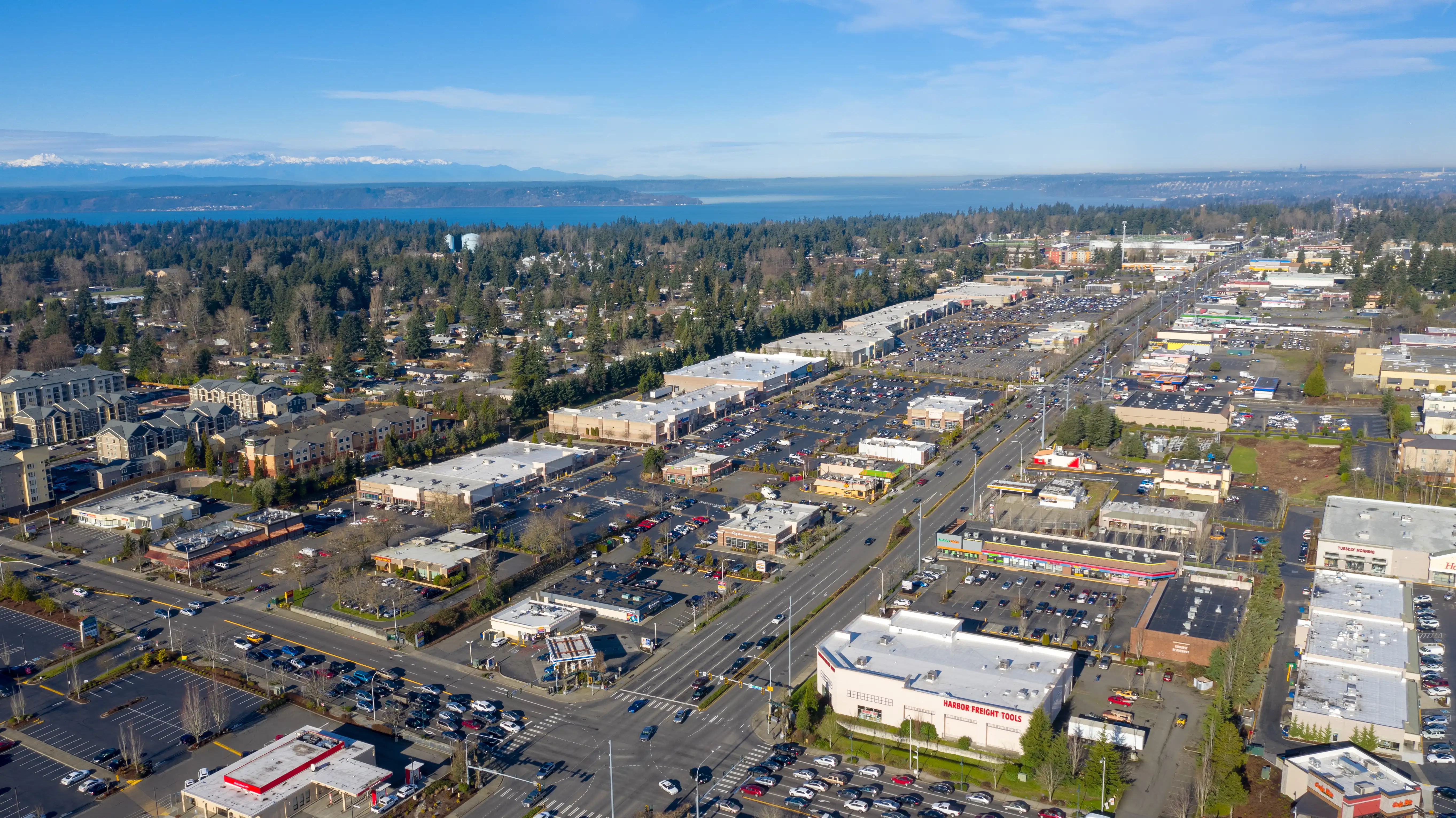
Not everyone doing a 1031 exchange is a seasoned institutional investor. A significant share of the people reading this guide sold a California home — maybe a Bay Area bungalow that appreciated into seven figures, or a Southern California rental they've held for two decades — and they're now sitting on proceeds that need to land somewhere within 180 days. Federal Way, Washington has quietly become one of the more compelling replacement property markets in the Pacific Northwest for exactly that kind of capital. Prices are accessible, rental demand is durable, and Washington's tax structure removes an entire layer of cost that California investors never stopped paying.
Federal Way's rental market is built on genuine structural demand. Roughly 44% of households here rent, and the majority of those renter households are families — not transient singles. Major employers like St. Francis Hospital, Federal Way Public Schools, World Vision, and the Totem Ocean Trailer Express operation keep a steady workforce in place. When Seattle's home prices make ownership feel out of reach for middle-income earners, Federal Way absorbs the overflow. That dynamic has kept the regional vacancy rate among the tightest in the country, with suburban submarkets like Federal Way projecting rent growth exceeding 3.5% annually even as some Seattle-core rents softened.
This guide covers everything a 1031 buyer needs to move intelligently in this market: the mechanics of the exchange, what types of investment property actually trade here and at what cap rates, why Pacific Northwest markets are drawing California capital, Washington's tax advantages compared side-by-side with California, the property management reality, and a due diligence checklist built for buyers on a 45-day identification clock.
The core of a 1031 exchange is straightforward: sell a qualifying investment property, and instead of paying capital gains tax on the proceeds, roll them into a replacement property of equal or greater value. The IRS gives you 45 days from the close of your relinquished property to identify potential replacement properties — in writing, to your qualified intermediary. You have 180 days total to close on the replacement. Miss either deadline by a single day and the exchange fails; you owe the tax.
The qualified intermediary (QI) is non-negotiable. You cannot touch the proceeds between transactions — the moment the money hits your personal account, the exchange is dead. Your QI holds the funds in escrow and transfers them directly to the closing of your replacement property. Choose a QI before you list your relinquished property, not after.
The like-kind rule is broader than most investors realize. Real property to real property qualifies — a California rental house can exchange into a Washington duplex, a commercial strip mall, or a raw land parcel. The "boot trap" catches investors who let cash fall out of the deal: if your replacement property is worth less than your relinquished property, the difference is taxable boot. Keep the debt equal or higher, and the replacement value equal or higher, and you preserve the full deferral.
Federal Way's investment market in 2026 is defined by one central reality: inventory is tight and investor-grade product moves fast. As of late 2025, only three multifamily properties were listed for sale within city limits, priced between $675,000 and just under $3 million. Single-family rentals are more plentiful but carry thin cap rates at today's prices, and small multifamily — the two-to-four unit sweet spot that most 1031 buyers target — is genuinely scarce.
The median sold price for Federal Way homes sits at approximately $610,000 as the CSV baseline, with recent transaction data from late 2025 showing individual months ranging from the upper $550s to low $600s depending on property type and season. Single-family rental houses typically gross $2,400 to $3,100 per month, placing gross rent multipliers in the 16-to-20 range and yielding estimated cap rates between 4% and 5.5% before expenses. Multifamily properties run differently: across the broader Seattle metro, Class B suburban product is trading at cap rates around 7.85%, with economy and value-add assets pushing 8.6%.
The commercial cap rate for Federal Way specifically averages around 5.85%, across 25 active commercial listings as of late 2025, with average prices running approximately $259 per square foot. For a 1031 buyer on a 45-day clock, the tight multifamily inventory is the most serious operational constraint — you may need to broaden your identification list to adjacent submarkets like Kent or Des Moines.
| Property Type | Typical Price Range | Est. Cap Rate | Avg Days to Close |
|---|---|---|---|
| Single-Family Rental (SFR) | $510,000 – $700,000 | 4.0% – 5.5% | 35 – 45 days |
| Duplex / Small Multifamily | $675,000 – $1,100,000 | 5.5% – 7.5% | 30 – 40 days |
| Larger Multifamily (5+ units) | $1,100,000 – $3,000,000 | 7.0% – 8.5% | 45 – 60 days |
| Commercial / Retail | $1,000,000 – $3,500,000 | 5.5% – 6.5% | 45 – 75 days |
SFRs move fastest — often pending within two weeks of listing. Larger multifamily and commercial product can absorb longer due diligence periods, which actually benefits 1031 buyers who need time to clear inspections without blowing a closing deadline.
Looking to buy in Estimate your payment.
Enter your numbers to see an estimated monthly mortgage payment.
Estimate only. Excludes HOA fees and mortgage insurance.
The math driving California capital north is simple: a property that sold for $1.4 million in the Bay Area or $1.1 million in Southern California can deploy into multiple Federal Way assets — debt-free, with meaningful cash flow — rather than rolling into a single California replacement property at the same or higher price point. Washington's landlord-friendly regulatory history (though evolving, as discussed below) and its lack of state income tax make the ongoing economics look even more favorable.
A Bay Area investor selling a rental that cleared $1.4 million in proceeds can realistically acquire a duplex in the $700,000–$850,000 range plus a single-family rental in the $510,000–$600,000 range — two properties, no debt, both cash-flowing. Federal Way's renter base skews toward stable working families, which is a fundamentally different tenant profile than urban Bay Area stock. For someone tired of managing a single high-value San Francisco unit with complex rent control compliance, the trade makes intuitive sense.
Southern California investors, particularly those exiting Los Angeles County or Orange County rentals, often arrive with $900,000 to $1.3 million in proceeds. At Federal Way's price range, that capital buys either a solid small multifamily or two SFRs. Los Angeles County has among the most restrictive landlord-tenant regulations in the country — moving to Washington (with its statewide framework and no city-level rent control in Federal Way) registers as a meaningful reduction in compliance burden, even with HB 1217's new caps in place.
Sacramento and Inland Empire sellers typically arrive with smaller proceeds — often in the $600,000 to $900,000 range — but they're used to cap rates that pencil and tenant bases that aren't exclusively high-income. Federal Way's working-class and middle-income renter demographics feel familiar. A single SFR or a duplex acquired at the right basis can produce cash-on-cash returns that outperform what those proceeds would generate if redeployed in the same California submarket.
Washington is one of nine states with no state income tax, and for rental property investors, that single fact changes the P&L permanently. In California, rental net income is taxed as ordinary income at the state level — the top bracket is 13.3%, and even middle-income landlords commonly face rates of 9% to 11% on rental profits. In Washington, that line item is zero. Every dollar of net rental income belongs entirely to the investor.
Washington does impose a 7% capital gains tax on long-term gains exceeding $262,000 per year, effective since 2023 and confirmed as of 2026. For most small investors receiving annual rental income, this threshold is irrelevant — it primarily affects those selling appreciated assets in a single tax year above that amount. The 1031 exchange itself defers the federal capital gains and depreciation recapture, and Washington's capital gains tax similarly does not apply to like-kind exchange proceeds that remain in the transaction.
On the property tax side, King County's rate runs approximately 1.11%, compared to California's Prop 13 effective rate on newly purchased properties, which typically runs 1.0% to 1.2% of assessed value plus local Mello-Roos assessments. The two states end up roughly comparable on property tax for new purchases — the dramatic difference lives in state income tax treatment of rental cash flow. Washington does impose a 6.5% state sales tax (plus local additions) on materials and furnishings for rental renovations. Factor this into any rehab budget; an Oregon investor doing a value-add project across the border won't face this cost, but it's manageable.
| Tax Item | California | Washington |
|---|---|---|
| State income tax on rental income | Up to 13.3% | None |
| Property tax rate (new purchase) | ~1.0%–1.2% + special assessments | ~1.11% (King County) |
| Sales tax on rehab materials | None (no general sales tax) | 6.5% + local |
| Capital gains on property sale | Up to 13.3% state + federal | 7% state (gains >$262K/yr) |
| 1031 exchange state recognition | Yes | Yes |
One important depreciation note: in a 1031 exchange, the depreciation basis from your relinquished property carries over into the replacement property rather than resetting at the new purchase price. This affects your annual depreciation deduction going forward and should be factored into projected cash flow — your CPA handles the calculation, but understanding the mechanics prevents surprises in year one.
For investors who want complete passive exposure with no management burden, Delaware Statutory Trust (DST) structures allow 1031 proceeds to flow into fractional institutional-grade property ownership. It's a legitimate option for investors who've decided they're done being landlords but still need a qualifying replacement property within the 180-day window.
Washington's landlord-tenant law is detailed and tenant-protective. The Residential Landlord-Tenant Act (RCW 59.18) governs everything from notice requirements to habitability standards, and in 2025, House Bill 1217 added statewide rent stabilization caps — limiting annual rent increases to 7% plus CPI, with the law remaining in effect through July 2040. For out-of-state investors, this is the single biggest regulatory shift to understand before closing. Federal Way itself has no additional local rent control layer, but HB 1217 now applies statewide. For investors acquiring at today's basis, 7% + CPI annual increases still allows meaningful rent growth — it's not a freeze, but it does change long-term underwriting assumptions.
Property management in Federal Way typically runs 8%–10% of gross monthly rent, with leasing fees of half to one full month's rent for tenant placement. On a property grossing $2,400 per month, that's roughly $2,300–$2,900 per year in management fees before leasing costs. Out-of-state owners consistently underestimate vacancy turns — even in a low-vacancy market, a single 30-day vacancy between tenants plus a standard cleaning and repainting costs $3,000–$5,000 at Federal Way's labor rates. Build this into year-one cash flow projections, not as an exception. Local property management companies with verified Federal Way presence include Real Property Management Puget Sound and Windermere Property Management.
The average apartment age in Federal Way skews toward 1980s construction — the largest share of rental stock was built between 1980 and 1989. This creates genuine value-add opportunity for investors willing to fund interior upgrades, but it also means deferred maintenance (aging plumbing, original windows, older HVAC) shows up frequently in pre-purchase inspections. Budget accordingly before submitting offers.
| Item | What to Verify | Local Resource |
|---|---|---|
| Title search | Clear title, no liens or encumbrances | Local title company (e.g., Chicago Title, First American) |
| Sewer / septic status | Public sewer connection vs. private septic | City of Federal Way Public Works |
| Flood zone status | FEMA flood map designation | FEMA Flood Map Service Center |
| Rental registration | Federal Way business license for rental activity | City of Federal Way Business Licensing |
| HOA restrictions | Rental caps, STR prohibitions, approval requirements | Review HOA CC&Rs directly |
| Zoning for ADU potential | Washington ADU laws are strong — verify lot size eligibility | City of Federal Way Planning Division |
| School district confirmation | Federal Way Public Schools boundary mapping | FWPS boundary lookup tool |
| Current lease review | Rent amounts, lease terms, security deposits, notice periods | Obtain copies from seller at mutual acceptance |
| Deferred maintenance inspection | Roof, HVAC, plumbing, electrical — especially 1980s-era stock | Licensed WA home inspector |
| Rent roll vs. market rent | Verify in-place rents against current market (avoid inflated proformas) | Rentometer, Zillow Rental Manager |
| Short-term rental ordinance | Federal Way's STR status — confirm current allowability | City of Federal Way Code Compliance |
| Environmental flags | Oil tanks, wetlands proximity (Hylebos-area parcels), asbestos | Phase I ESA for commercial; inspector for SFR |
| Property management referral | Identify management company before closing if out-of-state | Real Property Management Puget Sound |
| Title company recommendation | Use a WA-based company familiar with 1031 closings | Coordinate with your QI early |
Local Expert Takeaway: The most common mistake California 1031 buyers make in Federal Way is underwriting to Bay Area vacancy assumptions — assuming 2% or 3% vacancy and smooth year-over-year rent growth without accounting for HB 1217's new stabilization caps or the true cost of a deferred maintenance turn on 1980s-era stock. The investors who succeed here do the honest math: real vacancy (closer to 6%), real management fees, real repair reserves on older property, and rent growth modeled conservatively at 4%–5% annually. Identify at least three replacement properties on day one of your 45-day window — not two. Tight multifamily inventory means your first choice may fall through inspection.
✅ Federal Way's 44% renter-occupied rate and constrained construction pipeline create durable rental demand — suburban markets like Federal Way are projecting rent growth of 3.5%+ annually while some urban core rents soften.
⚠️ Washington's HB 1217 caps annual rent increases at 7% + CPI through 2040 — model conservatively and confirm your acquisition basis supports cash flow within those limits.
📍 Small multifamily inventory is extremely tight — with fewer than five active listings in most months, 1031 buyers should broaden their identification list to include Kent, Des Moines, and Auburn as alternatives within the same submarket.
Does a 1031 exchange work for out-of-state property?
Yes — like-kind exchanges are a federal IRS mechanism, so a California investor can sell a California property and acquire a Washington replacement property within the same 1031 structure. The exchange simply requires a qualified intermediary to hold proceeds between closings, and both states recognize the transaction. Washington has no additional state-level barrier to a cross-state 1031.
What is the cap rate on rental property in Federal Way?
Single-family rentals in Federal Way typically yield estimated cap rates in the 4% to 5.5% range at current prices, with gross rents for houses running $2,400 to $3,100 per month. Small multifamily and value-add properties can push into the 7%–8.5% range depending on condition and in-place rents, which is more in line with broader Seattle-metro Class B suburban product trading in 2026.
Do I need a local property manager for a 1031 investment in Washington?
Not legally required, but practically essential for out-of-state owners. Washington's Residential Landlord-Tenant Act carries specific notice requirements and tenant protections — managing remotely without local support leads to compliance errors that cost far more than the 8%–10% management fee. HB 1217's new rent stabilization rules add another layer of compliance that experienced local managers handle as routine.
Explore the full Federal Way series: The Ultimate Federal Way Relocation Guide · Is Federal Way Safe? · Cost of Living in Federal Way · Best Neighborhoods in Federal Way · Federal Way Schools & Family Life · Federal Way Youth Sports · Federal Way Parks & Recreation · Retiring in Federal Way · 1031 Tax-Deferred Exchange in Federal Way · Federal Way First-Time Homebuyers Guide · Moving to Federal Way from California
Tell us what you need help with and we'll connect you with local resources.

About the Author
Todd Davidson is the founder of Living in Oregon and Living in Washington, where he publishes in-depth city guides, neighborhood resources, and local market insights covering more than 180 communities across the Pacific Northwest. While his background is in home financing and real estate, he created these digital platforms to help families research and compare regions before making a move.