
Puget Sound · Washington
Maybe your company is relocating you to the Eastside corridor and someone in the office mentioned Mercer Island as the alternative to Bellevue. Maybe you've been watching Seattle home prices and someone told you that for what you'd spend in Montlake or Madison Park, you could actually own a house — not just a unit — with water views and a yard. Maybe you just drove across the I-90 bridge, glanced left at the tree canopy and right at Lake Washington, and thought: what is that place, and why doesn't anyone talk about it? The central tension of Mercer Island is this: it is one of the most desirable addresses in the entire Pacific Northwest, but it operates with the quiet restraint of a town that doesn't need to advertise. Median sold prices sitting in the $2.4 to $2.6 million range — with waterfront estates regularly clearing $10 million — and yet the island produces no flashy billboards, no lifestyle campaigns, no social media scenes. It simply exists, and the people who find it tend to stay.
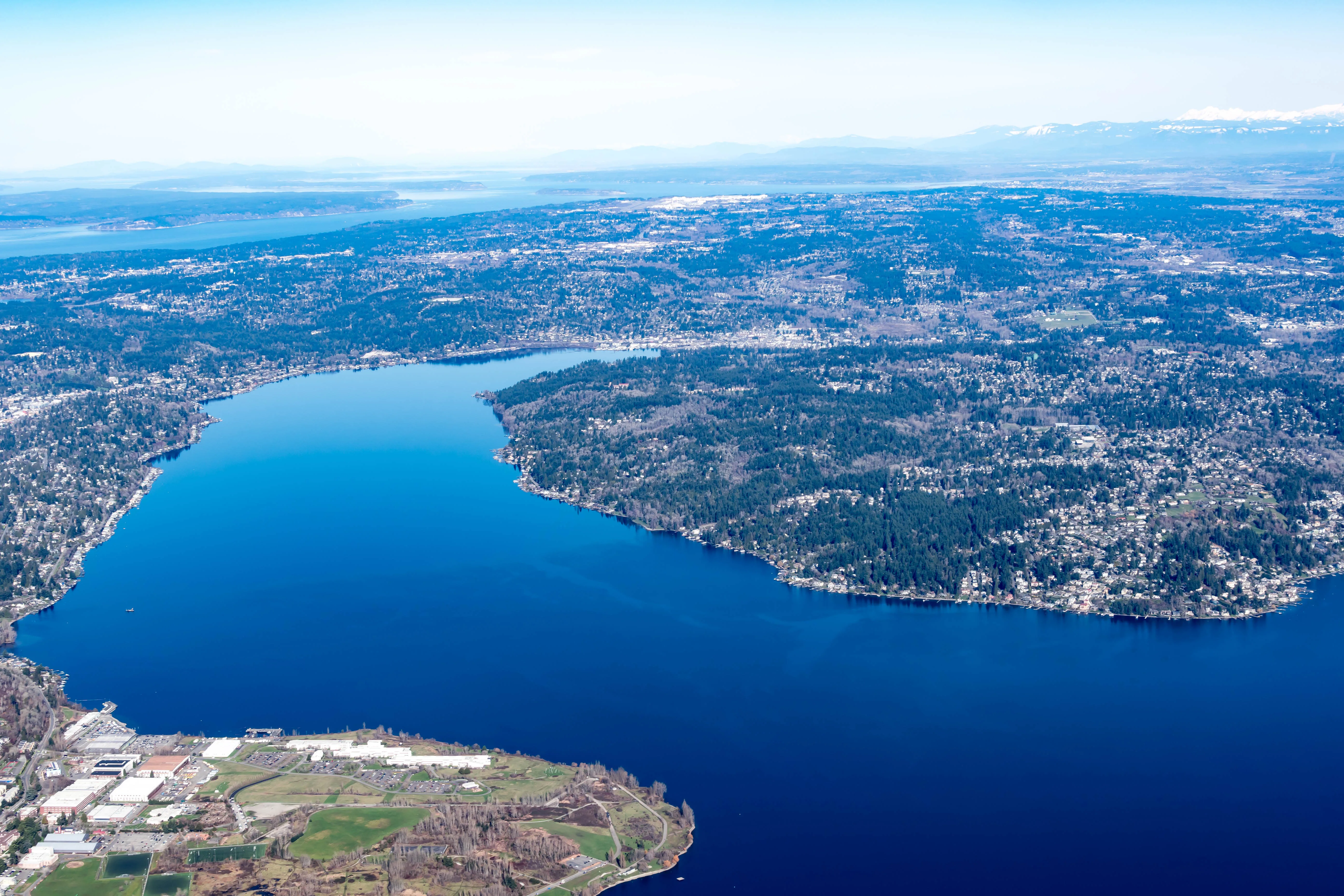
What shapes daily life here is geography in the most literal sense. Mercer Island is an actual island — four miles long, two miles wide — sitting in the middle of Lake Washington, connected to Seattle on the west and Bellevue on the east by the I-90 floating bridge corridor. There is no ferry. There is no back road. You are on an island, and that single fact governs everything from traffic patterns to community character to the way neighbors recognize each other at Clarke Beach. As of March 2026, you can also ride Link light rail directly from the island into Downtown Seattle in about 15 minutes, making this the only place in the Pacific Northwest where you can walk off a wooded trail to a rail platform that puts you at Pike Place Market before lunch.
This guide will help you answer the question that every serious buyer eventually asks: is Mercer Island actually worth it? You'll find an honest look at who fits here and who doesn't, what the neighborhoods actually feel like at street level, where the tradeoffs are real versus overstated, and what a local with years of Eastside market experience would tell you over coffee before you made an offer.
Not every buyer who falls in love with Mercer Island at an open house is the right fit for it. The island rewards certain lifestyles and mildly frustrates others. Here's a direct breakdown.
| Best For | Why |
|---|---|
| Seattle & Bellevue commuters | 15-minute drive to Seattle, light rail now running to Downtown, and I-90 access to Bellevue's tech corridor in under 20 minutes on a good morning |
| Families with school-age children | Mercer Island School District ranks within the top 1% of Washington districts; MIHS consistently ranked among the state's top two or three high schools |
| Remote workers with high incomes | Island living, quiet neighborhoods, genuine outdoor recreation — without sacrificing fast internet or proximity to urban culture when you need it |
| Retirees downsizing from Seattle | Walkable Town Center, low violent crime (0.4 per 1,000 residents), medical access via ferry or bridge, and a condo market entry point around $550K–$850K |
| Buyers priced out of Seattle's waterfront neighborhoods | Mercer Island offers waterfront access — both private and public beach parks — at price points that would buy a basic lot in Leschi or Madrona |
| First-time luxury buyers moving from out of state | The island's relative quiet and community cohesion offer a gentler landing than Capitol Hill or Bellevue's high-density core |
The first thing that surprises newcomers isn't the money — it's the trees. Roughly 40% of Mercer Island's landmass is forested, and the island enforces strict tree canopy protections that give even the densest residential streets a genuine sense of enclosure. Driving through West Mercer or North End in summer feels less like a suburb than like threading through a Pacific Northwest nature preserve that happens to have driveways. That canopy is not accidental — it is the product of decades of deliberate land-use decisions by a city government that has consistently prioritized environmental character over density.
Daily life organizes around a few central nodes. Town Center, the island's commercial core along SE 27th Street and SE 68th Avenue, holds the grocery stores, the coffee shops, the Saturday farmers market, and the community gathering infrastructure that makes the island feel like a town rather than a commuter landing pad. The Mercer Island Community & Event Center functions as the island's civic living room — fitness facilities, meeting spaces, youth programming, senior services, and the social glue for a community of roughly 25,000 people who largely chose to be here intentionally. Families with kids tend to cluster around the parks and recreation programming based out of this facility, and the Friday evening energy around Town Center is noticeably different from the anonymous strip-mall vibrancy you'd find in comparable Eastside suburbs.
The commute reality has changed fundamentally in 2026. The Mercer Island Link station — positioned in the I-90 median and notable as part of the first light rail line in the world to operate on a floating bridge — now delivers riders to the International District in 10 minutes and to the University of Washington campus in 21 minutes. The drive to Seattle's First Hill medical corridor or South Lake Union tech campuses runs 15 minutes in off-peak conditions. In realistic morning rush traffic, budget 25 to 35 minutes and consider the train for anything near Downtown. Getting to Bellevue's Spring District or Overlake tech campuses runs 20 minutes by car; those trips are not served as efficiently by light rail, which routes through Downtown Seattle before reaching Bellevue.
One human friction moment that catches people off-guard: there is only one way on and off this island by car, and it runs through the I-90 interchange. On ordinary weekday mornings, this is a non-issue. On Seahawks game days, on holiday weekends, and occasionally during Mercer Island's own community events, the SE 27th Street and Island Crest Way corridors back up in ways that feel disproportionate for a town this size. Longtime residents have internalized the timing; newcomers who move here expecting suburban flexibility sometimes spend the first few months recalibrating. Build your routines around it rather than against it.
The schools are the most commonly cited reason families move here, and the reputation is earned. Mercer Island High School has held a position among the top two or three high schools in Washington state across multiple ranking systems, with math proficiency commonly reported around 87%, ELA proficiency near 93%, and a four-year graduation rate of approximately 97%. The district's four elementary schools — Island Park, Lakeridge, Northwood, and West Mercer — feed into Islander Middle School in a single-district pipeline that parents describe as unusually coherent. The district implemented a cell phone-free policy at both Islander Middle School and the high school for the 2025–26 year, a move that drew national coverage and reflected the community's willingness to act on values rather than just discuss them.
The parks system is legitimate, not just adequate. Luther Burbank Park on the northeast shore offers 77 acres of waterfront trails, off-leash dog areas, a swimming beach, and a boat launch with one of the finest unobstructed views of Bellevue's skyline available from water level. Pioneer Park on the island's south end covers more than 120 acres of old-growth-adjacent forest with trail networks that feel genuinely wild for a community this close to two major cities. Clarke Beach Park, Groveland Beach Park, and Aubrey Davis Park round out the public waterfront access in ways that most Seattle neighborhoods — even expensive ones — cannot match.
The community cohesion is real and somewhat unusual for a place this affluent. A median household income of approximately $219,000 and a population with over 40% holding advanced degrees creates a community that is deeply invested in its own civic life — school board meetings here are attended at rates that would be unusual in most cities. The Mercer Island Farmers Market runs weekly through summer, the holiday boat parade is a genuine local tradition rather than a chamber of commerce promotion, and the informal social infrastructure around Luther Burbank and the Town Center tends to produce the kind of neighbor relationships that most suburban buyers claim they want but rarely find.
There is also the waterfront access question, which deserves honest treatment. Private waterfront on Mercer Island sells at prices that reflect true scarcity — the 2025 high-water mark was a $25 million North End sale for a west-facing property with 102 feet of prime frontage. But public beach access is distributed well enough that non-waterfront residents genuinely use the lake. On summer weekday mornings before 9 a.m., the beach parks feel like private amenities. That experience — paddling on Lake Washington in July with the Cascades visible to the east and downtown Seattle's skyline visible to the west — is the thing residents mention most when asked why they've never seriously considered leaving.
Looking to buy in Estimate your payment.
Enter your numbers to see an estimated monthly mortgage payment.
Estimate only. Excludes HOA fees and mortgage insurance.
The price of entry is real and does not bend. Mercer Island has no affordable housing tier in any conventional sense. Single-family homes in the least expensive parts of the island — older construction in Mercerdale or parts of Mid-Island — start around $1.7 to $1.8 million. The condo market offers the lowest entry point at $550,000 to $850,000, but condos are a limited inventory on an island that is primarily single-family residential. Buyers who stretch to their absolute limit to get here frequently find themselves house-rich but lifestyle-constrained on an island where restaurants, private school options, and recreational activities run at premium price points as a matter of baseline. The rule of thumb floating around the market — that you need to earn at least $500,000 annually to comfortably carry the median home — is not an exaggeration.
The island's geographic isolation, which creates the community character people love, also creates a specific kind of friction for buyers who underestimate it. There is no Costco on Mercer Island. There is no Home Depot. There is no urgent care clinic operating late evenings. For routine errands that most suburban homeowners take for granted — the Saturday afternoon hardware run, the last-minute grocery restock at 10 p.m., a pediatric urgent care visit on a Sunday — you are crossing a bridge. Bellevue's Factoria corridor and Seattle's Rainier Avenue corridor both cover most of these needs, but the psychological shift of being on an island takes some residents longer to adjust to than they anticipated.
The market's own volatility is a tradeoff worth naming. Mercer Island's price data across 2025 and early 2026 shows meaningful variance: the Windermere/NWMLS full-year 2025 benchmark was $2,550,000 with 80 total single-family sales, while Q1 2026 Redfin data showed a softer $2.2 million median, and a recent 30-day window pushed $2.7 million. A market with that range — in a single year — means that buyers who need to sell in a specific window face genuine timing risk. This is not a complaint about Mercer Island specifically; it reflects the general volatility of a thin luxury market where 80 annual sales can swing meaningfully based on a handful of waterfront closings in either direction.
Why some people leave. The residents who move off the island after three to five years generally cite one of two things: children who've left for college create empty nesters who want urban density and street-level walkability that Town Center, for all its strengths, doesn't fully deliver; or households whose professional circumstances shift away from the Eastside corridor find that Mercer Island's geographic position becomes a commute liability rather than an asset. Neither of these is a knock on the island — they're honest reflections of the life stages where Mercer Island fits best.
The west side of the island is Mercer Island's most prestigious address, and the price data makes that unambiguous — the Westside median sat at approximately $5.8 million in 2025. West-facing waterfront properties here capture the full Seattle skyline panorama across Lake Washington, with afternoon light that professional photographers describe as among the best in the Pacific Northwest. Properties tend to be on generous lots with mature tree coverage, and the neighborhood's relative seclusion from Island Crest Way traffic gives it a quieter daily rhythm than the more central parts of the island. The honest tradeoff is that this is a neighborhood for buyers who have already made their decision about Mercer Island — it is not a place to explore the lifestyle before committing.
Best for: Established buyers seeking waterfront privacy, panoramic Seattle views, and no compromise on lot quality.
The east side runs along Lake Washington's eastern shore facing Bellevue, with properties that offer city light views of the Eastside skyline rather than Seattle's. Prices are meaningfully lower than the west side — still well above the island's $2.4 to $2.6 million overall median in waterfront configurations — and the I-90 proximity makes East Mercer one of the more practical neighborhoods for buyers whose primary commute destination is Bellevue rather than Seattle. The neighborhood has a slightly more open, less forested character than the western slopes.
Best for: Bellevue-focused commuters who want lake adjacency without west-side price points.
The North End is where Mercer Island's most storied estate properties sit — this is the neighborhood that produced the $25 million waterfront sale in 2025. Larger lots, older-growth tree coverage, and direct frontage on the northern lake reach toward the Mercer Slough give this part of the island its most dramatic residential feel. Luther Burbank Park anchors the northeastern corner with public beach access that all island residents use, which softens the exclusivity somewhat. Entry into the North End's single-family market starts well above the island's median, with waterfront properties representing a distinct tier above even that.
Best for: Buyers seeking estate-scale properties, deep lots, and proximity to Luther Burbank Park's trail network.
The South End is defined by Pioneer Park's 120-plus acres of forest trails and a residential character that feels more tucked away than any other part of the island. Homes here tend to be on slightly larger lots than Mid-Island, and the neighborhood's distance from Town Center contributes to prices that, while still substantial, frequently come in below the island median for comparable square footage. Families who prioritize trail access and a lower-key social scene over walkable retail tend to gravitate here.
Best for: Outdoor-focused families who want Pioneer Park as a backyard and don't need to walk to a coffee shop.
Mid-Island is the island's most heterogeneous residential zone — a mix of 1960s and 1970s construction updated to varying degrees, newer infill builds, and the occasional teardown-rebuilt property that signals neighborhood transition. This is where buyers with genuine budget constraints find Mercer Island's closest thing to an entry point in the single-family market, with some properties still trading in the $1.7 to $2.1 million range. Island Crest Way, the main north-south arterial, runs through here, so traffic proximity varies by exact street.
Best for: Buyers seeking the most accessible price entry into Mercer Island single-family ownership.
Town Center is the only part of Mercer Island that approaches conventional walkability — coffee shops, the PCC Natural Markets, restaurants, the Saturday farmers market, and the Community & Event Center are all within a 10-minute walk of the condo and mixed-use buildings clustered along SE 27th Street. The condo market here offers the island's most accessible price points at $550,000 to $850,000 for standard units, with townhomes reaching $1.3 million for larger configurations. The new light rail station at the I-90 median makes Town Center genuinely transit-connected for the first time.
Best for: Downsizers, retirees, and commuters who want walkable access to transit and don't need a yard.
Mercerdale is consistently cited as the island's most affordable single-family neighborhood, with a 2025 median around $1,775,000 — meaningfully below the island-wide figure. The neighborhood sits near Mercerdale Park, a well-used open space with sports fields and open lawn, and its proximity to Town Center means residents don't sacrifice convenience for relative value. The housing stock is older on average, and buyers here are typically doing more cosmetic updating than in the premium neighborhoods.
Best for: Buyers who want to maximize square footage and lot size relative to Mercer Island budget.
First Hill (the Mercer Island version, not to be confused with Seattle's First Hill) occupies a central-to-southern position on the island with established residential streets, larger lots than the Town Center corridor, and a neighborhood feel that long-term residents describe as the quintessential Mercer Island experience — school buses, neighbors who know each other, and no commercial activity within earshot. Prices here typically sit in the $2 to $2.8 million range for renovated single-family homes.
Best for: Families with children in the district schools who want a traditional residential feel and room to grow.
| City | Best For | Median Home Price | Commute to Seattle | Vibe |
|---|---|---|---|---|
| Mercer Island | Families, top schools, island lifestyle | ~$2.5M (sold, 2025) | 15 min drive / 10 min rail | Quiet affluence, strong civic identity |
| Bellevue | Tech workers, urban amenities, density | ~$1.5M–$1.8M | 25–35 min | Corporate polish, fast growth |
| Seattle (Madison Park) | Urban walkability, proximity | ~$1.3M–$2M | On-city | Dense, walkable, less family-oriented |
| Newcastle | Value relative to Bellevue, newer construction | ~$950K–$1.3M | 25–30 min | Suburban, less distinct identity |
| Clyde Hill | Ultra-premium, Bellevue-adjacent estates | ~$3M+ | 20–25 min | Quiet luxury, no commercial core |
| Beaux Arts Village | Micro-community, extreme privacy | ~$2M–$3M | 20–25 min | Tiny, tight-knit, no amenities |
| Stat | Detail |
|---|---|
| Population | ~25,078 |
| Median Household Income | ~$219,069 (2024) |
| Median Sold Home Price | ~$2.5M (2025 full year, NWMLS) |
| Property Tax Rate | ~0.61% effective rate |
| Violent Crime Rate | 0.4 per 1,000 residents |
| School District Rating | A (top 1% in Washington state) |
| Commute to Seattle | ~15 min (drive) / ~10 min (Link light rail, 2026) |
| Commute to Bellevue | ~15–20 min (drive) |
| Median Age | 46.4 years |
| Advanced Degree Holders | ~41% of adult population |
The light rail station art is worth a look. When the Mercer Island Link station opened in March 2026 as part of the 2 Line's historic floating-bridge crossing, Sound Transit commissioned two pieces by artist Beliz Brother specifically for the station: Stroke, a suspended installation of paddles and oars above the west entrance, and Crossing, a simplified boat on a wave at the east entrance. Most commuters hustle past without pausing, but the pieces are a genuine reflection of the island's relationship with water culture — kayaking, rowing, paddleboarding — that has defined community life here long before the trains arrived.
The holiday boat parade is a legitimate community event. Every December, local boaters light up their vessels and parade through the stretch of Lake Washington visible from the island's waterfront parks. This is not a chamber of commerce spectacle with sponsors and ticketed seating — it is a genuine neighborhood tradition that draws residents to the shoreline in coats and scarves, and the crowd at Luther Burbank's beach on parade night includes people who've been watching from the same spot for 20 years. It is one of the clearest illustrations of what makes Mercer Island's community feel different from a comparable-income zip code in, say, Clyde Hill.
The farmers market on Saturdays is the de facto social institution. The Mercer Island Farmers Market runs from June through October in the Town Center, and it functions the way the island's founders probably hoped a town square would: as the place where you see your neighbors, run into your kids' teachers, and find out what's actually happening locally before it shows up anywhere else. The market itself is well-curated and not enormous — which is the point. It is scaled for the community it serves.
What I would not do if moving here: Don't buy on or immediately adjacent to Island Crest Way without spending time on that street during the Wednesday evening and Friday afternoon windows when the bottleneck near SE 40th Street compounds. The island's single ingress/egress means this corridor absorbs all through-traffic, and a house that feels perfectly quiet on a Tuesday morning can generate meaningful background noise during the commute pinch points. The effect is highly localized — one block off Island Crest Way in most neighborhoods, you'll barely notice it — but properties immediately abutting the road deserve a skeptical look during peak hours before you make an offer.

Local Expert Takeaway: The buyers who get the most out of Mercer Island are the ones who treat the Town Center condo market and the Mid-Island price range below $2 million as a genuine entry point rather than a consolation prize — get in, build equity, and let the island's extraordinary school district and the new light rail tailwind do the work. If you're drawn to the west side or the North End waterfront, the 2025–2026 period of elevated inventory and some pricing softness from 2024 highs represents one of the better entry windows in years. Don't try to time the $25 million end of the market; focus on the $1.8 to $2.5 million segment where volume is real and competition is manageable.
✅ Mercer Island's light rail connection — now running as of March 2026 — fundamentally changes the commute calculus for Seattle-bound buyers who previously weighed the island's geography as a liability.
⚠️ The $2.5 million median is real, and the lifestyle expectations embedded in that price point — from restaurant bills to school activity fees to home maintenance costs — add up faster than most relocation budgets anticipate.
📍 If your primary destination is Bellevue, understand that the new 2 Line routes through Downtown Seattle before reaching the Eastside, making the drive still the faster option for most Bellevue commuters. Mercer Island's position is optimized for Seattle access.
Is Mercer Island a good place for families?
Yes — Mercer Island is consistently among the top family destinations on the Eastside. The school district ranks within the top 1% in Washington state, Mercer Island High School holds a top-three statewide position by most measures, and the parks system offers genuine outdoor recreation at scales most comparable communities can't match. The realistic qualifier is that the financial commitment required to buy here — and to participate fully in the community's activity culture — is substantial.
What is the crime rate in Mercer Island?
Mercer Island's violent crime rate sits at approximately 0.4 incidents per 1,000 residents, which places it among the safer communities in King County by a significant margin. Property crime runs around 12 per 1,000 — not negligible, and largely concentrated in vehicle break-ins near the park-and-ride and transit corridor — but well below comparable suburban rates. The island's enclosed geography and tight community network contribute to a general sense of safety that residents cite consistently.
How does Mercer Island compare to nearby Bellevue?
Bellevue offers more commercial density, a broader range of home price points, and better direct access to the Eastside tech corridor — but it does not offer Mercer Island's school district performance, the island's natural character, or the community cohesion that comes from a geographically bounded town of 25,000 people. Mercer Island median sold prices run roughly $700,000 to $1 million above comparable Bellevue single-family product, and most buyers who make that premium work are doing so specifically for the schools and the lifestyle rather than the commute math.
Explore the full Mercer Island series: The Ultimate Mercer Island Relocation Guide · Is Mercer Island Safe? · Cost of Living in Mercer Island · Best Neighborhoods in Mercer Island · Mercer Island Schools & Family Life · Mercer Island Youth Sports · Mercer Island Parks & Recreation · Retiring in Mercer Island · 1031 Tax-Deferred Exchange in Mercer Island · Mercer Island First-Time Homebuyers Guide · Moving to Mercer Island from California
Tell us what you need help with and we'll connect you with local resources.

About the Author
Todd Davidson is the founder of Living in Oregon and Living in Washington, where he publishes in-depth city guides, neighborhood resources, and local market insights covering more than 180 communities across the Pacific Northwest. While his background is in home financing and real estate, he created these digital platforms to help families research and compare regions before making a move.