
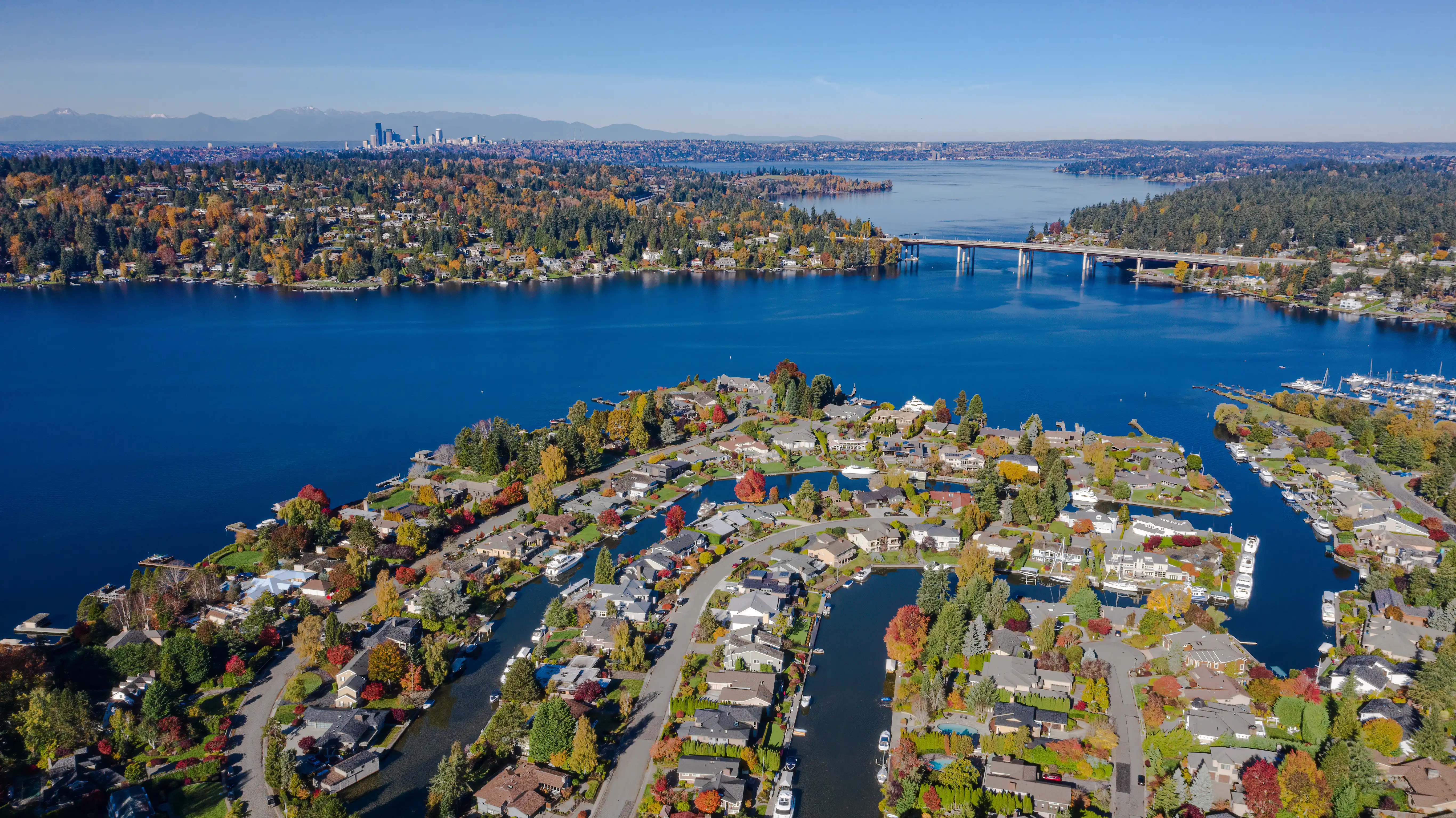
Puget Sound · Washington
Not everyone doing a 1031 exchange is a seasoned institutional investor. A significant share of the capital flowing into Bellevue right now comes from California homeowners — people who bought a Bay Area bungalow in 2003 or a San Diego duplex in 2010, watched it appreciate beyond anything they ever expected, and finally sold. Now they're sitting on taxable proceeds that could easily exceed $500,000 or $1 million, and they need a replacement property that makes economic sense. Bellevue has become a serious answer to that question — not because it's cheap, but because the fundamentals that drive rental demand here are unusually durable.
The Bellevue rental market is built on a tenant base that isn't going anywhere. Amazon's expansion into the Eastside, Microsoft's Redmond campus just minutes away, and a technology corridor that includes T-Mobile, Salesforce, Valve, and Concur means the renter profile here skews toward dual-income households earning $120,000 to $200,000 a year. These tenants pay on time, stay longer, and maintain properties better than average. Nearly half of Bellevue's 60,000-plus households are renter-occupied — about 29,500 units — and the new construction pipeline has collapsed to a 10-year low, with completions projected to fall sharply through 2025 and into 2026. That supply gap is exactly what a long-term investor wants to see.
This guide covers what you actually need to know before deploying 1031 proceeds into Bellevue: the exchange mechanics, the types of investment property that trade here, realistic cap rates by asset class, the Washington tax picture versus California, landlord-tenant law realities, and a due diligence checklist built for an out-of-state investor racing a 45-day identification clock.

The core mechanic is simple: sell a qualifying investment property, hand the proceeds to a qualified intermediary (QI) before you touch a dollar, and identify your replacement property within 45 calendar days of closing. That 45-day window is where most exchanges go sideways — not because investors can't find a property, but because they underestimate how fast that clock moves when you're navigating a market you don't know well. The 180-day closing deadline runs concurrently from the same sale date, not from the identification date, so a late identification leaves very little runway to close.
The like-kind rule is broader than most people realize. Any real property held for investment or business use qualifies — a raw lot in Redmond can replace a San Jose apartment building, and a Bellevue duplex can replace a commercial strip in Sacramento. What traps investors is "boot" — taxable cash or debt relief received in the exchange. If your relinquished property sold for $1.4 million and your replacement property costs $1.2 million, the $200,000 difference becomes a taxable event. To fully defer, the replacement must be equal or greater in value and the debt assumed must be equal or greater than the debt paid off.
The qualified intermediary requirement is non-negotiable and has no exceptions. The QI must be established before you close your sale — you cannot retroactively appoint one after the fact. Use a QI with experience in the Pacific Northwest market, as local title and escrow companies familiar with Washington's closing process will work more smoothly with regional QIs than with national platforms that don't know Bellevue's transaction norms.
Bellevue is not a high-cap-rate market and never has been. What it offers instead is low vacancy, durable tenant quality, and appreciation that has outperformed most comparable Pacific Northwest metros over any 10-year window you choose. The median sold price for Bellevue homes currently sits in the $1.45 million to $1.6 million range, with single-family residences in established neighborhoods often starting closer to $2 million. For a 1031 buyer replacing a California asset in that price range, the transaction math frequently works — especially when the Washington tax structure is factored in.
The asset types that trade most often as investment vehicles here are single-family rentals, small multifamily (2–8 units), and a smaller volume of commercial retail and mixed-use along corridors like Bel-Red Road and Factoria Boulevard. True apartment buildings are rare off-market and command institutional pricing when they do surface. The downtown Bellevue market-rate vacancy rate sits at approximately 3.8%, driven partly by Amazon's continued Eastside expansion, making well-located multifamily among the most defensible assets in the region.
| Property Type | Typical Price Range | Est. Cap Rate | Avg Days to Close |
|---|---|---|---|
| Single-Family Rental (SFR) | $1.4M – $2.5M | 3.0% – 4.0% | 10 – 21 days |
| Small Multifamily (2–8 units) | $1.8M – $4.5M | 4.2% – 5.0% | 21 – 45 days |
| Retail / Strip Commercial | $2.0M – $6.0M | 6.4% – 6.8% | 30 – 60 days |
| Industrial / Flex | $3.0M – $8.0M+ | 7.0% – 7.5% | 30 – 60 days |
| Office (Eastside Class A/B) | $3.5M – $10M+ | 7.6% – 8.0% | 45 – 90 days |
SFRs and small multifamily move fastest and are the most competitive for 1031 buyers — expect to write offers at or above asking with tight inspection contingencies. Office and industrial allow more negotiation time, which can be a practical advantage for an investor managing a 45-day identification clock.

Looking to buy in Estimate your payment.
Enter your numbers to see an estimated monthly mortgage payment.
Estimate only. Excludes HOA fees and mortgage insurance.
California remains the dominant source of 1031 exchange capital entering the Pacific Northwest. The combination of extreme appreciation, high state taxes, and increasingly complex landlord-tenant regulations has pushed investors to look north — and Bellevue consistently appears at the top of that shortlist.
A Bay Area homeowner who sold a primary residence or rental property in Atherton, Palo Alto, or Sunnyvale in 2025–2026 may be carrying $1.2 million to $2.5 million in net proceeds after paying off a mortgage. At Bellevue's current price points, that capital can acquire a quality SFR rental free and clear — no debt service drag, no lender approval required on the timeline — or leverage into a small multifamily at a debt-to-equity ratio the investor controls. The Bay Area buyer is also accustomed to paying 3% or less in cap rates at home, so Bellevue's 3.5% to 4% SFR yield combined with Washington's zero state income tax often pencils better on an after-tax basis than staying in California.
Los Angeles and San Diego investors frequently arrive with proceeds from small apartment buildings — the 4-to-8-unit assets that California cities increasingly regulate under just-cause eviction and rent stabilization ordinances. Bellevue offers a clean exit from that regulatory environment. A $2.8 million duplex or fourplex here operates under Washington's landlord-tenant framework, which has statewide protections but lacks the local rent stabilization overlay that defines Los Angeles, Santa Monica, and San Diego's rental landscape.
Sacramento and Inland Empire investors often come to Bellevue with lower absolute proceeds but greater appreciation percentages — properties bought in 2015 for $350,000 and sold in 2025 for $750,000 or more. For this buyer, a Bellevue SFR in Crossroads or Lake Hills in the $1.4 million to $1.6 million range makes sense as a leveraged replacement — 25% down, finance the balance using a DSCR loan, and let a professional property manager run it remotely. The rent-to-price ratio on entry-level Bellevue SFRs isn't spectacular, but the tenant quality and low vacancy make it a low-management, low-friction hold.
The most immediate advantage for a California investor acquiring rental property in Washington is the absence of state income tax. California taxes ordinary income — including net rental income — at rates up to 13.3% for high earners. A Bellevue rental generating $40,000 net annually costs a California resident $5,320 per year in state income tax if they remain a California taxpayer. For a Washington resident investor, that number is zero. Over a 10-year hold, the difference is material.
Washington does have a 7% capital gains tax enacted in 2021 and upheld by the state Supreme Court, but it applies only to long-term capital gains exceeding $262,000 per year (the current 2026 threshold after inflation adjustments). For most individual investors whose annual gain recognition is managed within a 1031 exchange structure, this threshold is rarely triggered on rental income alone. It becomes relevant on a future sale — and at that point, another 1031 simply defers the obligation again.
| Tax Item | California | Washington |
|---|---|---|
| State income tax on rental income | Up to 13.3% | None |
| Property tax rate (new purchase) | ~1.1% – 1.25% (Prop 13 reset) | ~0.73% – 1.1% (King County) |
| Sales tax | 7.25% – 10.75% | 8.6% – 10.6% |
| Long-term capital gains (state) | Up to 13.3% | 7% above $262K/year |
| 1031 exchange availability | Yes | Yes |
Washington's sales tax on construction materials and renovation supplies does add cost to a value-add rehab strategy — a $150,000 kitchen and bathroom renovation will carry approximately $12,000 to $15,000 in sales tax that a California investor using Oregon property wouldn't face. Factor that into your renovation budget. Property taxes in King County at Bellevue's price points run approximately 0.73% to 1.1% of assessed value depending on the ZIP code — the 98004 ZIP (downtown/West Bellevue) carries higher levy rates than 98007 or 98008, so verify the specific parcel's tax history before closing.
One critical point that catches investors off-guard: in a 1031 exchange, the depreciation basis of the relinquished property carries over to the replacement property — it does not reset to the new purchase price. Your accumulated depreciation recapture obligation transfers with the asset. A Delaware Statutory Trust (DST) is worth a brief mention here as an alternative for investors who want completely passive 1031 replacement exposure in the Pacific Northwest without the management burden of direct ownership.
Washington's landlord-tenant law sits between California's heavily tenant-favoring code and states with minimal tenant protections. As of 2026, there is no statewide rent control in Washington, and Bellevue does not have the local rent stabilization ordinances that cities like Seattle have proposed. Landlords must provide 20 days' notice to terminate a month-to-month tenancy without cause if the tenant has lived there less than one year, 60 days if they've lived there one to two years, and 90 days for tenancies over two years. For cause evictions follow a defined notice process with specific timeframes depending on the violation type.
Out-of-state owners consistently underestimate two things: the cost of professional property management and the time it takes to turn a unit between tenants. Professional management in Bellevue typically runs 8% to 10% of gross monthly rent, which on a $3,200/month rental means $256 to $320 leaves the top line every month before any expense. Brink Property Management and SJA Property Management are two established Eastside firms that handle single-family and small multifamily assets — both have experience working with remote owners on 1031-acquired properties. Vacancy between tenants in Bellevue typically runs 3 to 4 weeks when a property is priced correctly, but deferred maintenance discovered during a vacancy — not uncommon in properties acquired on a 1031 deadline without a thorough inspection — can stretch that to 6 to 10 weeks.
The tenant pool in Bellevue skews heavily toward technology sector employees. That means qualified applicants with strong income documentation, but it also means tenants who negotiate, know their rights, and will not tolerate deferred maintenance. Setting aside 8% to 12% of annual gross rent for maintenance and capital reserves is a conservative but appropriate baseline for properties over 15 years old.
| Item | What to Verify | Local Resource |
|---|---|---|
| Title search | Clean title, no undisclosed liens or easements | Washington licensed title company (Chicago Title, Stewart Title) |
| Sewer / septic status | Public sewer vs. septic; septic condition and permit history | King County Wastewater Division |
| Flood zone status | FEMA flood zone designation; flood insurance requirement | FEMA Flood Map Service Center |
| Rental permit / business license | Bellevue does not require a specific rental license, but verify zoning compliance | City of Bellevue Development Services |
| HOA restrictions on rentals | Many Bellevue HOAs restrict STR or cap long-term rental percentages | HOA CC&Rs and management company |
| Short-term rental ordinances | Bellevue requires STR operators to register; verify current rules | City of Bellevue Municipal Code |
| ADU potential | Lot size, setbacks, and zoning for detached or attached ADU addition | City of Bellevue ADU permit process |
| School district boundary | Property's assigned elementary/middle/high school affects tenant pool | Bellevue School District boundary tool |
| Current lease status | Month-to-month vs. fixed term; existing tenant notice obligations | Review executed lease documents |
| Deferred maintenance inspection | Full general inspection + sewer scope on any property over 15 years | Licensed Washington State inspector |
| Zoning verification | Confirm R-1, R-2, R-3 or multifamily zoning; verify future rezoning notices | King County GIS / City of Bellevue zoning map |
| Property management referral | Establish relationship before closing — not after | Brink Property Management, SJA Property Management |
| Depreciation history | Obtain depreciation schedule from seller for carryover basis calculation | Seller's CPA or tax records |
| Environmental / SEPA | Any known environmental issues on commercial or mixed-use parcels | Washington State SEPA database |
Local Expert Takeaway: The most common mistake California 1031 buyers make in Bellevue is assuming they have more time than they do. The 45-day identification window sounds generous until you realize that investment-grade SFRs in Lake Hills, Crossroads, or BelRed frequently accept offers within 72 hours of listing. Investors who arrive in Bellevue without a pre-approved DSCR loan commitment and a property manager referral are starting from scratch in a market that does not wait. Line up your financing structure and your local team before your relinquished property closes — not after.
✅ Bellevue's zero state income tax on rental income is a structural advantage over California that compounds significantly on a 10-year hold — the difference between 13.3% and 0% on $40,000+ annual net rent is real money every single year.
⚠️ Cap rates here run 3% to 5% on residential assets — Bellevue is a total-return market, not a cash-flow market. Investors expecting 7% or 8% cap rates on SFRs will be disappointed; the return thesis is appreciation, tenant quality, and tax efficiency, not monthly yield.
📍 ADU potential is one of Bellevue's most underused investor levers. Washington's updated ADU laws give investors a legitimate path to adding a second income unit on many SFR lots — a strategy that can meaningfully improve the effective cap rate on an otherwise thin-yielding property.
Does a 1031 exchange work for out-of-state property?
Yes — a 1031 exchange works across state lines without restriction. You can sell a California investment property and acquire a Washington replacement property, and the full capital gains deferral applies as long as both properties are held for investment or business use and you follow the 45-day identification and 180-day closing rules.
What is the cap rate on rental property in Bellevue?
Single-family rentals in Bellevue typically yield cap rates in the 3% to 4% range. Small multifamily assets run slightly higher, commonly in the 4.2% to 5.0% range. Commercial retail and industrial assets trade in the 6.4% to 7.5% range. Bellevue is a low-cap, high-appreciation market — investors who prioritize monthly cash yield over long-term total return often find better fit in Spokane or the Tri-Cities.
Do I need a local property manager for a 1031 investment in Washington?
For out-of-state owners, a local property manager is effectively non-optional in Washington's regulatory environment. Landlord-tenant notice requirements, maintenance response timelines, and tenant screening obligations require someone physically present in the market. Management fees of 8% to 10% of gross rent are the cost of owning Washington property without living here — and in Bellevue's rent range, that's a manageable expense against the income and appreciation potential.
Explore the full Bellevue series: The Ultimate Bellevue Relocation Guide · Is Bellevue Safe? · Cost of Living in Bellevue · Best Neighborhoods in Bellevue · Bellevue Schools & Family Life · Bellevue Youth Sports · Bellevue Parks & Recreation · Retiring in Bellevue · 1031 Tax-Deferred Exchange in Bellevue · Bellevue First-Time Homebuyers Guide · Moving to Bellevue from California
Tell us what you need help with and we'll connect you with local resources.

About the Author
Todd Davidson is the founder of Living in Oregon and Living in Washington, where he publishes in-depth city guides, neighborhood resources, and local market insights covering more than 180 communities across the Pacific Northwest. While his background is in home financing and real estate, he created these digital platforms to help families research and compare regions before making a move.