
Puget Sound · Washington
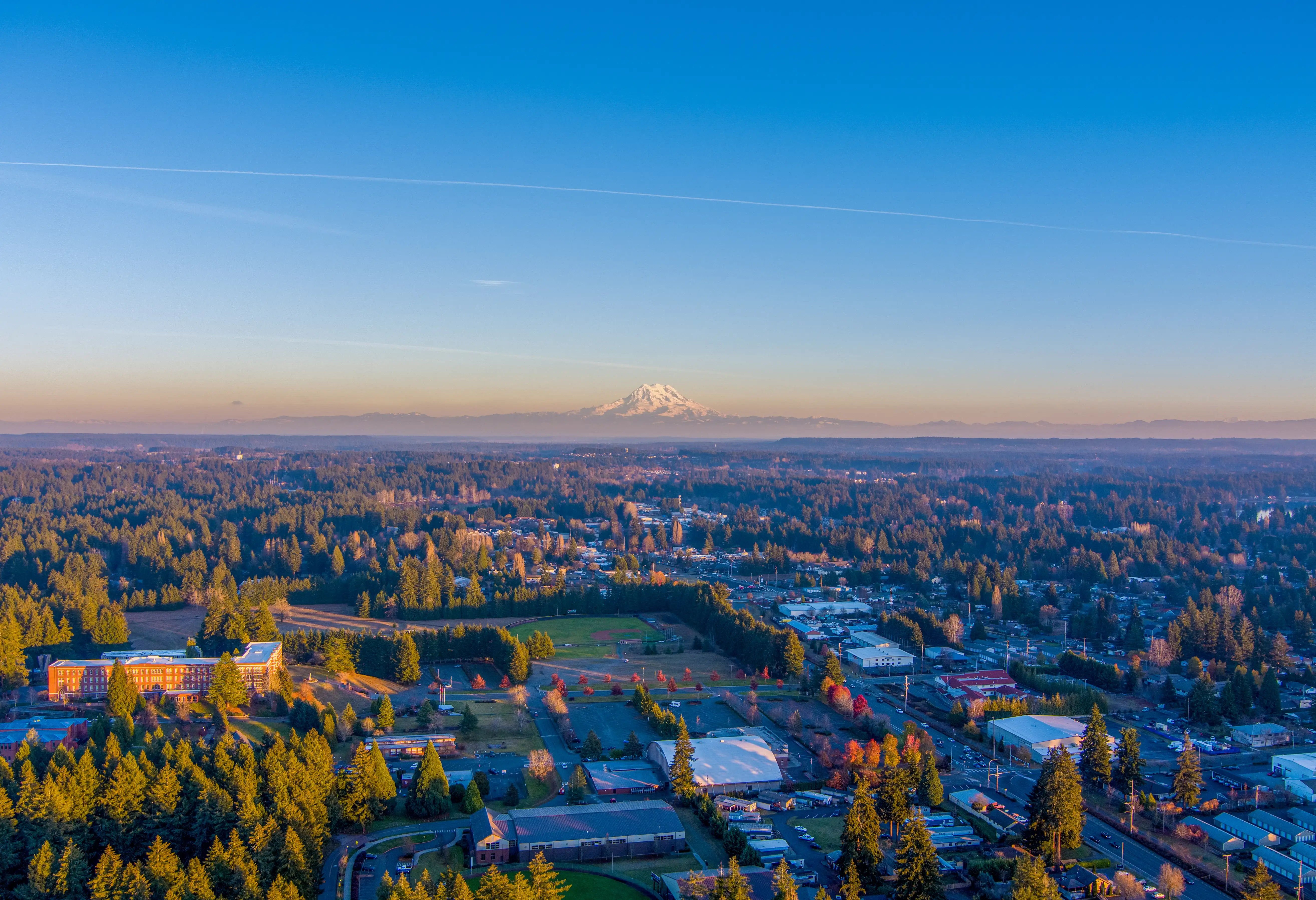
The Bay Area software engineer who finally got a yard and kept their salary. The San Diego family that stopped dreading the August utility bill and the October wildfire smoke advisories. The Sacramento couple who sold their townhome, bought a four-bedroom house with a two-car garage in Lacey's Hawks Prairie neighborhood, and still had six figures left over. These aren't edge cases — they're the story playing out along the southbound I-5 corridor every month, and Lacey keeps appearing near the top of the search results for a reason. A city of nearly 60,000 with a median home price of $516,000, no state income tax, and summers that genuinely surprise people, Lacey offers California buyers something increasingly rare: a financially rational move that doesn't require sacrificing quality of life.
Here's the part nobody puts in the relocation brochure. Lacey is not California. The gray starts in October and doesn't fully release its grip until late May, and if you've spent your whole life in Sacramento or San Diego, that shift is harder than you expect. The food scene is smaller. The social energy is different — quieter, more neighborhood-scaled, less of the constant ambient buzz that comes with living in a major metro. The things you assumed would be everywhere — year-round farmers markets at full capacity, a dense walkable dining district, beach access in any direction — are not everywhere. Some California transplants love this shift within six months. Others take two years to fully adjust. The ones who struggle most are the ones who weren't warned.
This guide covers the full picture: a cost-of-living comparison by California region, what your California equity actually buys in Lacey at different price points, the tax reality in plain numbers, the honest weather and lifestyle comparison, and an interactive tool to look up your specific California city. By the end, you'll know whether this move makes sense for your household — not just on a spreadsheet, but in real life.
| Lacey, Washington | Bay Area | Southern CA | Sacramento Metro | Central Valley | |
|---|---|---|---|---|---|
| Median Home Price (approx 2026) | $516,000 | $1.3M–$1.8M+ | $750K–$1.1M | $560K–$680K | $360K–$480K |
| Property Tax Rate (effective) | ~1.04% | ~1.1–1.25% | ~1.1–1.25% | ~1.1–1.25% | ~1.0–1.2% |
| State Income Tax | None | Up to 13.3% | Up to 13.3% | Up to 13.3% | Up to 13.3% |
| State Sales Tax | 8.0% (Lacey) | 7.25–10.75% | 7.25–10.75% | 7.25–8.75% | 7.25–8.75% |
| Avg Utilities (monthly est.) | $150–$200 | $220–$320 | $200–$280 | $180–$250 | $170–$240 |
| Avg 1BR Rent | $1,400–$1,700 | $2,800–$3,800 | $2,200–$3,000 | $1,600–$2,000 | $1,100–$1,500 |
A Bay Area buyer selling a $1.4 million home and purchasing in Lacey at $516,000 is not just trading down in price — they're often eliminating a mortgage entirely, or replacing a $6,500 monthly payment with something under $2,000. That's not an abstraction; it's a complete restructuring of monthly cash flow that changes what the next decade of their life looks like. The buyer leaving Walnut Creek or Palo Alto doesn't just get more square footage — they get the option to retire earlier, work fewer hours, or simply stop feeling financially suffocated.
The Washington no-income-tax advantage deserves its own sentence because people consistently underestimate it until they see their first full Washington paycheck. For a California household earning $150,000 a year, eliminating California's progressive income tax typically returns $10,000 to $15,000 annually in take-home pay — every year, permanently. That figure alone covers the property taxes on most Lacey homes with money to spare.
Washington has no state income tax — one of only nine states in the country to make that choice, and the headline financial advantage for every California transplant. The numbers are worth making concrete. A California earner taking home $120,000 annually pays roughly $9,000–$10,000 in California state income tax. At $150,000, that figure climbs to approximately $11,000–$14,000. At $200,000, California's tax bite reaches $16,000–$19,000 or more depending on filing status and deductions. Moving to Washington eliminates that line item entirely.
Washington's sales tax provides the partial offset that tax advisors always mention — Lacey's combined rate runs approximately 8.0%, and Washington applies sales tax more broadly than California in some categories. But on most household budgets, the sales tax difference doesn't come close to erasing the income tax savings. The net financial advantage of being a $150,000-earner in Washington versus California typically lands in the $8,000–$12,000 annual range even after accounting for the sales tax difference.
Washington's capital gains tax applies only to long-term capital gains exceeding $262,000 per year — a threshold that affects a small percentage of buyers. For most California transplants whose income is W-2 wages or self-employment earnings, Washington's capital gains tax is not a relevant factor in the daily financial picture.
| Tax Item | California | Washington | Net Impact for Transplant |
|---|---|---|---|
| State Income Tax | Up to 13.3% | None | Strongly positive — $9K–$19K+ annual savings |
| State Sales Tax | 7.25–10.75% | ~8.0% (Lacey) | Roughly neutral to slight WA disadvantage |
| Capital Gains Tax | Up to 13.3% | 7% over $262K/yr | Neutral for most wage earners |
| Property Tax (effective) | ~1.1–1.25% (on purchase price) | ~1.04% | Slight WA advantage |
| Senior Property Tax Exemption | Limited / income-based | Available 61+, income-based | Meaningful for retirees |
The property tax comparison deserves nuance. California's Proposition 13 caps reassessment for existing homeowners, which means longtime California owners often pay very low effective rates on their current home. But a buyer purchasing a new home in California pays the full 1.1–1.25% on today's elevated prices — which on a $1.3 million Bay Area purchase runs $14,000–$16,000 annually. Buying in Lacey at $516,000 with a 1.04% effective rate means roughly $5,366 per year in property taxes. That difference alone funds a lot of Pacific Northwest summers.
Buyers leaving San Jose, Fremont, or Walnut Creek with $1.4 million or more in equity can purchase any home currently listed in Lacey — outright, with cash, and still have significant liquidity remaining. The median Lacey home at $516,000 is a rounding error compared to that equity stack. What buyers at this level typically find is that the Lacey market's upper tier — new construction in Hawks Prairie running $650,000–$780,000, four-bedroom homes with solar panels, heat pumps, and green space backing — feels almost embarrassingly accessible.
The practical question for Bay Area buyers isn't whether they can afford Lacey's best — it's whether they want to put that equity to work through income-producing property, park it in a premium build and keep cash reserves, or consider a 1031 exchange if the California property was an investment. The financial leverage at this equity level is substantial. A buyer who purchases at $700,000 cash in Hawks Prairie and invests the remaining equity at even modest returns is in a fundamentally different financial position than they were paying a Bay Area mortgage.
A buyer leaving Irvine, Torrance, or Rancho Cucamonga with $900,000 in equity lands in Lacey's top tier with room to spare. At this level, the Woodland neighborhood's newer builds and Indian Summer's established lots offer the kind of space and finish level that would have required $2 million or more in Orange County. Even a buyer bringing $700,000 in net equity can purchase Lacey's median home entirely in cash or put 50–60% down and carry a genuinely manageable payment.
What surprises Southern California buyers most is that Lacey's market at $516,000 isn't a compromise tier — it's the heart of a functional, well-maintained suburban city with good schools, low commute stress relative to LA, and summers that feel comparable to San Diego's mild season. The lifestyle adjustment is real, but the financial upgrade is immediate.
Sacramento and Inland Empire buyers occupy the most interesting position in this comparison because the relative housing price advantage is narrower — Sacramento's metro median has climbed into the $580,000–$680,000 range — but the income tax elimination is just as powerful. A Roseville or Elk Grove buyer earning $130,000 who moves to Lacey immediately captures $10,000–$13,000 in annual income tax savings, every year.
Equity in the $400,000–$650,000 range puts Sacramento and Inland Empire buyers into Central Lacey, Tanglewilde, or the southern end of Hawks Prairie — established neighborhoods with 3-bedroom homes, good school access through North Thurston Public Schools, and room for a garden. Some buyers in this range qualify for Washington State Housing Finance Commission programs depending on purchase price and income thresholds. The monthly cash flow improvement from eliminating California income tax often covers the Lacey mortgage entirely.
The Central Valley buyer — leaving Fresno, Bakersfield, or Stockton — has the most modest relative housing advantage, and it's worth being honest about that. At $300,000–$450,000 in equity, Lacey buyers are looking at strong down payments on median-priced homes rather than outright purchases. The Lake Forest and Meridian Campus areas offer 3-bedroom homes in the $420,000–$490,000 range — typically older construction but solid, livable suburban housing with more interior square footage than the same money buys in most California markets.
The financial case for this buyer rests heavily on the income tax elimination. A Fresno household earning $100,000 pays roughly $6,500–$8,000 in California state income tax annually. In Washington, that money stays in the household budget. Over a decade, that's $65,000–$80,000 in cumulative take-home pay — a figure that meaningfully changes retirement timelines and financial flexibility.
Looking to buy in Estimate your payment.
Enter your numbers to see an estimated monthly mortgage payment.
Estimate only. Excludes HOA fees and mortgage insurance.
Here's what a good friend who made this move three years ago would actually tell you: the summers will exceed your expectations, and the winters will test your resolve more than you think. Lacey gets approximately 136 sunny days per year and 2,172 hours of annual sunshine — compared to roughly 259 in San Francisco, 284 in Los Angeles, and around 300 in Sacramento. The gray is real, and it concentrates hard between October and March, with November averaging 20 rainy days in a single month. That's not a number that comes with a silver lining — it's just true.
What California transplants genuinely love after a year, though, is consistent. July and August in Lacey are stunning — dry, warm days in the mid-70s, green everywhere, the Nisqually Wildlife Refuge and Chehalis Western Trail accessible without the crowd density of Bay Area open space. Summers along the Puget Sound corridor feel earned in a way that Southern California's year-round perfect weather sometimes doesn't. People who run, hike, or garden talk about those four months like they're owed to them after surviving winter. The sense of space — the yard, the lower-density neighborhoods, the absence of freeway-adjacent everything — hits California transplants within weeks of arriving.
What they miss is specific and honest: year-round beach access, the restaurant density of San Jose or San Diego, the social buzz of a major metro, and — most commonly — the sheer quantity of sunlight. Sacramento gets 3,608 annual sunshine hours. Lacey gets 2,172. That gap is not something to reason your way out of; it's a lifestyle variable that affects mood, routines, and how people spend weekends from November through April. California transplants who do best tend to be intentional about winter — they find indoor community, they get rain gear and use it, and they stop waiting for the sky to clear before going outside.
If you want to see how Lacey compares directly to the city you're leaving, use the tool below — it covers the 120 largest California cities with current housing and tax data.
Home prices: Redfin median sale data, Q1–Q2 2026. Select your city to compare.
Ready to talk through what your specific California equity could do in Lacey? Todd can model your exact scenario in a single call.
Mistake 1: Treating Lacey as one uniform neighborhood. Hawks Prairie, where new construction runs $620,000–$780,000 with HOA amenities and strong school proximity, is a fundamentally different purchase than Tanglewilde or Central Lacey, where older 3-bedroom homes run $400,000–$470,000 with no HOA and more variable street-by-street quality. California buyers who shop by city average price without understanding neighborhood character sometimes buy in the wrong tier for their lifestyle — and realize it in year two when they're driving 20 minutes for the amenities they assumed were nearby.
Mistake 2: Underestimating how different winter driving is from California. Rain in Lacey isn't San Francisco drizzle — the stretch from November through February involves sustained overcast, wet roads, and occasional frost in neighborhoods south of the Lacey city center near the Yelm Highway corridor. California drivers who've never navigated consistently slick conditions in the dark at 5 PM are frequently caught off guard. The commute into Olympia on surface roads performs fine in summer; it requires more awareness and margin in winter.
Mistake 3: Miscalculating the no-income-tax advantage on monthly cash flow. This sounds like it would be obvious, but most California buyers price their Lacey mortgage against their California take-home pay — then forget that their Washington take-home is meaningfully higher from day one. A buyer earning $160,000 who ran their budget assuming California take-home often has an extra $900–$1,200 per month in Washington that they didn't budget for. That changes how much house you can comfortably carry, and buyers who don't recalculate before making an offer sometimes leave money on the table by going too conservative.
Mistake 4: Assuming California-style year-round outdoor access. The Chehalis Western Trail and Woodland Creek Community Park are genuinely excellent. The Nisqually National Wildlife Refuge is one of the more remarkable natural features in Western Washington. But the outdoor culture in Lacey from November through March is fundamentally indoor-adjacent — the trails are muddy, the parks are empty, and the spontaneous after-work outdoor lifestyle that characterizes California suburban living largely hibernates. California transplants who plan for this and build winter routines — gym memberships, indoor climbing, hockey leagues at the Lacey area rinks — adapt significantly faster than those who assume the Pacific Northwest outdoors functions year-round.
Bay Area sellers with substantial equity — typically $1.2 million or more from a primary residence sale — often find themselves in an all-cash or very-low-LTV position when buying in Lacey. When the purchase price is $516,000 to $750,000 and the equity stack exceeds that figure, the mortgage conversation shifts from qualification to strategy. Terms and closing speed matter more than rate; a cash offer with a 15-day close frequently wins over a financed offer in Lacey's faster-moving segments. Buyers with California investment property should also flag the 1031 exchange path — buying Lacey income property with the proceeds from a California rental can preserve significant capital gains deferral. The Lacey 1031 Exchange guide covers the mechanics in detail.
Southern California sellers arriving with $700,000–$1.1 million in equity are almost always looking at conventional financing with large down payments — Lacey's median sits well below the jumbo loan threshold, so most of these buyers are in straightforward conventional territory. The ability to put 40–50% down dramatically improves debt-to-income ratios and often unlocks better rate tiers. Buyers who plan to carry a mortgage should model their payment against their new Washington take-home, not their California take-home — the difference is often significant.
Sacramento and Inland Empire buyers arriving with $400,000–$650,000 in equity may find themselves at the intersection of strong conventional financing and Washington state assistance programs. The Washington State Housing Finance Commission's Home Advantage program offers competitive rates and down payment assistance for qualifying buyers within purchase price and income limits. Buyers in this equity range who are purchasing in Lacey's $420,000–$520,000 tier should ask their lender to model both the conventional-with-large-down-payment path and the WSHFC path — the outcomes can vary meaningfully depending on cash flow priorities.

Local Expert Takeaway: The single thing California buyers most consistently underestimate about Lacey is the compounding effect of no state income tax on their actual monthly lifestyle — not just on paper. A household earning $150,000 and buying in Hawks Prairie at $600,000 with 20% down carries roughly $2,800/month in principal and interest. Their Washington take-home is $1,000–$1,300/month higher than it was in California. For many buyers, the tax savings alone nearly covers the mortgage payment — a fact that doesn't fully land until they see the first three months of Washington paychecks. Model your Washington take-home before you set your Lacey price ceiling.
✅ Washington's no-income-tax advantage is worth $9,000–$19,000 annually for most California earners — a permanent, compounding financial upgrade that begins with the first paycheck.
⚠️ Lacey's winters are genuinely gray — 163 precipitation days per year concentrated October through March. California transplants who plan for this do well; those who expect California-style year-round outdoor living often struggle through the first winter.
📍 Your California equity level determines your Lacey strategy — Bay Area sellers are frequently looking at all-cash or minimal-mortgage purchases; Sacramento and Inland buyers should model WSHFC programs alongside conventional financing for maximum monthly cash flow.
Is moving from California to Lacey worth it?
For most California households earning above $100,000, the financial case is strong and immediate — the income tax elimination alone returns thousands annually, housing costs are dramatically lower than most California metro areas, and property tax rates are comparable or favorable. The lifestyle shift is real, particularly around weather and urban density, but buyers who go in with accurate expectations about the winters typically find the trade genuinely worthwhile within a year.
How much cheaper is housing in Lacey vs. California?
Lacey's median home price of $516,000 sits roughly $257,000 below California's statewide median and $800,000 or more below the Bay Area median. In practical terms, the home you'd buy for $516,000 in Lacey — a four-bedroom, two-car garage, often with new construction finishes — would likely require $1.5 million or more in San Jose or $900,000–$1.1 million in San Diego.
What do I need to know about moving from California to Washington?
Washington has no state income tax, a sales tax around 8% in Lacey, and property taxes near 1.04%. You'll need to transfer your driver's license and vehicle registration within 30 days of establishing residency. Washington does not have a waiting period for voter registration relative to residency. The practical adjustments most California transplants flag are the gray winter weather, the need for rain gear used year-round, and recalibrating social expectations from major-metro density to a smaller, quieter suburban city.
Explore the full Lacey series: The Ultimate Lacey Relocation Guide · Is Lacey Safe? · Cost of Living in Lacey · Best Neighborhoods in Lacey · Lacey Schools & Family Life · Lacey Youth Sports · Lacey Parks & Recreation · Retiring in Lacey · 1031 Tax-Deferred Exchange in Lacey · Lacey First-Time Homebuyers Guide · Moving to Lacey from California
Tell us what you need help with and we'll connect you with local resources.

About the Author
Todd Davidson is the founder of Living in Oregon and Living in Washington, where he publishes in-depth city guides, neighborhood resources, and local market insights covering more than 180 communities across the Pacific Northwest. While his background is in home financing and real estate, he created these digital platforms to help families research and compare regions before making a move.