
Eastern Washington · Washington
The Bay Area software engineer who finally got a yard without a bidding war. The San Diego family who stopped dreading August utility bills and September wildfire smoke advisories. The Sacramento couple who sold their 1,400-square-foot townhome and bought a 2,400-square-foot house with a three-car garage and still had equity left over. These are real patterns playing out in Richland, Washington right now — a mid-sized city of roughly 65,000 people on the Columbia River in Eastern Washington where the median sold price sits at $510,000 and the state collects zero income tax.
The honest version of this story includes the parts most relocation guides skip. Richland is not a California suburb with cheaper housing grafted onto it. The winters are dark and cold in ways that surprise people from San Diego or Los Angeles. The food scene, the nightlife, the urban density that California transplants often take for granted — those things require recalibration. Some people move here and within eighteen months they know they've found their place. Others miss the coast so acutely that the financial math stops feeling worth it.
This guide covers the full picture: a cost comparison broken down by California region, what different levels of California equity actually buy here, the tax math in specific dollar terms, the weather reality, and a tool to compare your specific California city to Richland directly. The goal is not to sell you on Richland — it's to give you enough specific, honest information to know whether Richland makes sense for your life.

| Richland, WA | Bay Area | Southern CA | Sacramento Metro | Central Valley | |
|---|---|---|---|---|---|
| Median Home Price (approx. 2026) | $510,000 | $1,300,000+ | $978,000+ | $486,000 | $350,000–$420,000 |
| Property Tax Rate (effective) | ~1.00% | ~1.05–1.25% | ~1.05–1.25% | ~1.05–1.20% | ~1.00–1.15% |
| State Income Tax | None | Up to 13.3% | Up to 13.3% | Up to 13.3% | Up to 13.3% |
| State Sales Tax | 8.6% (Tri-Cities) | 8.625–10.75% | 7.25–10.25% | 7.25–8.75% | 7.25–8.25% |
| Avg Utilities (monthly est.) | $150–$190 | $250–$350 | $220–$320 | $200–$270 | $190–$260 |
| Avg 1BR Rent | $1,164–$1,400 | $2,800–$3,800 | $2,200–$3,200 | $1,600–$2,000 | $1,100–$1,500 |
A buyer leaving Walnut Creek with a $1.4 million sale in hand who purchases in Richland near the $510,000 median is potentially eliminating their mortgage entirely and investing the difference — or buying a premium home in the $700,000–$800,000 range with Columbia River views and still pocketing several hundred thousand dollars. That's not a hypothetical; it's the math that's driving migration patterns into the Tri-Cities right now.
The Washington no-income-tax advantage deserves specific dollar treatment, because people consistently underestimate it. A California resident earning $150,000 pays roughly $11,000–$13,000 per year in state income tax after deductions. At $200,000, that figure climbs toward $17,000–$19,000. Moving to Washington doesn't just change your tax form — it changes your monthly take-home pay by $900 to $1,500 or more, every single month, for as long as you live here. On a 10-year horizon, that difference compounds into six figures.
Washington has no state income tax — one of only nine states in the country that can say that. For California transplants, this single fact often represents the most meaningful financial shift of the entire move.
| Tax Item | California | Washington | Net Impact for Transplant |
|---|---|---|---|
| State Income Tax | 1%–13.3% marginal | None | $8,000–$19,000+/year savings at $120K–$200K income |
| Capital Gains Tax | Up to 13.3% (ordinary income) | 7% on gains over $262,000/year | Significant reduction for most earners |
| Sales Tax (combined) | 7.25%–10.75% | 8.6% (Tri-Cities area) | Roughly comparable; slight WA advantage in some cases |
| Property Tax (effective) | ~1.05–1.25% on purchase price | ~1.00% (Benton County) | Modest WA advantage |
| Gas Tax | $0.579/gallon | $0.494/gallon | Small WA advantage |
| Senior Property Tax Exemption | Available, income-based | Available at 61+, income-based | Similar structures |
Washington's 7% capital gains tax applies only to long-term capital gains exceeding $262,000 in a single year — a threshold most wage earners and retirees will never cross in their annual income picture. It's a consideration for high-volume investors, but for the typical California transplant selling a home and relocating, it doesn't factor meaningfully into the annual calculation.
The sales tax picture is the one offset worth naming directly. Richland's combined rate of approximately 8.6% is lower than Seattle's 10.35% but will feel familiar to anyone from Los Angeles County or the Bay Area. The practical reality is that Washington's sales tax is less aggressive than California's on income, meaning the net tax position for most California transplants earning over $100,000 is strongly positive in Washington — often by tens of thousands of dollars annually.
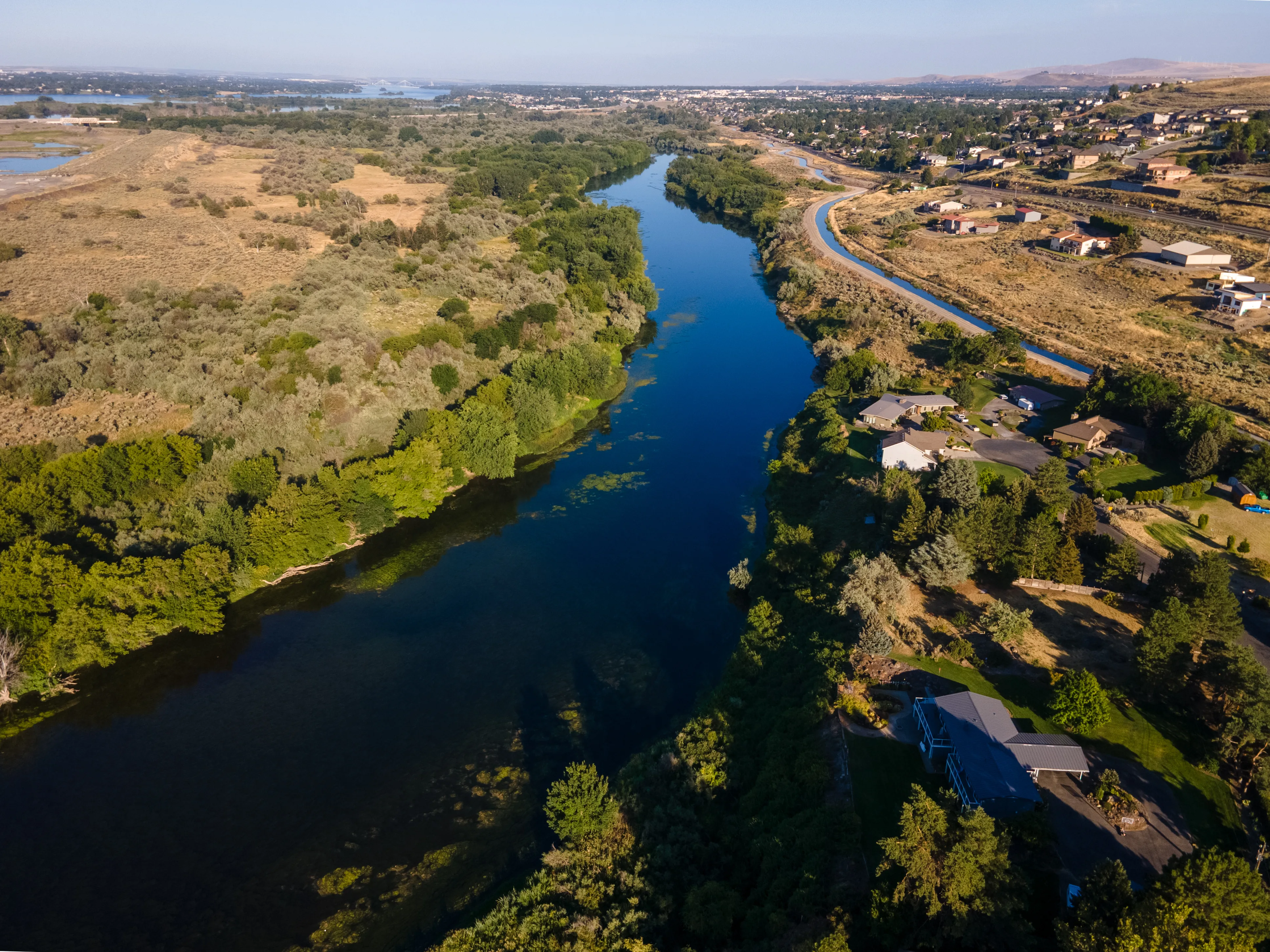
A buyer selling a $1.6 million home in Sunnyvale or San Jose and arriving in Richland with $1.2 million or more in equity is in a position most Americans never experience: they can buy the best property in the market outright and still have meaningful capital remaining. At the $700,000–$800,000 range in Richland, you're looking at large custom builds in the Badger Mountain or Queensgate corridors with panoramic views of the Columbia River, the Hanford Reach, and multiple mountain ranges — homes with 2,500 to 3,500-plus square feet on premium lots with resort-style finishes.
For Bay Area sellers, the more interesting question isn't whether they can afford Richland — it's what to do with the excess equity. A buyer at this level who purchases around the median and keeps the remaining capital liquid is simultaneously debt-free, building a six-figure cash reserve, and gaining $11,000–$19,000 annually in income tax savings. The cumulative financial position shift in year one is often startling.
A buyer leaving Pasadena or Irvine with $800,000 in equity walks into Richland's top tier. New construction at the base of Badger Mountain — communities like Westcliffe Heights by Pahlisch Homes — sits in the $550,000–$700,000 range, offering modern farmhouse designs with premium finishes, community amenities, and proximity to the Columbia Park Trail system. At this equity level, a Southern California buyer can purchase in the top quarter of Richland's market, carry a minimal mortgage, and still retain a significant down payment reserve.
The buyer leaving a $950,000 Torrance or Chula Vista house who couldn't have moved up in their own market without stretching dangerously arrives in Richland with genuine optionality. Neighborhoods like Meadow Springs and Queensgate offer the suburban quality-of-life signals — newer construction, walking paths, nearby retail — that Southern California buyers expect, at prices that no longer require creative financing.
Sacramento buyers face a closer relative comparison than Bay Area sellers do — the city medians aren't dramatically different on paper. What shifts the calculus is the income tax picture. A Sacramento household earning $130,000 combined keeps an additional $9,000–$11,000 per year in Washington. Over five years, that's $45,000–$55,000 in retained income on top of whatever appreciation differential plays out between the two markets.
A buyer selling a Sacramento property near the $486,000 median and carrying that equity into Richland can access solid 3–4 bedroom single-family homes in Meadow Springs, Horn Rapids, or North Richland in the $450,000–$550,000 range — comparable size and finish quality to what they're leaving, without the California tax structure attached to every paycheck going forward.
Central Valley buyers have the most modest relative equity advantage, but they're often moving from markets where wages haven't kept pace with even modest appreciation. In Fresno or Bakersfield, $380,000 of equity buys a house — but the income tax burden doesn't disappear with the lower housing cost. Moving to Richland, a Central Valley buyer in the $400,000–$450,000 price range can access entry-level single-family homes in North Richland or established parts of the Queensgate corridor — three-bedroom, two-bath homes in the 1,400–1,800 square foot range — while immediately gaining the Washington income tax advantage on everything earned going forward.
Looking to buy in Estimate your payment.
Enter your numbers to see an estimated monthly mortgage payment.
Estimate only. Excludes HOA fees and mortgage insurance.
Here's what almost nobody tells California buyers before they move, and what almost every California transplant mentions by month eight: Richland gets more annual sunshine hours than Los Angeles. Eastern Washington is not western Washington. The rainy, gray, drizzly Seattle reputation does not apply to the Tri-Cities. Richland averages roughly 3,667 sunshine hours per year — more than Los Angeles, more than San Diego, more than Sacramento. It gets approximately eight inches of rain annually, which is nearly 80% less than Seattle receives. July's average high temperature hits 90°F.
What the sunshine data doesn't capture is the seasonal concentration. Richland summers are genuinely exceptional — long days, dry heat, the Columbia River for water sports, wine country thirty minutes in any direction, and a community that spends those months outdoors aggressively. The Tri-Cities Ironman 70.3, launched in 2024 and already named one of the best-run courses in the world in the Ironman Athletes' Choice Awards, is a signal of the athletic, outdoor culture that draws active transplants. But December through February is a different experience — gray, cold, sometimes icy, with average December highs in the upper 30s and lows that drop to the upper 20s. A person from San Diego will notice this deeply in their first winter.
What California transplants consistently say they love after a year in Richland: the space, the traffic, and the community scale. A commute that took 45 minutes in Orange County takes 12 minutes here. A yard that would have cost $200,000 more in Rocklin comes standard on median-priced homes. The Howard Amon Park riverfront, the access to Badger Mountain trails, the winery corridor along the Yakima Valley — these become a genuine part of daily life in ways that California amenities, despite their excellence, often couldn't because of the cost of proximity to them. What transplants genuinely miss is harder to replace: the beach, the specific food culture of wherever they came from, the year-round outdoor warmth, and for many people, the density of their social network left behind. These are not small things, and no amount of financial math makes them disappear.
If you want to see how Richland compares directly to the city you're leaving, use the tool below — it covers the 120 largest California cities with current housing and tax data.
Home prices: Redfin median sale data, Q1–Q2 2026. Select your city to compare.
Ready to talk through what your specific California equity could do in Richland? Todd can model your exact scenario in a single call.
Assuming Eastern Washington is Western Washington. The single most common misconception California transplants arrive with is a gray, rainy mental image borrowed from Seattle coverage. Richland's climate is semi-arid and sun-rich in ways that genuinely surprise people on arrival. The mistake matters because buyers who've been told "Washington is rainy" sometimes overprice that factor in their hesitation — and then get here in July and feel slightly cheated by how long they waited.
Not running the income tax math before negotiating their salary. Remote workers moving from California often accept Washington-based roles or contractor positions at rates calibrated to their California take-home — without adjusting for the fact that the same gross salary now produces meaningfully more net income in Washington. A remote worker earning $160,000 who negotiates a Washington-based salary to match their California take-home is leaving money on the table. Run the net income comparison first.
Treating the Tri-Cities as one uniform market. Kennewick, Pasco, and Richland have distinct character, pricing, and school district profiles. Richland commands the highest median price of the three and contains the strongest-rated schools. A buyer who compares a Kennewick listing to a Richland listing and concludes "I'll just buy in Kennewick — same thing, cheaper" may be shortchanging themselves on the school district and neighborhood quality differential they actually care about. The cities are adjacent, not equivalent.
Underestimating the winter driving shift. California drivers who've never navigated black ice on Columbia Center Boulevard at 7 a.m. in January tend to learn this lesson once in their first winter here. The roads aren't consistently terrible, but Eastern Washington ice events are real and periodic, and they require driving habits that most California transplants haven't built. Snow tires or all-season tires rated for winter conditions are worth the investment — this is not a place where "I'll manage" holds up when temperatures drop overnight.
Bay Area sellers with large equity are increasingly arriving in Richland as all-cash or near-cash buyers, which creates real advantages in a market where the median home sells in under 30 days during spring and summer. Speed and certainty matter in competitive Richland neighborhoods like Badger Mountain and Queensgate. If the California property being sold was an investment property, a 1031 exchange may allow the buyer to defer capital gains taxes on the sale by rolling proceeds into a qualifying Richland property — a structure worth discussing before the California sale closes, not after. The full 1031 framework is covered in the Richland 1031 Exchange guide.
Southern California sellers with strong equity — typically $700,000 to $1.2 million — are well-positioned for conventional financing in Richland, where most transactions fall below the conforming loan limit and jumbo products are rarely necessary. A buyer putting 40–60% down on a $550,000 property carries a loan balance that qualifies comfortably for conventional terms, meaning better rates and simpler underwriting than they likely experienced in their California market.
Sacramento and Inland Empire buyers moving with $400,000–$650,000 in equity may find Richland properties priced within range of Washington State Housing Finance Commission programs like WSHFC Home Advantage, which offers below-market rate loans and down payment assistance for qualifying buyers. These programs have income and purchase price limits — worth verifying at time of application — but they can meaningfully improve monthly payment structure for buyers who aren't arriving cash-heavy.

Local Expert Takeaway: The California buyers who thrive in Richland fastest are the ones who calculate their Washington net income before they close — not after. The no-income-tax advantage isn't abstract: for a household earning $150,000, it's an extra $900–$1,100 per month in take-home pay from day one. Pair that with a mortgage payment that's often half what they carried in California, and the monthly cash flow difference can be $2,500–$3,500 in their favor before any appreciation or investment return is considered. If you're modeling your Richland decision, start with that number and work outward.
✅ Washington's no-income-tax advantage is worth $8,000–$19,000 annually for most California transplants earning between $120,000 and $200,000 — the single largest financial shift of the move.
⚠️ Richland winters require real recalibration for Southern California and Bay Area transplants — cold temperatures, periodic ice, and dark evenings from November through February are genuine trade-offs that financial math doesn't soften.
📍 Bay Area and Southern California sellers often arrive with enough equity to buy in Richland's top tier outright — Badger Mountain and Queensgate neighborhoods offer premium construction, Columbia River views, and resort-style amenities at price points that represent a fraction of comparable California options.
Is moving from California to Richland worth it?
For buyers who value housing space, financial flexibility, and outdoor access over urban density and year-round warmth, the answer is frequently yes. The combination of no state income tax, a $510,000 median home price, and one of the sunniest climates in Washington state makes Richland a financially and practically compelling destination — particularly for remote workers and equity-rich sellers who no longer need to live near a specific California employer.
How much cheaper is housing in Richland vs. California?
Compared to the Bay Area, Richland's median sold price is roughly 60–65% less than San Francisco and San Jose medians. Against Southern California, the discount is 45–50%. Sacramento buyers see the smallest gap on paper — Richland's $510,000 median is modestly above Sacramento's — but the income tax savings in Washington frequently offset that difference within two to three years of residency.
What do I need to know about moving from California to Washington?
Washington has no state income tax, a reality that changes monthly cash flow immediately. Property taxes in Benton County run approximately 1.00%, roughly comparable to California's newly purchased property effective rates. Eastern Washington's climate — sunny, semi-arid, with hot summers and cold winters — bears no resemblance to the rainy western Washington stereotype. And Richland is not a homogeneous suburb: neighborhoods differ meaningfully in character, price, and school access, so arriving with a specific neighborhood target matters more than many California buyers expect.
Explore the full Richland series: The Ultimate Richland Relocation Guide · Is Richland Safe? · Cost of Living in Richland · Best Neighborhoods in Richland · Richland Schools & Family Life · Richland Youth Sports · Richland Parks & Recreation · Retiring in Richland · 1031 Tax-Deferred Exchange in Richland · Richland First-Time Homebuyers Guide · Moving to Richland from California
Tell us what you need help with and we'll connect you with local resources.

About the Author
Todd Davidson is the founder of Living in Oregon and Living in Washington, where he publishes in-depth city guides, neighborhood resources, and local market insights covering more than 180 communities across the Pacific Northwest. While his background is in home financing and real estate, he created these digital platforms to help families research and compare regions before making a move.