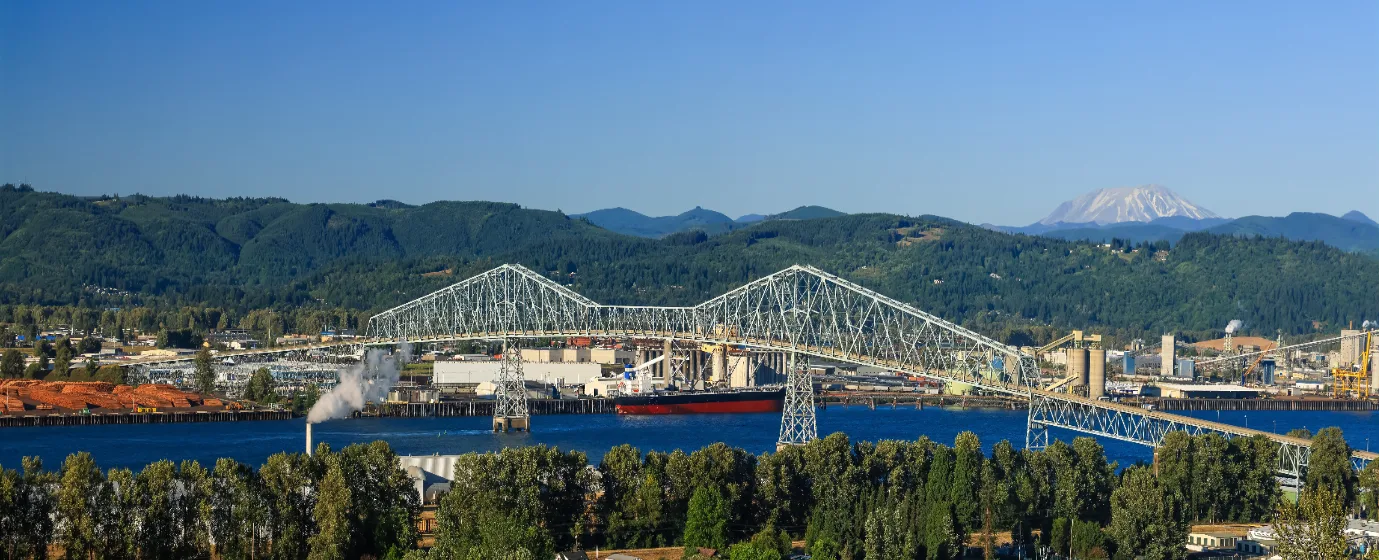
Southwest Washington · Washington
Not every 1031 buyer is a seasoned portfolio investor with a spreadsheet full of cap rates. A significant share of the people reading this sold a California home — a Bay Area bungalow, a Sacramento track house, an Inland Empire rental they held for 12 years — and are now sitting on a capital gain they'd rather not hand to the IRS. Longview, Washington keeps coming up in those conversations, and not by accident. With a median home price of $375,000, a landlord-friendly regulatory environment, and zero state income tax on rental proceeds, it's the kind of market that looks increasingly attractive when you've spent years watching California cap rates compress into the 3% range.
The Longview rental market is grounded in industrial and healthcare employment. PeaceHealth St. John Medical Center, Weyerhaeuser, the Port of Longview, and Pacific Seafood collectively employ thousands of workers who rent — not because they can't afford to buy, but because the transient nature of port and manufacturing shifts, combined with Longview's steady workforce turnover, keeps demand durable. Roughly a third of Longview residents rent, and that pool is replenished consistently. The properties that trade most often as investment vehicles are single-family rentals in the $280,000–$375,000 range and small multifamily (duplex through 6-unit), with the occasional commercial storefront in the downtown corridor.
This guide walks through the mechanics of a 1031 exchange for anyone who needs a clean refresher, then digs into Longview's specific investment property landscape — realistic cap rates, property types by neighborhood, Washington's tax advantages versus California's, and the due diligence checklist every out-of-state buyer on a 45-day clock should have in hand before making an offer.

The exchange itself is straightforward in principle and unforgiving in execution. When you sell a relinquished property, the proceeds go directly to a qualified intermediary — never to you personally. Touching the funds, even briefly, disqualifies the exchange and triggers immediate capital gains recognition. From the closing date on the sale, you have 45 calendar days to identify potential replacement properties in writing, and 180 calendar days to close on one of them. The 45-day clock doesn't pause for weekends, holidays, or title delays.
The like-kind rule is broader than most people realize. "Like-kind" in a 1031 context means real property exchanged for real property — a California rental house can become a Washington duplex, a commercial building, a raw land parcel, or a mobile home park. What doesn't qualify: personal property, stocks, partnership interests, or your primary residence. The replacement property must be held for investment or productive use in a trade or business, which is the same standard applied to the relinquished property.
The boot trap is where deals go sideways. If the replacement property's value is lower than the relinquished property's net sale price, the difference — the "boot" — is taxable in the year of the exchange. To defer 100% of the gain, the replacement property must be equal to or greater in value, and you must reinvest all of the equity. Many California sellers use this as an opportunity to buy multiple properties: the math on a $1.2 million relinquished property often works cleanly into two Longview properties purchased simultaneously, both identified within the 45-day window.
Longview's investment market is dominated by single-family rentals and small multifamily — duplexes through six-unit buildings — with a thin but active slice of commercial storefront along the downtown Broadway corridor. The city's median home price of $375,000 means entry points for rental properties are realistic even for smaller 1031 proceeds, and the price-to-rent ratio is more favorable than virtually anywhere in the Portland or Seattle metro areas. A 3-bedroom SFR in the $310,000–$350,000 range that rents at $1,553 per month is producing gross yield numbers that California investors haven't seen since the early 2000s.
| Property Type | Typical Price Range | Est. Cap Rate | Avg Days to Close |
|---|---|---|---|
| SFR (2–3 BR, workforce housing) | $260,000–$375,000 | 5.5–7.0% | 30–45 days |
| Duplex / Small Multifamily | $380,000–$550,000 | 5.7–6.5% | 30–45 days |
| 5–6 Unit Multifamily | $500,000–$750,000 | 5.7–6.0% | 45–60 days |
| Downtown Commercial / Mixed-Use | $350,000–$700,000 | 5.0–6.5% | 45–75 days |
Single-family rentals in the Highlands and Broadway neighborhoods move fastest — lower price points attract both owner-occupant and investor offers simultaneously. Larger multifamily and commercial assets take longer to underwrite and close, which is worth building into your 45-day identification strategy.
Looking to buy in Estimate your payment.
Enter your numbers to see an estimated monthly mortgage payment.
Estimate only. Excludes HOA fees and mortgage insurance.
The arithmetic is hard to argue with. California investors selling properties that appreciated 200–400% over two decades are arriving in a market where $375,000 buys a rent-producing asset — not a down payment on one.
A Bay Area investor selling a typical San Jose rental house at $1.4 million can land in Longview with enough equity to acquire a duplex and a standalone SFR simultaneously — often without financing at all. That same scenario in the Portland market would still require a mortgage on at least one property. Debt-free acquisition at realistic cap rates is the Bay Area story in Longview.
Los Angeles and San Diego investors are generally selling properties in the $800,000–$1.1 million range and looking to replace with one or two cash-flowing assets. Longview's duplex inventory in the $380,000–$500,000 range fits that band cleanly, and the absence of California's 13.3% top marginal income tax rate means their ongoing rental income math looks dramatically different year over year.
Sacramento and Riverside County sellers are often working with proceeds in the $450,000–$700,000 range — a range that maps directly onto Longview's mid-tier SFR and duplex market. These buyers tend to be most price-sensitive and most interested in cap rates, and Longview's 5.7–7.0% range is a meaningful upgrade over what Sacramento's current market produces at comparable price points.
The most significant line item in the California-to-Washington investor comparison is state income tax. Washington has no state income tax — every dollar of net rental income stays in your pocket rather than being split with Sacramento at rates that can reach 13.3% for high earners.
| Tax Item | California | Washington |
|---|---|---|
| State income tax on rental income | Up to 13.3% | 0% |
| Property tax rate (new purchase) | Varies; Prop 13 protects existing owners | ~0.88% of assessed value |
| Sales tax | 7.25% (state) | 6.5% + local (typically ~8.5%) |
| Capital gains tax | Taxed as ordinary income (up to 13.3%) | 7% on gains over $262,000/year (2026) |
Washington's capital gains tax, introduced in 2022, applies only to long-term capital gains exceeding $262,000 per year, and real estate sales are currently exempt from it. For most individual investors, this means rental income and eventual property appreciation are both taxed only at the federal level — a structural advantage that California investors feel immediately in year one of ownership.
Property taxes in Cowlitz County run approximately 0.88% of assessed value. On a $375,000 investment property, that's roughly $3,300 annually — a figure that, combined with depreciation deductions and no state income tax on the rental stream, reshapes the net-of-tax yield meaningfully. One caveat worth knowing: Washington's sales tax does apply to materials and contractor labor on rental property rehabs, which California investors accustomed to Oregon's no-sales-tax environment sometimes overlook in renovation budgets.
Two planning tools worth flagging for the right buyer: depreciation basis carries over in a 1031 exchange rather than being reset to the new acquisition price, which affects your ongoing depreciation schedule. And for investors who want yield without management responsibility, Delaware Statutory Trusts (DSTs) qualify as like-kind replacement property and allow passive fractional ownership — a useful fallback if your 45-day window closes before you've identified a direct-ownership replacement.
Washington's landlord-tenant law is a balanced code with specific notice requirements for rent increases, entries, and terminations. As of 2026, Washington has no statewide rent control — landlords can raise rents between tenancies without restriction. Some municipalities have proposed local limits, but Longview has not enacted them. For out-of-state owners, the most important practical reality is that Washington's notice requirements are specific: 20 days' written notice for month-to-month termination in most cases, with longer windows for long-term tenants in some circumstances.
Local property management is available — firms serving the Longview-Kelso area typically charge 8–10% of gross monthly rent for full-service management. On a $1,250/month rental, that's $100–$125 per month in management fees before maintenance reserves. Out-of-state investors consistently underestimate the cost of deferred maintenance on Longview's older housing stock and the time required to source reliable local contractors for turnover repairs. Building a 10–15% annual maintenance reserve on top of management fees is standard practice for properties built before 1990.
Vacancy in Longview tracks the suburban national average of roughly 6–7%, though the market's limited new construction pipeline and steady industrial/healthcare workforce tend to keep well-priced rentals occupied more consistently than that benchmark suggests. Properties near PeaceHealth St. John Medical Center and in the Northlake-Corman corridor — with easy access to the Triangle Center retail and Highway 30 — typically see the fastest lease-up times.
| Item | What to Verify | Local Resource |
|---|---|---|
| Title search | Clear title, no liens, encumbrances, or easements | Cowlitz County title company / Stewart or Fidelity National |
| Sewer vs. septic status | City sewer connection or septic permit/inspection | City of Longview Public Works |
| Flood zone status | FEMA flood map — Columbia River proximity matters | FEMA FIRM maps / Cowlitz County GIS |
| Rental permit requirement | City of Longview rental registration requirements | City of Longview Community Development |
| Zoning & ADU potential | R-1/R-2 zoning; Washington's ADU laws allow strong add-value play | City of Longview Planning Dept. |
| HOA rental restrictions | CC&Rs prohibiting or limiting non-owner rentals | HOA documents via title report |
| Short-term rental ordinances | Longview STR permit requirements if Airbnb/VRBO use intended | City of Longview Municipal Code |
| Current lease status | Existing tenants, lease terms, rent amounts, security deposits | Seller disclosure / estoppel certificates |
| School district confirmation | Longview School District boundaries for tenant pool targeting | Longview School District |
| Full inspection (deferred maintenance) | Roof, HVAC, foundation, plumbing — especially pre-1990 stock | Licensed WA inspector; ASHI-certified preferred |
| Environmental / industrial proximity | Proximity to Port of Longview, industrial corridor, rail lines | Cowlitz County assessor / site visit |
| Property management referral | Local PM company vetted before closing | Agent referral; Cowlitz County REIA |
| 1031 timeline confirmation | Qualified intermediary paperwork in place; ID deadline tracked | Your QI / closing attorney |
| Comparable rent analysis | Current asking rents vs. in-place rents for accurate cap rate | Redfin, Zillow Rent Zestimate, local PM |

Local Expert Takeaway: The most common mistake California 1031 buyers make in Longview is running cap rate math on in-place rents rather than market rents — and on older properties in the Highlands and Broadway corridors, in-place rents are often $150–$250 below what the market will currently bear. That gap is real upside, but it doesn't show up in the seller's proforma. Have a local property manager run a current rent comp before you submit your identification paperwork, and factor a full rehab inspection into your offer price — the workforce housing stock here is durable but maintenance-intensive.
If you're running a 1031 exchange and your 45-day clock is already ticking, the worst position to be in is unqualified when the right duplex hits the market. Todd works with investors on both conventional investment property financing and DSCR loans — debt-service coverage ratio loans that underwrite based on the property's rental income rather than your personal income, keeping the transaction off your DTI entirely. Reach out before the relinquished property closes, not after.
✅ Longview's median home price of $375,000 makes it one of the few Pacific Northwest markets where a mid-range California 1031 can acquire multiple cash-flowing properties debt-free.
⚠️ The 45-day identification window is unforgiving — and Longview's investment-grade inventory moves. Line up financing, inspection contacts, and a property manager before your relinquished property closes.
📍 Washington's zero state income tax on rental income is the single largest structural advantage over California ownership — and it compounds every year you hold the asset.
Does a 1031 exchange work for out-of-state property?
Yes — the 1031 exchange has no geographic restriction. You can sell a California property and replace it with a Washington property, or any other state. The like-kind requirement applies to property type (real for real), not location. Your qualified intermediary holds the funds between closings regardless of which states are involved.
What is the cap rate on rental property in Longview?
Cap rates on active Longview investment listings in 2025–2026 have ranged from roughly 5.5% to 7.0%, depending on property type and condition. Smaller multifamily listings — five and six-unit properties — have come to market at around 5.7–6.0%, while well-priced SFR rentals in workforce housing neighborhoods can yield closer to 6.5–7.0% on purchase price. These figures are based on in-place rents; value-add plays with below-market leases can underwrite higher.
Do I need a local property manager for a 1031 investment in Washington?
Not legally — but practically, yes. Washington's landlord-tenant notice requirements, the specifics of the local rental registration process in Longview, and the reality of maintaining older housing stock from out of state make professional management worth the 8–10% monthly fee. Out-of-state owners who self-manage consistently report higher vacancy and maintenance costs than those using local PMs, particularly during tenant turnover.
Explore the full Longview series: The Ultimate Longview Relocation Guide · Is Longview Safe? · Cost of Living in Longview · Best Neighborhoods in Longview · Longview Schools & Family Life · Longview Youth Sports · Longview Parks & Recreation · Retiring in Longview · 1031 Tax-Deferred Exchange in Longview · Longview First-Time Homebuyers Guide · Moving to Longview from California
Tell us what you need help with and we'll connect you with local resources.

About the Author
Todd Davidson is the founder of Living in Oregon and Living in Washington, where he publishes in-depth city guides, neighborhood resources, and local market insights covering more than 180 communities across the Pacific Northwest. While his background is in home financing and real estate, he created these digital platforms to help families research and compare regions before making a move.