
Puget Sound · Washington
The Bay Area software engineer who finally has a yard and still earns the same salary. The San Diego family that made it through last summer without a single wildfire evacuation alert and opened their utility bill in August without dread. The Sacramento couple who sold their 1,400-square-foot townhome, crossed the California border with equity in their pocket, and bought a four-bedroom house with a real backyard in Puyallup for less than they paid. California-to-Washington migration has been happening for years, but the version happening now is different — it's driven less by desperation and more by deliberate math that finally adds up.
The honest part comes next. Puyallup is not California, and pretending otherwise in a relocation guide is how people end up miserable in a city they chose based on a spreadsheet. The gray is real. October through March in the South Sound doesn't feel anything like San Diego in January, and if you're leaving Marin County, Sacramento, or Long Beach expecting the same light quality and outdoor rhythm year-round, the first winter will be a reckoning. The pace is different. The food scene is maturing but it isn't Los Angeles. The cultural energy is suburban Pacific Northwest, which has real strengths and real gaps depending on what you're used to.
This guide covers the full picture for California buyers specifically: a head-to-head cost comparison across California's four main origin markets, what your California equity realistically buys at the median and above, the tax math that most buyers underestimate, the weather trade-off told plainly, and the four most common mistakes California transplants make in Puyallup. There's also an interactive comparison tool below to look up your specific California city directly.

| Puyallup, Washington | Bay Area | Southern CA | Sacramento Metro | Central Valley | |
|---|---|---|---|---|---|
| Median Home Price (approx 2026) | $565,882 | $1.3M–$1.8M+ | $750K–$1.1M | $480K–$600K | $350K–$480K |
| Property Tax Rate (effective) | ~1.17% | ~1.1% | ~1.1% | ~1.1% | ~1.1% |
| State Income Tax | None | Up to 13.3% | Up to 13.3% | Up to 13.3% | Up to 13.3% |
| State Sales Tax | 8.8%–10.5% | 8.25%–10.25% | 7.25%–10.5% | 7.25%–8.25% | 7.25%–8.25% |
| Avg Utilities (monthly est.) | ~$180–$220 | ~$250–$320 | ~$200–$280 | ~$200–$260 | ~$190–$250 |
| Avg 1BR Rent | ~$1,650–$1,900 | $2,800–$3,600 | $2,200–$2,900 | $1,500–$1,900 | $1,000–$1,400 |
A buyer leaving Walnut Creek or Palo Alto with $1.4 million in equity and buying in Puyallup at the $565,882 median isn't just downgrading their mortgage — they're potentially eliminating it entirely, or buying significantly above median and still walking away with six figures in the bank. The math on that transaction looks almost implausible until you run it.
The tax picture is where the long-term financial advantage compounds. Washington has no state income tax — a buyer earning $150,000 in California paid roughly $10,000–$13,000 per year in state income tax, depending on deductions. In Puyallup, that money stays in their account every year, permanently, without doing anything different. Over ten years, that's a real number that changes retirement trajectories.
Washington's no-income-tax advantage is the headline — but the details matter for California buyers who've been told that Washington's sales tax "cancels it out." It largely doesn't, for most incomes.
| Tax Item | California | Washington | Net Impact for Transplant |
|---|---|---|---|
| State Income Tax | 1%–13.3% marginal | 0% | Strongly positive for WA |
| Sales Tax | 7.25%–10.5% | 8.8%–10.5% (local) | Roughly neutral |
| Property Tax (new purchase) | ~1.1% on assessed value | ~1.17% (Pierce County) | Roughly neutral |
| Capital Gains Tax | Up to 13.3% (state) | 7% on gains over ~$262K/year | Positive for WA at most income levels |
| Estate/Inheritance Tax | None | WA estate tax on estates over $2.193M | Neutral to slightly negative at high wealth |
| Senior Property Tax Exemption | Available, varies | Yes — income-based, age 61+ | Comparable |
A California household earning $120,000 in wages pays roughly $6,000–$7,500 per year in California state income tax. At $150,000, that figure climbs to $9,000–$12,000. At $200,000, California's marginal rate pushes the bill to $15,000 or higher, depending on filing status and deductions. In Washington, every dollar of that becomes take-home pay. Washington's 7% capital gains tax applies only to long-term capital gains exceeding approximately $262,000 per year — a threshold the vast majority of California transplants earning wages will never touch in their day-to-day income.
The sales tax offset is real but often overstated in California-versus-Washington arguments. Yes, Puyallup's combined sales tax rate is roughly 8.8%, and California's can run 8.25%–10.5% in major metro counties. For most households, the difference in total sales tax paid per year is a few hundred dollars at most — far outweighed by the income tax savings for anyone earning above $80,000. The one exception worth flagging: buyers coming from low-cost Central Valley cities like Fresno or Bakersfield where California's income tax burden is real but the wage base is lower. For those buyers, the Washington advantage is still positive, but the margin is narrower.
A buyer leaving San Jose, Fremont, or Pleasanton with $1.4 million in equity and purchasing at Puyallup's median of $565,882 can buy outright in cash and still have more than $800,000 remaining — a number that completely restructures how that household builds wealth going forward. At this equity level, the Puyallup decision isn't just a lifestyle choice; it's a fundamental balance sheet reset.
Buyers at this level typically look at South Hill for newer construction in the $600,000–$750,000 range, or Downtown Puyallup for restored Victorian-era homes with walkability that doesn't exist at comparable price points anywhere in the Bay Area. Those who want acreage and privacy often look east toward the Orting corridor or up toward the hillside neighborhoods. Cash buyers in this range are competitive in Puyallup's market — in a city where many buyers are using conventional financing with moderate down payments, a no-contingency cash offer closes fast.
A buyer leaving Torrance, Irvine, or Long Beach with $900,000 in equity is positioned at the very top of Puyallup's market. At $565,882 median, this buyer can put 50% down and still have $600,000+ in reserve, or they can buy significantly above median — new construction in South Hill, larger homes on the northern edge of the city — and still carry a manageable mortgage at a low loan-to-value.
Southern California buyers at this equity level often end up surprised by what they can afford in Puyallup's premium tier. A home that would run $1.4 million in Rancho Palos Verdes or Thousand Oaks trades in the $650,000–$800,000 range here. That price gap, combined with no state income tax, creates genuine financial acceleration for households that were previously stretched in SoCal.
These buyers have the most interesting math. Sacramento and Riverside County equity doesn't create the same dramatic overshoot — a buyer from Elk Grove or Rancho Cucamonga with $500,000 in equity is buying near or around Puyallup's median, not dramatically above it. The financial advantage here isn't the size of the equity windfall; it's the ongoing income tax benefit and the lifestyle upgrade per dollar.
A Sacramento buyer who paid $580,000 for their home in Natomas and sells at $600,000 isn't bringing a mountain of equity to Puyallup. But they're arriving in a city where the same $500,000–$565,000 purchase comes with better schools, four actual seasons, and no state income tax — worth $6,000–$10,000 per year for a dual-income household. Over a ten-year horizon, that tax advantage alone outpaces many equity-position arguments.
Buyers leaving Fresno, Stockton, or Bakersfield bring the most modest equity positions relative to Puyallup's market, but the lifestyle upgrade is arguably the most dramatic. A $350,000 Fresno house that sells in the mid-$300s isn't going to buy a Puyallup home outright — but it creates a healthy down payment (40%–60% down at median), lowers the monthly obligation substantially, and moves a family from a Central Valley summer that regularly hits 105°F into a Pacific Northwest city where August highs average 76°F.
At this equity level, buyers are looking at starter inventory in the $380,000–$460,000 range — older ranchers, smaller craftsman homes, and entry-level construction on the eastern and northern edges of the city. These properties exist in Puyallup in a way they simply don't in comparable coastal California cities. For a Fresno or Modesto family making the move, the combination of lower summer utility bills, greener environment, and no state income tax on their wages can genuinely improve monthly cash flow even with a conventional mortgage in place.

Looking to buy in Estimate your payment.
Enter your numbers to see an estimated monthly mortgage payment.
Estimate only. Excludes HOA fees and mortgage insurance.
Here is what a good friend who moved from Pleasanton to Puyallup three years ago would actually tell you: the winters are longer and darker than you're imagining. Puyallup averages 142 sunny days per year — Los Angeles gets 284, San Diego gets 266, San Francisco gets 259. From October through March, the sky is typically a shade of pewter, the rain comes in waves, and the low is psychological more than temperature-based. It rarely snows more than a trace, and temperatures stay mostly in the 37°F–48°F range all winter — but the absence of light is real and it catches people off guard even when they thought they'd prepared.
The other side of that deal is a Pacific Northwest summer that is, genuinely, one of the better climates in the country. June through September in Puyallup is warm, dry, and green in a way California's summer fire smoke and triple-digit heat does not deliver. The Puyallup Farmers Market, Bradley Lake Park, and the Puyallup River trail system become a different city in July and August. The Washington State Fair — one of the ten largest in the country — takes over the city for three weeks every September and is a cultural anchor unlike anything in most California suburbs.
What California transplants say they genuinely love after a year in Puyallup, in order: the summers and the feeling of real seasons, the housing space they couldn't afford at home, the absence of wildfire smoke anxiety, and the traffic, which is real but nothing like I-405 through Irvine at 5:15 on a Thursday. What they genuinely miss: year-round beach access, the diversity and density of the food scene in any major California metro, and the social acceleration of living in a large coastal city. The Puyallup food scene is good and growing, but it is not Los Angeles. The pace is slower and tighter. For many buyers, that's the point.
If you want to see how Puyallup compares directly to the city you're leaving, use the tool below — it covers the 120 largest California cities with current housing and tax data.
Home prices: Redfin median sale data, Q1–Q2 2026. Select your city to compare.
Ready to talk through what your specific California equity could do in Puyallup? Todd can model your exact scenario in a single call.
Assuming the whole city is equally suburban. Puyallup has genuine geographic and character divides that matter at the buying decision level. Downtown Puyallup — near Pioneer Park, the Meeker Mansion, and the weekly farmers market — has a walkable, historic Pacific Northwest feel that doesn't match anything in South Hill, which is newer, denser, and more car-oriented strip-mall suburbia. A California buyer who visited downtown and then buys in the South Hill corridor six miles away without understanding the difference tends to feel like they got a different city than the one they previewed.
Underestimating the income tax impact on monthly cash flow. This is the most consistently underestimated advantage of the Washington move. Buyers run the gross income comparison, look at the Washington sales tax, shrug, and move on. They don't run the month-one paycheck math. A California household earning $160,000 combined that moves to Puyallup sees their net monthly take-home increase by roughly $800–$1,100 per month immediately, before their mortgage, utilities, or lifestyle spending changes at all. That's real money and it changes what mortgage payment is comfortable.
Getting caught by winter driving on SR-512 and SR-167. California buyers accustomed to rain but not to Pacific Northwest winter conditions tend to underestimate how different wet, cold, and occasionally icy pavement behaves compared to Southern California drizzle. SR-512 through central Puyallup and SR-167 toward Auburn move fine in summer — they slow dramatically in heavy November and December rains. Buyers choosing between neighborhoods based purely on map distance to work should add 15–25 minutes to winter morning estimates before they commit to a commute.
Expecting California's year-round outdoor culture to transfer directly. Hikers, cyclists, and weekend-outdoor-activity people from California often move to Puyallup planning to continue the same year-round activity calendar. The summer version works beautifully — the Puyallup River, Mount Rainier day trips, Sunrise and the Carbon River corridor, Bradley Lake Park all deliver. November through February, the outdoor culture contracts. Most California transplants who stay and thrive make the mental shift to indoor seasons — paddleboarding in July, coffee shops and weekend drives to the mountains in January. The ones who fight it by planning to mountain bike every weekend through December tend to have harder adjustment periods.
Bay Area sellers with large equity positions — $1M or more clearing after the sale — are often better served thinking about their Puyallup purchase in terms of terms and speed rather than interest rate. At a 30%–50% down payment on a $565,882 purchase, the monthly obligation at any reasonable rate is so modest relative to their income that rate optimization matters less than closing timeline. Cash buyers in this range compete well in Puyallup's market, where homes are going pending in roughly 30 days and multiple offers on well-priced properties are still common. For buyers who sold investment property in California, a 1031 exchange into Puyallup real estate is worth a direct conversation — see the Puyallup 1031 Exchange guide for how that works in the Pierce County market.
Southern California sellers arriving with $700,000–$1.2M in equity typically land in conventional territory in Puyallup. The city's median of $565,882 sits well below the conforming jumbo threshold, so even buyers purchasing at $700,000–$750,000 are in standard conventional loan territory with strong down payments. Buyers in this range who want to preserve liquidity rather than put 60% down can do so easily — a 25%–30% conventional down payment at these prices results in a monthly payment that typically runs $1,000–$1,500 less than what they were carrying in California on a property worth twice as much.
Sacramento and Inland Empire buyers with $400,000–$650,000 in equity have several paths worth exploring. Buyers purchasing at or near the Puyallup median with $100,000–$150,000 down are in strong conventional territory with healthy loan-to-value ratios. Those purchasing below $450,000 may qualify for Washington State Housing Finance Commission's Home Advantage program, which offers below-market interest rates and optional down payment assistance — a useful tool for buyers who want to preserve California equity as a financial cushion rather than deploying it all at closing. The Puyallup Down Payment Assistance Guide covers current income and purchase price limits.
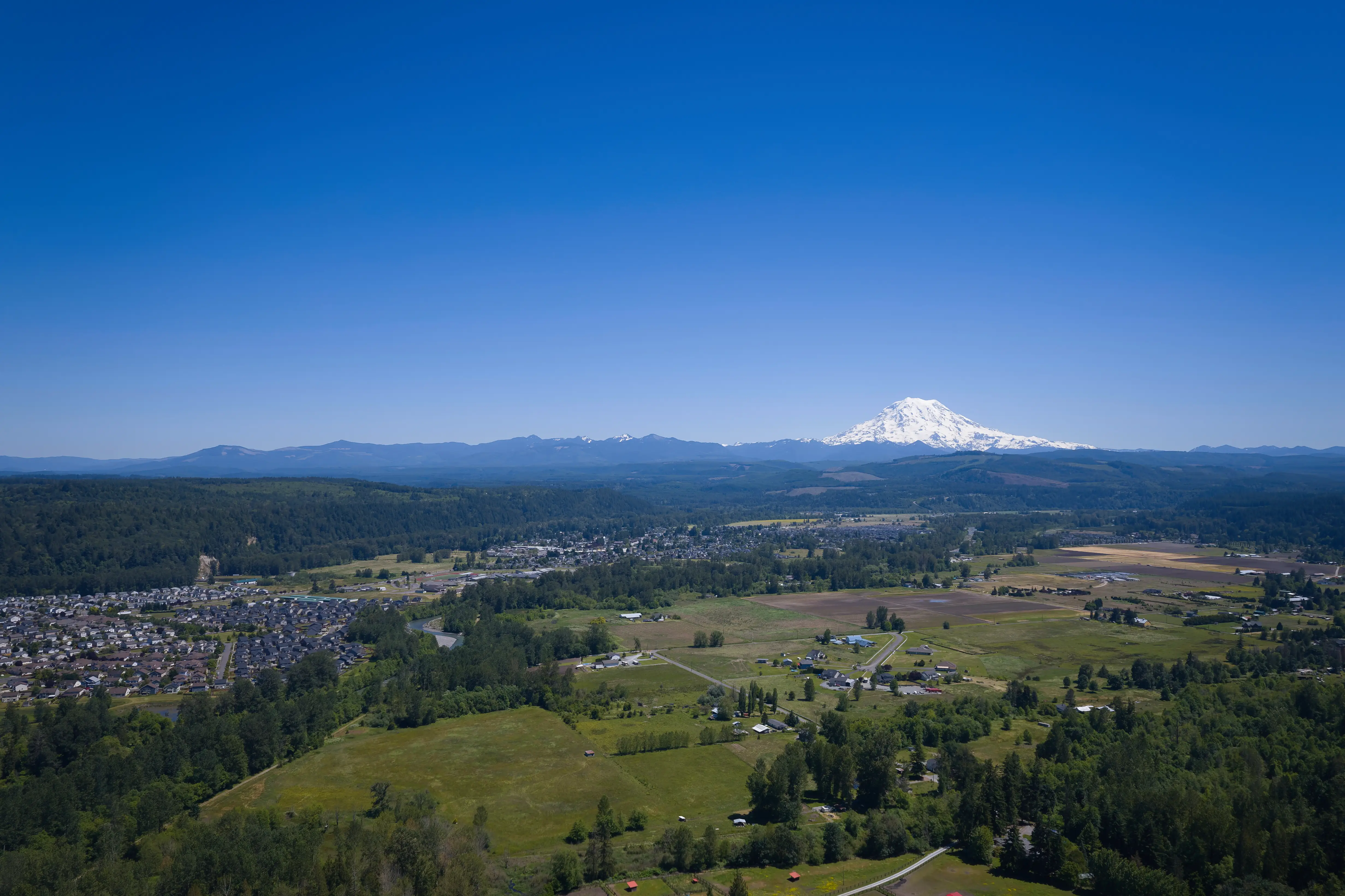
Local Expert Takeaway: The single thing California buyers most consistently underestimate about Puyallup isn't the weather — it's the neighborhood divide between Downtown Puyallup and South Hill, and what it means for their daily life. If walkability, a farmers market two blocks away, and a historic neighborhood feel are what sold you on the move, buy near downtown — Shaw Road north, the blocks around Pioneer Park, the streets adjacent to the Meeker Mansion corridor. If you want newer construction, more square footage, and proximity to the commercial corridor on Meridian, South Hill delivers that. Buying in one expecting the other is the most common California-buyer regret in this market.
✅ Washington's no state income tax advantage is worth $6,000–$15,000+ per year for most California transplant households — the most immediate and durable financial benefit of the move.
⚠️ Puyallup's winters average only 142 sunny days per year, a significant drop from any California metro. The adjustment is real and worth planning for before you commit.
📍 Downtown Puyallup and South Hill are different markets — buyers who preview one and purchase in the other often feel like they moved to a different city.
Is moving from California to Puyallup worth it?
For most California buyers, the financial math is compelling and the lifestyle trade-offs are manageable. The combination of no state income tax, housing prices well below California metros, and genuine Pacific Northwest quality of life makes Puyallup a strong destination — particularly for remote workers and dual-income households who don't need to accept a pay cut to make the move. The honest answer is that it's worth it for buyers who go in clear-eyed about the weather and the suburban pace, and less worth it for buyers who expect California cultural density transplanted into a smaller city.
How much cheaper is housing in Puyallup vs California?
At the median, Puyallup's $565,882 is roughly 57% less expensive than a Bay Area median, 40%–50% less than most Southern California coastal markets, and comparable to or modestly below Sacramento and Riverside County. The widest gap is with Bay Area buyers, where the equity differential is large enough to eliminate a mortgage entirely. Central Valley buyers see the smallest relative housing cost advantage but gain significantly on income tax and utility costs.
What do I need to know about moving from California to Washington?
Three things most buyers don't account for: first, Washington has no state income tax, which improves monthly take-home pay immediately and permanently. Second, the Pacific Northwest winter — October through March — is genuinely gray and wet in a way that California rain does not prepare you for. Third, Washington requires establishing residency within 30 days of moving — updating your driver's license, vehicle registration, and voter registration — and the state takes residency verification seriously, particularly for income tax purposes if you have California business income.
Explore the full Puyallup series: The Ultimate Puyallup Relocation Guide · Is Puyallup Safe? · Cost of Living in Puyallup · Best Neighborhoods in Puyallup · Puyallup Schools & Family Life · Puyallup Youth Sports · Puyallup Parks & Recreation · Retiring in Puyallup · 1031 Tax-Deferred Exchange in Puyallup · Puyallup First-Time Homebuyers Guide · Moving to Puyallup from California
Tell us what you need help with and we'll connect you with local resources.

About the Author
Todd Davidson is the founder of Living in Oregon and Living in Washington, where he publishes in-depth city guides, neighborhood resources, and local market insights covering more than 180 communities across the Pacific Northwest. While his background is in home financing and real estate, he created these digital platforms to help families research and compare regions before making a move.