
Puget Sound · Washington
Puyallup gets lumped into the "affordable Pierce County alternative" conversation so often that buyers arrive with unrealistic expectations. The reality is more nuanced: Puyallup is meaningfully cheaper than most of King County, but it is not cheap. Median sold prices are running in the $585,000–$625,000 range depending on the month, and property taxes on a mid-range home will add roughly $585 a month to your payment. If you've been quoting someone Seattle suburb numbers, prepare for a correction in the right direction — just not as dramatic as you hoped.
What shapes the cost picture here is a mix of suburban Pierce County land prices, Washington State's no-income-tax structure, and a housing stock that ranges from older downtown bungalows to sprawling five-bedroom builds in Manorwood and South Hill. The Washington State Fair brings seasonal economic energy, MultiCare Good Samaritan anchors healthcare employment, and the Amazon logistics footprint keeps a steady base of working-class incomes in the area. This is not a single-industry company town — it's a functional mid-size suburb with layered employment and a genuine range of housing options.
This guide will help you understand exactly what it costs to live in Puyallup in 2026: what buying versus renting looks like at different budget levels, how the tax structure compares to neighboring cities, and what your monthly budget actually looks like after the mortgage is signed.
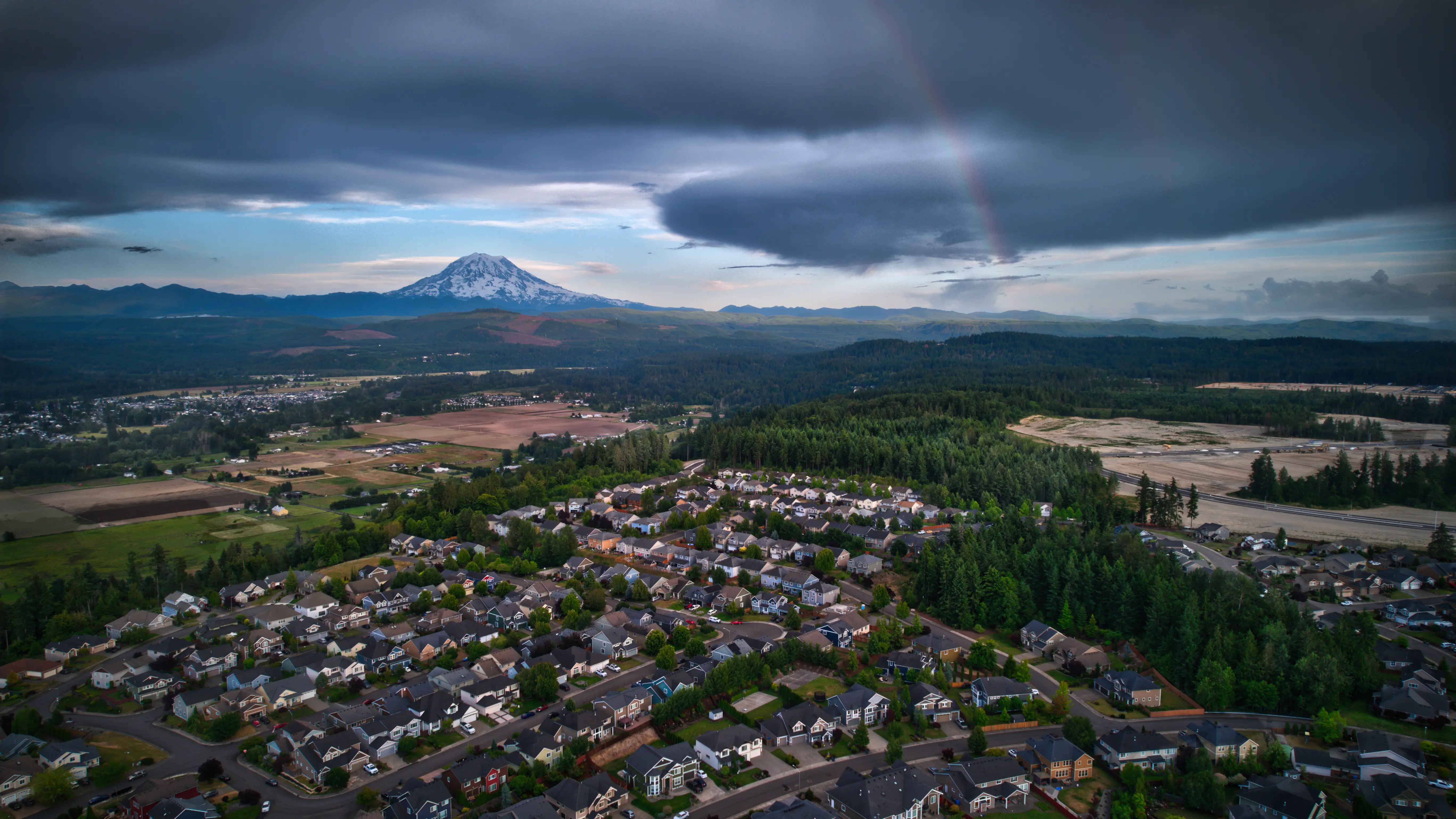
The Puyallup housing market is competitive without being the chaotic bidding-war environment that defined Seattle's peak years. Homes are selling in around 24 days on average, typically receiving two offers, and Redfin's competitiveness score puts the market at 80 out of 100. The median sold price has been tracking in the $585,000–$625,000 range through early 2026, with the Zillow Home Value Index — which blends all home stock rather than just recent sales — coming in at $565,882. For budgeting purposes, $600,000 is the most practical working figure for a median purchase.
What does $600,000 buy here? Typically a three-to-four bedroom home with 1,800 to 2,200 square feet, likely in a neighborhood like Sunrise, Northwest Puyallup, or the broader South Hill area. At $281 per square foot (the current median), buyers who prioritize space over location tend to get more for their money than in comparable Tacoma zip codes. The entry point for ownership is meaningfully lower — older downtown condos and smaller bungalows can appear in the $350,000–$450,000 range — while the upper end of the market in Manorwood and Deer Creek pushes well past $800,000.
The market has softened slightly from its 2022 highs. Year-over-year appreciation is essentially flat to mildly positive, with Redfin showing a 0.8% increase in median sold prices through March 2026. That's not a market losing steam dramatically — it's a market that corrected and stabilized, which for buyers is actually a reasonable moment to act before rates force further affordability compression.
| Budget Range | What to Expect | Typical Areas |
|---|---|---|
| Under $450,000 | Condos, older bungalows, smaller townhomes | Downtown Puyallup, older South Hill corridors |
| $450,000–$575,000 | 3-bed/2-bath homes, 1,400–1,900 sq ft, some updates needed | Sunrise, Northwest Puyallup, Woodland |
| $575,000–$750,000 | 4-bed family homes, newer builds, good school proximity | South Hill, Meridian, Ridgecrest, La Grande Station |
| $750,000+ | Large 5-bed homes, luxury finishes, larger lots | Manorwood, Deer Creek, Shalimar, upscale South Hill |
Pierce County applies approximately 1.17% effective property tax rate within Puyallup city limits — slightly above the county average of 1.13%, largely because of the Puyallup School District's voter-approved capital levy, which adds $4.14 per $1,000 of assessed value. On a $565,882 home, that works out to roughly $6,621 per year, or about $552 per month. On a $600,000 purchase — closer to current sold prices — the annual bill runs closer to $7,020. Payments are split into two equal installments, due May 1 and October 31. Washington caps annual property tax levy increases at 1% without voter approval, which provides some long-term predictability that states without levy limits cannot offer. Homeowners 61 and older with gross household income below $64,000 per year qualify for the state's senior exemption program, which can meaningfully reduce the annual bill.
The rental market here is close to evenly split: roughly 49% of Puyallup households rent, which means inventory exists but doesn't overwhelm. The largest concentration of apartments is in Downtown Puyallup and South Hill, and the most available unit type is the two-bedroom, which makes up about half of all rentals citywide. Rents have ticked up modestly — about 1.9% year over year — and the overall market sits slightly below or near the national average depending on which source and unit type you're looking at.
| Unit Type | Average Monthly Rent |
|---|---|
| Studio | $1,339–$1,693 |
| 1-Bedroom | $1,574–$1,683 |
| 2-Bedroom | $1,948–$2,059 |
| 3-Bedroom | $2,486–$2,677 |
| 4+ Bedroom (house/townhome) | $3,233+ |
The most affordable rental neighborhoods are Downtown Puyallup, Summit Puyallup, and South Hill — which is somewhat counterintuitive given that South Hill also appears in the pricier tier depending on the specific complex and proximity to major retail. Emerald Pointe and South Side Puyallup tend to run at the higher end of the rental spectrum. For renters who want to be close to the Puyallup Farmers Market, Pioneer Park, or the walkable amenities of the historic downtown core, the tradeoff is either older building stock or longer waitlists at updated complexes.
Electricity costs in Puyallup run approximately $0.19 per kWh, which is about 11% below the national average — a meaningful number for households running electric heat, EV charging, or high-usage appliances. The typical monthly electricity bill for a single-family home lands in the $150–$200 range for moderate users, though larger homes with electric heat or heavy EV use can push that figure closer to $285–$300. Puget Sound Energy handles gas service for most of the city, and internet is served primarily by Comcast/Xfinity and Ziply Fiber, with fiber availability expanding but not yet citywide.
Puyallup is car-dependent. That's not a criticism — it's the geography. Most residents own at least one vehicle, and shopping, medical appointments, and school pickups all assume you're driving. SR-512, SR-167, and access to I-5 via Tacoma mean the freeway system is reasonably accessible, but rush-hour congestion on SR-512 between Puyallup and I-5 is a daily reality for westbound commuters. The 42-minute average commute to Seattle is achievable off-peak; during peak hours on I-5 through Tacoma, add 15–25 minutes. Pierce Transit provides bus service within the city, and Sounder commuter rail from Puyallup Station to Seattle is a genuine option for daily commuters who can structure their schedule around fixed departure times.
Grocery access is solid across most of Puyallup. Fred Meyer, Safeway, WinCo Foods, and QFC serve the major residential corridors. South Hill has the densest retail concentration, with the South Hill Mall and surrounding commercial area providing everything from big-box shopping to sit-down dining. Downtown Puyallup has a more walkable food and coffee scene — a handful of locally owned spots anchor the main streets — but for full weekly grocery runs, most downtown residents still drive to South Hill or the nearby Meridian corridor. Gas prices track slightly below Seattle metro averages, typically $0.10–$0.20 per gallon cheaper than King County.

Looking to buy in Puyallup? Estimate your payment.
Enter your numbers to see an estimated monthly mortgage payment.
Estimate only. Excludes HOA fees and mortgage insurance.
| City | Median Home Price | Property Tax Rate | State Income Tax | Avg Commute to Seattle | Key Trade-off |
|---|---|---|---|---|---|
| Puyallup | $565,882 (ZHVI) | 1.17% | None | 42 min | Balance of price and amenities |
| Tacoma | ~$440,000 | ~1.18% | None | 35 min | Lower entry price, urban amenities |
| Sumner | ~$575,000 | ~1.10% | None | 48 min | Quieter, small-town feel |
| Edgewood | ~$620,000 | ~1.05% | None | 40 min | Low density, less retail access |
| Fife | ~$480,000 | ~1.15% | None | 38 min | Industrial corridor, improving retail |
| Graham | ~$520,000 | ~1.08% | None | 55 min | More space, longer commute |
| Orting | ~$475,000 | ~1.05% | None | 60 min | Rural feel, volcanic hazard zone |
This budget assumes a $565,882 home purchase with 10% down ($56,588), financed at approximately 6.75% on a 30-year fixed mortgage. Property taxes use the 1.17% effective rate.
| Expense Category | Monthly Cost |
|---|---|
| Mortgage (principal + interest, 10% down) | $3,300 |
| Property taxes (1.17% on $565,882) | $552 |
| Homeowner's insurance | $120 |
| HOA (if applicable — many homes have none) | $0–$200 |
| Electricity | $160 |
| Natural gas | $80 |
| Internet | $65 |
| Water/sewer/garbage | $110 |
| Groceries (household of 3) | $700 |
| Transportation (2 vehicles, gas + maintenance) | $650 |
| Dining out / entertainment | $400 |
| Healthcare (employer-supplemented) | $350 |
| Estimated Total | $6,487–$6,687 |
At a median household income of $97,826 — roughly $8,152 per month gross — this budget runs tight but not impossible for a dual-income household. Single-income buyers at or below median will find the math genuinely challenging without a larger down payment to reduce the monthly principal and interest figure. The budget improves meaningfully at 20% down, which eliminates PMI and drops the mortgage payment by approximately $200 per month.
Washington State has no personal income tax. For buyers relocating from Oregon or California — both of which levy meaningful income taxes — this difference can be substantial. A household earning $97,826 in Oregon would pay roughly $5,500–$7,000 in state income tax annually; in Washington, that number is zero. This isn't a minor footnote: it's a genuine structural advantage that makes Washington's higher property tax rates more palatable in context.
Washington does levy a 6.5% sales tax, with Pierce County adding to bring the combined rate to 10.2% in Puyallup. Groceries are exempt from sales tax. There is no Washington estate tax exemption below $2.193 million (as of 2026), and the state capital gains tax — enacted in 2022 — applies to long-term capital gains above $262,000, which affects some investors and business owners but rarely typical homebuyers. For retirees or those with significant investment income, Washington's lack of income tax is particularly advantageous. The state also offers a property tax deferral program for qualifying seniors and disabled persons, separate from the exemption program, allowing taxes to be deferred until the property is sold.
Local Expert Takeaway: The buyers who consistently make the best decisions in Puyallup are the ones who run the full monthly cost picture — not just the mortgage payment. At 1.17%, property taxes here add roughly $550 a month on a median purchase, and that surprises people who've been budgeting against Seattle-area properties assessed at lower effective rates. My advice: put 20% down if you can get there, target South Hill or Meridian for the best combination of school quality and resale trajectory, and treat the Washington income tax advantage as real money — because compared to Oregon or California, it absolutely is.
Is Puyallup affordable compared to other Puget Sound cities?
Relative to King County and Seattle's closer suburbs, yes — Puyallup offers meaningfully lower home prices. The median sold price in the $585,000–$625,000 range compares favorably to Bellevue or Renton, but buyers coming from truly affordable inland markets will find it a mid-tier suburban market rather than a bargain. The full monthly cost picture, including taxes and utilities, runs roughly $6,500 for a household purchasing at the median.
What are property taxes like in Puyallup?
Puyallup carries an effective property tax rate of approximately 1.17%, which is slightly above the Pierce County average. On a home purchased at the $565,882 ZHVI figure, the annual tax bill runs around $6,621 — paid in two installments each year. Homeowners 61 and older with household income below $64,000 annually may qualify for the county's senior exemption program, which can significantly reduce that figure.
Is it cheaper to rent or buy in Puyallup right now?
For most households, the monthly cost of owning at the median price exceeds renting a comparable-sized unit by $1,500–$2,000 per month in pure cash-flow terms. Renting a three-bedroom home runs roughly $2,677 per month, while owning a comparable property at median price with 10% down costs closer to $4,100 before utilities. The ownership case rests on equity accumulation and Washington's historically stable property values rather than short-term monthly savings.
Explore the full Puyallup series: The Ultimate Puyallup Relocation Guide · Is Puyallup Safe? · Cost of Living in Puyallup · Best Neighborhoods in Puyallup · Puyallup Schools & Family Life · Puyallup Youth Sports · Puyallup Parks & Recreation · Retiring in Puyallup · 1031 Tax-Deferred Exchange in Puyallup · Puyallup First-Time Homebuyers Guide · Moving to Puyallup from California
Tell us what you need help with and we'll connect you with local resources.

About the Author
Todd Davidson is the founder of Living in Oregon and Living in Washington, where he publishes in-depth city guides, neighborhood resources, and local market insights covering more than 180 communities across the Pacific Northwest. While his background is in home financing and real estate, he created these digital platforms to help families research and compare regions before making a move.