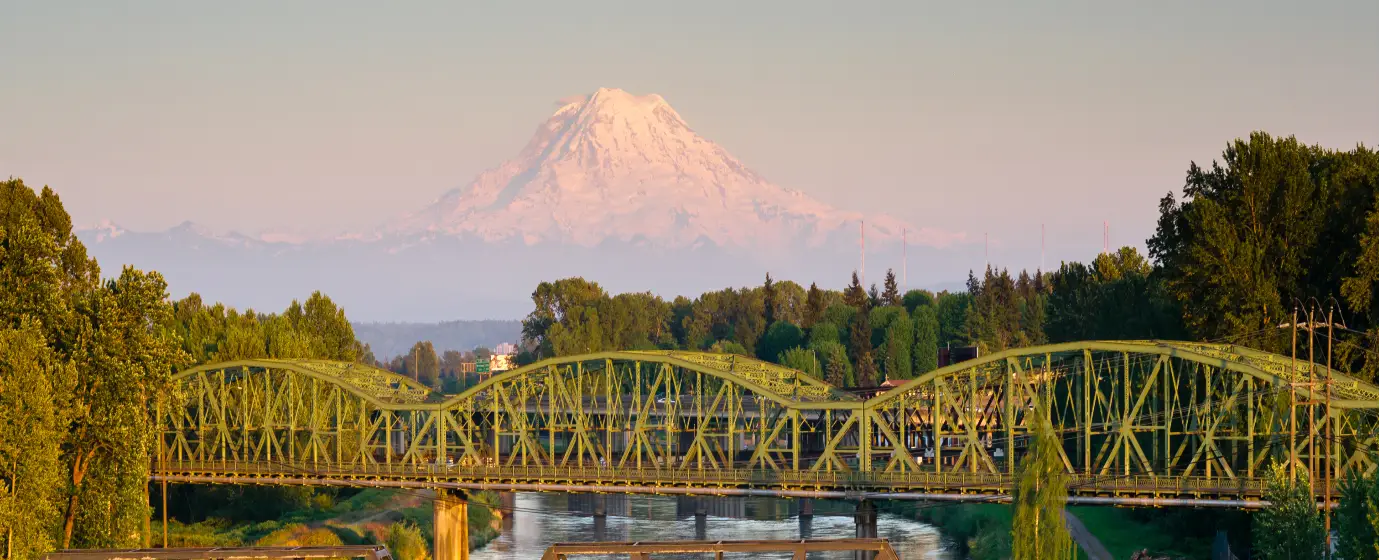
Puget Sound · Washington
Puyallup is one of those cities where the headline crime numbers and the lived experience don't always tell the same story. Property crime rates that rank in the bottom tier nationally sit alongside a poverty rate of just 6.1% — well below the national average — and Nextdoor surveys where residents consistently describe their neighborhoods as peaceful, family-friendly, and walkable. That gap between the statistics and the sentiment is real, and understanding why it exists matters more than either number alone.
The practical shape of crime in Puyallup is highly concentrated. Retail corridors near the fairgrounds, the downtown commercial core, and the northeast quadrant absorb a disproportionate share of incidents — particularly vehicle theft and property crimes — partly because high-traffic zones are where opportunity crime clusters. The quieter residential west side, by contrast, sees a fraction of those numbers. Where you live in Puyallup matters far more than the citywide average suggests.
This guide breaks down the verified crime data, compares Puyallup against its neighbors, and gives you a neighborhood-by-neighborhood read on where safety varies most. Whether you're buying near the Puyallup Farmers Market, considering a commute from South Hill, or weighing the northwest neighborhoods against closer-in options, the picture here is more nuanced than any crime index alone will tell you.
The most honest framing for Puyallup's crime picture starts with a clear separation of violent and property crime — because they point in opposite directions. Local police data and FBI estimates both suggest that violent crime in Puyallup sits in a range that various methodologies categorize differently: some sources rank it slightly above the national average, others rate it below. What isn't disputed is that property crime is the city's primary challenge, running significantly higher than both state and national benchmarks.
The overall crime index, commonly reported around 311 by city-level trackers, puts Puyallup higher than most U.S. cities by that measure. But context matters here. The 2024 data also reflects a notable year-over-year drop — property crimes fell by roughly 42% compared to the prior year, and the overall rate declined by close to 40%. These aren't marginal improvements; they suggest real movement in the right direction, even if the city's starting point meant the numbers still look elevated relative to national medians.
Structurally, what drives Puyallup's property crime rate is commercial density and visitor volume, not neighborhood character. The Washington State Fair draws over a million visitors annually and anchors a north-central commercial corridor that, when viewed on a crime heat map, appears concerning — but that activity is concentrated at retail intersections and event-adjacent areas, not dispersed through residential streets. The city's poverty rate of 6.1% is well below the national average of 15.1%, which typically correlates with lower baseline crime in residential neighborhoods. That separation between commercial-zone incidents and residential reality is the single most important thing to understand about this city's crime profile.
Based on FBI estimates and local reporting, Puyallup's violent crime rate runs approximately 3.2 per 1,000 residents — a figure that different platforms weight differently depending on how they normalize for population and visitor traffic. In practical daily terms, the risk of being a victim of violent crime is low for most residents: one commonly cited estimate puts individual annual odds around 1 in 267. For context, that's a rate that some analytical tools place slightly above national norms and others place below — the methodology genuinely changes the answer. What doesn't change is that street-level violent crime is not a defining feature of daily life in Puyallup's residential neighborhoods, and residents in surveys consistently rate their own streets as safe.
Property crime is where Puyallup's numbers genuinely stand out — and not in a favorable way. The rate commonly reported around 29–38 incidents per 1,000 residents puts the city in the lower tier nationally by most measures. Vehicle theft is the dominant concern: Puyallup has been flagged in FBI data as having one of the higher motor vehicle theft rates in the country, with roughly 1 in 119 odds of a vehicle being stolen annually. That figure clusters heavily around commercial areas, Park-and-Ride lots near transit corridors, and apartment complexes close to the SR-512 and SR-167 interchange zones. Residential burglary and package theft are secondary concerns, particularly in higher-density blocks near the downtown core and north-side retail districts.
Northwest Puyallup is consistently cited by residents and reflected in incident data as the city's safest quadrant. Violent crime odds in this part of the city run roughly 1 in 708 annually by commonly reported estimates — a figure that compares favorably to most Pierce County communities. Property crime is also measurably lower here, with annual incident counts in the range of 94 per year for the broader northwest zone, compared to multiples of that figure in the commercial northeast.
Best for: Buyers who want the lowest crime exposure in Puyallup's city limits.
Downtown Puyallup is the city's most commercially active area and, predictably, the place where crime data is most influenced by foot traffic and retail density. The Pioneer Park corridor, Farmers Market area, and blocks adjacent to the Meeker Mansion see the highest concentration of property-related incidents — largely vehicle break-ins, theft, and occasional retail-adjacent offenses. That said, downtown is also where community presence is highest: active storefronts, regular foot traffic, and proximity to City Hall and the police department create natural deterrence. Living here is different from parking here; residential blocks a few streets off the main commercial strip are substantially calmer than the numbers suggest.
Best for: Buyers who understand commercial-zone crime dynamics and want walkable access to the Farmers Market and Riverwalk Trail.
South Hill is technically an unincorporated Pierce County community adjacent to Puyallup — not within city limits — and is served by the Pierce County Sheriff rather than the Puyallup Police Department. Its crime profile differs accordingly. Safety within South Hill varies significantly by location: the southeast corner is consistently considered the safest by residents, while the northern portion near busy commercial arterials sees higher incident rates. The overall rate is commonly reported around 32 per 1,000 residents, which tracks roughly in line with surrounding unincorporated communities rather than Puyallup proper.
Best for: Buyers who want larger lots and newer construction near Puyallup without paying city taxes — but who should research specific street locations carefully.
The Sunrise area sits east of downtown Puyallup and is primarily residential in character, with a mix of established single-family homes and some multifamily housing near the SR-512 corridor. Its proximity to the freeway interchange means it has more exposure to transient traffic than purely interior neighborhoods — a pattern that shows up in property crime data for similar locations across Pierce County. Residents describe it as a functional, working neighborhood rather than a premium one, with crime levels that reflect the mix of older housing stock and access-road proximity.
Best for: Buyers focused on price point who can accept slightly more noise and traffic in exchange for proximity to both downtown and the freeway.
The Meridian corridor — running along Meridian Avenue through central Puyallup — blends residential streets with commercial strip development, and that mix shapes its safety profile in predictable ways. Retail-adjacent blocks experience the property crime patterns typical of any commercial corridor, while streets that step back from the main arterial into established neighborhoods see much lower activity. It's a neighborhood where geography within the neighborhood matters: being two blocks east or west of Meridian itself can represent a meaningfully different daily experience.
Best for: Buyers who want central access to Puyallup's services and don't mind navigating a mixed-use corridor.
Manorwood is one of the city's more established residential neighborhoods and sits in the northwest quadrant that local data consistently identifies as Puyallup's safest zone. Larger lots, lower density, and minimal commercial intrusion create the conditions where property crime is least likely to cluster. Residents in this area tend to report high satisfaction with neighborhood safety, and the combination of cul-de-sac layouts and neighborhood cohesion — typical of planned residential areas from the 1980s and 1990s — adds additional natural deterrence.
Best for: Families and households prioritizing low property crime exposure in a quiet, established residential setting.
Looking to buy in Estimate your payment.
Enter your numbers to see an estimated monthly mortgage payment.
Estimate only. Excludes HOA fees and mortgage insurance.
| City | Violent Crime / 1K | Property Crime / 1K | Overall Safety Profile |
|---|---|---|---|
| Puyallup | ~3.2 | ~29.3 | Below WA average; property crime is primary concern |
| Tacoma | ~8.1 | ~52.4 | One of the highest crime rates in the region |
| Sumner | ~2.1 | ~18.6 | Safer than Puyallup on both measures |
| Edgewood | ~1.4 | ~12.3 | Among the safer small cities in Pierce County |
| Fife | ~4.8 | ~38.7 | Higher crime, driven by I-5 commercial corridor |
| Graham | ~2.6 | ~22.1 | Unincorporated; moderate risk profile |
| Orting | ~1.9 | ~14.8 | Small population, lower incident volume |
Puyallup sits in the middle of this peer group — significantly safer than Tacoma and Fife on both measures, but not as low as smaller neighbors like Edgewood and Orting. For buyers who are specifically comparing Puyallup against Sumner, the safety gap is real but not dramatic, and Puyallup's larger job base and amenity access often tips the decision.
The most consistent piece of advice from long-term Puyallup residents is simple: never leave anything visible in your car. Vehicle theft and smash-and-grab incidents concentrate around the Shaw Road and Meridian retail corridors, the transit Park-and-Ride lots near the Sounder station on Stewart Avenue, and parking areas adjacent to the fairgrounds on 9th Avenue SW. These aren't abstract risks — they're the specific locations where the majority of Puyallup's property crime incidents originate. Most residents who have lived here a few years have developed an automatic habit of clearing their vehicles and parking in garages when possible.
What safety apps and aggregate crime maps miss is the dramatic difference between Puyallup's northeast quadrant near the commercial core and the city's residential west side. A buyer who filters by city and sees a D– property crime grade is looking at a number heavily skewed by incidents in parking lots that they may never personally use. The northwest neighborhoods — particularly the streets feeding into Manorwood and the residential blocks west of Pioneer Park — carry a genuinely different risk profile than that grade implies. Locals are quick to point this out when the city gets discussed online.
The city has also made measurable progress. The 40% drop in overall crime rates year-over-year in 2024 isn't a statistical quirk — it reflects both directed enforcement efforts and the natural property crime cycle that followed a regional spike during 2022 and 2023. Puyallup has a dedicated police department rather than relying on county services, which means response times in city limits are faster than in adjacent unincorporated communities. That distinction matters more than most relocating buyers initially realize.
Local Expert Takeaway: If you're choosing a neighborhood in Puyallup with safety as a priority, the northwest side of the city — particularly the Manorwood area and streets west of Meridian Avenue — is where the incident data and resident sentiment align most clearly. Avoid leaving vehicles in the Park-and-Ride on Stewart Avenue overnight, and treat the Shaw Road retail corridor as a shopping destination rather than a residential anchor. Buyers comparing Puyallup to Sumner or Edgewood on safety alone will find those neighbors score better on paper, but Puyallup's northwest quadrant competes directly with both of them at the neighborhood level.
✅ Northwest Puyallup and Manorwood offer the city's lowest crime exposure — incident counts here are a fraction of the citywide average, and resident satisfaction with safety is consistently high in these areas.
⚠️ Vehicle theft is the primary real-world risk — concentrated around commercial corridors, transit lots near the Sounder station, and fairgrounds-adjacent parking. A garage makes a meaningful difference.
📍 The citywide crime grade understates how livable most residential neighborhoods are — the numbers are skewed by high-traffic commercial zones that most residents don't live in or regularly use.
Is Puyallup safe for families?
For families settled into Puyallup's residential neighborhoods — particularly the northwest quadrant and established areas away from the commercial corridors — daily life tends to feel safe and community-oriented. Resident surveys consistently describe the city as clean, quiet, and family-friendly, and the violent crime rate, while debated across methodologies, is not a defining feature of life in most parts of the city. Families with school-age children in particular tend to report high satisfaction, given the presence of well-regarded schools throughout the district.
What is the biggest crime concern in Puyallup?
Property crime — and specifically vehicle theft — is the clearest documented risk. Puyallup's motor vehicle theft rate is among the higher ones in the state, with incident concentration around Park-and-Ride lots, retail parking areas on Shaw Road and Meridian Avenue, and apartment complexes near the SR-512 interchange. Residents who park in garages and avoid leaving valuables visible in vehicles report far fewer personal experiences with this type of crime.
How does Puyallup compare to Tacoma for safety?
Puyallup is meaningfully safer than Tacoma on both violent and property crime measures. Tacoma's violent crime rate runs more than twice Puyallup's commonly reported figure, and property crime is similarly elevated across most Tacoma neighborhoods. Many buyers who work in Tacoma choose Puyallup specifically because it offers a shorter risk profile while maintaining a reasonable commute — the 42-minute drive to Seattle and close proximity to Tacoma employers makes that trade-off practical.
Explore the full Puyallup series: The Ultimate Puyallup Relocation Guide · Is Puyallup Safe? · Cost of Living in Puyallup · Best Neighborhoods in Puyallup · Puyallup Schools & Family Life · Puyallup Youth Sports · Puyallup Parks & Recreation · Retiring in Puyallup · 1031 Tax-Deferred Exchange in Puyallup · Puyallup First-Time Homebuyers Guide · Moving to Puyallup from California
Tell us what you need help with and we'll connect you with local resources.

About the Author
Todd Davidson is the founder of Living in Oregon and Living in Washington, where he publishes in-depth city guides, neighborhood resources, and local market insights covering more than 180 communities across the Pacific Northwest. While his background is in home financing and real estate, he created these digital platforms to help families research and compare regions before making a move.