
Puget Sound · Washington
Arlington, Washington doesn't show up on the retirement shortlists that circulate in Arizona snowbird Facebook groups or the glossy "best places to retire in the Pacific Northwest" listicles. That's partly why it's worth examining seriously. For the right retiree — someone who wants a genuine small town with real infrastructure, space for a single-family home, and Washington's exceptional tax climate — Arlington delivers in ways that more famous retirement destinations in Snohomish County don't always match.
The retiree who thrives here tends to value elbow room over urban convenience. They're comfortable owning a car, they appreciate a quiet downtown with a local coffee shop over a dense walkable district, and they want a hospital nearby without paying Kirkland prices to be close to it. Cascade Valley Hospital sits south of downtown on Stillaguamish Avenue, senior living options are genuinely diverse, and the tax situation for retirees in Washington State is among the best in the country.
This guide works through all of it: the tax picture, healthcare reality, senior living options, what daily life actually looks like in retirement here, and how Arlington stacks up against nearby alternatives. If you're weighing this city seriously, you'll have a clear answer by the end.
Washington State's retirement tax environment is one of the most favorable in the country, and it's worth spelling out exactly what that means for someone moving a fixed income here from California, Oregon, or the Midwest.
| Income Type | Washington State Tax Treatment |
|---|---|
| Social Security benefits | Not taxed |
| Pension income | Not taxed |
| 401(k) / IRA withdrawals | Not taxed |
| Investment dividends & interest | Not taxed |
| Capital gains (retirement accounts) | Not taxed |
| Wages / earned income | Not taxed |
| Property tax | 1.10% effective rate (Arlington) |
| Sales tax | ~9.0% combined state/local rate |
| Estate tax | Applies above $2.193 million threshold |
Washington has no personal income tax — full stop. Every dollar you pull from your IRA, your pension check, your Social Security deposit — none of it faces state-level taxation. For a retiree drawing $70,000 to $90,000 annually from retirement accounts, that's a meaningful annual savings compared to Oregon's income tax, which runs as high as 9.9% on income over $125,000 and applies to most retirement income in full.
The property tax picture in Arlington is reasonable for the region. At approximately 1.10%, a home at the city's median price generates roughly $6,600 annually in property taxes — less than many comparable Snohomish County suburbs. Washington State also offers a senior property tax exemption for residents 61 and older who meet income thresholds, which can meaningfully reduce that figure. The program is administered through Snohomish County and bases eligibility on combined disposable income, making it accessible for retirees on moderate fixed incomes. Oregon offers similar exemption programs, but the income tax exposure in Oregon often erases whatever property tax savings seniors capture — a comparison that consistently favors Washington for retirement planning purposes.
Cascade Valley Hospital sits at 330 S Stillaguamish Avenue, a short drive from most Arlington neighborhoods, and it's the anchor of healthcare access for the region. The facility is a 48-bed, Medicare-certified general hospital operated under Skagit Regional Health — the same system that runs the larger Skagit Valley Hospital in Mount Vernon. Cascade Valley completed a $45 million renovation and expansion in 2010, and the campus now sits on 17 acres with a Level IV Emergency Department, an ICU, operating rooms, an orthopedic surgery unit, a coronary care unit, diagnostic imaging, MRI, CT, and nuclear medicine capabilities.
For routine senior healthcare — orthopedic follow-ups, imaging, outpatient surgery, rehabilitation after a procedure — Cascade Valley handles the full spectrum. The hospital also operates five medical clinics and a freestanding ambulatory surgery center in the surrounding area, which matters for retirees who need regular specialist access without driving to Everett.
Where the picture gets honest: a Level IV Emergency Department is a stabilize-and-transfer facility, not a trauma center capable of handling the most complex cardiovascular events or neurological emergencies. For open-heart surgery, comprehensive cancer treatment, or neurosurgical intervention, the relevant destination is Providence Regional Medical Center in Everett — roughly 25 miles south — or the University of Washington Medical Center in Seattle, which is approximately 55 miles from Arlington on I-5. Retirees with complex or actively managed cardiac conditions should factor that distance into their planning.
Skagit Valley Hospital in Mount Vernon, about 20 miles north, offers a Level III Emergency Department, comprehensive cancer care, advanced cardiac services, and joint replacement programs — which makes it a practical alternative for many specialty needs without requiring the full drive to Seattle.
Arlington has a more developed senior living ecosystem than its population might suggest, with communities spread across the city and into the Smokey Point corridor.
| Community | Type | Location | Est. Monthly Cost |
|---|---|---|---|
| Fields Senior Living at Smokey Point | Assisted living & memory care | 3607 169th St NE | $3,400–$10,000 |
| Olympic Place by Bonaventure | Independent, assisted & memory care | 20909 Olympic Pl NE | From $3,780 |
| Cascade Valley Senior Living | Assisted living & memory care | 8400 207th Pl NE | From $3,900 |
| Affinity at Arlington | Senior living | Arlington | Contact for pricing |
Fields Senior Living has operated as a family-owned community since 1958 — a long track record in an industry where turnover of ownership is common. The Smokey Point location gives it quick access to the Highway 9/530 retail corridor. Olympic Place by Bonaventure sits closer to downtown Arlington's older commercial district and offers the broadest level-of-care range on this list, with capacity for up to 81 residents in independent through memory care configurations.
Cascade Valley Senior Living accepts Medicaid once residents exhaust private funds — a distinction that matters significantly for long-term financial planning and one that not all communities in the region offer. The city-wide average cost of assisted living runs approximately $5,324 per month, which is below Seattle metro averages for comparable care levels. Retirees arriving with long-term care insurance will find the coverage aligns reasonably well with Arlington's pricing.

Looking to buy in Estimate your payment.
Enter your numbers to see an estimated monthly mortgage payment.
Estimate only. Excludes HOA fees and mortgage insurance.
The honest answer about walkability in Arlington is that it functions like most Pacific Northwest towns of its size — adequate in the Old Town core, and essentially car-dependent everywhere else. Downtown Arlington has a small grid of walkable blocks around Olympic Avenue and Division Street, with a handful of restaurants, a coffee shop, and local retail within walking distance for residents who live nearby. For anyone in Eagle Heights, Crown Ridge, or the Smokey Point corridor, a car is a practical necessity for groceries, medical appointments, and daily errands.
Daily convenience is solid without being exceptional. Grocery access runs through Fred Meyer and Safeway options in the Smokey Point area, with a mix of local and chain restaurants along Highway 9. The retail density increases substantially just a few miles south on I-5, where the Smokey Point commercial corridor connects to Marysville's big-box offerings. Retirees who've downsized from a high-activity urban environment may find the pace slower than expected — but for the retiree who genuinely wants quiet mornings and easy afternoon errands, that pace is the point.
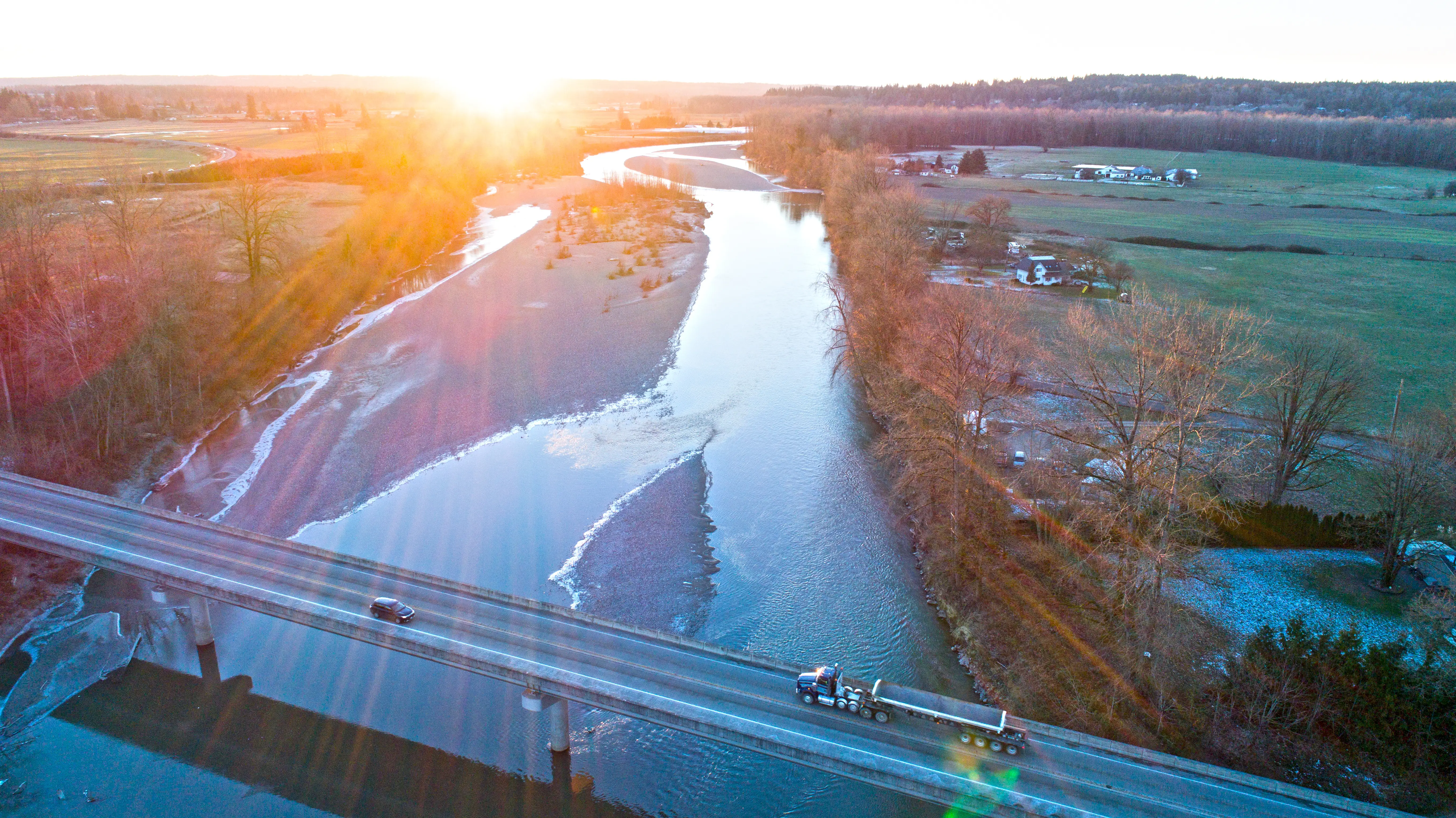
The Centennial Trail is the recreational centerpiece. This paved multi-use path runs through the heart of Arlington and extends toward Snohomish County's broader trail network, offering flat and accessible walking and cycling for retirees who want daily outdoor activity without technical terrain. The Stillaguamish River adds a scenic dimension, with fishing access and natural areas along its banks. Lake Armstrong and Lake Ki, both within the city's orbit, draw fishing and paddling activity across the warmer months.
Arlington's community calendar centers around a few long-running traditions. The Arlington Fly-In and Airshow at Arlington Municipal Airport is one of the largest events of its kind in the Pacific Northwest and draws aviation enthusiasts every summer — worth knowing about whether you love it or would rather plan around the crowds. The Arlington Rodeo, held at the Stillaguamish Tribal grounds, is another event with deep local roots that gives the summer calendar a genuinely different flavor than you'd find in the more suburban communities to the south.
What surprises many retirees after six months in Arlington is how much they rely on Marysville and Everett for specialty services — dental specialists, certain medical subspecialties, a broader restaurant selection — without minding the drive. The town-feel of Arlington is real, but it pairs naturally with the resources of the larger Snohomish County corridor.
| City | Median Home Price | Hospital Access | Walkability | Senior Living Depth | Overall Fit |
|---|---|---|---|---|---|
| Arlington | $598,417 | Cascade Valley (8 min) | Low–Moderate | Good | Strong for outdoors/low-key retirees |
| Marysville | ~$580,000 | Providence Regional (20 min) | Low | Moderate | Similar profile, less charm |
| Stanwood | ~$560,000 | Cascade Valley (25 min) | Low | Limited | Rural, scenic, further from services |
| Lake Stevens | ~$640,000 | Providence Regional (20 min) | Low | Moderate | Newer builds, suburban feel |
| Everett | ~$520,000 | Providence Regional (on-site) | Moderate | Strong | Best for urban retirees, less quiet |
| Granite Falls | ~$480,000 | Cascade Valley (30 min) | Very Low | Minimal | Rural, lowest cost, most isolated |
The clearest comparison Arlington forces is against Marysville to the south. The two cities share a similar price range and suburban profile, but Arlington holds an edge in small-town character, the Centennial Trail access, and a downtown that — modest as it is — has a distinct identity. Marysville's retail sprawl along I-5 is more developed, which matters if proximity to big-box shopping is a priority.
Everett offers the strongest hospital access and senior living ecosystem of any city in this comparison, along with Sounder train service to Seattle for retirees who want the option of car-free city access. The catch is that Everett's urban density is significantly higher than what most retirees are seeking when they look at Arlington, and the quiet small-town atmosphere disappears quickly once you're inside city limits.
Stanwood and Granite Falls sit at the lower end of the price range but require accepting meaningful distance from both hospital services and daily conveniences. For fully healthy, independent retirees who want maximum quiet and minimum cost, those trade-offs can make sense. For anyone managing ongoing health conditions or who may need assisted living within the next decade, the proximity of Arlington's care infrastructure matters more.
Local Expert Takeaway: Arlington fits the retirement profile of someone who wants a paid-off single-level home under $650,000, genuine outdoor access via the Centennial Trail and local waterways, and Washington's excellent retirement tax environment — without paying the premium of Edmonds, Mukilteo, or the Eastside. Eagle Heights and Crown Ridge are worth starting with for newer single-level construction with manageable maintenance. Retirees with active cardiovascular conditions should be clear-eyed about the distance to higher-level cardiac care in Everett or Seattle — Cascade Valley is strong for day-to-day and moderate acute care, but it has real limits at the high end. Old Town Arlington, just a few blocks in scale, suits the retiree who wants to walk to coffee without a car, but inventory there is limited and homes tend to be older. The honest version: if quiet, affordable, and outdoors-oriented sounds like your retirement, Arlington deserves a serious look.
Is Arlington, WA a good place to retire?
Arlington is a strong fit for retirees who want a small-town Pacific Northwest lifestyle, manageable home prices relative to the broader Puget Sound metro, and Washington's tax-friendly environment for fixed incomes. It works best for those who are comfortable being car-dependent and who don't need dense urban amenities within walking distance. Active, outdoors-oriented retirees in particular tend to find the Centennial Trail, the Stillaguamish River, and the lakes in and around the city more than compensate for the city's limited downtown depth.
How far is Arlington from major Seattle-area hospitals?
Cascade Valley Hospital is the local option, operating around the clock with a Level IV Emergency Department and a full suite of outpatient and surgical services. For higher-acuity cardiac, neurological, or oncological care, Providence Regional Medical Center in Everett is roughly 25 miles south, and the University of Washington Medical Center in Seattle is about 55 miles away. Most retirees find Cascade Valley handles their day-to-day health needs well, with Everett as a practical secondary option for specialty referrals.
How does Arlington's cost of living compare to other Snohomish County retirement destinations?
Arlington's median home price of $598,417 sits below Lake Stevens and most communities closer to the Eastside corridor, while Marysville runs comparably. Everett comes in lower on home prices but with significantly different neighborhood character. Property taxes at approximately 1.10% are mid-range for the county. The most significant cost advantage Arlington holds over any Oregon retirement destination is the elimination of state income tax on retirement income — a recurring annual benefit that compounds meaningfully over a long retirement.
Explore the full Arlington series: The Ultimate Arlington Relocation Guide · Is Arlington Safe? · Cost of Living in Arlington · Best Neighborhoods in Arlington · Arlington Schools & Family Life · Arlington Youth Sports · Arlington Parks & Recreation · Retiring in Arlington · 1031 Tax-Deferred Exchange in Arlington · Arlington First-Time Homebuyers Guide · Moving to Arlington from California
Tell us what you need help with and we'll connect you with local resources.

About the Author
Todd Davidson is the founder of Living in Oregon and Living in Washington, where he publishes in-depth city guides, neighborhood resources, and local market insights covering more than 180 communities across the Pacific Northwest. While his background is in home financing and real estate, he created these digital platforms to help families research and compare regions before making a move.