
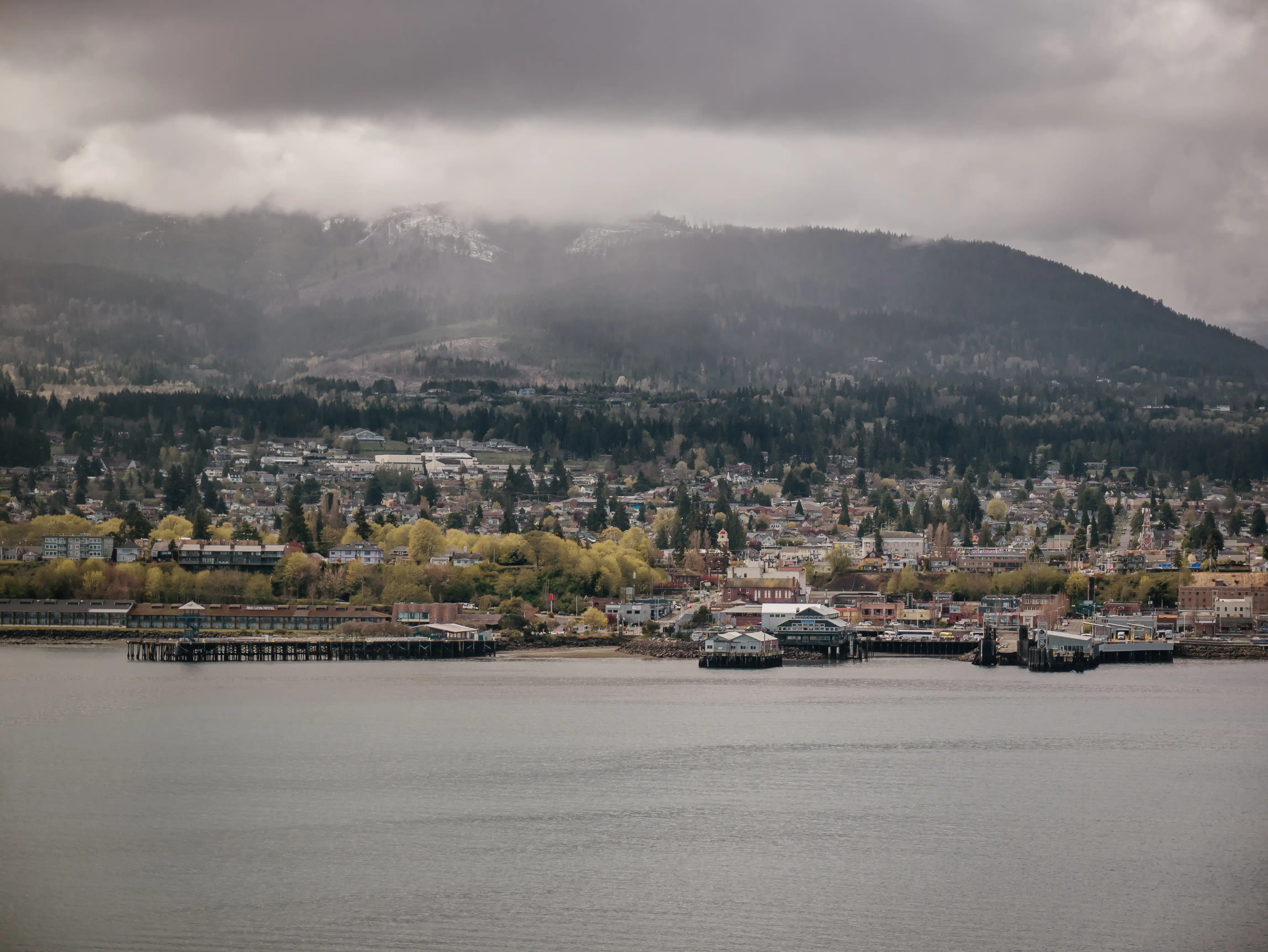
Olympic Peninsula · Washington
The Bay Area software engineer who took remote work seriously in 2021 and hasn't looked back. The San Diego family who stopped calculating what air conditioning costs in August and stopped checking air quality indexes before letting the kids play outside. The Sacramento buyer who sold a 1,400-square-foot townhome and bought a four-bedroom with a yard, a mountain view, and money left in the bank. Port Angeles isn't a place most Californians grow up dreaming about, but for a specific kind of buyer — someone who has run the numbers, who values space and clean air and low taxes over scene and sunshine volume — it keeps appearing at the top of the list.
The honest part comes next: Port Angeles is genuinely different from California, and not just in the ways relocation guides mention. The pace is slower in ways that can feel like relief in year one and friction in year three. The food scene is limited. The social energy of a mid-size California city — the density of friends and restaurants and things happening on a Saturday night — doesn't exist here in the same form. November through February, the Olympic rain shadow helps, but there are still weeks of gray that test a person who grew up under Sacramento sun. None of this is disqualifying, but none of it should surprise you either.
This guide covers exactly what a California transplant needs to make a clear-eyed decision: the cost comparison broken out by California origin market, what your California equity actually buys at Port Angeles prices, the tax picture in real dollar terms, the weather reality against California's best and worst, and a comparison tool to look up your specific California city.

| Port Angeles, WA | Bay Area | Southern CA | Sacramento Metro | Central Valley | |
|---|---|---|---|---|---|
| Median Home Price (approx. 2026) | $433,000 | $1.3M–$1.6M | $750K–$950K | $520K–$620K | $350K–$450K |
| Property Tax Rate (effective) | ~0.90% | ~1.1–1.2% | ~1.1–1.25% | ~1.1–1.25% | ~1.0–1.15% |
| State Income Tax | None | Up to 13.3% | Up to 13.3% | Up to 13.3% | Up to 13.3% |
| State Sales Tax | 8.4% (WA avg) | 8.625–10.25% | 9.5–10.5% | 7.25–8.75% | 7.25–8.75% |
| Avg Utilities (monthly est.) | ~$180–$220 | ~$250–$320 | ~$280–$380 | ~$240–$310 | ~$220–$290 |
| Avg 1BR Rent | ~$1,100–$1,400 | ~$2,800–$3,600 | ~$2,200–$2,800 | ~$1,600–$1,950 | ~$1,100–$1,500 |
Washington has no state income tax — full stop. For a California transplant earning $150,000 per year, the difference between California's graduated income tax (which hits that income level at an effective rate somewhere in the range of 8–9%) and Washington's zero adds up to roughly $12,000–$14,000 in annual take-home pay. That's a mortgage payment. That's a college fund contribution. The sales tax in Washington runs higher than California's base rate, and there's a 7% capital gains tax on long-term gains exceeding $262,000 per year — but for most working households, the net annual advantage of leaving California for Washington runs solidly positive.
Washington's no-income-tax status is the single biggest financial change California transplants experience, and it takes most people a full year to actually feel it in their checking account. The mechanics are straightforward: California taxes income on a graduated scale from 1% on the first dollars earned up to 13.3% on income above roughly $1 million. For realistic transplant income levels, the practical difference looks like this:
| Tax Item | California | Washington | Net Impact for Transplant |
|---|---|---|---|
| State Income Tax ($120K earner) | ~$8,700/yr | $0 | +$8,700/yr take-home |
| State Income Tax ($150K earner) | ~$12,500/yr | $0 | +$12,500/yr take-home |
| State Income Tax ($200K earner) | ~$18,500/yr | $0 | +$18,500/yr take-home |
| Capital Gains Tax | Taxed as income | 7% on gains >$262K | Neutral for most earners |
| State Sales Tax | 7.25% (base) | 6.5% + local (~8.4%) | Slight WA disadvantage |
| Property Tax Rate | ~1.1–1.25% (post-purchase) | ~0.90% (Clallam County) | WA advantage on most homes |
| Senior Property Tax Exemption | Limited | Available at 61+, income-based | WA advantage for retirees |
Property taxes in Clallam County run at approximately 0.90%, which is meaningfully lower than what most California buyers encounter on a newly purchased property. California's Proposition 13 keeps long-time owners at artificially low effective rates, but buyers purchasing at today's California prices are resetting their assessed value — and paying 1.1–1.25% on a $900,000 or $1.3 million purchase adds up fast. On a $433,000 Port Angeles home, 0.90% is roughly $3,900 per year. On a $1.2 million San Jose home, 1.15% is nearly $13,800. That gap of nearly $10,000 annually is real money compounding over time.
A buyer leaving Palo Alto or San Jose with $1.4 million in equity is, in practical terms, an all-cash buyer for most of what Port Angeles offers. At the $433,000 median, they're buying a home outright and investing the remaining $900,000+ elsewhere. For buyers who want to spend more, Port Angeles's upper tier — waterfront properties along the Strait, larger homes in the Mount Angeles area with Olympic views, or well-appointed houses near the Elwha River corridor — typically peaks in the $700,000–$900,000 range. That's still a cash purchase for a Bay Area seller, with $500,000 or more in remaining capital.
The neighborhoods that represent the best value at this equity level are Harbor View and the elevated streets with Olympic or Strait of Juan de Fuca views. These properties are genuinely hard to find at these price points anywhere on the West Coast. A buyer coming out of a $1.5 million Sunnyvale townhome and arriving in Port Angeles with a view lot, a proper yard, and no mortgage is the transplant story that circulates in Olympic Peninsula Facebook groups — and it's not exaggerated.
A buyer leaving Carlsbad or Pasadena with $850,000 in equity is buying in Port Angeles's top 10–15% of the market with a comfortable cushion. Homes in this range in Port Angeles are typically larger, better positioned, and often newer than what the same budget touched in Southern California. The Crown neighborhood and the higher elevations on Mount Angeles Road offer some of the most compelling value propositions at this equity level — panoramic views, larger lots, and homes that simply don't exist at equivalent prices south of Portland.
Southern California transplants at this equity level often invest a portion in a Port Angeles property and retain liquidity for other purposes — an investment property in the Sequim corridor, a renovation budget for an older home, or simply a financial cushion that California homeownership never allowed. The shift from asset-poor-but-housed to genuinely liquid is one of the most underappreciated outcomes of this move.
Sacramento buyers — particularly those leaving Elk Grove, Folsom, or Rancho Cordova — arrive with equity that maps closely to Port Angeles's median price. Someone selling a $580,000 Folsom home with $500,000 in equity has meaningful options: a well-located Port Angeles home with a modest remaining mortgage, or a smaller purchase outright with money left over. The no-income-tax advantage hits particularly hard for this cohort, since Sacramento-area households often earn in the $100,000–$160,000 range and are paying 8–9% effective state income tax.
Price-specific reality for Sacramento buyers: The $400,000–$550,000 range in Port Angeles buys a three-bedroom home on a real lot in neighborhoods like Georgiana, Edgewood, or Lauridsen — areas with established trees, good access to Lincoln Park and the Olympic Discovery Trail, and a quieter residential feel. This is not a sideways move from Sacramento. It's a meaningful upgrade in space, environment, and monthly cash flow.
Central Valley buyers — from Fresno, Bakersfield, Modesto, or Stockton — are making the most modest relative gain in pure equity terms, but the lifestyle shift can be the most dramatic. A buyer leaving a $380,000 Fresno home with $320,000 in equity is not arriving in Port Angeles as a cash buyer, but they are arriving with a substantial down payment that positions them for a conventional loan on a $433,000 home with comfortable terms.
The places where this budget performs best are the West End neighborhoods, older parts of the Civic area, and properties near the Lincoln Park corridor that need some updating. Port Angeles has a meaningful stock of 1960s–1980s homes that haven't been renovated, priced in the $350,000–$420,000 range, where a buyer with Central Valley equity and a renovation budget can build significant value. The no-income-tax advantage accelerates this — an extra $7,000–$9,000 in annual take-home pay is real capital for a family building equity in a home.
Looking to buy in Estimate your payment.
Enter your numbers to see an estimated monthly mortgage payment.
Estimate only. Excludes HOA fees and mortgage insurance.
Port Angeles sits inside the Olympic rain shadow, which matters more than most California transplants expect before moving. The mountains to the south deflect Pacific storm systems in a way that drops Port Angeles's annual rainfall to roughly 32–36 inches — lower than Seattle, and dramatically lower than the windward side of the Olympics. July in Port Angeles averages 11 hours of sunshine per day and only about half an inch of rainfall for the entire month. June through October is genuinely dry and sunny, and longtime residents refer to Port Angeles summers with the kind of loyalty that only comes from actually experiencing them.
The honest part is winter. November brings 21 rainy days on average. December and January are gray, cold, and short on daylight. Port Angeles winters are not Portland winters — they're milder and drier than Seattle — but they are nothing like San Diego or Sacramento. A family leaving Irvine or Folsom who expects Washington to deliver the same outdoor lifestyle year-round will spend their first February recalibrating. The transplants who fare best are those who actively replace summer-only outdoor recreation with winter indoor culture, embrace the ski season at Hurricane Ridge (literally 17 miles from downtown), and find the community rituals that keep winter from feeling isolating.
What California transplants who've been in Port Angeles three or more years tend to say: summers here are the best-kept secret in the Pacific Northwest. August in Port Angeles — 70-degree days, almost no rain, views of the Strait from City Pier, kayaking out toward Ediz Hook — outperforms what many of them experienced on a crowded Southern California beach. They also consistently mention traffic, or the near-absence of it. A person who spent five years on the 405 or Highway 50 does not take lightly the ability to cross the entire city in eight minutes. What they miss, honestly and specifically: the restaurant depth of a mid-size California city, access to year-round outdoor swimming, the social density that comes with living near millions of people, and — for Sacramento and Central Valley transplants especially — consistent summer heat.
If you want to see how Port Angeles compares directly to the city you're leaving, use the tool below — it covers the 120 largest California cities with current housing and tax data.
Home prices: Redfin median sale data, Q1–Q2 2026. Select your city to compare.
Ready to talk through what your specific California equity could do in Port Angeles? Todd can model your exact scenario in a single call.
Mistake 1: Treating Port Angeles as a uniform market. California buyers who've researched the median price and booked a two-day scouting trip often tour three homes in three different corners of the city and leave confused about why they felt so different. The city has genuine character divides. The area around Lincoln Park and the western neighborhoods near Ediz Hook has a quieter, more rural edge. Downtown and the Civic area carry the density and commercial energy. The elevated neighborhoods along Mount Angeles Road and Crown feel entirely different from the valley floor. Buying without understanding these distinctions — and how they affect value, noise, views, and commute patterns to downtown employers — is one of the most common and costly mistakes California buyers make here.
Mistake 2: Assuming Highway 101 commuting works like California highways. California transplants with experience on freeways underestimate what driving Highway 101 east toward Sequim or west toward Forks looks like in November fog or after a winter storm. There is no redundancy on the Olympic Peninsula — one road, one direction, and if there's a washout or a serious accident near the Elwha River corridor, you're waiting. This doesn't affect most city-based commuters, but buyers who are considering living on the rural edges of Port Angeles and commuting to Olympic Medical Center or the school district's eastern facilities should account for it.
Mistake 3: Underestimating the no-income-tax effect on monthly cash flow. Most California transplants intellectually know Washington has no income tax. Very few of them have actually modeled what their first full Washington paycheck will look like. A household earning $140,000 per year in California typically sees $900–$1,100 per month disappear to state income tax alone. In Washington, that money stays. It shows up in checking accounts in a way that feels startlingly different from the projection, and buyers who modeled their Port Angeles mortgage affordability on their California net pay are often significantly better positioned than they expected once they arrive.
Mistake 4: Expecting a California-scale amenity set. Port Angeles has good grocery access (a full Fred Meyer and a Walmart Supercenter anchor the daily shopping needs for most residents), a functioning downtown with independent restaurants and coffee shops, and genuinely excellent outdoor recreation infrastructure. What it doesn't have is the restaurant density of a California city at the same population size, the breadth of retail that California buyers take for granted, or a major regional airport. William R. Fairchild International Airport serves small regional flights, but connecting to a major hub requires a 153-minute drive to Seattle or the MV Coho ferry to Victoria. Buyers who build this reality into their expectations before moving fare far better than those who arrive assuming Port Angeles will eventually scale up to match what they left.
Bay Area sellers arriving with $1 million or more in equity face a different problem than most buyers: they're frequently choosing between an all-cash purchase and a very small mortgage carried for portfolio or tax purposes. At Port Angeles's median price of $433,000, the all-cash calculation is straightforward for most Bay Area sellers, and rate becomes nearly irrelevant. For those purchasing an investment property with California proceeds, the 1031 exchange pathway deserves serious consideration — and a conversation before the California sale closes, not after. The 1031 exchange guide for Port Angeles covers the mechanics in detail.
Southern California sellers with $700,000–$1 million in equity are typically conventional buyers with 50–80% down payments. Port Angeles pricing doesn't require a jumbo loan in most scenarios — a buyer putting $400,000 down on a $600,000 home carries a conforming conventional balance. For sellers who want to move quickly in a competitive Port Angeles situation, having a same-day pre-approval letter in hand matters; properties in the $400,000–$550,000 range are not sitting.
Sacramento and Inland Empire buyers with $400,000–$650,000 in equity may find that some Port Angeles price points qualify for Washington State Housing Finance Commission (WSHFC) Home Advantage program assistance, particularly for first-time buyers or those whose household income falls within program guidelines. This is worth a 20-minute call to verify before assuming it doesn't apply.

Local Expert Takeaway: The buyers who make this move most successfully are the ones who've already modeled their Washington net pay versus their California net pay before making an offer — because the monthly cash flow shift from no state income tax is large enough to change what's genuinely affordable here. A household earning $150,000 is effectively getting a $1,000-per-month raise the moment they cross the state line. Factor that into your Port Angeles number before you assume you're stretching.
✅ Washington's no-income-tax advantage is worth $8,000–$18,000 per year for most California transplants — often more than offsetting higher sales taxes and any difference in cost of living.
⚠️ Port Angeles is not a California city with rain. The pace, the amenity set, the restaurant depth, and the winter daylight are genuinely different. The buyers who thrive here have done honest self-assessment about what they need versus what they want.
📍 Port Angeles's median sold price of $433,000 represents a real, sustained entry point — not a distressed market discount. Bay Area and Southern California sellers arriving with substantial equity are buying into a stable, scenic, low-traffic city with direct access to one of the most impressive national parks in the country.
Is moving from California to Port Angeles worth it?
For the right buyer, the financial case is overwhelming — especially for Bay Area and Southern California sellers whose equity eliminates or dramatically reduces a mortgage. The lifestyle shift is real, and winter takes adjustment, but most transplants who went in with clear expectations report strong satisfaction after the first full year. The combination of no state income tax, lower housing costs, clean air, and genuine space is difficult to replicate anywhere else on the West Coast.
How much cheaper is housing in Port Angeles vs California?
Port Angeles's median sold price sits at $433,000 — compared to $1.3M–$1.6M in most Bay Area markets, $750,000–$950,000 across much of Southern California, and $520,000–$620,000 in the Sacramento metro. Even against Central Valley markets, the relative value in Port Angeles includes features — Olympic views, waterfront proximity, large lots — that simply aren't available at equivalent prices in California.
What do I need to know about moving from California to Washington?
The three things that matter most: Washington has no state income tax, and the monthly cash flow difference is larger than most people project. Washington's 7% capital gains tax applies only to long-term gains above $262,000 per year and doesn't affect wages or home sale proceeds for most buyers. And Port Angeles specifically sits inside the Olympic rain shadow, making it significantly sunnier and drier than Seattle — but it is still a Pacific Northwest winter, and year-round California-style outdoor access is not part of the deal.
Explore the full Port Angeles series: The Ultimate Port Angeles Relocation Guide · Is Port Angeles Safe? · Cost of Living in Port Angeles · Best Neighborhoods in Port Angeles · Port Angeles Schools & Family Life · Port Angeles Youth Sports · Port Angeles Parks & Recreation · Retiring in Port Angeles · 1031 Tax-Deferred Exchange in Port Angeles · Port Angeles First-Time Homebuyers Guide · Moving to Port Angeles from California
Tell us what you need help with and we'll connect you with local resources.

About the Author
Todd Davidson is the founder of Living in Oregon and Living in Washington, where he publishes in-depth city guides, neighborhood resources, and local market insights covering more than 180 communities across the Pacific Northwest. While his background is in home financing and real estate, he created these digital platforms to help families research and compare regions before making a move.