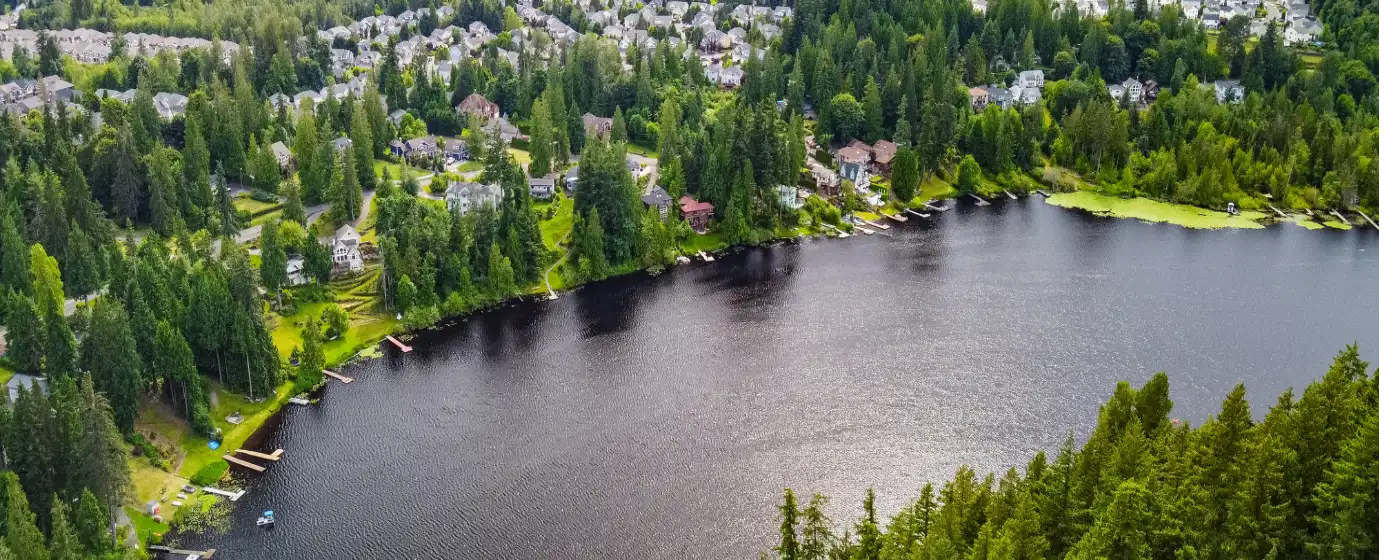
Puget Sound · Washington
Not everyone doing a 1031 exchange is a seasoned commercial investor managing a portfolio of apartment complexes. Many of the buyers circling Renton right now are California homeowners who finally sold — a Bay Area bungalow, a Southern California duplex, an Inland Empire rental that tripled in value — and they're sitting on a tax liability they'd rather defer. Renton keeps surfacing on their shortlists because the math is honest: a city of nearly 105,000 people anchored by Boeing, Valley Medical Center, and PACCAR, sitting 20 minutes from Seattle, with a median sold price still in the $640,000 range. That combination doesn't exist many places in the Pacific Northwest anymore.
The rental demand here is not speculative. Nearly half of Renton's households — roughly 46% — are renter-occupied, and vacancy has dropped below 4%, well beneath both the Puget Sound regional average and the national rate of around 7%. The workforce drawing those renters is stable and diverse: aerospace technicians, healthcare professionals, gaming industry employees at Wizards of the Coast, and a steady stream of professionals commuting north to Seattle or east to Bellevue. The investment property types that trade most frequently in Renton are single-family rentals, duplexes, and small multifamily buildings — the kind of assets that fit squarely within a 1031 replacement property strategy.
This guide walks through the mechanics of a 1031 exchange, what the Renton investment market actually looks like in 2026, the specific tax advantages Washington offers compared to California, and the due diligence steps that out-of-state buyers on a 45-day clock tend to skip. If you're deploying 1031 proceeds and Renton is on your list, read this before you call a broker.

A 1031 exchange lets you sell investment real estate and roll the proceeds into a new property — deferring federal capital gains tax entirely, as long as you follow three hard deadlines. The first is the 45-day identification window: from the day you close on your relinquished property, you have 45 calendar days to identify replacement properties in writing. Most investors identify up to three properties (the "three-property rule"), though you can identify more under specific value thresholds. Missing this window by even one day collapses the exchange.
The second deadline is the 180-day closing requirement. You must close on your replacement property within 180 days of selling the relinquished one — or by the tax filing deadline for that year, whichever comes first. In practice, this means buyers entering Renton's market on a 1031 clock need to move with more decisiveness than a typical purchaser. The third non-negotiable is the qualified intermediary: the sale proceeds from your relinquished property can never touch your hands. They must flow through a QI, who holds the funds and facilitates the purchase. If you receive the money — even briefly — the exchange is disqualified.
The "like-kind" rule is broader than most investors realize. All real property held for investment or business use qualifies — a California condo can exchange into a Renton duplex, a raw land parcel, or a commercial strip. What you cannot do is let any cash fall out of the exchange untouched. That leftover cash is called "boot," and it's taxable in the year of the exchange. To defer the full gain, your replacement property value must equal or exceed the relinquished property's net sale price, and all equity must be reinvested.
Renton's investment property market in 2026 is defined by a tension that benefits patient buyers and punishes impulsive ones: demand is real, inventory is tight, and the 45-day identification window is a genuine constraint. Single-family rentals trade most frequently, with median sold prices around $640,000 and typical rents for a single-family home running $2,800 to $3,200 per month. That pencils to cap rates in the 3.5% to 5.0% range depending on condition, location, and how aggressively the seller priced it.
Small multifamily — duplexes through fourplexes — offers more compelling returns. Downtown Renton has seen active listing activity for value-add duplexes and combo properties, with cap rates on well-located small multifamily typically falling between 4.5% and 6.5%. New construction in the downtown core has produced Class A six-unit developments trading at cap rates as high as 6.7%, though those assets come with premium price tags. The multifamily market has absorbed supply steadily, with properties averaging around 29 days before going under contract.
| Property Type | Typical Price Range | Est. Cap Rate | Avg Days to Close |
|---|---|---|---|
| Single-Family Rental (SFR) | $580,000–$800,000 | 3.5%–5.0% | 30–45 days |
| Duplex | $700,000–$950,000 | 4.5%–6.0% | 25–40 days |
| Small Multifamily (3–6 units) | $950,000–$2,000,000 | 5.0%–6.7% | 35–55 days |
| Commercial / Mixed-Use | $1,500,000–$4,500,000 | 5.5%–7.0% | 45–75 days |
The fastest-moving assets are entry-level duplexes and turnkey SFRs near The Landing and the Cedar River corridor — properties that don't need work and can be leased immediately. Value-add multifamily sits longer, which actually creates an opportunity for 1031 buyers who can use that extra time to complete inspections without a bidding war forcing their hand.

Looking to buy in Estimate your payment.
Enter your numbers to see an estimated monthly mortgage payment.
Estimate only. Excludes HOA fees and mortgage insurance.
California's capital gains rates — combined federal and state — can push a long-term investor's effective tax rate on a sale past 35%. That alone explains why so many 1031 buyers from the state are looking north. Renton specifically attracts California capital because of its price-to-rent dynamics, Boeing's stabilizing employment base, and the relative accessibility compared to Bellevue or Seattle proper.
A Bay Area homeowner selling a primary residence that has appreciated to $1.4 million — after the federal exclusion — still faces a meaningful taxable gain on any investment portion or amounts exceeding the exclusion threshold. Deploying those proceeds into Renton, that investor can acquire a duplex outright for under $900,000 and still have capital remaining for a single-family rental, potentially entering two income-producing assets debt-free. That kind of leverage reversal — from high-cost California to moderate-cost Renton — is the central draw.
Los Angeles and San Diego investors are accustomed to SFR cap rates below 3.5% and rent-controlled markets that limit upside. Renton's lack of local rent control and sub-4% vacancy offers a fundamentally different risk profile. A Southern California rental trading at $1.2 million with $3,400 in monthly rent can be exchanged into a Renton property at half the acquisition cost generating comparable or better gross income.
Sacramento and Riverside County investors often arrive with equity in the $400,000 to $700,000 range — enough to acquire a solid single-family rental in Renton with conservative leverage. The Inland Empire in particular has seen significant appreciation since 2020, creating a wave of investors whose basis is low but whose properties no longer match their long-term goals. Renton's combination of a stable employer base and durable rental demand makes it a logical landing spot for that capital.
Washington's most important advantage for rental property investors is one that rarely makes the brochure but matters every April: Washington has no state income tax. Every dollar of net rental income you collect in Renton stays in your pocket. In California, that same dollar faces a top marginal rate of 13.3% — meaning a California-based investor keeping a California property effectively hands the state more than a dime on every dollar of profit.
Washington does apply a 7% capital gains tax on long-term gains above $262,000 per year, as of 2026, but this threshold means most individual investors operating a single rental or small portfolio will not encounter it in a typical year. Routine rental income is not capital gains — this tax applies to sale proceeds, not annual cash flow. One caveat worth building into renovation budgets: Washington's combined sales tax in Renton runs approximately 9.43%, which applies to materials and furnishings for a rental rehab. That's a real cost California investors sometimes underestimate, since California's tax structure hits differently.
| Tax Item | California | Washington |
|---|---|---|
| State income tax on rental income | Up to 13.3% | None |
| Property tax rate on new purchase | Prop 13 reset to ~1.1%–1.2% | Approximately 0.97% |
| Sales tax | 7.25%–10.75% (varies) | 9.43% in Renton |
| Capital gains treatment | Up to 13.3% state | 7% on gains over $262K/yr |
| Estate / inheritance tax | None | Washington estate tax applies |
Two additional items worth knowing: depreciation basis carries over in a 1031 exchange — it does not reset to the new property's value — so if you've been depreciating a California property for 15 years, that reduced basis follows you into the Renton replacement property. And for investors who want income without management burden, a Delaware Statutory Trust (DST) qualifies as a 1031 replacement property — a useful option if you can't close on a direct acquisition within the 180-day window.
Washington's landlord-tenant code is detailed and has evolved meaningfully over the past several years. As of 2026, there is no statewide rent control, but landlords are required to provide advance written notice for rent increases — currently 180 days' notice for increases of 3% or more for month-to-month tenancies. Eviction rules require just cause in most circumstances, and the process, while legally clear, takes longer than California landlords accustomed to pre-2020 timelines might expect. Out-of-state owners who try to self-manage from California consistently underestimate how critical local representation is when a lease violation or turnover situation arises.
Professional property management in Renton typically runs 8% to 10% of gross monthly rent, with leasing fees often equivalent to one-half to one full month's rent. Local firms with Renton-area portfolios include Windermere Property Management and Umpqua Bank-affiliated regional managers — verify current availability and portfolio focus when interviewing. The vacancy reality is favorable: sub-4% vacancy means well-priced units lease quickly, but deferred maintenance or above-market rents can leave a unit sitting longer than an investor on a 1031 clock can afford.
What out-of-state owners most often underestimate is the speed at which a Renton tenant base turns over in response to rent increases. With average apartment rents around $2,127 per month and single-family rents in the $2,800-plus range, tenants are cost-sensitive. Pricing a unit $150 above market to optimize cash flow often produces a 60-day vacancy that wipes out months of the premium. Local management firms understand these micro-dynamics in ways a California-based owner simply cannot replicate from a distance.
| Item | What to Verify | Local Resource |
|---|---|---|
| Title Search | Clear title, no liens or encumbrances | King County Recorder or local title company |
| Sewer / Septic Status | Connected to city sewer vs. private septic | City of Renton Public Works |
| Flood Zone Status | FEMA Zone designation — Cedar River properties especially | FEMA Flood Map Service Center |
| Rental Permit / Business License | Renton requires a business license for rental properties | City of Renton Finance Department |
| HOA Restrictions | Rental caps, short-term rental bans, approval requirements | HOA governing documents |
| Zoning for ADU Potential | Washington state ADU laws are permissive — verify lot size | City of Renton Planning Division |
| School District Boundaries | Renton School District attendance zones affect tenant pool | Renton School District |
| Current Lease Status | Month-to-month vs. fixed term, rent amount, security deposit held | Review lease directly with seller |
| Deferred Maintenance Inspection | Roof, HVAC, plumbing, electrical — budget before closing | Licensed WA home inspector |
| Property Management Referral | Establish management before closing if out-of-state | Interview 2–3 local firms pre-close |
| Title Company Selection | Choose a company experienced in 1031 exchange coordination | Confirm QI relationship before opening escrow |
| Short-Term Rental Ordinance | Renton restricts STRs in certain zones — verify if Airbnb strategy planned | City of Renton Community Development |
| Current Rent vs. Market Rent | Identify gap between in-place rent and achievable rent | Local property manager rent analysis |
| Capital Gains Calculation | Confirm adjusted basis from relinquished property with CPA | CPA familiar with IRC Section 1031 |

Local Expert Takeaway: The most common mistake California 1031 buyers make in Renton is targeting Kennydale or the Lake Washington waterfront because the addresses feel premium — then discovering the cap rates are below 3.5% and the 45-day clock runs out before they can pivot. If you're coming from a California market with equity in the $700,000 to $1.2 million range, focus your identification on small multifamily in Downtown Renton or value-add duplexes in the Highlands, where the price-to-rent ratios actually support investment returns. Get your property management firm identified before Day 1 of the exchange — not after you're under contract.
Before your 45-day identification window opens, get pre-approved for investment financing — even if you plan to buy cash. DSCR loans let the property's rental income qualify the loan, keeping the transaction entirely off your personal debt-to-income ratio, which matters if you're still carrying a California mortgage. Todd can connect you with the right lender and walk you through which Renton neighborhoods are producing the strongest returns for out-of-state investors right now.
✅ Renton's sub-4% vacancy rate and 46% renter-occupied population make it one of the most durable rental markets in King County — demand is anchored by Boeing, Valley Medical Center, and proximity to Seattle's job core.
⚠️ The 45-day identification window is your biggest risk — Renton's competitive market means desirable multifamily properties move in under 30 days. Identify backup properties and have your QI and financing lined up before your relinquished property closes.
📍 Washington's zero state income tax on rental income is the single most underappreciated advantage for California investors relocating capital here — the effective difference on $50,000 of annual net rental income versus a California-held property can exceed $6,000 per year.
Does a 1031 exchange work for out-of-state property?
Yes — the like-kind rule applies nationally, not locally. You can sell investment real estate anywhere in the United States and use the proceeds to purchase replacement property in Renton, Washington, or any other state. The property types must both be held for investment or business use, but geography is irrelevant to the exchange's validity.
What is the cap rate on rental property in Renton?
Cap rates in Renton range from roughly 3.5% to 5.0% for single-family rentals, and 4.5% to 6.7% for small multifamily depending on condition and location. New construction Class A product in Downtown Renton has recently traded at the higher end of that range, while established SFRs near Lake Washington compress toward the lower end due to acquisition prices.
Do I need a local property manager for a 1031 investment in Washington?
Technically no — but practically, yes. Washington's landlord-tenant code has specific notice requirements, just-cause eviction standards, and procedural steps that vary from California's framework in ways that catch out-of-state owners off guard. A local property manager also provides the market intelligence to price units correctly, which directly impacts vacancy rates and your actual annual return.
Explore the full Renton series: The Ultimate Renton Relocation Guide · Is Renton Safe? · Cost of Living in Renton · Best Neighborhoods in Renton · Renton Schools & Family Life · Renton Youth Sports · Renton Parks & Recreation · Retiring in Renton · 1031 Tax-Deferred Exchange in Renton · Renton First-Time Homebuyers Guide · Moving to Renton from California
Tell us what you need help with and we'll connect you with local resources.

About the Author
Todd Davidson is the founder of Living in Oregon and Living in Washington, where he publishes in-depth city guides, neighborhood resources, and local market insights covering more than 180 communities across the Pacific Northwest. While his background is in home financing and real estate, he created these digital platforms to help families research and compare regions before making a move.