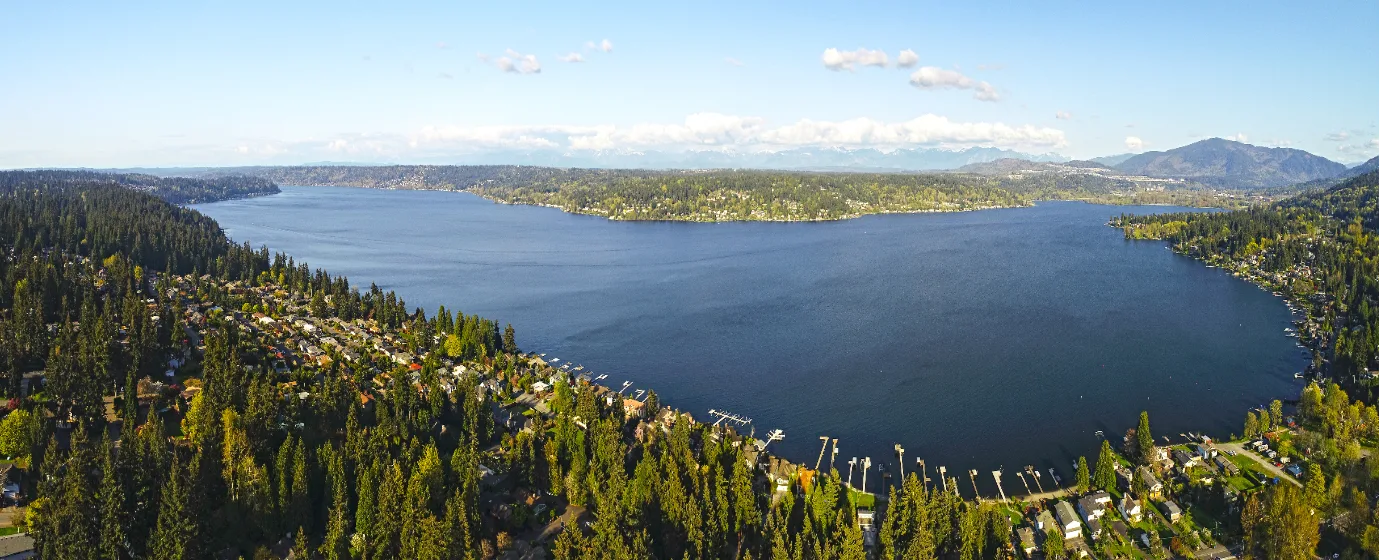
Puget Sound · Washington
The software engineer who spent three years in a 900-square-foot San Jose condo — paying $4,200/month in rent while their company's remote policy quietly became permanent — didn't move to Sammamish because of a spreadsheet. They moved because they finally did the math on what a California salary looked like without California taxes, and what that same dollar amount bought on the Eastside of Seattle. Sammamish kept coming up: A+ schools, a neighborhood feel that doesn't require a car for every errand, and home prices that look steep until you're comparing them to Palo Alto. The buyers coming from Walnut Creek, Irvine, Folsom, and Temecula are not moving to save money in the simple sense — they're moving to keep more of what they earn and buy more of what they want.
The hard part is what the listings don't show. Sammamish averages around 155 sunny days per year, compared to Los Angeles's 267 and San Diego's 251. December brings just 8.5 hours of daylight, with only 4 of those hours actually sunny. The social energy that comes with year-round outdoor weather in Southern California — the Saturday farmers markets in November, the beach days in January, the backyard dinners in February — doesn't exist here in the same form. The pace is quieter, the winters are genuinely gray, and some California transplants discover by February that they underestimated how much the sun shaped their daily life.
This guide breaks down the actual financial comparison by California region, what different equity levels buy in Sammamish today, the tax picture in plain numbers, the lifestyle trade-offs a good friend would actually tell you about, and an interactive tool to compare your specific California city directly to Sammamish.
| Sammamish, WA | Bay Area | Southern CA | Sacramento Metro | Central Valley | |
|---|---|---|---|---|---|
| Median Home Price (approx. 2026) | $1,600,000 | $1,350,000–$1,900,000 | $750,000–$1,200,000 | $480,000–$600,000 | $340,000–$460,000 |
| Property Tax Rate (effective) | ~0.81% | ~1.1%–1.25% | ~1.0%–1.2% | ~1.0%–1.15% | ~1.0%–1.1% |
| State Income Tax | None | Up to 13.3% | Up to 13.3% | Up to 13.3% | Up to 13.3% |
| State Sales Tax | ~10.2% (King Co.) | 8.625%–10.25% | 7.25%–10.25% | 7.25%–8.75% | 7.25%–8.75% |
| Avg Utilities (monthly est.) | $180–$220 | $200–$280 | $220–$320 | $190–$260 | $200–$270 |
| Avg 1BR Rent | $2,400–$2,800 | $2,800–$3,800 | $2,100–$2,900 | $1,500–$1,900 | $1,100–$1,500 |
A Bay Area buyer selling at $1.4 million and purchasing in Sammamish at the city's $1.6 million median isn't necessarily stretching — they're often restructuring. After transaction costs, a seller walking away from a paid-off Bay Area property frequently has enough equity to either purchase outright or carry a mortgage so small it functions more like a monthly savings transfer than a debt obligation. The housing price delta is narrower between Sammamish and San Francisco than most Californians expect — but the income tax elimination is where the real arithmetic shifts.
Washington's no-income-tax advantage is worth naming in real dollars. A California resident earning $150,000 annually pays roughly $11,000–$13,000 in state income tax depending on filing status and deductions. At $200,000, that figure climbs to approximately $17,000–$19,000. Moving to Washington doesn't raise your salary — it simply stops taking that slice. For remote workers keeping Bay Area or SoCal salaries while living in Sammamish, the combined effect of lower housing payments and no state income tax can shift monthly cash flow by $2,000–$3,000 without any lifestyle reduction.
Washington has no state income tax — one of only nine states in the country. For most California transplants, this single line item reshapes their entire financial picture faster than any other factor.
| Tax Item | California | Washington | Net Impact for Transplant |
|---|---|---|---|
| State Income Tax | Up to 13.3% | None | $11,000–$19,000/yr saved at $150K–$200K income |
| Capital Gains Tax (long-term) | Up to 13.3% | 7% over $262,000/yr threshold | Net win for most earners |
| Property Tax Rate | ~1.0%–1.25% (newly purchased) | ~0.81% (Sammamish) | Lower in WA |
| Sales Tax | 7.25%–10.25% | ~10.2% (King County) | Slight WA disadvantage |
| Estate/Inheritance Tax | None | WA has estate tax starting at $2.193M | Relevant for high-net-worth |
| Senior Property Tax Relief | Limited | Exemption available at 61+ (income-based) | WA advantage for retirees |
At $120,000 in annual income, a California filer typically owes around $8,500–$9,500 in state income tax. That same earner in Washington owes zero. At $150,000, the difference is roughly $11,000–$13,000 per year. At $200,000 — a salary that is not unusual for the tech workers landing in Sammamish — California captures approximately $18,000 annually in state income tax. Washington captures none of it.
Washington's capital gains tax, enacted in 2022 and upheld by the state Supreme Court, applies only to long-term capital gains exceeding $262,000 per year. A California transplant selling a primary residence does not trigger this — the federal primary residence exclusion ($250,000 single / $500,000 married) applies first, and most home sale proceeds don't generate $262,000 in taxable gains beyond that exclusion. The sales tax comparison is where Washington gives some of that advantage back: King County's rate runs approximately 10.2%, which is on the high end of what California buyers are used to. On most household budgets, though, the income tax savings dwarf the additional sales tax cost by a factor of three to five.
A buyer selling a paid-off home in Sunnyvale, Danville, or San Ramon with $1.4M–$1.8M in equity walks into Sammamish's market in a position most buyers here can't match. At $1.6 million — the city's median — they can purchase outright in cash and eliminate a mortgage entirely. That's not a hypothetical: a significant share of Sammamish transactions in 2025 were all-cash or near-cash purchases, and Eastside agents see this scenario regularly. Neighborhoods like Sahalee and Aldarra sit at the top of Sammamish's market, with homes frequently listing at $2.5M–$4M+. Bay Area buyers with this equity level can purchase luxury properties in those corridors while retaining meaningful reserves.
For buyers whose equity lands in the $1.2M–$1.5M range, the Sammamish median price means a moderate mortgage — often in the $200K–$400K range — which, combined with the no-income-tax shift, may result in a lower total monthly outlay than their California PITI. Klahanie and East Lake Sammamish offer well-built homes in the $1.4M–$1.8M range with excellent access to the I-90 corridor — a natural landing spot for buyers who want market value without paying the Sahalee premium.
A buyer selling a Pasadena bungalow, a Carlsbad single-family home, or a Temecula tract house with $800K–$1M in net equity can put 50–65% down on a Sammamish median-priced home. That means a mortgage of roughly $600K–$800K — manageable on dual tech incomes or a single senior engineering salary. The income tax shift recaptures $10,000–$15,000 annually, which reduces the effective cost of that mortgage further. Buyers at this equity level typically land in Trossachs, Pine Lake, or Beaver Lake — established neighborhoods with strong schools and home prices generally between $1.3M and $1.9M depending on size and finish.
SoCal buyers in this range often discover that the relative purchasing power shift is more dramatic than the raw price comparison suggests. A $1.6M Sammamish home averages 3,200–4,000 square feet with a yard, a three-car garage, and access to top-rated Issaquah or Lake Washington district schools. The equivalent square footage in Irvine, Redondo Beach, or Encinitas costs more and comes with a state income tax bill.
This buyer group carries the tightest relative gap, but the financial case still holds. A buyer selling a Folsom or Elk Grove home with $500K in equity puts 30–35% down on Sammamish's median — a healthy down payment that avoids PMI and secures a conventional or jumbo loan. The bigger shift is the ongoing no-income-tax benefit: a Sacramento household earning $160,000 pays roughly $12,000–$14,000 annually in California state income tax. In Washington, that's $12,000–$14,000 that stays in their account. Over five years, that's the equivalent of a $60,000–$70,000 down payment supplement.
Buyers from this equity range often look at Timberline, Inglewood, or Plateau — neighborhoods where Sammamish's price range includes newer construction with full school access and reasonable commute positioning. Entry-level single-family homes in Sammamish start around $700,000 for older or smaller inventory, though most buyers in this equity tier are targeting the $1M–$1.4M range.
The Central Valley buyer — Fresno, Visalia, Bakersfield, Stockton — faces the steepest relative jump. Their equity covers 20–28% of Sammamish's median, which is still a workable down payment on a conforming jumbo loan but leaves them with a substantial monthly payment. The financial case rests primarily on income and tax math: if they're relocating for a tech role or remote position that pays $130K+, the no-income-tax benefit begins compounding from day one. The Sunny Hills and Thompson Hill areas of Sammamish, or the broader Plateau zone, offer relatively more accessible price points for buyers whose budget tops out around $1M–$1.2M. Condos in the Klahanie area can be found from approximately $400K, offering a foothold that allows buyers to build equity before moving up.
Looking to buy in Estimate your payment.
Enter your numbers to see an estimated monthly mortgage payment.
Estimate only. Excludes HOA fees and mortgage insurance.
If someone who moved from San Diego three years ago gave you an unfiltered call about Sammamish winters, it would sound something like this: the first October is fine, November starts to feel different, and by December you genuinely miss the sun in a way that's physiological, not just nostalgic. Sammamish averages around 151 rainy days per year and receives 53 inches of annual rainfall — more than Portland, significantly more than any California city. Sunshine hours in the Seattle metro run approximately 2,170 per year; in Los Angeles, that figure is over 3,250. That gap doesn't close — it just becomes something you build around.
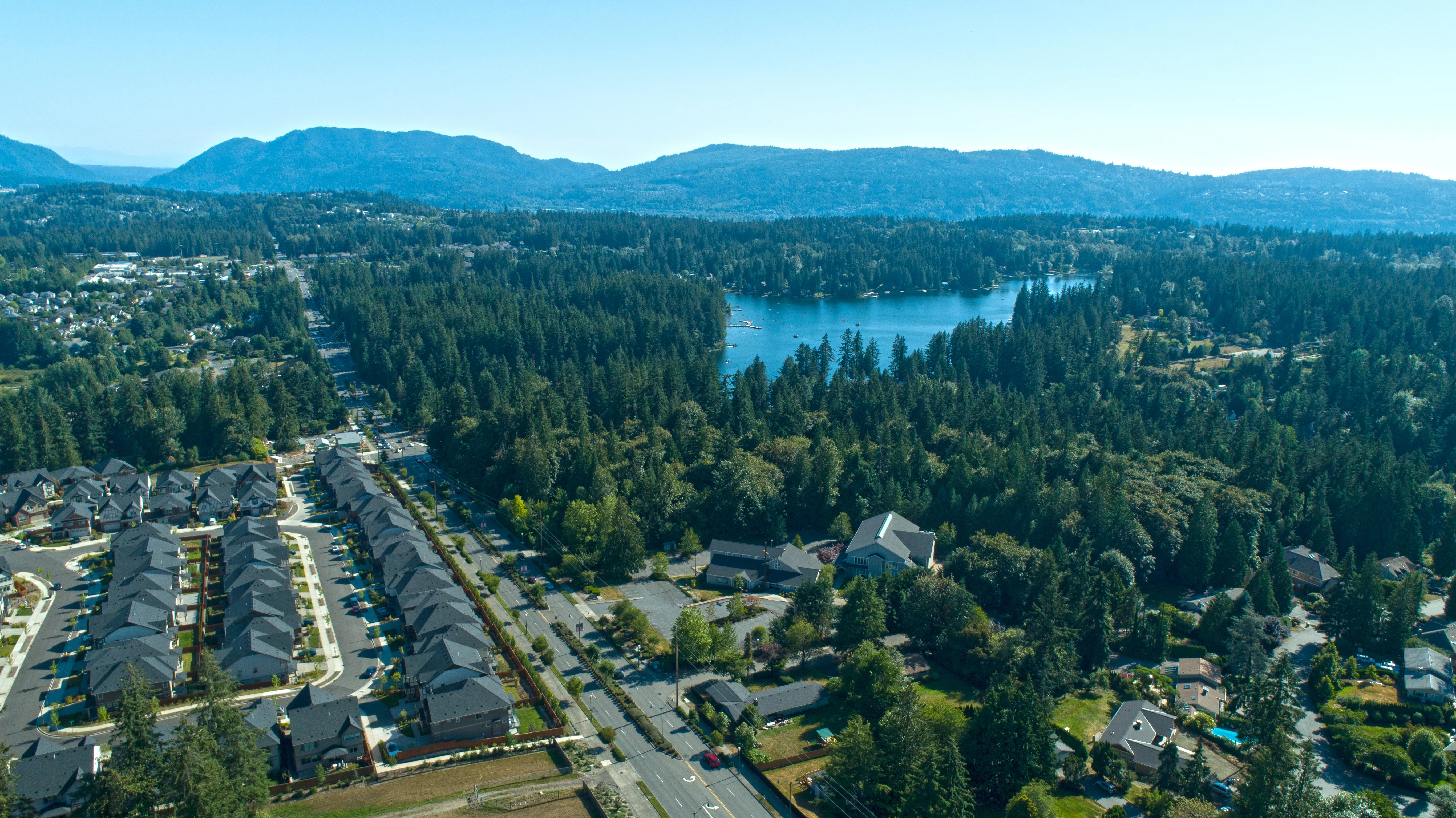
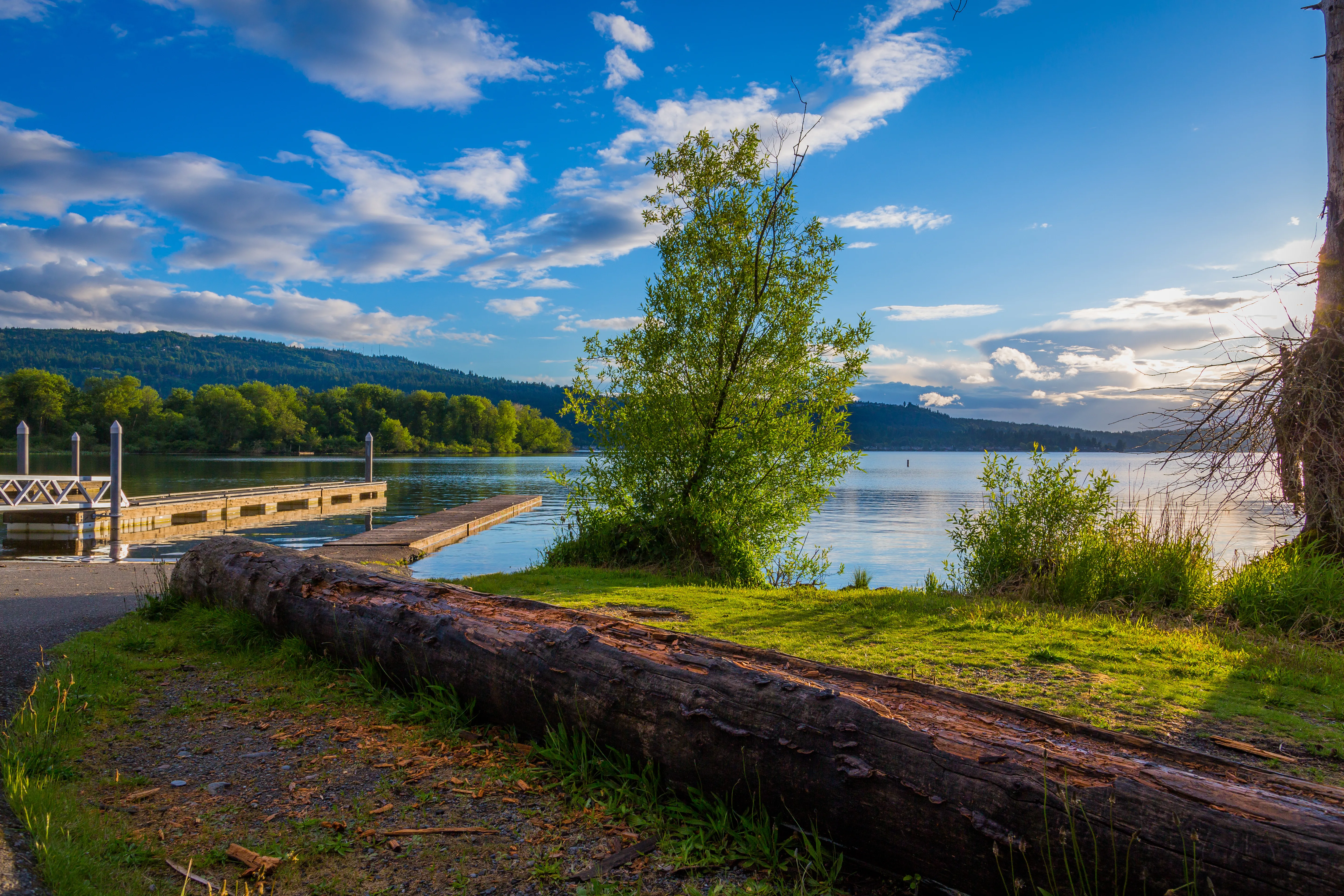
What surprises most California transplants after six months of living in Sammamish is the summer. June through August is genuinely spectacular in a way that's difficult to overstate if you've only known California summers of heat and smoke. Sammamish averages 64–76°F in summer with extended daylight past 9 PM, no wildfire smoke most years, and a community that goes fully outdoors from Memorial Day through Labor Day — hiking Soaring Eagle Regional Park, paddleboarding on Lake Sammamish, cycling the East Lake Sammamish Trail. The outdoor lifestyle is real; it's just compressed into a more defined season than California allows.
What California transplants genuinely miss — beyond sunshine volume — tends to be specific and cultural: the year-round farmers market circuit, Mexican food that isn't a 30-minute drive, the Saturday energy of a Southern California beach city, and for Bay Area transplants, the walkable restaurant density of neighborhoods like Rockridge or Los Gatos. Sammamish is primarily residential and intentionally quiet. It doesn't have a downtown dining scene. The trade-off most transplants describe after three years isn't "I wish I had sun" — it's "I wish I had more good Thai food walking distance from my house." The square footage and the silence are almost universally loved. The food infrastructure takes some adjustment.
If you want to see how Sammamish compares directly to the city you're leaving, use the tool below — it covers the 120 largest California cities with current housing and tax data.
Home prices: Redfin median sale data, Q1–Q2 2026. Select your city to compare.
Ready to talk through what your specific California equity could do in Sammamish? Todd can model your exact scenario in a single call.
Mistake 1: Treating Sammamish as uniformly priced. The spread between entry-level and top-end in this city is dramatic. Condos in Klahanie start around $400K; estates in Sahalee and Aldarra exceed $4M. A buyer who researches "Sammamish median home price" and assumes that reflects what's available in the neighborhoods nearest to their target school — say, Skyline High School's feeder area versus Eastlake High's — will be surprised by a $400,000–$600,000 gap between comparable home sizes in different zones. Know the neighborhood, not just the city-wide figure.
Mistake 2: Underestimating how different winter commuting is. The 228th Ave SE and SE 8th Street corridors into Issaquah can back up significantly in wet weather — and winter in Sammamish means low visibility, occasional ice on the Plateau roads, and morning fog that doesn't lift until 10 AM. California buyers used to year-round clear-weather driving often don't factor this into their neighborhood selection. If you're working hybrid and commuting to Bellevue or Redmond three days per week, the difference between a neighborhood with easy I-90 access versus one requiring a Plateau surface road loop matters on a January morning.
Mistake 3: Calculating savings on gross income, not net. The no-income-tax benefit is real and substantial — but buyers who have been earning California salaries with California tax expectations sometimes miscalculate their actual monthly cash flow improvement. The full benefit appears only after accounting for Washington's higher sales tax (King County's rate is approximately 10.2%), the cost of goods in a higher-cost-of-living metro, and the reality that Sammamish property taxes on a $1.6M home run approximately $12,960 annually. That's lower than a comparable California purchase would generate, but it's not nothing — and first-year buyers who didn't budget for it feel it.
Mistake 4: Assuming California networking and career infrastructure will transfer immediately. Sammamish is not a company town, but the Eastside tech economy is tightly clustered around Microsoft's Redmond campus, Amazon's Bellevue presence, and a dense ring of software and biotech companies. California transplants who arrive with strong Bay Area professional networks and assume Seattle operates the same way sometimes find the social and professional culture more insular and slower to open than they expected. The local tech community is collegial but not the same density as SoMa or Mountain View on a Tuesday afternoon. Give it a year.
Bay Area sellers with large equity often arrive at Sammamish's market with options that most local buyers don't have: the possibility of an all-cash offer, the ability to close in under two weeks, and a leverage position in competitive multiple-offer situations. In Sammamish's market — where homes in desirable neighborhoods can still see two or three competing offers — cash buyers or near-cash buyers with 60%+ down carry meaningful advantages. If the California property being sold was an investment or rental, a 1031 exchange deserves serious consideration before closing; the Sammamish 1031 Exchange guide covers the mechanics and timelines specific to this market.
Southern California sellers with $700K–$1.2M in equity are positioned for a strong conventional or jumbo down payment in Sammamish. Most transactions at Sammamish's price points are jumbo loans, and buyers coming from active California markets typically arrive with strong credit profiles and documented income — exactly what jumbo lenders want to see. A 40–50% down payment on a $1.6M purchase lands the financed amount in the $800K–$960K range, which competitive jumbo lenders can move on quickly once pre-approval is in place.
Sacramento and Inland Empire buyers with $400K–$650K in equity are typically financing the majority of a Sammamish purchase with a conventional or jumbo loan, putting 30–35% down as described above. Buyers targeting the lower end of Sammamish's market — older inventory or townhomes in the $900K–$1.1M range — will find the smallest loan amounts and the most straightforward underwriting. A conversation with a lender about the full range of conventional structures is worth having before assuming a larger down payment is required.
Local Expert Takeaway: The single thing California buyers most consistently underestimate about Sammamish is how dramatically the no-income-tax benefit reshapes their monthly budget rather than just their annual tax return. A dual-income household moving from the Bay Area and earning a combined $300,000 walks away from roughly $30,000 in annual California state tax — that's $2,500 per month that effectively doesn't exist in Washington. Combined with Sammamish's 0.81% property tax rate on a $1.6M purchase ($12,960/year vs. what a $1.4M California purchase generates at 1.2%), most buyers find their monthly housing cost is lower in Sammamish than the sticker price suggests. Run the after-tax comparison before you decide the price tag is out of reach.
✅ Washington's no-income-tax advantage is worth $11,000–$19,000 annually for most California households earning $150K–$200K — this is the single most impactful financial shift of the move.
⚠️ Sammamish's weather is a genuine trade-off. With ~155 sunny days per year versus San Diego's 251 or Los Angeles's 267, and approximately 151 rainy days annually, the gray winters are real and affect daily life in ways California buyers often don't anticipate until their first December.
📍 California equity levels vary dramatically in what they unlock here. Bay Area sellers can eliminate their mortgage entirely; Sacramento or Inland Empire buyers are looking at strong down payments on a jumbo loan. Know your equity tier before you price the neighborhoods.
Is moving from California to Sammamish worth it?
For most tech workers, remote professionals, and families with school-age children, the financial and lifestyle case is compelling. The no-income-tax benefit alone recaptures thousands annually, the schools rank among the state's best, and the summer quality of life in Sammamish is genuinely exceptional. The honest caveat is the winter: buyers who need year-round sunshine for their mental health or outdoor routine should weigh that seriously before committing.
How much cheaper is housing in Sammamish vs. California?
Sammamish is not uniformly cheaper than California — the median sits at $1.6 million, which exceeds most Sacramento, Inland Empire, and Central Valley markets significantly. The comparison that favors Sammamish is against Bay Area markets like San Jose, Palo Alto, or Marin, where comparable square footage frequently exceeds Sammamish prices, and against the broader cost picture when income tax savings are factored in. Buyers leaving sub-$600K California markets are making a price-for-price step up, not a savings play.
What do I need to know about moving from California to Washington?
Establish Washington residency formally and promptly — update your driver's license within 30 days, register your vehicle in Washington, and update your voter registration. Washington has no state income tax, but you'll need to file your final California return for the portion of the year you lived there. Washington does have an estate tax starting at approximately $2.193 million in taxable estate value, which is relevant for buyers in higher net-worth situations. And budget for the cultural adjustment: Washington's outdoor and social culture is genuine, but it operates on a different rhythm than California — quieter, more reserved, and heavily weather-influenced.
Explore the full Sammamish series: The Ultimate Sammamish Relocation Guide · Is Sammamish Safe? · Cost of Living in Sammamish · Best Neighborhoods in Sammamish · Sammamish Schools & Family Life · Sammamish Youth Sports · Sammamish Parks & Recreation · Retiring in Sammamish · 1031 Tax-Deferred Exchange in Sammamish · Sammamish First-Time Homebuyers Guide · Moving to Sammamish from California
Tell us what you need help with and we'll connect you with local resources.

About the Author
Todd Davidson is the founder of Living in Oregon and Living in Washington, where he publishes in-depth city guides, neighborhood resources, and local market insights covering more than 180 communities across the Pacific Northwest. While his background is in home financing and real estate, he created these digital platforms to help families research and compare regions before making a move.