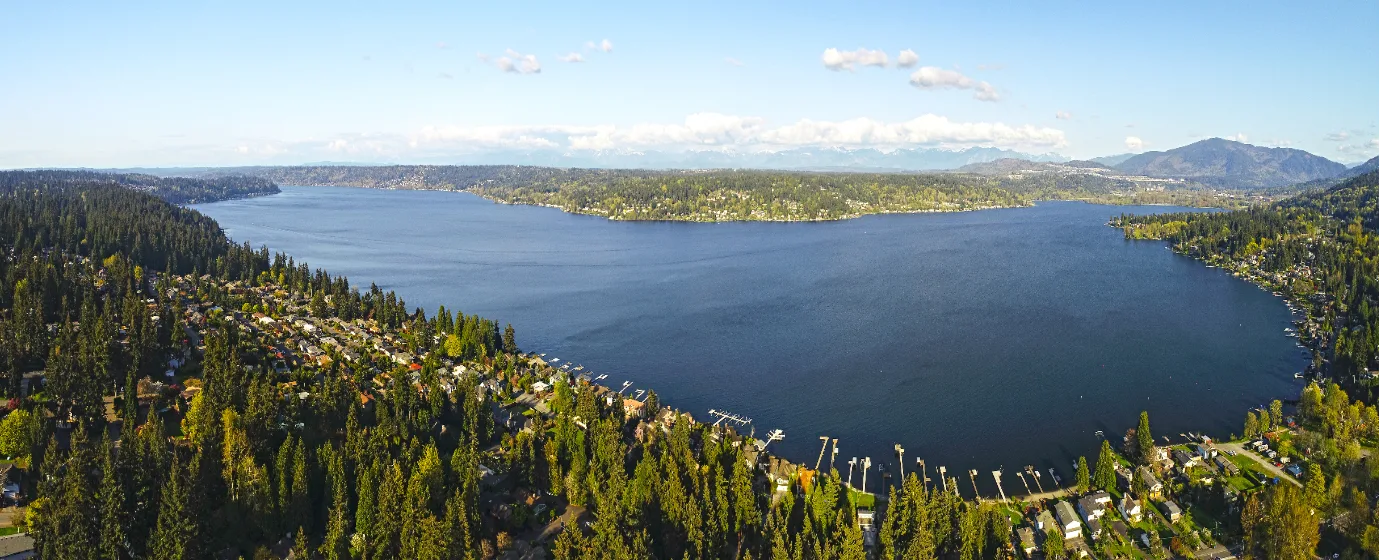
Puget Sound · Washington
Not every investor doing a 1031 exchange is a professional with a portfolio of apartment buildings. A significant share of the capital flowing into Sammamish right now comes from California homeowners who finally sold — a Bay Area craftsman, a San Jose tech-era townhome — and are sitting on $800,000 to $1.4 million in equity that will evaporate in taxes if they don't act. Sammamish earns a serious look as a replacement property destination because of what surrounds it: Microsoft's Redmond campus, Amazon's Bellevue presence, and a tenant pool of dual-income tech households who rent by necessity, not by choice, because buying in this market requires $400,000 down.
The Sammamish rental market is smaller than most investors expect — only about 17% of households here rent, which means vacancy is low and competition for quality rentals is real. The typical Sammamish renter holds a bachelor's degree or higher, earns above the national median, and is renting a three-bedroom single-family home while waiting to buy. That profile creates durable demand but also demands landlord professionalism: these tenants have options and they know it. The properties that trade most often as investment vehicles are single-family rentals, with a small number of townhomes; true duplexes and small multifamily are genuinely scarce on the Sammamish plateau.
This guide covers the mechanics of a 1031 exchange, what the Sammamish investment market actually looks like in 2026, Washington's tax advantages compared to California, the new statewide rent stabilization law every landlord needs to understand, and a due diligence checklist built for out-of-state investors working against a 45-day clock.
The core mechanic is straightforward: sell a qualifying investment property, route the proceeds through a qualified intermediary — never touch the money yourself — and use those proceeds to purchase a like-kind replacement property. "Like-kind" in real estate is broad: a single-family rental in California exchanges into a commercial building in Washington, a duplex into a vacant lot held for investment. The asset class flexibility is wide; the timeline is not. From the closing date of your relinquished property, you have 45 calendar days to formally identify your replacement property in writing, and 180 calendar days to close on it. These are hard deadlines with almost no exceptions.
The identification rules allow you to name up to three properties without restriction, or more than three if their combined value doesn't exceed 200% of the relinquished property's sale price. Most investors use the three-property rule and identify aggressively — you want backup options in a market as competitive as Sammamish, where quality rentals can go under contract in two weeks. The boot trap catches investors who don't reinvest the full amount: if your relinquished property sold for $1.2 million and you only deploy $950,000 into the replacement, the $250,000 difference is taxable in the year of the exchange, eliminating a significant portion of the tax deferral benefit.
The qualified intermediary is non-negotiable. You cannot receive, control, or constructively access the sale proceeds at any point between transactions. Choosing a QI with Pacific Northwest real estate experience matters — they'll understand Washington closing timelines, escrow norms, and title company relationships that can prevent a deadline miss.
Sammamish is, without ambiguity, an appreciation-play market. The median sold price for single-family homes came in at approximately $1,694,000 in early 2026 based on Northwest MLS data — and at that price point, the math on cash flow is honest but not exciting. A typical three-bedroom SFR rents in the $3,500–$4,500 per month range, which produces a gross yield around 2.5% to 3.2% and a net cap rate after taxes, insurance, maintenance, and vacancy of roughly 2.0% to 3.0%. Investors who buy here aren't buying for yield; they're buying for the long-term appreciation trajectory of one of the wealthiest cities in the United States.
The inventory picture in early 2026 shifted meaningfully. For-sale listings rose over 77% year over year, giving 1031 buyers more options than they had in 2024 or 2025 — but with homes still selling in around 15 days on average, the window to identify, inspect, and execute is tight. The market sits at roughly 2.6 months of inventory, which is still technically a seller's market. Out-of-state investors on a 45-day identification clock need an agent on the ground with pre-screened properties, not a Zillow search.
| Property Type | Typical Price Range | Est. Cap Rate | Avg Days to Close |
|---|---|---|---|
| Single-Family Rental (3–4 BR) | $1,200,000–$1,800,000 | 2.0%–3.0% | 30–45 days |
| Townhome / Attached | $700,000–$950,000 | 2.5%–3.5% | 30–40 days |
| ADU-Enabled SFR | $1,400,000–$2,000,000 | 3.0%–4.0% | 35–50 days |
| Commercial / Mixed-Use | $2,000,000+ | 4.5%–6.0% | 45–60 days |
ADU-enabled single-family homes represent the most interesting near-term play in Sammamish. Washington's strong state-level ADU laws have opened the door to accessory dwelling units on many single-family lots, effectively creating a two-income property within a single-family zoning footprint. These properties move quickly; straight SFRs without ADU potential tend to sit marginally longer.
Looking to buy in Estimate your payment.
Enter your numbers to see an estimated monthly mortgage payment.
Estimate only. Excludes HOA fees and mortgage insurance.
The capital thesis starts simply: California investors are sitting on decades of appreciation in markets that have become difficult to operate in — high taxes, rent control exposure, regulatory complexity. Washington offers a cleaner operating environment, and the Eastside's employment base makes tenant demand genuinely durable.
A Bay Area investor selling a $1.4 million property can realistically deploy those proceeds into one Sammamish single-family rental debt-free, or split the capital between a Sammamish SFR and a higher-yielding multifamily asset in Renton or Federal Way. The tenant pool comparison is stark: San Jose renter profiles and Sammamish renter profiles are nearly identical — dual-income tech households, high education, stable employment. The difference is that Washington has no state income tax.
Los Angeles and Orange County investors often arrive with $900,000 to $1.3 million in exchange proceeds and face the same price points they just left. Sammamish's entry-level SFRs start in the high $900,000s, which means a leveraged replacement property is accessible, and the rental demand from tech-sector employees relocating to the Eastside absorbs supply consistently. Southern California investors experienced in navigating AB 1482's rent caps will find Washington's new HB 1217 framework familiar — different ceiling, same general structure.
Sacramento and Inland Empire sellers typically come with smaller exchange amounts — $600,000 to $900,000 — which makes straight Sammamish SFRs challenging but townhomes and ADU-equipped properties achievable with modest leverage. More commonly, this investor profile targets Renton or Burien for replacement property, using the Sammamish data as a comp anchor for what quality Eastside tenants will pay.
The single most important number in the California-to-Washington tax comparison is 13.3% — California's top marginal income tax rate, which applies to net rental income. Washington has no state income tax, meaning every dollar of net rental income stays with the investor rather than being split with Sacramento. For a landlord netting $36,000 per year in rental income, that difference alone represents over $4,700 annually at California's top rate.
| Tax Item | California | Washington |
|---|---|---|
| State income tax on rental income | Up to 13.3% | None |
| Property tax rate (new purchase) | ~1.1%–1.2% effective (Prop 13 resets on sale) | Approximately 0.81% in King County |
| Sales tax on rehab materials | 7.25%–10.75% | 6.5% + local (varies; plan for ~9%–10%) |
| Long-term capital gains (state) | Taxed as ordinary income (up to 13.3%) | 7% on gains over $262,000/year |
| Depreciation basis (1031) | Carries over, not stepped up | Same — federal rule, applies equally |
Washington's 7% capital gains tax, enacted in 2021 and upheld by the state Supreme Court in 2023, applies only to long-term capital gains exceeding $262,000 in a given year — and it exempts real estate sales entirely. Rental income is ordinary income for federal purposes, not a capital gain, so Washington's capital gains tax is largely irrelevant to the day-to-day economics of owning a rental here. The practical advantage remains the zero state income tax on rental earnings.
One item California investors consistently overlook is Washington's sales tax on construction materials. Unlike Oregon — which has no sales tax — Washington applies its combined rate to lumber, fixtures, and furnishings purchased for a rental rehab. On a $60,000 renovation budget, that's approximately $5,400 to $6,000 in additional cost that doesn't appear in California-based renovation estimates.
For investors who want the tax deferral of a 1031 without the operational burden of owning real property, a Delaware Statutory Trust (DST) qualifies as like-kind replacement property under IRS rules. DSTs are passive fractional ownership vehicles — an investor exchanges into a professionally managed portfolio without becoming a landlord. They're worth exploring for sellers who are older or simply done with property management.
Washington's landlord-tenant law changed materially in 2025. Governor Ferguson signed HB 1217 in May 2025, establishing the state's first statewide rent stabilization framework. Annual rent increases are now capped at 7% plus inflation or 10%, whichever is lower; for 2026, the Department of Commerce set the maximum at 9.683%. Landlords cannot raise rent at all during the first 12 months of a new tenancy, and the required notice for rent increases extended from 60 to 90 days. This is not rent control in the Los Angeles sense — there are no vacancy control provisions and landlords retain substantial flexibility — but out-of-state investors accustomed to Washington's previously uncapped rental market need to update their underwriting assumptions.
Vacancy in Sammamish runs below regional averages because the owner-to-renter ratio is so skewed. When a quality three-bedroom SFR comes available, it typically leases within two to three weeks. Out-of-state owners consistently underestimate the importance of move-in condition: Sammamish renters paying $3,500 to $4,000 per month expect appliances, landscaping, and mechanical systems to be fully functional. Deferred maintenance that would be acceptable in lower-rent markets will generate immediate friction with this tenant profile.
Professional property management is strongly recommended for absentee owners. Management fees in the Sammamish and broader Eastside market typically run 8% to 10% of gross monthly rent, plus a leasing fee of roughly one half to one full month's rent for tenant placement. Several Eastside-focused property management firms serve the Sammamish plateau, including Renters Warehouse Seattle and local boutique operators — interview two or three and verify they have active experience specifically with plateau-area single-family rentals.
| Item | What to Verify | Local Resource |
|---|---|---|
| Title search | Clear title, no undisclosed liens or easements | Stewart Title or Chicago Title (Eastside offices) |
| Sewer vs. septic | Many Sammamish homes on older lots use septic — confirm hookup status | King County Permit Portal |
| Flood zone status | Check FEMA maps; East Lake Sammamish Trail corridor has flood considerations | FEMA Flood Map Service Center |
| Rental permit requirement | City of Sammamish does not currently require a rental registration permit — verify current ordinance | City of Sammamish Planning Dept. |
| HOA rental restrictions | Many Sammamish neighborhoods (Klahanie, Trossachs, etc.) have HOA CC&Rs — some cap the % of rental units | Request HOA resale certificate from seller |
| ADU potential | Lot size, setbacks, and existing structures determine ADU feasibility | City of Sammamish ADU regulations |
| Zoning classification | Confirm R-4 or R-6 zoning; affects future development options | King County GIS / City of Sammamish |
| Current lease status | Month-to-month vs. fixed term; HB 1217 12-month no-increase rule starts on tenant move-in | Request lease documents from seller |
| School district assignment | Issaquah SD or Lake Washington SD; both are A+ rated and affect tenant demand | District boundary maps (online) |
| Deferred maintenance inspection | Full inspection by licensed WA inspector; septic pump-out if applicable | WA State Dept. of Licensing inspector lookup |
| Short-term rental ordinance | Sammamish does not have a permissive STR framework — verify if Airbnb strategy is viable | City of Sammamish Municipal Code |
| Property tax assessment | Confirm current assessed value and any senior/veteran exemptions that terminate on sale | King County Assessor's Office |
| Property management referral | Line up management before closing — don't scramble post-exchange | Ask your agent; interview 2–3 firms pre-close |
| Title company selection | Use a 1031-experienced escrow team familiar with QI coordination requirements | Eastside office of a national title company |
Local Expert Takeaway: The single most common mistake California 1031 investors make in Sammamish is treating it like a multifamily market — arriving with $1.6 million in exchange proceeds expecting to buy a duplex or small apartment building, only to discover that true multifamily inventory here is nearly nonexistent. The plateau is overwhelmingly single-family, and at a 2%–3% cap rate, straight SFRs are appreciation plays, not income plays. If your exchange requires cash flow to service debt, be honest about that before you start the 45-day clock — and consider whether a Sammamish SFR paired with a higher-yield property in Renton or Burien better serves your investment thesis than forcing the exchange into the wrong market.
Todd specializes in helping investors navigate 1031 exchanges on the Eastside — including getting pre-approved for investment financing before the 45-day identification window opens, so you're not scrambling for a lender while the clock runs. If you want to keep the transaction off your personal DTI, DSCR loans are worth a conversation — they underwrite based on the property's rental income, not your W-2. Reach out before your relinquished property closes, not after.
✅ Sammamish is an appreciation-driven market — net SFR cap rates of 2%–3% mean the wealth-building case is long-term equity, not monthly cash flow. Investors with yield requirements should underwrite carefully or consider pairing a Sammamish SFR with a higher-cap asset elsewhere in the region.
⚠️ HB 1217 changed the operating rules — Washington's new statewide rent stabilization law caps annual increases at roughly 9.683% for 2026, requires 90 days notice for rent changes, and prohibits any increase in the first 12 months of a new tenancy. Update your proforma accordingly.
📍 ADU-enabled SFRs are the sharpest 1031 play in Sammamish right now — Washington's strong ADU law lets investors add a legal accessory dwelling unit to a single-family lot, effectively creating two-income properties within a single purchase. These properties trade at a premium but produce meaningfully better yields than standard SFRs at the same price point.
Does a 1031 exchange work for out-of-state property?
Yes — a 1031 exchange has no geographic restriction within the United States. You can sell a relinquished property in California and acquire a replacement property in Washington, or vice versa. The like-kind requirement simply means both properties must be real estate held for investment or business use; where they're located doesn't affect qualification.
What is the cap rate on rental property in Sammamish?
Single-family rentals in Sammamish typically produce net cap rates in the 2.0%–3.0% range, derived from median sold prices near $1,694,000 and typical monthly rents of $3,500–$4,500 for a three-bedroom home. ADU-enabled properties can approach 3.0%–4.0% with both units occupied. Sammamish is firmly an appreciation market — investors prioritizing cash flow typically look toward Renton, Burien, or Federal Way for higher-yield replacement properties.
Do I need a local property manager for a 1031 investment in Washington?
You're not legally required to use one, but out-of-state ownership of a Sammamish rental without professional management is a high-friction strategy. Sammamish tenants paying $3,500 to $4,000 per month have high expectations for responsiveness and property condition. Washington landlord-tenant law — including the new HB 1217 notice requirements — has enough procedural specificity that a local property manager who knows current compliance standards typically pays for their 8%–10% fee in avoided legal exposure and reduced vacancy.
Explore the full Sammamish series: The Ultimate Sammamish Relocation Guide · Is Sammamish Safe? · Cost of Living in Sammamish · Best Neighborhoods in Sammamish · Sammamish Schools & Family Life · Sammamish Youth Sports · Sammamish Parks & Recreation · Retiring in Sammamish · 1031 Tax-Deferred Exchange in Sammamish · Sammamish First-Time Homebuyers Guide · Moving to Sammamish from California
Tell us what you need help with and we'll connect you with local resources.

About the Author
Todd Davidson is the founder of Living in Oregon and Living in Washington, where he publishes in-depth city guides, neighborhood resources, and local market insights covering more than 180 communities across the Pacific Northwest. While his background is in home financing and real estate, he created these digital platforms to help families research and compare regions before making a move.