
Puget Sound · Washington
Shoreline sits in that complicated middle ground that frustrates buyers who want a simple answer. It's not a city where you'd hesitate to walk your dog after dark in most neighborhoods, but it's also not a city where you can ignore where you park your car overnight. The safety story here is genuinely neighborhood-specific — the northwest corner of the city reads like a different place than the Aurora Avenue corridor three miles southeast, and understanding that divide is more useful than any single citywide crime rate.
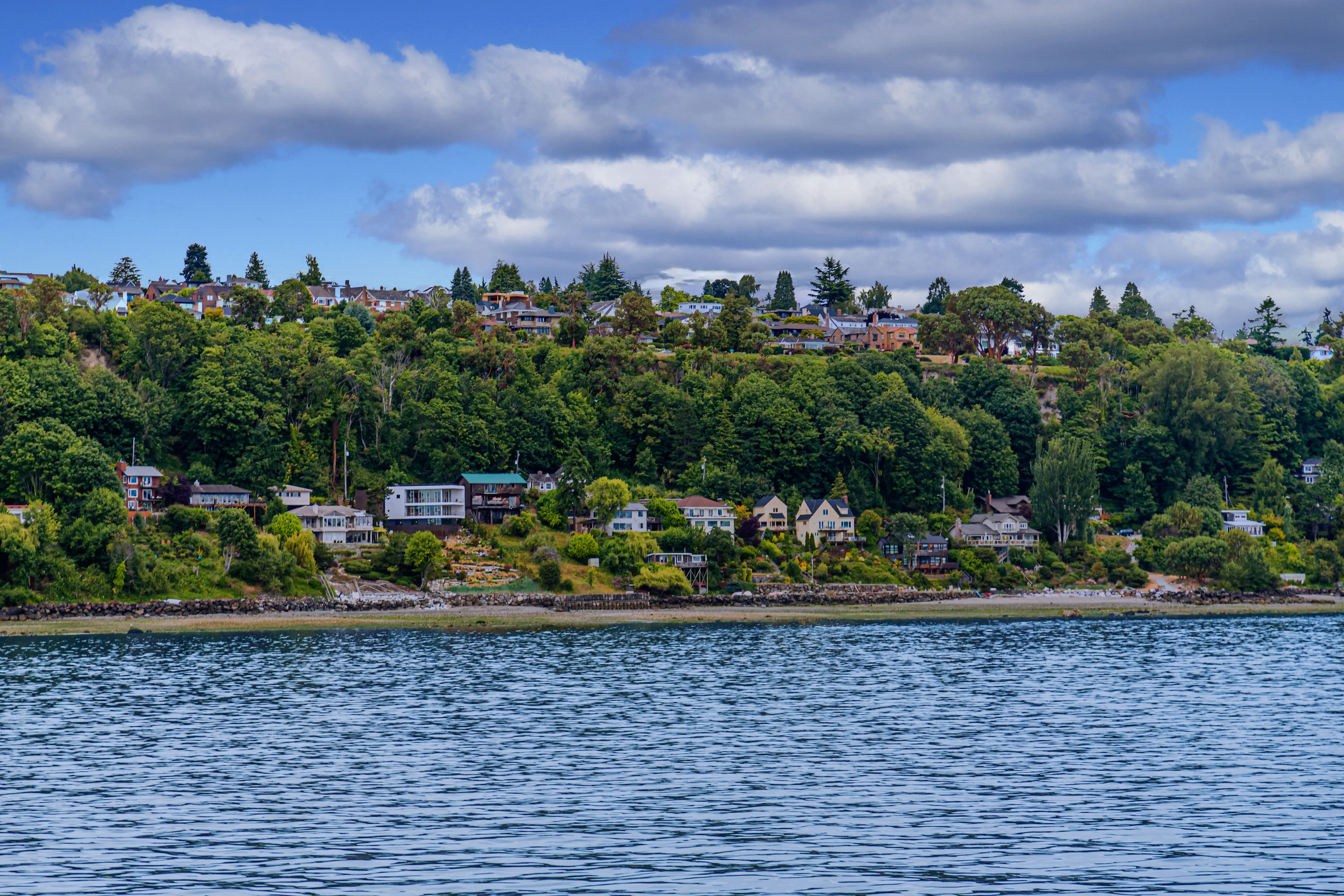
What the numbers actually reflect is a city shaped by its geography and commercial footprint. Shoreline's southern edge runs along Aurora Avenue N, one of the busiest commercial corridors in the north Seattle metro, and retail density reliably inflates reported crime statistics everywhere it exists. The residential neighborhoods west of I-5 and along the Puget Sound bluffs tell a quieter story entirely.
This guide breaks down what the crime data means in practice, which neighborhoods consistently earn high safety marks from residents and data alike, and what locals have learned to pay attention to — so you can make a genuinely informed decision about where to buy or rent in Shoreline.
FBI estimates for the most recent reporting year put Shoreline's total crime rate at approximately 2,744 per 100,000 residents — a figure that lands about 30% above the national average but sits just below the Washington State average of roughly 2,793 per 100,000. In plain terms, Shoreline is safer than most Washington cities but sees more crime than the national baseline. That positioning is worth holding onto, because it means the city isn't an outlier in either direction — it's a mid-range urban suburb dealing with the same pressures as comparable cities of its size and density.
What structurally drives the numbers is worth understanding before drawing conclusions. Shoreline incorporated in 1995 and inherited Aurora Avenue N — a four-lane commercial arterial that runs along the city's southern boundary and has historically concentrated retail, motels, and late-night businesses in one corridor. Crime that occurs along that strip gets assigned to Shoreline's statistics, which skews the overall rate higher than what residents actually experience in the city's quieter residential quarters. Higher homeownership rates in the northwest neighborhoods, lower foot traffic, and tight-knit block watch participation all contribute to meaningfully lower crime risk in those areas.
Local police data suggests overall crime ticked up about 1% year-over-year in the most recent period, while high-priority 911 response times have actually improved significantly — dropping to around 4.24 minutes in 2025, down from over 6 minutes just two years prior. Shoreline contracts with the King County Sheriff's Office for policing, maintaining a dedicated force of roughly 50 officers who respond to more than 25,000 calls for service annually. That's a real structural advantage: officers are embedded in the community and know the neighborhoods, rather than rotating through from a county-wide pool.
Locally reported figures put Shoreline's violent crime rate at approximately 212 per 100,000 residents — which, according to FBI 2024 data, runs about 41% below the national rate and roughly 35% below Washington State's average. For a city of nearly 70,000 people adjacent to Seattle, that's a meaningful figure. Aggravated assault, the category that dominates violent crime statistics in most cities, registers at well below the national rate here. There was one homicide recorded in the most recent full year. For most residents, violent crime doesn't factor into daily decisions about where to walk, shop, or let kids play — and that's a fair read of the practical reality.
Property crime is where Shoreline earns its asterisks. Local police data suggests burglary runs at roughly 1.7 times the national average, and motor vehicle theft is among the higher rates in the region — residents commonly estimate about a 1-in-200 chance of vehicle theft annually. Larceny-theft and vehicle break-ins are the crimes residents actually talk about on neighborhood apps, with porch piracy rounding out the list of common concerns. The pattern clusters predictably near commercial corridors, transit stops, and apartment concentrations in the southern part of the city — not evenly distributed across every block.
Innis Arden sits in the northwest corner of Shoreline along the Puget Sound bluffs and is consistently rated among the safest neighborhoods in the entire Seattle metro. Commonly cited safety grades from neighborhood data platforms place it at A+ — the highest available — with median household incomes around $170,000 that reflect both the housing stock and the demographics that correlate with lower property crime. The neighborhood is anchored by 50 acres of forested reserve land, which creates natural buffer between properties and limits through-traffic. Residents describe the area as genuinely quiet in a way that's unusual this close to a major urban center.
Best for: Buyers prioritizing safety above all else, who want proximity to Seattle without the urban crime profile.
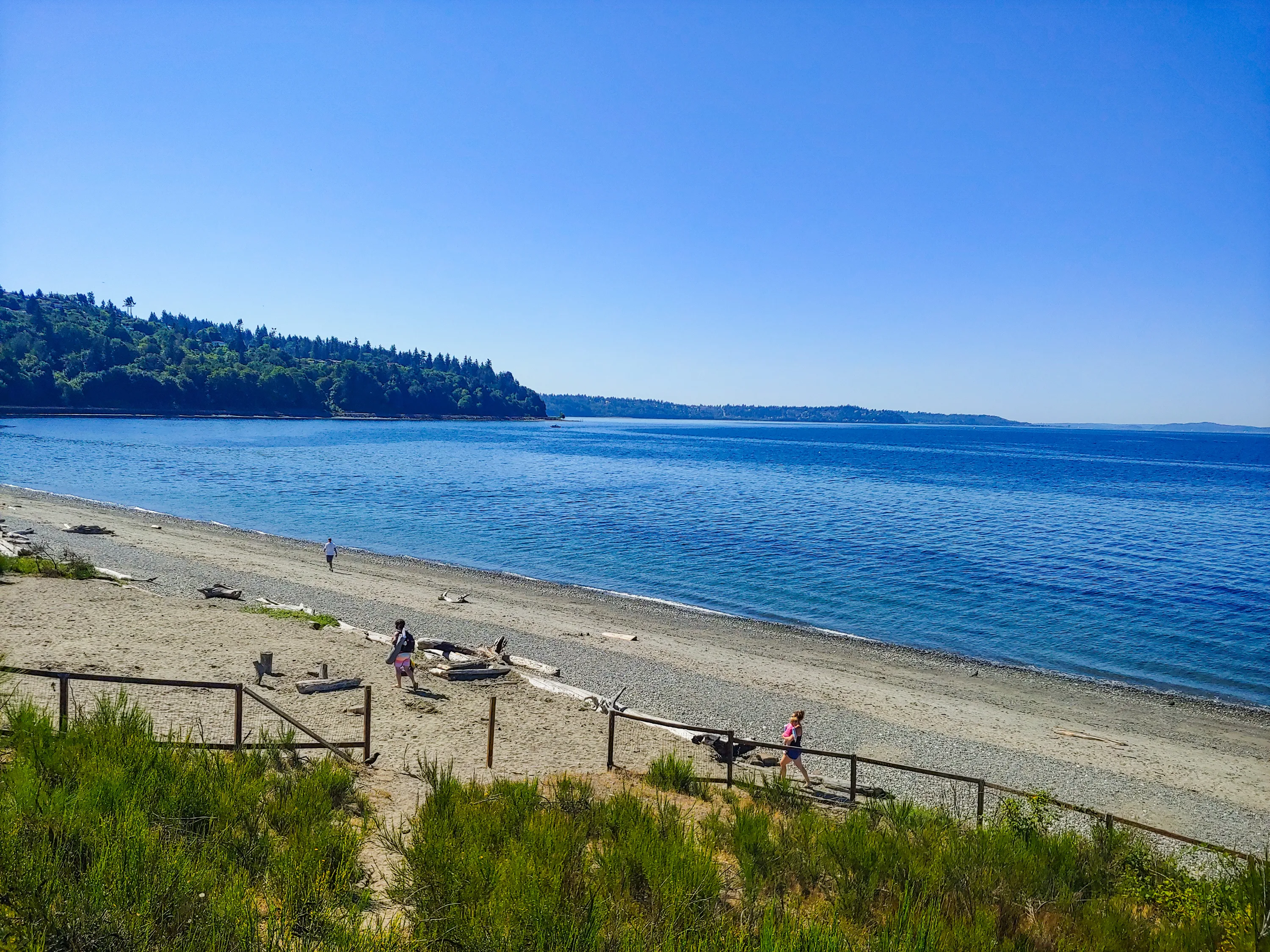
Richmond Beach shares Innis Arden's A+ safety designation and earns some of the lowest CAP Index crime scores in Shoreline — well below the national benchmark. The neighborhood wraps around Richmond Beach Saltwater Park on the Sound, which means it draws a consistent community of residents who actually use the outdoor spaces and know their neighbors. That kind of foot traffic and community familiarity tends to deter opportunistic property crime better than most formal programs.
Best for: Families and retirees who want a coastal feel, strong community ties, and genuinely low crime exposure.
Echo Lake sits in the central-west portion of Shoreline and benefits from its residential character and distance from the Aurora corridor. The neighborhood clusters around Echo Lake Park, which gives it a natural gathering point and the kind of regular pedestrian presence that keeps streets feeling active without the commercial density that drives crime statistics elsewhere. Property crime is reported at moderate levels, consistent with broader Shoreline residential neighborhoods, with vehicle security being the practical concern locals pay most attention to.
Best for: Buyers who want central Shoreline access with a quieter residential safety profile.
Hillwood sits in the northwest quadrant and is frequently mentioned alongside Innis Arden by residents as one of the neighborhoods where community identity is strong and crime feels genuinely distant from daily life. The area's tree-canopied streets and single-family character create natural social surveillance — neighbors know each other, and it shows in how the block watch programs here operate. Several active Shoreline Watch groups operate in this area, and the community participation level is noticeably higher than in more transient rental-heavy parts of the city.
Best for: Buyers who want an established neighborhood with active community involvement and low crime exposure.
North City is Shoreline's walkable commercial node along 15th Avenue NE, and its safety profile reflects that mixed-use character. The neighborhood sees more foot traffic, more retail activity, and predictably more property crime incidents than the quiet residential west side. Vehicle break-ins are the most common complaint, particularly near the denser apartment buildings. That said, violent crime in North City doesn't meaningfully diverge from the city's already-low rate — it's a property crime story, not a personal safety concern for most residents.
Best for: Renters and buyers who want walkable urban amenities and can take standard urban precautions with vehicles.
Richmond Highlands occupies the northeast corner of Shoreline and tends toward a more mixed housing profile — a blend of older single-family homes, rentals, and some commercial activity along Meridian Avenue N. Crime data suggests this area sits closer to the city's midpoint than the safer northwest neighborhoods, driven in part by its proximity to busier arterials and higher residential turnover. It's not an area locals flag as concerning, but the strong sense of community that characterizes Innis Arden or Hillwood is less pronounced here.
Best for: Budget-conscious buyers who want Shoreline's school district and location without the premium pricing of the northwest neighborhoods.
Looking to buy in Estimate your payment.
Enter your numbers to see an estimated monthly mortgage payment.
Estimate only. Excludes HOA fees and mortgage insurance.
| City | Violent Crime/1K | Property Crime/1K | Overall Safety Profile |
|---|---|---|---|
| Shoreline | ~3.4 | ~25.3 | Near state average; northwest neighborhoods significantly safer |
| Seattle | ~7.2 | ~47.8 | Higher across both categories; notable variation by district |
| Lake Forest Park | ~1.1 | ~12.4 | Consistently among the safest in King County |
| Edmonds | ~1.8 | ~18.6 | Low crime, strong community character |
| Mountlake Terrace | ~3.1 | ~22.7 | Comparable to Shoreline overall |
| Lynnwood | ~5.2 | ~38.4 | Higher property crime driven by commercial density |
| Kenmore | ~1.4 | ~14.9 | Low crime suburban profile |
The comparison that matters most for buyers choosing between Shoreline and its neighbors is the Lake Forest Park and Edmonds column. Both cities offer meaningfully lower crime rates — but both also carry higher price premiums and, in Edmonds' case, a longer commute window. Shoreline's northwest neighborhoods close much of that safety gap while holding a competitive price point relative to Edmonds.
The single thing that surprises most people after six months of living in Shoreline is how location-dependent their actual experience turns out to be. Buyers who land west of I-5 in Innis Arden or Richmond Beach report a quality of daily life that feels genuinely removed from the crime statistics that show up in aggregate searches. Buyers who end up near the Aurora Avenue corridor — particularly the stretch between N 145th Street and N 160th Street — report a noticeably different experience with vehicle security and overnight parking. The divide is real, and it's worth paying attention to during the home search rather than discovering it after closing.
What locals actually do is straightforward and not particularly dramatic. Most northwest-neighborhood residents don't lock their doors during the day — but nearly everyone with a garage uses it for their car rather than storage, especially given the elevated vehicle theft rate. Ring cameras and motion lights are common on properties near arterials. The Shoreline Watch program, which organizes neighbors into small geographic clusters connected to a dedicated patrol officer, is active in several northwest neighborhoods and gives residents a direct line to the department rather than just a 911 number. For residents near commercial areas, the habit is consistent: don't leave anything visible in a parked car, period.
One practical note on traffic: Shoreline recorded over 660 traffic collisions in the most recent full year — a record high — and the city has not adopted automated traffic cameras, unlike neighboring Edmonds, Lynnwood, and Seattle. Aurora Avenue N and the 185th Street corridor during peak hours are where most of those incidents concentrate. For families with teenage drivers or people making daily commutes through these corridors, that's worth factoring into the daily reality assessment alongside the crime data.
Local Expert Takeaway: If safety is a primary criterion, narrow your search to the area bounded roughly by Aurora Avenue N to the east and the Puget Sound to the west, between N 175th and N 205th Street. Innis Arden, Richmond Beach, and Hillwood consistently outperform the citywide average by a meaningful margin, and the Shoreline Watch groups active in those neighborhoods give new residents a practical community connection from day one. Avoid the stretch of Aurora between 145th and 160th for overnight parking regardless of which neighborhood you ultimately choose.
✅ Shoreline's northwest neighborhoods — particularly Innis Arden and Richmond Beach — rank among the safest in the Seattle metro, with safety grades that compare favorably to Edmonds and Lake Forest Park.
⚠️ Property crime, especially vehicle theft and break-ins, is the meaningful concern in Shoreline — not violent crime, which runs well below state and national averages.
📍 The Aurora Avenue corridor in southern Shoreline concentrates the city's highest crime activity and skews citywide statistics; buyers who focus their search north and west of this corridor will experience a materially different reality.
Is Shoreline a safe place to live?
Shoreline is a reasonably safe city with meaningful variation by neighborhood. Violent crime runs well below state and national averages, and the northwest neighborhoods consistently earn the highest safety ratings in the Seattle metro. Property crime — particularly vehicle theft and break-ins — is the area where residents take practical precautions, especially near commercial corridors.
What is the crime rate in Shoreline, WA?
FBI estimates put Shoreline's total crime rate at roughly 2,744 per 100,000 residents — slightly below the Washington State average but above the national figure. The violent crime rate of approximately 212 per 100,000 is about 41% lower than the national average, while property crime at roughly 2,532 per 100,000 runs above it, driven primarily by vehicle theft and burglary near commercial areas.
Which Shoreline neighborhoods are the safest?
Innis Arden and Richmond Beach are consistently identified as Shoreline's safest neighborhoods, with A+ safety ratings and crime risk well below national benchmarks. Hillwood and Echo Lake also perform above the city average. The southern neighborhoods near Aurora Avenue N see the highest incident counts, primarily reflecting proximity to commercial activity rather than residential crime patterns.
Explore the full Shoreline series: Living in Shoreline · Is Shoreline Safe? · Cost of Living · Best Neighborhoods · Schools & Family Life · Youth Sports · Parks & Rec · Retiring in Shoreline
Tell us what you need help with and we'll connect you with local resources.

About the Author
Todd Davidson is the founder of Living in Oregon and Living in Washington, where he publishes in-depth city guides, neighborhood resources, and local market insights covering more than 180 communities across the Pacific Northwest. While his background is in home financing and real estate, he created these digital platforms to help families research and compare regions before making a move.