
Puget Sound · Washington
Shoreline doesn't make the top of most retirement destination lists, and that's actually part of why it works. It lacks the resort-town feel of Edmonds and the headline cachet of Capitol Hill, but it delivers something harder to find: genuine suburban livability within 22 minutes of one of America's most economically dynamic cities, combined with Washington's most retiree-friendly tax environment. For the right person, it's a very easy yes. For someone hoping for walkable waterfront villages and a car-free lifestyle, it requires a more honest look.
The retirees who land well in Shoreline are typically those who moved from somewhere like California or Oregon carrying years of accumulated equity, and who want to stretch that equity while staying connected to urban amenities on their own terms. They value access to world-class healthcare nearby, clean and quiet neighborhoods, and parks that don't require a ferry or a 45-minute drive. They're not necessarily done with driving — but they want the choice.
This guide covers everything a prospective retiree needs to evaluate Shoreline honestly: the tax advantages Washington extends to older residents, the healthcare infrastructure nearby, what independent and assisted living actually costs here, what a typical week looks like without a commute to anchor it, and how Shoreline stacks up against the alternatives most retirees are weighing.
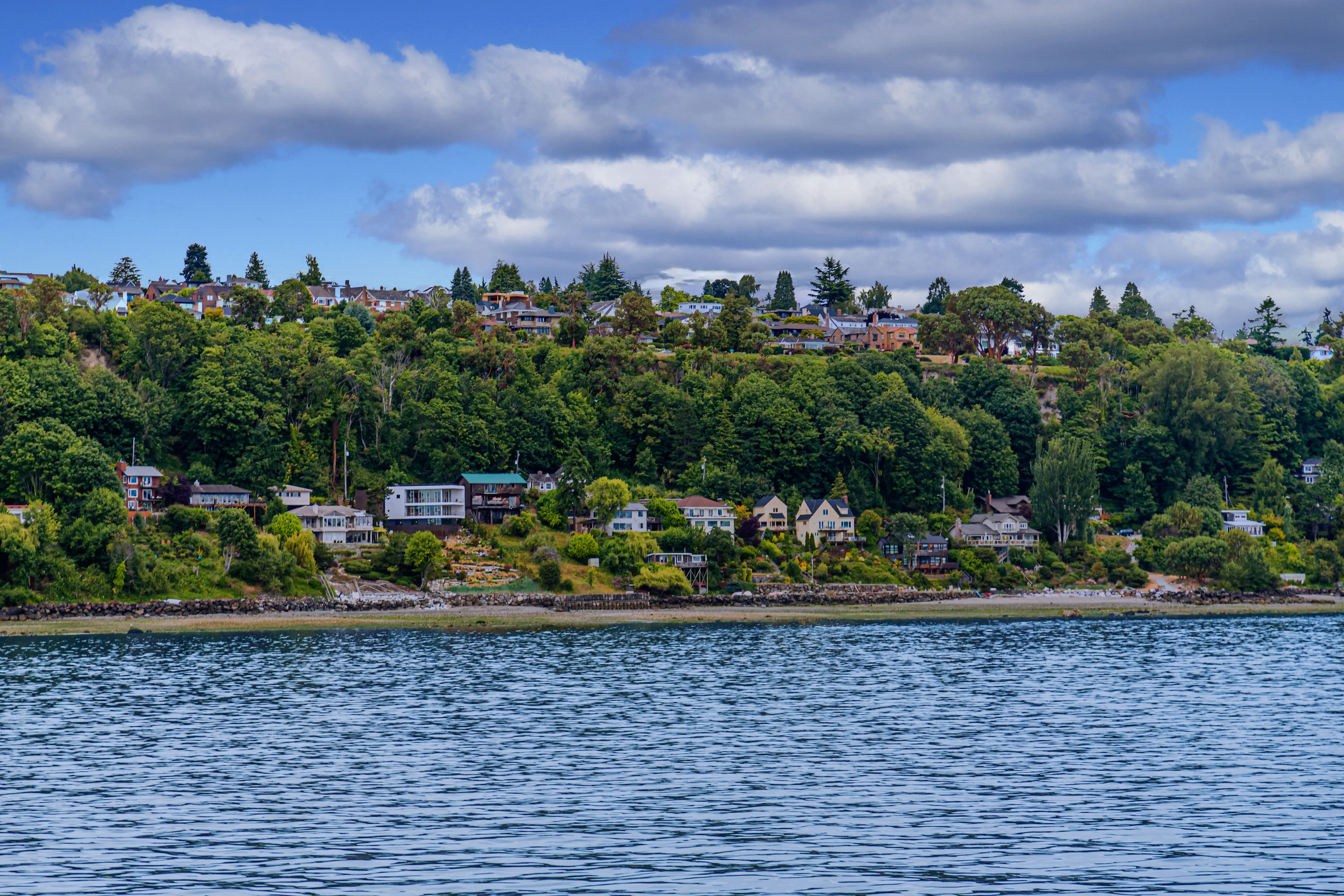
Few states offer as clean a retirement tax story as Washington. The table below lays out what that means in practical terms for the income sources most retirees draw from.
| Income Type | Washington State Tax Treatment |
|---|---|
| Social Security Benefits | Not taxed (no state income tax) |
| Traditional IRA / 401(k) Withdrawals | Not taxed |
| Pension Income | Not taxed |
| Military Retirement Pay | Not taxed |
| Roth IRA Distributions | Not taxed |
| Investment Dividends & Interest | Not taxed |
| Long-Term Capital Gains | Taxed (above $278,000 threshold) |
| Property Tax | Assessed locally; King County rate approx. 1.10% |
| Sales Tax | Approx. 10.3% combined state + King County |
The immediate benefit for retirees relocating from Oregon — where retirement income is taxed at rates up to 9.9% — is often measured in thousands of dollars annually. A couple drawing $120,000 in combined pension and IRA income each year saves that entire distribution from state taxation in Washington. The only meaningful exception is capital gains: Washington enacted a 7% tax on long-term capital gains above $278,000 (the 2025 threshold), which affects relatively few retirees but is worth knowing if you're planning a large asset liquidation in the same year you sell a home.
King County's senior property tax exemption kicks in at age 61 — notably earlier than the 65-year threshold most states apply — and is available to households with combined disposable income of $84,000 or less. Senate Bill 6162, passed in early 2026 with near-unanimous legislative support, represents the most significant expansion of this program in decades, recalibrating income thresholds to 110% of current county median household income. An estimated 30,000 additional Washington households will qualify statewide, with the Department of Revenue expected to publish King County's updated figures by August 2026. Retirees who've previously checked their eligibility and fallen just outside the threshold should check again before the 2027 tax year. Eligible homeowners also benefit from a frozen assessed value, meaning subsequent market appreciation won't increase their property tax burden — a meaningful protection in a market where Shoreline's median has hovered around $770,000.
Shoreline itself does not have a full acute-care hospital within city boundaries, which is worth stating plainly — but the surrounding healthcare infrastructure is genuinely strong, and the distances involved are short. UW Medical Center – Northwest, located at 1550 N 115th Street in North Seattle, is the primary full-service option most Shoreline residents rely on. It became an official campus of UW Medical Center in 2020 and offers emergency, inpatient, and outpatient medical, surgical, and therapeutic care with recognized excellence in gastrointestinal care. From most Shoreline neighborhoods, you're looking at 10 to 15 minutes by car.
Swedish Edmonds Campus, to the north in Edmonds, provides a full scope of medical and surgical services including a Level IV Trauma emergency department. It's part of the broader Swedish Health Services network and is often the preferred option for residents in the northern sections of Shoreline like Richmond Beach and North City. For those who need tertiary academic medical care — oncology, organ transplant, complex cardiovascular procedures — UW Medical Center's main Montlake campus in Seattle is the regional referral center, roughly 25 to 30 minutes away in light traffic.
For day-to-day primary care, UW Medicine Primary Care at Shoreline operates inside the Aurora Village Mall at 1355 N 205th Street, seeing patients six days a week including evenings and offering same-day appointments. The clinic accepts Medicare and many commercial insurance plans, and an on-site lab handles routine diagnostics without sending patients elsewhere. For retirees who've been burned by practices that don't take new Medicare patients, the UW Medicine affiliation here is a meaningful advantage. Shoreline Health & Rehabilitation Center at 2818 NE 145th Street rounds out the in-city care picture with skilled nursing and rehabilitation, holding a 5-star overall rating from Medicare — about as strong a credential as that rating system produces.
The senior living landscape in Shoreline is broader than most first-time visitors expect. There are roughly 33 independent living communities within the city, along with 9 assisted living communities offering memory care options. Monthly costs in the area run from approximately $3,595 on the lower end up to $4,934 for higher-tier assisted living arrangements, though independent living options with fewer services can fall below that range. The table below captures the primary community types and estimated cost ranges.
| Community Name | Type | Location | Est. Monthly Cost |
|---|---|---|---|
| Shoreline Senior Living | Independent Living | Shoreline, WA | $3,600–$4,200 |
| The Hearthstone | Independent / AL | North Seattle (near Shoreline) | $4,200–$5,500 |
| Josephine Caring Community | Assisted Living / SNF | Stanwood vicinity / NW WA | $4,500–$5,800 |
| Crista Shores | Independent / CCRC | Edmonds, WA (adjacent) | $4,000–$6,500+ |
| Westminster Manor | Senior Living | Shoreline, WA | $3,595–$4,500 |
| Aegis Living Lake Union | Memory Care / AL | Seattle (25 min) | $6,000–$8,000+ |
Continuing care retirement communities (CCRCs) — facilities that offer independent living, assisted living, and skilled nursing on a single campus — are the format most retirement planners recommend for couples with even modestly different health trajectories. Crista Shores in Edmonds, directly adjacent to Shoreline's northern edge, is among the strongest CCRC options in the immediate area, though its wait list reflects its reputation. Within Shoreline itself, the inventory skews toward independent living and smaller assisted living communities rather than full-campus CCRCs, which means retirees who anticipate needing multiple levels of care over time may want to structure their housing strategy with that gap in mind.

Looking to buy in Estimate your payment.
Enter your numbers to see an estimated monthly mortgage payment.
Estimate only. Excludes HOA fees and mortgage insurance.
A retired week in Shoreline is shaped almost entirely by whether you're comfortable driving. The honest walkability answer is: moderate at best, and highly neighborhood-dependent. Residents of North City near 15th Avenue NE can walk to coffee, grocery, and a handful of restaurants without touching a car. Richmond Beach retirees enjoy genuine waterfront trail access but will drive for most errands. The Aurora Corridor — Highway 99 — is the city's commercial spine, lined with everything from Fred Meyer to independent restaurants, but it is not a pedestrian-friendly street by any standard.
The Interurban Trail is the city's most useful active infrastructure for retirees: a paved multi-use path that runs north–south through Shoreline, connecting to King County's broader trail network and providing a car-free route for cycling, walking, and light exercise that doesn't require navigating Aurora. Hamlin Park's forested interior trails are a consistent draw for the 60-and-older crowd who want something more immersive than a paved loop. Richmond Beach Saltwater Park offers Puget Sound views, a gravel beach, and a genuine sense of distance from the suburbs — it's one of the region's better day-trip destinations that happens to be walkable from certain Shoreline addresses.
Shoreline's cultural calendar is quieter than Seattle's but more active than its suburban reputation suggests. The Shoreline-Lake Forest Park Farmers Market runs seasonally and provides a natural weekly social anchor. Shoreline Community College brings ongoing public lectures, performing arts events, and continuing education programming specifically designed for older adults — their older adult enrichment offerings are genuinely well-regarded in the community. The Boeing Creek corridor and Echo Lake Park provide year-round walking environments, and Lake Ballinger on the southern edge offers a more lake-adjacent setting that some retirees find more appealing than the more manicured alternatives.
Getting around without a car is workable but not effortless. King County Metro runs reliable bus service along Aurora Avenue, and the planned Lynnwood Link light rail extension — with a Shoreline North/185th Street Station — will meaningfully expand car-free options to downtown Seattle once operational. For now, retirees who want to remain fully mobile without driving will find Shoreline requires some planning and occasional rideshare. The city is actively investing in pedestrian infrastructure around its future light rail corridors, so the car-optional picture improves materially over the next two to three years.
| City | Median Home Price | Nearest Hospital | Walkability | Senior Living Depth | Overall Retirement Fit |
|---|---|---|---|---|---|
| Shoreline, WA | $770,000 | UW Med NW (10–15 min) | Moderate | Strong (33+ IL communities) | ★★★★ |
| Edmonds, WA | $820,000–$900,000 | Swedish Edmonds (in-city) | Good–Excellent | Moderate | ★★★★½ |
| Lake Forest Park, WA | $850,000–$950,000 | UW Med NW (15 min) | Low | Limited | ★★★ |
| Mountlake Terrace, WA | $650,000–$720,000 | Swedish Edmonds (10 min) | Moderate | Moderate | ★★★ |
| Kenmore, WA | $760,000–$830,000 | Evergreen Health (20 min) | Low | Limited | ★★½ |
| Lynnwood, WA | $600,000–$680,000 | Swedish Edmonds (10 min) | Moderate | Good | ★★★½ |
Shoreline's strongest argument in this comparison is density of senior living options relative to price. Thirty-three independent living communities within a single mid-sized city is a meaningful number, and the combination of UW Medicine's primary care presence, the 5-star rehabilitation center, and the proximity to UW Med NW creates a care continuum that competes credibly with any suburb in the northern King County ring.

Local Expert Takeaway: Shoreline fits best for retirees who want to stay close to Seattle without paying Seattle prices, value a real senior living infrastructure, and are comfortable driving for most errands — at least until the light rail station opens. Innis Arden and Richmond Beach are the neighborhoods I'd look at first for equity-strong buyers who want some privacy and natural setting without sacrificing proximity. Retirees on a tighter budget who need strong walkability and lower home prices should honestly look at Mountlake Terrace or Lynnwood first. And anyone who qualifies — or just barely didn't qualify before — should revisit the senior property tax exemption after the Department of Revenue publishes King County's updated SB 6162 thresholds in August 2026.
Is Shoreline a good place to retire?
Shoreline works well for retirees who want suburban quiet, genuine proximity to Seattle's world-class healthcare and cultural amenities, and the benefit of Washington's favorable tax structure — all without paying the premiums that come with living inside Seattle itself. It's not a walkable retirement village, but it offers meaningful outdoor access, a growing senior living inventory, and a planned light rail connection that will expand mobility options considerably.
What healthcare options do retirees have in Shoreline?
Shoreline doesn't have a full acute-care hospital within city limits, but UW Medical Center – Northwest is 10 to 15 minutes away for emergency and complex care, and Swedish Edmonds provides Level IV Trauma services to the north. Within the city, UW Medicine Primary Care at Shoreline on Highway 99 offers six-days-a-week primary care with same-day appointments and accepts Medicare.
How does Washington's tax environment benefit Shoreline retirees?
Washington has no state income tax, which means pension income, Social Security, IRA withdrawals, and 401(k) distributions are completely sheltered from state taxation. King County's senior property tax exemption begins at age 61 — four years earlier than most states — and the 2026 SB 6162 expansion significantly broadens eligibility. The main exceptions are a sales tax around 10.3% and a capital gains tax on gains above $278,000 annually.
Explore the full Shoreline series: Living in Shoreline · Is Shoreline Safe? · Cost of Living · Best Neighborhoods · Schools & Family Life · Youth Sports · Parks & Rec · Retiring in Shoreline
Tell us what you need help with and we'll connect you with local resources.

About the Author
Todd Davidson is the founder of Living in Oregon and Living in Washington, where he publishes in-depth city guides, neighborhood resources, and local market insights covering more than 180 communities across the Pacific Northwest. While his background is in home financing and real estate, he created these digital platforms to help families research and compare regions before making a move.