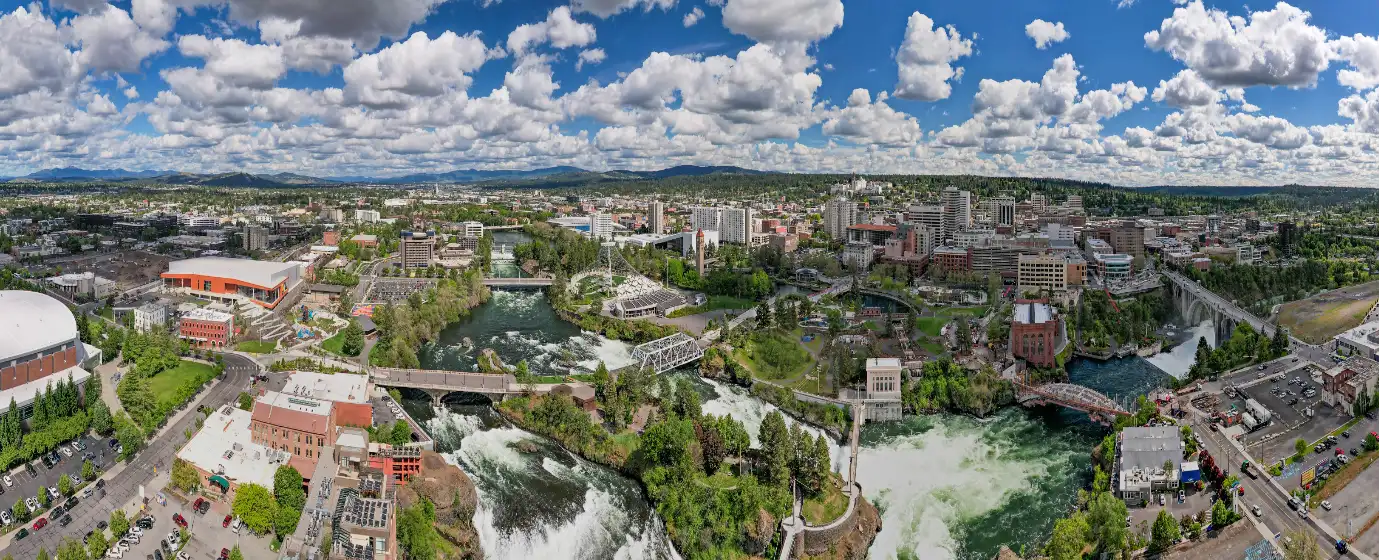
Eastern Washington · Washington
Not every investor doing a 1031 exchange is a seasoned portfolio manager with a 12-unit building in escrow. A significant share of the capital flowing into Spokane Valley right now is coming from California homeowners who sold a property they'd held for 20 years, realized a $600,000 to $900,000 gain, and are staring down a tax bill large enough to fundamentally change their retirement picture. Spokane Valley keeps showing up in that conversation for a reason: it's one of the few markets in the Pacific Northwest where a California seller can redeploy those proceeds into income-producing property without immediately burning half the equity in acquisition costs.
The Spokane Valley rental market is built on durable demand. With roughly 42% of households renter-occupied — about 18,000 renter households — the tenant pool spans young professionals commuting to Spokane employers, families priced out of buying, healthcare workers at Providence and MultiCare, and Amazon fulfillment employees who want a stable address without a long-term mortgage. That diversity keeps vacancy from being tied to any single economic cycle. Average rents sit around $1,400 per month citywide, with higher-demand corridors like Veradale pulling closer to $2,100. Single-family rentals and small multifamily — duplexes through four-plexes — are the most commonly traded investment vehicles, though larger apartment complexes are increasingly attracting institutional buyers drawn to the area's below-national cap rate compression.
This guide walks through 1031 mechanics as they apply to an out-of-state buyer on a deadline, lays out what the Spokane Valley investment property market actually looks like in 2026, explains Washington's tax structure honestly, and covers the operational realities that California investors consistently underestimate. By the end, you'll know whether Spokane Valley belongs in your identification list — and what to do before the 45-day clock starts.

The core mechanic of a 1031 exchange is straightforward: sell a qualifying investment property, defer the capital gains tax by rolling the proceeds into a replacement property of equal or greater value, and never let that money touch your personal bank account. The IRS gives you 45 calendar days from the close of your relinquished property to identify replacement properties in writing — and 180 days total to close on one of them. Both deadlines are absolute. Missing the 45-day identification window by a single day collapses the exchange.
Your proceeds must be held by a qualified intermediary (QI) — an independent third party who holds the funds between transactions. You cannot use your attorney, accountant, or a family member. The QI receives the sale proceeds, holds them, and releases them to purchase the replacement property. The like-kind rule is broader than most people realize: "like-kind" in real estate means any real property held for investment or business use can be exchanged for any other. A California duplex can exchange into a Spokane Valley commercial strip, a single-family rental, or a five-unit apartment building. The only hard requirement is that both properties are held for investment or productive use — not personal residence.
The boot trap catches investors who don't plan carefully. If your replacement property purchase price is lower than your net sale proceeds, or if you take cash back at closing, the difference is "boot" — and it's taxable in the year of the exchange. To fully defer your gain, you need to reinvest all proceeds and replace or exceed the debt on the relinquished property. If you sold a $1.2M California property with $400K in remaining mortgage, you need to take on at least $400K in debt on the replacement side or compensate with additional equity — otherwise the debt relief is treated as boot.
Single-family rentals remain the most liquid investment product in Spokane Valley, with a median sold price ranging from approximately $430,000 to $458,000 depending on the measurement period. At those prices and with three-bedroom rents in the $1,700–$1,900 range for well-located stock, gross yields on SFR typically run in the 4.5% to 5.5% range — not aggressive cap rates by any measure, but comparable to what investors are accepting in Portland or Seattle at twice the acquisition cost. The more compelling cap rate story sits in small multifamily.
Duplex and small apartment inventory has seen real movement. In the first quarter of 2025, duplex sales in Spokane County surged year-over-year, with average per-unit costs dropping to roughly $224,000. Larger apartment deals — the kind that trade as true investment assets rather than owner-occupied conversions — are seeing cap rates in the 6.3% to 6.8% range on five-plus-unit properties, based on recorded Spokane County transactions through mid-2025. Institutional buyers are landing closer to 5.2% on well-located Class A apartment product like the Eagle Rock transaction in the Mirabeau submarket. The gap between what sellers expect (4%–6%) and what buyers demand (above 6%) on mid-market multifamily means deals are achievable for disciplined buyers who know where to look.
| Property Type | Typical Price Range | Est. Cap Rate | Avg Days to Close |
|---|---|---|---|
| Single-Family Rental (SFR) | $310,000 – $480,000 | 4.5% – 5.5% | 30 – 45 days |
| Duplex / Small Multifamily | $380,000 – $600,000 | 5.5% – 6.5% | 30 – 60 days |
| 5–20 Unit Apartment Building | $700,000 – $4.5M | 6.0% – 7.0% | 45 – 90 days |
| Commercial / Retail Strip | $800,000 – $3M+ | 6.5% – 8.5% | 60 – 120 days |
Single-family rentals move fastest and are easiest to identify on a 45-day clock. Commercial assets, particularly multi-tenant retail and office, carry longer due diligence timelines that can challenge the 180-day close window — factor this in if your exchange proceeds are north of $1.5 million.
Looking to buy in Estimate your payment.
Enter your numbers to see an estimated monthly mortgage payment.
Estimate only. Excludes HOA fees and mortgage insurance.
The arithmetic is hard to ignore. A home that sells for $1.2 million in the Bay Area or $900,000 in coastal Southern California generates proceeds that simply don't translate into comparable assets in those same markets. In Spokane Valley, those proceeds buy multiple income-producing properties — outright, or with conservative leverage — at price points where cash flow is achievable from day one.
A Bay Area seller who closes on a $1.4 million property and rolls $900,000 in net proceeds into Spokane Valley can realistically acquire a duplex and a single-family rental simultaneously, identifying both as replacement properties within the 45-day window. At Spokane Valley's median price range, that's two income-producing assets with zero debt service — a position most Bay Area investors couldn't approximate by reinvesting locally. The rental yields, while not spectacular on paper, are genuine cash flow rather than negative-carry appreciation bets.
Southern California investors — particularly those selling in the Inland Empire or San Diego — often arrive having already compared Spokane Valley against Boise, Phoenix, or Albuquerque. What tips the decision toward Spokane Valley for many of them is the employment base: healthcare, manufacturing, and logistics jobs that generate a stable, non-seasonal tenant pool. Inland Empire sellers can often exchange a single-family rental that's now worth $650,000–$750,000 into a small multifamily in Spokane Valley with meaningful equity cushion.
Sacramento sellers often find the Spokane Valley price range the most intuitive comparison, given that Sacramento's own median has climbed past $450,000. The advantage here isn't dramatically cheaper housing — it's the tax structure. California taxes rental income as ordinary income at rates up to 13.3%. Washington has no state income tax at all, which means a Sacramento investor replacing a Sacramento rental with a Spokane Valley rental keeps materially more of their net operating income every year.
The most consequential tax difference between California and Washington for a real estate investor isn't property tax or depreciation — it's income tax. Washington is one of nine states with no state income tax. Every dollar of net rental income is taxed only at the federal level. A California investor in the top bracket who generates $40,000 in annual rental income saves over $5,000 per year just by holding that asset in Washington rather than California. Compounded over a 10- or 20-year hold, that difference is material.
Washington does levy a 6.5% state sales tax, and most counties add local surtax on top of that, bringing Spokane County's combined rate to roughly 8.9%. That applies to materials, fixtures, and appliances purchased for a rental rehab — a renovation budget that would cost $80,000 in materials needs to account for approximately $7,000 in sales tax that an Oregon investor wouldn't face. Factor this into your pro forma on any value-add acquisition.
| Tax Item | California | Washington |
|---|---|---|
| State income tax on rental income | Up to 13.3% | None |
| Property tax rate on new purchase | ~1.1%–1.25% (post-Prop 13 reset) | ~0.95% (Spokane County) |
| Sales tax on renovation materials | None (no sales tax) | ~8.9% combined |
| Capital gains on investment property sale | Up to 13.3% state + federal | 7% state on gains over $262K/year (long-term); 0% for most small investors |
| Depreciation basis in 1031 | Carries over (not stepped up) | Same federal rule applies |
Washington's capital gains tax — 7% on long-term gains above $262,000 annually — is worth understanding but rarely triggers for a buy-and-hold investor generating annual rental income. It applies to realized capital gains in the year of sale, not to ordinary rental income. For most investors in this market, the effective state tax burden on annual operations is zero. The depreciation basis from your relinquished California property carries forward into the replacement property — it is not reset — so factor your existing depreciation position into your long-term tax modeling.
Delaware Statutory Trusts (DSTs) are worth a brief mention for investors who want passive 1031 replacement without property management. DSTs allow multiple investors to hold fractional interests in larger properties through a trust structure that qualifies as like-kind. They sacrifice control and liquidity for simplicity — useful for an older investor who wants to exit active management entirely.
Washington's landlord-tenant law is one of the more tenant-protective frameworks in the Western U.S., though it stops short of Portland or Seattle's restrictions. Statewide, there is no rent control as of mid-2026, and Spokane Valley has not enacted local rent limitations. Notice requirements for non-renewal and cause-based evictions have tightened over the past several years at the state level — landlords are advised to stay current with Washington's Residential Landlord-Tenant Act, particularly around required notice periods and documentation standards. An out-of-state owner managing remotely without a local property manager who knows current law is a liability.
Local property management companies including companies like Realty One Group and various Spokane Valley-based operators typically charge 8%–10% of gross monthly rent, with leasing fees often running an additional half-month to full-month rent for placement. On a $1,600/month rental, budget roughly $150/month for ongoing management plus a one-time leasing fee of $800–$1,600 per tenant placement. That's not trivial, but it's also the cost of not dealing with 3 a.m. maintenance calls from three time zones away.
What out-of-state owners consistently underestimate is the deferred maintenance reality in Spokane Valley's older rental stock. Much of the most attractively priced small multifamily — the properties that look best on a cap rate spreadsheet — was built between 1955 and 1985. Roofs, HVAC systems, and original plumbing on those buildings are often at or past their useful life. A 6.5% cap rate on paper becomes a 4% cap rate in year two after a furnace replacement and re-roof.
| Item | What to Verify | Local Resource |
|---|---|---|
| Title search | Clear title, existing liens, encumbrances | Local title company (Spokane Valley) |
| Sewer vs. septic | City sewer connection vs. septic system | Spokane County Environmental Services |
| Flood zone status | FEMA flood map Zone X vs. AE | FEMA Flood Map Service Center |
| Rental permit requirements | City of Spokane Valley rental registration requirements | City of Spokane Valley Development Services |
| HOA restrictions on rentals | CC&Rs, rental caps, short-term rental prohibitions | HOA governing documents / title report |
| ADU/zoning potential | Washington's ADU-friendly laws; lot coverage and setback rules | Spokane Valley Planning Dept. |
| School district boundaries | Central Valley vs. East Valley; affects tenant pool quality | SpokaneRealtors.com / SVSD website |
| Current lease status | Month-to-month vs. fixed term; existing rent vs. market | Seller disclosure + lease docs |
| Physical inspection | Roof age, HVAC, plumbing, electrical panel, foundation | Licensed WA home inspector |
| Short-term rental ordinances | Spokane Valley STR rules and registration if considering Airbnb | City of Spokane Valley Code |
| Property management referral | Vetted local PM company before closing | Local agent referral |
| Title company recommendation | Experienced in 1031 closings and QI coordination | Your QI's preferred local title company |
| Environmental screening | Phase I if commercial; underground storage tanks on older properties | Spokane County or licensed environmental firm |
| Market rent verification | Current comparable rents in that specific submarket | Local PM company or Redfin rent data |

Local Expert Takeaway: The single most common mistake California investors make entering the Spokane Valley market on a 1031 timeline is conflating the citywide median price with what they'll actually find available in the 45-day window. The properties that look best on paper — small multifamily on the Pines or Sullivan corridors with 6%+ cap rates — are either already under contract or carrying deferred maintenance that a motivated seller priced in. Start your search before the clock starts, narrow your focus to the Mirabeau, Veradale, and Greenacres submarkets for SFR quality, and budget a real inspection budget — not a walkthrough — before you submit.
Getting pre-approved for an investment property loan before your relinquished property closes isn't optional — it's the difference between having real options on day 44 and scrambling for anything with a pulse. If you want to keep the replacement property transaction off your personal debt-to-income ratio, ask Todd about DSCR loans, which qualify based on the property's rental income rather than your W-2 or tax returns. Todd works with investors on exactly this kind of structured approach — reach out before the 45-day window opens, not after.
✅ Spokane Valley delivers real cash flow potential — median home prices near $440,000–$458,000, rents averaging $1,400/month citywide with higher-demand areas pushing above $1,700, and no Washington state income tax on rental proceeds make the numbers work for disciplined buyers.
⚠️ The 45-day clock punishes the unprepared — small multifamily in the best corridors moves quickly, and out-of-state buyers who haven't previewed the market before their exchange closes often end up stretching into lower-quality stock or missing the window entirely.
📍 Washington's ADU laws are an underutilized upside — Spokane Valley's zoning environment, combined with Washington's statewide ADU-friendly legislation, means many SFR lots can support an accessory dwelling unit, effectively converting a single-family rental into a duplex income stream.
Does a 1031 exchange work for out-of-state property?
Yes, a 1031 exchange works across state lines without restriction. You can sell a California investment property and purchase a replacement property in Washington — or any other state — and fully defer your capital gains tax as long as you meet the 45-day identification and 180-day closing deadlines and use a qualified intermediary. The like-kind rule applies to all U.S. real property held for investment.
What is the cap rate on rental property in Spokane Valley?
Cap rates vary meaningfully by property type. Single-family rentals typically yield in the 4.5%–5.5% range based on current prices and rents. Small multifamily — duplexes through four-plexes — runs closer to 5.5%–6.5% on quality stock. Five-plus-unit apartment properties have transacted in the 6.3%–6.8% range in recent Spokane County deals, though well-located Class A product trades tighter, around 5.2%–5.5%.
Do I need a local property manager for a 1031 investment in Washington?
You aren't legally required to hire one, but for an out-of-state owner, skipping professional management is rarely the right financial decision. Washington's landlord-tenant law has specific notice and documentation requirements that vary from California's, and a compliance misstep on a non-renewal or eviction can be expensive. Local property managers in Spokane Valley typically charge 8%–10% of gross monthly rent — an expense that buys meaningful legal protection and operational peace of mind.
Explore the full Spokane Valley series: The Ultimate Spokane Valley Relocation Guide · Is Spokane Valley Safe? · Cost of Living in Spokane Valley · Best Neighborhoods in Spokane Valley · Spokane Valley Schools & Family Life · Spokane Valley Youth Sports · Spokane Valley Parks & Recreation · Retiring in Spokane Valley · 1031 Tax-Deferred Exchange in Spokane Valley · Spokane Valley First-Time Homebuyers Guide · Moving to Spokane Valley from California
Tell us what you need help with and we'll connect you with local resources.

About the Author
Todd Davidson is the founder of Living in Oregon and Living in Washington, where he publishes in-depth city guides, neighborhood resources, and local market insights covering more than 180 communities across the Pacific Northwest. While his background is in home financing and real estate, he created these digital platforms to help families research and compare regions before making a move.