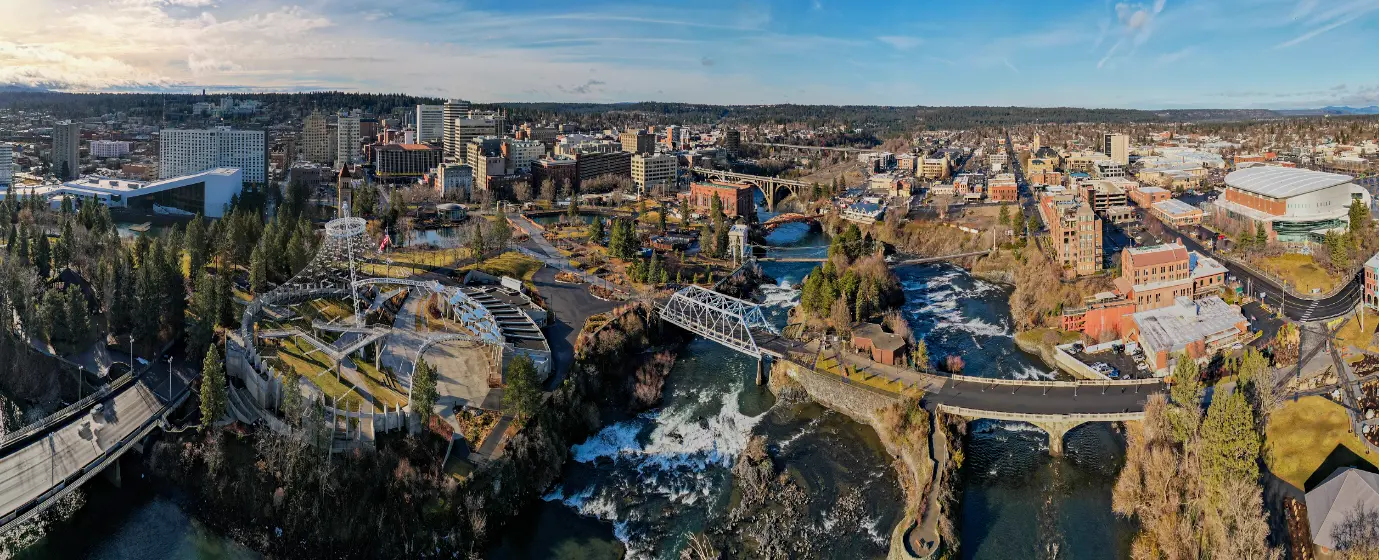
Eastern Washington · Washington
The Bay Area software engineer who finally got a yard and kept their $180,000 salary. The San Diego family that stopped dreading the August utility bill and the smoke notifications on their phone. The Sacramento couple who sold their 1,400-square-foot townhome for $620,000 and bought a four-bedroom house in Spokane's South Hill for $415,000 — with money left over. California-to-Spokane migration isn't a trend anymore; it's a pattern with a consistent profile. Californians consistently represent the largest out-of-state source of newcomers to Spokane, and the reasons go beyond housing costs alone. It's about reclaiming financial breathing room and space — literal square footage, literal yards, literal quiet.
The hard part is that Spokane is not California, and this guide isn't going to pretend otherwise. The winters here are real — not Midwest brutal, but genuinely dark and cold in a way that catches Los Angeles and San Diego transplants completely off guard. The food scene, the density of cultural options, the specific social energy of a major coastal metro — none of those fully transfer. Buyers who move here expecting a cheaper version of California tend to struggle in year one. Buyers who arrive understanding they're trading one set of tradeoffs for another tend to love it by year two.
This guide walks through the full comparison: what you actually save (and spend) across different California origin markets, what your equity buys here, the tax picture that most financial advisors underestimate, the weather reality, and a tool to compare your specific California city directly to Spokane. The goal is to help you make a clear-eyed decision — not sell you on the move.

| Spokane, WA | Bay Area | Southern CA | Sacramento Metro | Central Valley | |
|---|---|---|---|---|---|
| Median Home Price (approx. 2026) | $355,000 | $1.3M–$1.8M+ | $750K–$1.1M | $520K–$640K | $340K–$450K |
| Property Tax Rate (effective) | ~0.96% | ~1.1–1.2% (Prop 13 capped) | ~1.1–1.2% | ~1.1–1.25% | ~1.1–1.25% |
| State Income Tax | None | Up to 13.3% | Up to 13.3% | Up to 13.3% | Up to 13.3% |
| State Sales Tax (combined avg.) | ~8.9% | ~8.6–10.3% | ~8.5–10.5% | ~7.75–8.5% | ~7.75–8.75% |
| Avg. Utilities (monthly est.) | $150–$190 | $250–$350 | $220–$320 | $180–$260 | $175–$250 |
| Avg. 1BR Rent | $1,050–$1,350 | $2,800–$4,000+ | $2,100–$3,200 | $1,500–$2,000 | $1,100–$1,600 |
A Bay Area buyer selling at $1.4 million and purchasing in Spokane near the $355,000 median is looking at effectively eliminating their mortgage — or carrying a very small one — and banking the difference. Even after closing costs, capital gains (if applicable), and moving expenses, the equity gap is transformative. That's not a lifestyle upgrade on paper; it's a structural shift in monthly cash flow that most buyers don't fully model until they're already living it.
The no-income-tax advantage deserves its own line item. Washington is one of nine states with zero state income tax on wages and salaries. For a California buyer earning $150,000, the effective California state income tax on that income runs approximately $10,000–$12,000 per year. At $200,000, the figure climbs to roughly $18,000 annually. That money doesn't disappear into a higher mortgage or lifestyle inflation — it stays in your paycheck every month, permanently, the day you establish Washington residency.
The headline is simple: California taxes earned income aggressively; Washington does not tax it at all. For transplants, this is the most durable financial benefit of the move — not a one-time gain like housing arbitrage, but a recurring annual advantage that compounds over time.
| Tax Item | California | Washington | Net Impact for Transplant |
|---|---|---|---|
| State Income Tax | Up to 13.3% (effective ~5.8% at $100K; ~9% at $200K) | 0% on wages/salary | Save $5,700–$18,000+/year depending on income |
| Capital Gains Tax | Up to 13.3% (treated as ordinary income) | 7% on gains over ~$262K/year | Lower for most income levels; similar for high earners with large gains |
| Property Tax Rate | Prop 13 capped; new buyers ~1.1–1.25% | ~0.96% in Spokane County | Slight advantage to Spokane on new purchase |
| Sales Tax (combined avg.) | ~8.68% | ~9.38% (Spokane) | CA slight advantage (~$700/yr on $50K spending) |
| Estate/Inheritance Tax | None at state level | None at state level | Neutral |
| Senior Property Tax Exemption | Limited programs | Yes — income-based, age 61+ | Meaningful benefit for retirees |
Washington's 7% capital gains tax sounds alarming on first read but applies only to long-term capital gains exceeding approximately $262,000 in a single tax year. For most transplants — even those with significant investment accounts — this threshold rarely triggers on annual income. It matters most for equity-heavy investors liquidating large positions in a single year, not for buyers selling a primary residence who can typically exclude up to $500,000 in gains under federal rules.
The sales tax picture is the one genuine offset. Washington's combined average rate in Spokane runs slightly above California's statewide average. On $50,000 of taxable spending per year, that's roughly $700 more annually — a real cost, but one that disappears in the noise against $10,000–$18,000 in income tax savings for most earners.
A buyer leaving Walnut Creek or Palo Alto with $1.4 million in equity can purchase one of the finest properties in Spokane outright — in cash — and have six figures left in reserve. The upper end of Spokane's market sits in the $600,000–$900,000 range, concentrated in South Hill's Rockwood and Comstock neighborhoods, the renovated Craftsmans of Browne's Addition, and the newer construction in Five Mile Prairie. At that equity level, the relevant question isn't whether you can afford Spokane — it's how much mortgage, if any, you want to carry at all.
Many Bay Area buyers at this equity level elect to purchase at $450,000–$550,000, retain the rest in liquid investments, and let the no-income-tax savings accelerate their net worth annually. That combination — low housing cost, zero state income tax, and cash reserves — creates a financial position that simply wasn't accessible in the Bay Area at any realistic price point.
A family leaving Irvine or Pasadena with $850,000 in equity enters Spokane's market in an elite position. At that down payment level, even a $600,000 purchase — the top tier of Spokane's residential market — carries a manageable mortgage by Southern California standards. More commonly, buyers at this equity level target the $380,000–$500,000 range, put 40–60% down, and redirect the remaining capital toward retirement accounts, college savings, or rental property.
The South Hill corridor — specifically the streets running through Rockwood, Comstock, and the Lincoln Heights area — offers the best combination of housing quality, school access, and neighborhood stability in this price range. Buyers leaving the coastal Southern California market consistently cite square footage and lot size as the most visceral upgrade: a $480,000 South Hill home routinely delivers 2,400–3,000 square feet with a full yard, a garage, and mountain views.
This buyer has a closer relative gain than the coastal transplant, but the move still pencils out clearly. A buyer leaving Elk Grove or Rancho Cucamonga with $520,000 in equity can purchase a well-maintained home in Spokane's South Perry neighborhood, the Garland District, or the South Hill for $350,000–$420,000 — and enter with either a small mortgage or none at all. The annual income tax savings become the primary financial argument at this equity level, since the housing arbitrage is real but not dramatic.
What frequently surprises Sacramento buyers is how much more house $400,000 buys in Spokane compared to what that figure commands in Elk Grove or Roseville. The same budget that gets a 1,600-square-foot starter home in a Sacramento suburb delivers a 2,200-square-foot home in a mature neighborhood in Spokane — often with a finished basement, which Sacramento buyers have never needed or considered.
Fresno and Bakersfield buyers bring the most modest relative advantage, but the move still makes financial sense on the tax side. With $350,000 in equity and a purchase price around $355,000, a Central Valley transplant can enter Spokane as a near-debt-free homeowner — a position that would take another decade to reach in their origin market given current price trajectories. The neighborhoods most relevant at this equity level include Logan, Minnehaha, the Nevada/Lidgerwood corridor, and West Central — all areas where $280,000–$360,000 buys livable, improving housing stock with reasonable access to employment centers.
The honest assessment for Central Valley buyers is that the lifestyle shift — four seasons, genuine winter, a smaller city's cultural footprint — matters more here than the financial arbitrage. The math is positive, but the decision is really about whether Spokane's pace and character fit what you're looking for.
Looking to buy in Estimate your payment.
Enter your numbers to see an estimated monthly mortgage payment.
Estimate only. Excludes HOA fees and mortgage insurance.
Spokane gets 171 sunny days per year — which sounds respectable until you compare it to San Diego's roughly 266 sunny days or Los Angeles's even higher count. In summer, Spokane competes with any California city for outdoor living: July temperatures hover around 86°F with low humidity, practically no rain, and long evenings that stretch toward 9 p.m. The Centennial Trail, the river corridor, the Spokane Valley hiking access, weekend trips to Lake Coeur d'Alene 30 minutes east — summer here genuinely surprises California transplants in the best way.
Winter is where the comparison inverts. December in Spokane averages about two hours of usable sunlight per day. The city sits in a bowl that collects cold air, and from November through February, the combination of gray skies, occasional hard freezes, and roads that require actual winter driving technique creates a psychological adjustment that no amount of advance research fully prepares you for. San Diego and Los Angeles transplants tend to struggle most in year one. Bay Area buyers — accustomed to damp, overcast winters — adapt more quickly than they expect. What the numbers don't capture: Spokane's snowfall is generally light enough to be manageable rather than paralyzing, and the eastern Washington climate produces considerably less rain than Seattle. The city gets 17.2 inches of rain annually — San Francisco gets twice that.
After a year, what California transplants consistently cite as genuine improvements: the traffic, or absence of it; the ability to get anywhere in the city in under 20 minutes; the housing space; the lack of wildfire smoke anxiety; and the social ease of a mid-sized city where community feels reachable rather than anonymous. What they miss is more honest: year-round access to outdoor weather that lets you skip the puffy jacket, the specific food diversity of a large coastal metro, the density of professional networking, and — particularly for Southern California transplants — the ocean itself. Nobody finds a substitute for that.
If you want to see how Spokane compares directly to the city you're leaving, use the tool below — it covers the 120 largest California cities with current housing and tax data.
Home prices: Redfin median sale data, Q1–Q2 2026. Select your city to compare.
Ready to talk through what your specific California equity could do in Spokane? Todd can model your exact scenario in a single call.
Mistake 1: Assuming the whole city is uniform. Spokane has genuine neighborhood character divides that matter enormously for daily quality of life. The South Hill — the ridge running south of downtown along Grand Boulevard and 14th through 57th — has a fundamentally different character, school quality, and property profile than the North Side neighborhoods. Buyers who purchase in the first affordable listing they find without understanding this geography sometimes end up in areas with older housing stock, higher crime concentrations, and fewer walkable amenities than they expected. Drive the city before you make an offer.
Mistake 2: Not accounting for winter commuting. California driving assumes year-round dry pavement. In Spokane, the stretch from November through March requires real winter tires, more stopping distance, and genuine respect for the hills — particularly the steep residential streets on the South Hill and the Monroe Street corridor through Browne's Addition. Buyers who purchase at the far end of a long, hilly commute route and haven't driven it in January tend to feel differently about that location by February.
Mistake 3: Underestimating how the no-income-tax advantage changes monthly cash flow. Most buyers run a housing cost comparison and stop there. They compare their old mortgage to their new one and declare the move a win. What they miss is the income tax delta, which for a household earning $150,000–$200,000 amounts to $10,000–$18,000 per year in take-home pay — showing up in every paycheck, not just at closing. Factoring this into your monthly budget changes what you can comfortably carry in mortgage debt and what your real cost of living looks like.
Mistake 4: Expecting California-style year-round outdoor access. Spokane's summer outdoor culture is genuinely exceptional. The Centennial Trail alone runs 37 miles. But the California transplant who plans to hike and bike year-round needs to recalibrate expectations for the four months when trails are icy, temperatures are in the 20s, and the outdoor habits that defined California life go into hibernation. The buyers who thrive are those who either embrace winter activities — skiing at Mount Spokane, snowshoeing in the Dishman Hills — or have indoor hobbies and social lives that carry them through. Buyers who just expect to continue their California outdoor routine in December don't.
Bay Area sellers arriving in Spokane with $1 million or more in equity face a different problem than most buyers: optimizing terms and speed rather than qualifying. At that equity level, all-cash purchases are common and strategically smart in Spokane's competitive segments — homes in the $380,000–$500,000 range that attract multiple offers are won more consistently with cash than with financing contingencies. If you're selling an investment property rather than a primary residence, the 1031 exchange option deserves serious attention before closing; a properly structured exchange can defer capital gains taxes and deploy California equity into Spokane investment property without an immediate tax event. The Spokane 1031 Exchange guide covers the mechanics in detail.
Southern California and Sacramento sellers typically arrive with strong equity and land in conventional financing territory without needing a jumbo loan — Spokane's price points sit comfortably below the conforming loan limits for most scenarios. A buyer bringing $300,000 down on a $420,000 purchase is at a 28% LTV that most lenders compete aggressively for. If your purchase price and income profile align with the Washington State Housing Finance Commission's Home Advantage program, there may be additional DPA options worth exploring — though at Sacramento and Southern California equity levels, most buyers don't need them. Central Valley buyers with tighter equity margins benefit most from exploring WSHFC programs, which can bridge the gap between equity and a full conventional down payment on Spokane's entry-level inventory.

Local Expert Takeaway: The California buyer who does the math on housing costs alone is leaving money on the table. At $150,000 in household income, the move from California to Spokane is worth roughly $12,000–$14,000 per year in state income tax savings — permanently. That figure, compounded over ten years, is more valuable than the housing arbitrage for many buyers. Model both numbers before you decide. Then drive the South Hill, the Garland District, and South Perry on a Saturday before you commit to a neighborhood — the price gaps between these areas are meaningful, but so are the character differences.
✅ Washington has zero state income tax on wages — at $150K household income, that's $12,000–$14,000 back in your paycheck annually versus California, permanently.
⚠️ Spokane winters require genuine adjustment — December averages two hours of usable sunlight daily and road conditions that demand winter tires and slower commutes. San Diego transplants find year one harder than they expected.
📍 Know the geography before you buy — the South Hill, Kendall Yards, and Browne's Addition offer very different price points, commute profiles, and neighborhood character than the North Side. Purchasing without understanding this divide is one of the most common mistakes California buyers make in Spokane.
Is moving from California to Spokane worth it?
For most buyers running the full financial picture — housing cost reduction, income tax elimination, and cost-of-living differential — the answer is yes by a meaningful margin. The caveat is lifestyle fit: Spokane is a mid-sized inland city with genuine winters and a pace that rewards buyers who want community and space over coastal energy and year-round sunshine. Buyers who arrive expecting a cheaper California tend to miss it; buyers who arrive ready for something different tend to stay.
How much cheaper is housing in Spokane vs. California?
Spokane's median home price sits at $355,000, against California's statewide median of approximately $809,000. In the Bay Area, the gap is even more dramatic — entry-level properties in San Jose and San Francisco routinely exceed $1.2 million. Even compared to Sacramento, which is among California's more affordable metros, Spokane's median represents a 40–45% discount on purchase price for comparable square footage.
What do I need to know about moving from California to Washington?
Establish Washington residency clearly and promptly — update your driver's license, vehicle registration, and voter registration within the required timeframes. California's Franchise Tax Board actively tracks high-income departures, so if you're a remote worker earning California-sourced income, confirm with a tax advisor when your California tax obligation ends. Once you're a full Washington resident, your wage and salary income is untaxed at the state level. The transition is clean — but it requires the paperwork.
Explore the full Spokane series: The Ultimate Spokane Relocation Guide · Is Spokane Safe? · Cost of Living in Spokane · Best Neighborhoods in Spokane · Spokane Schools & Family Life · Spokane Youth Sports · Spokane Parks & Recreation · Retiring in Spokane · 1031 Tax-Deferred Exchange in Spokane · Spokane First-Time Homebuyers Guide · Moving to Spokane from California
Tell us what you need help with and we'll connect you with local resources.

About the Author
Todd Davidson is the founder of Living in Oregon and Living in Washington, where he publishes in-depth city guides, neighborhood resources, and local market insights covering more than 180 communities across the Pacific Northwest. While his background is in home financing and real estate, he created these digital platforms to help families research and compare regions before making a move.