
Eastern Washington · Washington
Forbes put Spokane on its list of the top 25 places to retire in 2026 — and that ranking surprised a lot of people who still picture Eastern Washington as flyover country between Seattle and somewhere else. The reality is more interesting. Spokane is a legitimate regional city with a median sold price of $355,000, a healthcare infrastructure that serves four states, and a tax environment that treats retirees exceptionally well. The honest answer to whether it fits your retirement is: it depends on what you're willing to trade.
The retiree who thrives here tends to be someone who wants a real city — museums, universities, a symphony, a serious food scene — without paying coastal prices for it. They're not bothered by cold winters, they don't need an ocean view, and they'd rather have a house with a yard and money left over than a condo in a warmer market at twice the price. Roughly 31% of Spokane County's population is 55 or older, which means the infrastructure, the social calendar, and the healthcare system have all grown to serve that demographic.
This guide covers the tax picture, healthcare reality, senior living options, what daily life actually looks like, and how Spokane stacks up against the retirement destinations that competing for the same buyers. If you're comparing spreadsheets, the numbers are genuinely good. But you'll want the full picture before you make an offer.

| Income Type | Washington State Tax Treatment |
|---|---|
| Social Security Benefits | Not taxed |
| Pension Income | Not taxed |
| IRA/401(k) Withdrawals | Not taxed |
| Military Pension | Not taxed |
| Dividends & Interest | Not taxed |
| Long-Term Capital Gains (under $270K) | Not taxed |
| Long-Term Capital Gains (over $270K) | 7% on amount exceeding threshold |
| Washington State Estate Tax | Yes — $3M exclusion (inflation-adjusted as of June 2026) |
| Sales Tax | 6.5% state + local; up to 10.25% combined |
Washington's lack of a state income tax is the headline, but the depth of that advantage is worth spelling out. A retiree drawing $60,000 a year from a combination of Social Security, a pension, and IRA distributions pays zero Washington state income tax on any of it. Move the same income picture to Oregon and you're looking at a marginal rate of up to 9.9% — a difference that compounds significantly over a 20-year retirement. The trade-off is Washington's sales tax, which runs as high as 8.9% in Spokane proper, and an estate tax that kicks in on estates above $3 million. For most retirees, the math still favors Washington by a wide margin.
The property tax story just got meaningfully better. Washington's senior property tax exemption — expanded by Senate Bill 6162 — now covers Spokane County households earning up to $74,000 annually, up from the previous $50,000 threshold. Qualifying seniors 61 and older can save between $1,900 and $2,800 per year, and the program freezes the assessed value of your home so future appreciation doesn't inflate your tax bill. With Spokane's property tax rate at approximately 0.96%, a homeowner at the $355,000 median is already paying modest taxes by national standards — the exemption makes that figure even more manageable for those on fixed incomes.
Spokane functions as the medical hub for a region spanning Eastern Washington, northern Idaho, and parts of Montana and Oregon — a catchment area that has driven the development of a healthcare infrastructure well beyond what a city of 231,000 would typically support. The flagship facility is Providence Sacred Heart Medical Center at 101 W. 8th Avenue, which holds the U.S. News & World Report ranking as the best regional hospital in the Spokane metro for 2025–26. It houses the only Level II Pediatric Trauma Center and Level IV NICU in Eastern Washington, alongside a regional cancer center and a transplant program that draws patients from across the four-state area.
On the north side, Providence Holy Family Hospital at 5633 N. Lidgerwood Street earns high-performing designations from U.S. News for colon cancer surgery and hip fracture treatment — two categories of particular relevance for aging patients. MultiCare Deaconess Hospital rounds out the major acute-care options downtown. The practical implication for retirees is that most serious procedures don't require a flight to Seattle. Cardiac intervention, orthopedic surgery, cancer treatment, and neurology are all available locally at facilities with national performance recognition.
What Spokane cannot fully replicate is a Level I Trauma Center or a major academic medical center with cutting-edge clinical trials for rare conditions. The closest National Cancer Institute-designated comprehensive cancer center is the Fred Hutchinson Cancer Center in Seattle — a 250-minute drive. For routine care, specialist access, and most surgical needs, Spokane performs well. For extremely complex cases or participation in leading-edge trials, some patients do travel west.
The ratio of primary care physicians per capita in Spokane was specifically called out by Forbes as a strength, and in practice that translates to reasonable wait times for new patient appointments compared to most Pacific Northwest cities. Washington State University's medical school has a Spokane campus, which feeds a pipeline of physicians into the regional system. For retirees who want solid, accessible healthcare without living in a major metro, Spokane's medical infrastructure is a genuine asset.
The senior living market in Spokane is deep and geographically distributed, with significant concentrations on South Hill and in North Spokane near Holy Family Hospital. The table below reflects estimated monthly costs for independent and assisted living — memory care and skilled nursing typically run higher.
| Community | Type | Location | Est. Monthly Cost |
|---|---|---|---|
| Rockwood South Hill | CCRC (Independent, AL, Memory) | South Hill | $3,200–$5,800 |
| Riverview Retirement Community | Independent / AL / Memory | West Spokane | $2,800–$5,200 |
| Fairwinds – Brighton Court | Independent Living | North Spokane | $3,000–$4,800 |
| Northpointe Senior Living | Independent / Assisted Living | North Spokane | $2,600–$4,500 |
| Garden Terrace at Ashley Gardens | Assisted Living / Memory Care | East Spokane | $3,500–$5,500 |
| MorningStar of Spokane | Assisted Living / Memory Care | South Hill | $4,200–$6,200 |
| Terrace at Valley | Assisted Living | Spokane Valley | $3,000–$4,800 |
| The Stafford at Ridgeline | Independent / Assisted Living | South Spokane | $3,200–$5,000 |
The broader South Hill and North Spokane corridors represent the most robust concentration of senior living options in the city. The Garland District and areas near Holy Family Hospital have seen development of smaller boutique assisted living facilities over the past several years. Retirees looking to age in place in a single-family home will find that most Spokane neighborhoods have accessible grocery, pharmacy, and medical clinic options within a few miles, though a car remains essential in most areas outside of South Hill and downtown.
Looking to buy in Estimate your payment.
Enter your numbers to see an estimated monthly mortgage payment.
Estimate only. Excludes HOA fees and mortgage insurance.
Getting around is the honest starting point. Spokane is not a city where you hand over the car keys and live fully on foot. Outside of South Hill — where the density of services, Manito Park, and the 29th Avenue corridor create a genuinely walkable daily environment — most errands require driving. Spokane Transit Authority runs fixed-route bus service and a downtown plaza hub, and the system works reasonably well for getting to major medical facilities and downtown destinations. But the network thins out quickly in North Spokane, Five Mile Prairie, and the South Hill edges, so retirees who anticipate not driving should plan their neighborhood choice accordingly.
The cultural calendar is more substantial than most people expect from a city this size. The Spokane Symphony performs at the Martin Woldson Theater at the Fox — a restored 1931 venue downtown — through a full season running fall through spring. The Northwest Museum of Arts & Culture on West Riverside houses regional art and rotating exhibitions alongside a permanent collection that includes significant Pacific Northwest holdings. Gonzaga University brings speakers, theater productions, and athletic events to the north side of the city throughout the academic year.
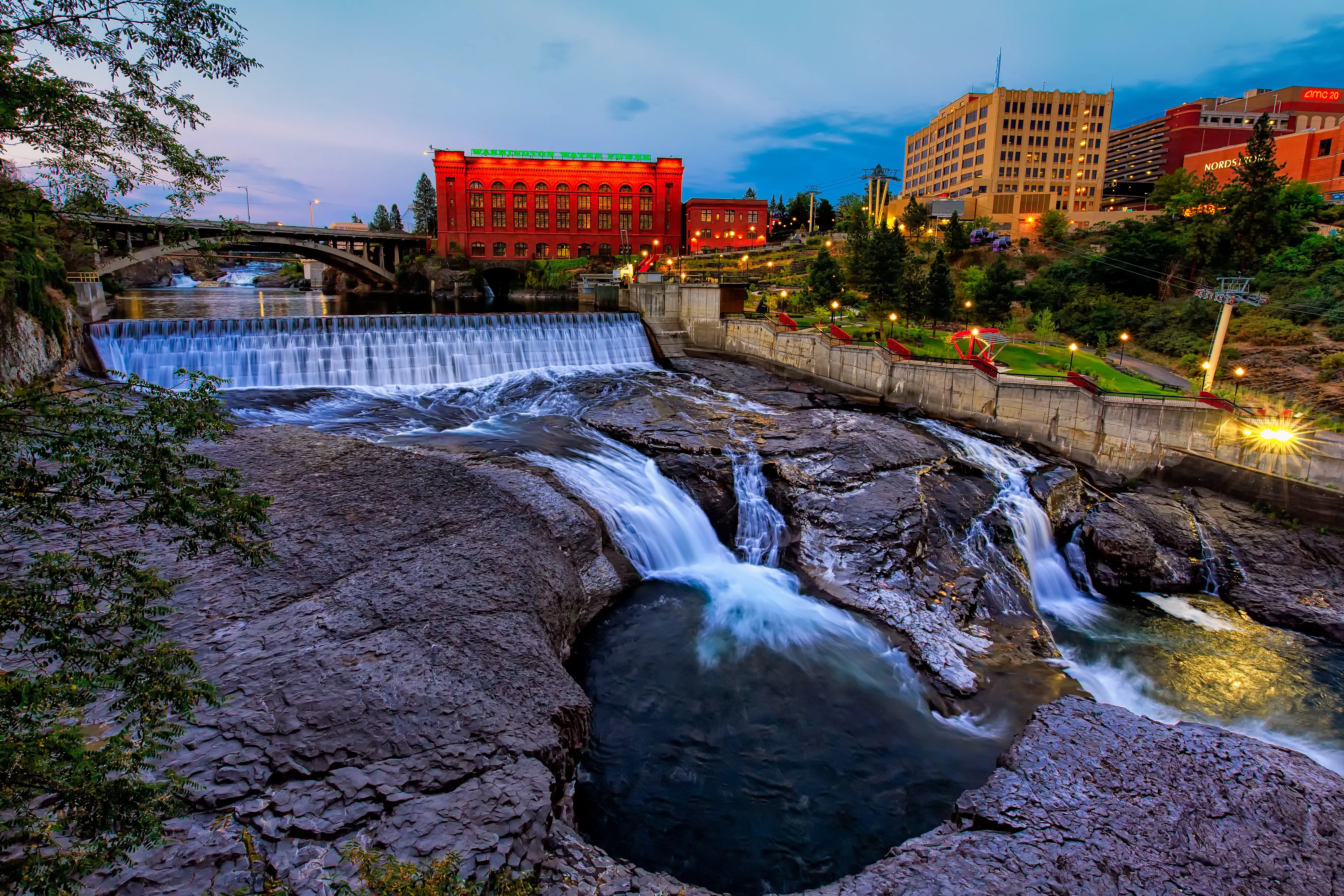
Outdoor life is a genuine daily draw from April through October and tolerable for the hardier set through winter. The Centennial Trail runs 40 miles from Riverfront Park east toward Coeur d'Alene, and sections near downtown are flat, paved, and heavily used by cyclists and walkers. Manito Park's rose garden and duck pond are a legitimate neighborhood institution on summer mornings. Spokane Falls in Riverfront Park remains one of the more dramatic urban natural features in the Pacific Northwest — a waterfall running through the heart of downtown that doesn't lose its novelty after years of living here.
Farmers markets and community food culture run through the warm months with particular energy at the South Perry Farmers Market on Thursdays and the Kendall Yards Night Market on Wednesday evenings in summer. The South Hill grocery corridor along 29th Avenue gives residents of that neighborhood access to natural grocery options, specialty retailers, and pharmacy services within walking distance. Downtown Spokane's renovation over the past decade has produced a legitimate restaurant and café scene centered around Main Avenue and the Kendall Yards neighborhood on the north bank of the Spokane River.
What surprises most people after six months is the winter. Spokane averages around 40 inches of snow annually, and while the city handles it better than most Pacific Northwest cities, the stretch from late November through early March requires planning. Those who've lived with Pacific Northwest coastal winters often underestimate how much sunnier Spokane is — the city sits in a rain shadow and logs significantly more annual sunshine hours than Seattle or Portland. The flip side is that "sunshine" in January means 28°F and packed snow on side streets. Retirees from colder climates adapt quickly; those from Southern California or Arizona may find it a harder adjustment.
| City | Median Home Price | Major Hospital | Walkability | Senior Living Depth | Overall Retirement Fit |
|---|---|---|---|---|---|
| Spokane, WA | $355,000 | Providence Sacred Heart (Regional Best) | Moderate (South Hill walkable) | Strong | ★★★★☆ |
| Coeur d'Alene, ID | ~$520,000 | Kootenai Health (Level II Trauma) | Moderate | Good | ★★★★☆ |
| Spokane Valley, WA | $420,000 | Proximity to Spokane systems | Car-dependent | Moderate | ★★★☆☆ |
| Cheney, WA | ~$310,000 | 20 min to Spokane facilities | Limited | Limited | ★★☆☆☆ |
| Liberty Lake, WA | ~$478,000 | 20 min to Spokane facilities | Good (mixed-use core) | Moderate | ★★★☆☆ |
| Walla Walla, WA | ~$340,000 | Providence St. Mary (smaller) | Good downtown | Moderate | ★★★☆☆ |
Coeur d'Alene is the most frequent comparison for Spokane retirees, and the decision usually comes down to price versus setting. Coeur d'Alene's lakefront draws are real, but so is the approximately $165,000 premium over Spokane's median — and Idaho's income tax means you lose Washington's no-income-tax advantage the moment you cross the state line. Liberty Lake offers a newer, more walkable suburban environment at a meaningful premium, but lacks Spokane's cultural depth and healthcare proximity. For pure affordability with access to Spokane's infrastructure, Cheney and parts of unincorporated Spokane Valley work financially but sacrifice the walkability and amenity access that most retirees find they actually want day-to-day.

Local Expert Takeaway: Retirees who thrive in Spokane tend to land in three neighborhoods: South Hill for walkability and Manito Park proximity, Rockwood/Comstock for quiet tree-lined streets with good access to Providence Sacred Heart, and Kendall Yards for a lock-and-leave lifestyle with the Centennial Trail at the front door. Those who struggle here typically underestimated the winters or overestimated the ability to live car-free outside of those core neighborhoods. If you're comparing Spokane to Coeur d'Alene, run the income tax math first — for retirees drawing pension and IRA income, Washington's no-income-tax structure is worth more than the scenery premium most people assume they're paying for.
Is Spokane a good place to retire?
Yes, for the right profile. Spokane makes the most sense for retirees who want a real city's cultural and medical infrastructure without paying Seattle or Portland prices. The combination of a $355,000 median sold price, Washington's no-income-tax advantage, and a healthcare system that serves the entire Inland Northwest creates a compelling case — particularly for those drawing pension or retirement account income who would face significant state income taxes in Idaho or Oregon.
How cold are Spokane winters, and is it manageable for retirees?
Spokane averages around 40 inches of annual snowfall and temperatures that regularly dip below freezing from December through February. The city handles snow removal reasonably well, and the significantly higher sunshine hours compared to western Washington help psychologically. Most retirees from the Midwest or Mountain West adapt easily; those relocating from Southern California or coastal Oregon should spend a January in Spokane before committing.
How does Spokane's senior property tax exemption work?
Washington's expanded program, effective for the 2027 tax year, allows homeowners 61 and older with household income under $74,000 to qualify for meaningful property tax relief in Spokane County. The program not only reduces taxes but freezes the assessed value of your home, meaning future appreciation won't increase your bill. The Spokane County Assessor's Office administers applications, and the expanded income threshold is expected to bring in thousands of new qualifying households across the county.
Explore the full Spokane series: The Ultimate Spokane Relocation Guide · Is Spokane Safe? · Cost of Living in Spokane · Best Neighborhoods in Spokane · Spokane Schools & Family Life · Spokane Youth Sports · Spokane Parks & Recreation · Retiring in Spokane · 1031 Tax-Deferred Exchange in Spokane · Spokane First-Time Homebuyers Guide · Moving to Spokane from California
Tell us what you need help with and we'll connect you with local resources.

About the Author
Todd Davidson is the founder of Living in Oregon and Living in Washington, where he publishes in-depth city guides, neighborhood resources, and local market insights covering more than 180 communities across the Pacific Northwest. While his background is in home financing and real estate, he created these digital platforms to help families research and compare regions before making a move.