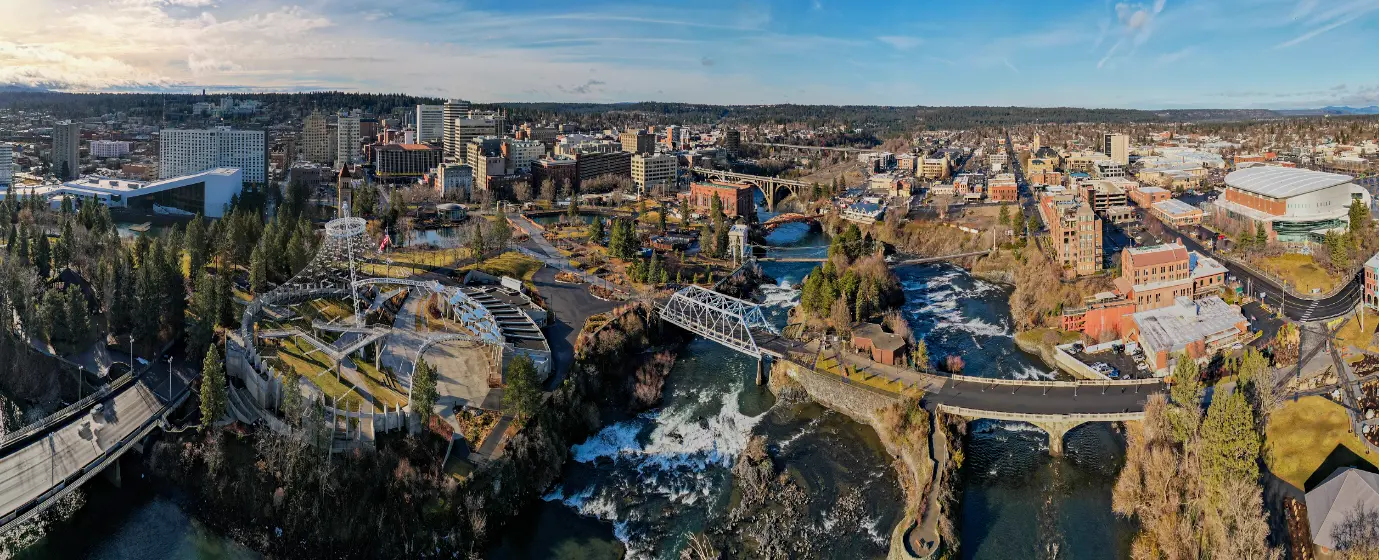
Eastern Washington · Washington
Not everyone doing a 1031 exchange is a seasoned portfolio investor. A growing share of the capital flowing into Spokane right now belongs to California homeowners — people who sold a primary residence, a rental house, or a small commercial property and are sitting on proceeds they'd rather deploy than hand over to the IRS. Spokane earns serious consideration as a replacement property market for one straightforward reason: a $1.4 million Bay Area property can buy meaningful rental inventory here, often debt-free or nearly so, in a market where rents are durable, tenants are plentiful, and the landlord-friendly environment is a sharp contrast to what California investors just left behind.
Spokane's rental market is anchored by real institutional demand. Gonzaga University, Washington State University Spokane, Providence Sacred Heart Medical Center, and a cluster of state government offices collectively keep a large, revolving pool of renters in place year after year. Roughly 42% of Spokane households rent — about 40,000 renter-occupied units citywide — and that proportion has been stable for years. The property types that trade most actively as investment vehicles here are single-family rentals, duplexes, and small multifamily buildings in the 4-to-20 unit range, with occasional larger apartment complexes trading among institutional buyers at the top of the market.
This guide walks through the mechanics of a 1031 exchange, what Spokane's investment property market looks like in 2026, the tax advantages Washington delivers compared to California, and the due diligence realities every out-of-state investor needs to understand before the 45-day clock starts running.

The core structure of a 1031 exchange is simpler than most people expect. You sell a relinquished property, and before closing, you appoint a qualified intermediary (QI) to hold the proceeds. You never touch the money — the moment those funds land in your personal account, the exchange is disqualified. From the close of your relinquished property sale, you have 45 calendar days to identify your replacement property in writing to the QI, and 180 calendar days total to close on it. These deadlines are absolute and cannot be extended except in declared federal disasters.
The like-kind rule is broader than most people realize. "Like-kind" in Section 1031 means real property exchanged for real property — period. A California single-family rental can exchange into a Spokane duplex, a strip of retail, a small apartment building, or bare land held for investment. What you cannot do is exchange investment property for a primary residence or personal-use vacation home without satisfying separate safe-harbor rules. The 1031 simply defers capital gains and depreciation recapture — it does not erase them — so the tax liability transfers to your Spokane property's adjusted basis.
The boot trap is the detail that catches investors off guard. If the replacement property's purchase price or equity is less than the relinquished property's net proceeds, the difference — called "boot" — is taxable in the year of the exchange. To defer 100% of the gain, the replacement property must be equal or greater in value to the relinquished property, and all cash proceeds must be reinvested. Financing down is fine; taking cash out is not.
Spokane's investment property market in 2026 is best described as recalibrating. The frenzied low-rate years pushed valuations up and compressed cap rates; the rate correction since 2022 has widened the bid-ask spread, particularly in small multifamily. The median home price sits at $355,000 citywide, which translates to meaningful buying power for investors arriving with exchange proceeds from California, where that figure wouldn't cover a garage.
Single-family rentals remain the most liquid asset class here. They move quickly, carry straightforward financing, and appeal to a deep tenant pool — particularly the families and healthcare workers who comprise a large share of Spokane's renter base. Duplexes have more inventory than a year ago, with roughly 6.5 months of supply, giving 1031 buyers room to negotiate. The small multifamily segment (5+ units) is where the pricing gap between buyers and sellers has been most pronounced: as of mid-2025, 81 multifamily properties were on the Spokane County market but only 7 were under contract. That illiquidity creates opportunity for buyers who can move quickly, but it also means the 45-day identification window is not forgiving for investors who arrive underprepared.
| Property Type | Typical Price Range | Est. Cap Rate | Avg Days to Close |
|---|---|---|---|
| Single-Family Rental | $280,000–$420,000 | 5.0%–6.5% | 30–45 days |
| Duplex (2-unit) | $380,000–$550,000 | 5.5%–6.8% | 35–50 days |
| Small Multifamily (5–20 units) | $650,000–$2.2M | 6.0%–7.0%+ | 45–75 days |
| Commercial / Mixed-Use | $800,000–$3M+ | 6.5%–8.5% | 60–90 days |
Single-family rentals and duplexes move fastest and represent the most reliable option for buyers on a tight 1031 timeline. Larger multifamily sits longer — useful for identification purposes, but buyers need experienced local counsel to avoid closing delays.
Looking to buy in Estimate your payment.
Enter your numbers to see an estimated monthly mortgage payment.
Estimate only. Excludes HOA fees and mortgage insurance.
California investors doing 1031 exchanges face a structural challenge: their relinquished properties have appreciated so far that finding replacement real estate at equal or greater value — without dramatically overpaying — requires looking outside their home state. Spokane has emerged as a landing spot because the math works, the landlord laws are more balanced, and Washington's tax structure is meaningfully friendlier. Here's how it breaks down by origin market.
A Bay Area investor selling a rental property at $1.4 million in exchange proceeds can realistically acquire two or three Spokane properties outright — a duplex near the South Hill plus a solid single-family rental in a neighborhood like Lincoln Heights or South Perry — and still have proceeds left over for capital reserves. The rent-to-price ratios in Spokane are materially better than anything available within 200 miles of San Francisco, and the exchange eliminates a state capital gains bill that could have run $100,000 or more at California's top rate.
Los Angeles and Orange County investors selling properties in the $800,000–$1.2 million range often target Spokane's small multifamily segment. A six-unit building in a stable Spokane neighborhood — think Garland or the area near Gonzaga — typically trades in the $900,000–$1.5 million range and delivers cap rates well above what the same capital could achieve in any Southern California submarket. The value proposition is straightforward: more units, higher yield, and no state income tax on the rental income going forward.
Sacramento and Inland Empire investors are often working with proceeds in the $500,000–$900,000 range — proceeds from properties that appreciated dramatically from pandemic-era buying. This cohort tends to target Spokane duplexes and strong single-family rentals in neighborhoods with tight vacancy, such as the areas around WSU Spokane's medical campus or the established residential corridors near Providence Sacred Heart. The price point aligns closely with what they're selling, making it easier to deploy the full exchange proceeds without taking on significant debt.
Washington's tax environment is genuinely one of its strongest competitive advantages for rental property investors, and the contrast with California is not subtle.
| Tax Item | California | Washington |
|---|---|---|
| State income tax on rental income | Up to 13.3% | None |
| Property tax rate on new purchase | Varies; often 1.1%–1.3% | ~0.96% (Spokane County) |
| Sales tax | None (services/goods vary) | 6.5% + local (materials, furnishings) |
| Long-term capital gains (state) | Up to 13.3% | 7% on gains over ~$262,000/year |
| Depreciation recapture (state) | Taxed as ordinary income | No state income tax — no recapture at state level |
Washington has no state income tax — one of nine states in the country with that distinction. For a rental investor netting $40,000 per year on a Spokane property, that zero-tax treatment versus California's top bracket of 13.3% represents real annual savings compounding over a long hold period. The depreciation deductions you take federally pass through without any state reclaim.
Washington's 7% capital gains tax — enacted in 2022 and upheld by the state Supreme Court — applies only to long-term capital gains exceeding roughly $262,000 per year for individual filers. For most buy-and-hold rental investors, annual rental income does not trigger this threshold, and depreciation recapture on a future sale would be the primary concern. The one tax item investors should budget for is Washington's sales tax on materials and furnishings for a rental renovation — at 6.5% plus Spokane's local additions, a $50,000 rehab budget carries a meaningful materials surcharge that California investors (with no sales tax) sometimes overlook.
A 1031 exchange preserves the depreciation basis from the relinquished property — the basis is not stepped up, so the carry-over depreciation schedule continues on the replacement property. For investors considering completely passive ownership, Delaware Statutory Trusts (DSTs) qualify as like-kind replacement property and eliminate the management burden entirely, though they come with illiquidity and require accredited investor status.
Washington's landlord-tenant code is more balanced than California's but has tightened meaningfully since 2020. Notice requirements for nonpayment are currently 14 days written notice before filing, and eviction timelines — while not as protracted as California — can still run 60 to 90 days through the full court process when contested. Statewide rent control does not exist in Washington as of 2026, though it has been proposed periodically in the legislature; Spokane itself has no local rent ordinance in place.
Out-of-state owners almost uniformly benefit from professional property management, and Spokane has an established ecosystem to support it. Management fees typically run 8–10% of collected rent, with leasing fees of half to one month's rent for new placements. The average citywide rent of approximately $1,416 per month means management costs are manageable relative to the income, especially on multifamily. Vacancy is the more nuanced story: South Spokane neighborhoods run vacancy rates around 4.4%, while North Spokane's figure approaches 12.8% — a difference that reflects newer construction and higher apartment supply in the north. Knowing which submarket you're buying into matters enormously.
What out-of-state owners consistently underestimate is deferred maintenance on Spokane's older housing stock. Many of the duplexes and small multifamily buildings that look attractive on paper were built in the 1940s through 1970s and carry real capital expenditure risk — roofs, electrical panels, plumbing, and sewer lines that haven't been touched in decades. A pre-close sewer scope and full mechanical inspection are not optional; they are the difference between a performing asset and a money pit.
| Item | What to Verify | Local Resource |
|---|---|---|
| Title search | Clear title, no undisclosed liens or easements | Spokane-area title company (Stewart, First American, Fidelity) |
| Sewer / septic status | Connected to city sewer or on septic; scope lines on older stock | City of Spokane Utilities or licensed sewer inspector |
| Flood zone status | FEMA flood map designation, especially near Spokane River corridors | FEMA Flood Map Service Center |
| Rental permit requirements | City of Spokane rental registration — required for all rental units | City of Spokane Business Registration Office |
| HOA restrictions on rentals | CC&Rs for any condo or HOA property — some prohibit or limit rentals | HOA management company; review CC&Rs directly |
| ADU zoning potential | Washington's strong ADU laws allow detached ADUs on most SFR lots; verify setback | City of Spokane Planning & Development |
| School district boundaries | Spokane Public Schools vs. neighboring districts affects tenant pool quality | Spokane Public Schools boundary maps |
| Current lease status | Month-to-month vs. fixed term; rent level vs. market; tenant screening standards | Request estoppel letters from current tenants |
| Deferred maintenance inspection | Full home inspection + sewer scope + electrical panel on pre-1980 buildings | Licensed Washington state inspector |
| Property management referral | Interview 2+ local PMs before closing; establish relationship before taking ownership | Spokane Association of Realtors referrals |
| Short-term rental ordinances | Spokane requires STR licensing; confirm property qualifies if Airbnb is part of the plan | City of Spokane STR permit portal |
| Zoning confirmation | Confirm R1/R2/R3 classification; verify actual legal use matches seller's representation | City of Spokane permit portal |
| Insurance estimate | Spokane experiences real winters; insurance costs on older multifamily have risen sharply | Get quote pre-offer, not post-closing |
| 1031 timeline alignment | Confirm realistic close date fits within your 180-day window | Work with local escrow company familiar with 1031s |

Local Expert Takeaway: The single biggest mistake California investors make entering Spokane is targeting the highest-yielding property on the MLS without accounting for the actual age of the asset. A duplex in East Central or West Central priced at $380,000 with an advertised 7% cap rate often comes with a sewer lateral that hasn't been scoped since the Clinton administration, a 200-amp panel feeding a 4-unit property, and a roof within two years of failure. Run the inspection and scope before you waive contingencies — the 45-day window creates pressure, but it doesn't justify skipping due diligence that a local investor would never skip.
✅ Spokane's median home price of $355,000 and cap rates above 6% on small multifamily make it one of the most accessible replacement property markets for California 1031 investors working with mid-range proceeds.
⚠️ North Spokane vacancy rates near 12.8% reflect new apartment supply in that corridor — investors targeting strong cash flow should focus on South Spokane and established mid-city neighborhoods where vacancy runs closer to 4–5%.
📍 Washington's no-income-tax structure means every dollar of net rental income is yours — no state bite on the way in, and no state-level depreciation recapture when you eventually sell.
Does a 1031 exchange work for out-of-state property?
Yes — the 1031 exchange has no geographic restriction within the United States. You can sell a property in California, identify a replacement property in Spokane, and complete the exchange as long as both properties qualify as investment or business-use real estate and you meet the 45/180-day deadlines. The qualified intermediary handles the funds transfer across state lines without issue.
What is the cap rate on rental property in Spokane?
Small multifamily and duplex properties in Spokane typically trade with cap rates in the 5.5%–7.0% range as of 2026, with the strongest returns on value-add buildings in established residential neighborhoods. Larger apartment complexes (5+ units) have been trading in the 6.0%–7.0%+ range, while single-family rentals generally run closer to 5.0%–6.5% depending on condition and submarket. The key variable is vacancy — properties in South Spokane or near the university corridors tend to underwrite more reliably than newer supply areas in the north.
Do I need a local property manager for a 1031 investment in Washington?
You are not legally required to hire a property manager, but out-of-state owners who self-manage Spokane rentals routinely underestimate the practical difficulty — particularly when navigating Washington's specific notice and eviction procedures for the first time. A local manager at 8–10% of collected rent handles maintenance calls, lease renewals, legal notices, and tenant screening, and typically pays for itself in avoided mistakes. Establishing that relationship before closing, not after the tenant's first call, is strongly recommended.
Explore the full Spokane series: The Ultimate Spokane Relocation Guide · Is Spokane Safe? · Cost of Living in Spokane · Best Neighborhoods in Spokane · Spokane Schools & Family Life · Spokane Youth Sports · Spokane Parks & Recreation · Retiring in Spokane · 1031 Tax-Deferred Exchange in Spokane · Spokane First-Time Homebuyers Guide · Moving to Spokane from California
Tell us what you need help with and we'll connect you with local resources.

About the Author
Todd Davidson is the founder of Living in Oregon and Living in Washington, where he publishes in-depth city guides, neighborhood resources, and local market insights covering more than 180 communities across the Pacific Northwest. While his background is in home financing and real estate, he created these digital platforms to help families research and compare regions before making a move.