
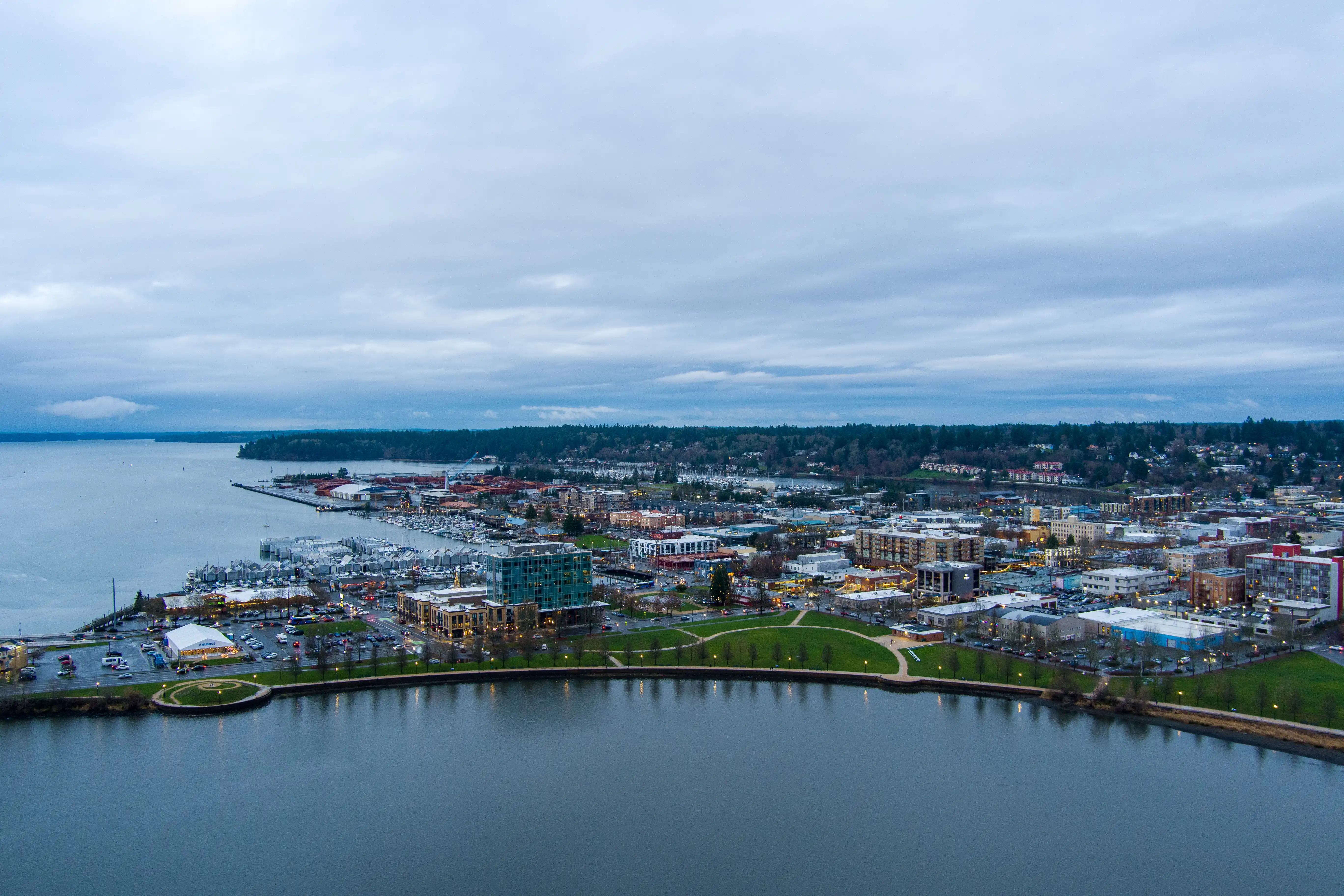
Puget Sound · Washington
Not everyone doing a 1031 exchange is a full-time real estate investor. A significant share of the capital flowing into Olympia right now comes from California homeowners — people who bought a house in the Bay Area or San Diego two decades ago, finally sold, and are now sitting on $800,000 to $1.4 million in equity they need to deploy within 180 days or hand a large portion to the IRS. Olympia is worth a serious look as a replacement property market because the median home price sits at $513,000 — roughly half of Seattle's — the state collects no income tax on rental proceeds, and a government-anchored tenant base keeps demand unusually durable for a city of 56,000.
The rental market here runs on a simple engine: Olympia is the state capital, which means thousands of state employees, university students, and healthcare workers need housing they cannot afford to own. Roughly 51% of households in Olympia are renter-occupied — a share more typical of a dense urban core than a mid-sized Pacific Northwest city. Two-bedroom units dominate the stock, and the bulk of the market rents in the $1,500–$2,000 range. Single-family rentals, duplexes, and small multifamily buildings are the investment vehicles that trade most frequently here, with larger apartment communities increasingly concentrated in adjacent Lacey and Tumwater.
This guide covers everything a 1031 investor needs before making an offer in Olympia: a clean-language refresher on exchange mechanics, a realistic look at local cap rates and property types, the Washington tax picture versus California, the management reality for out-of-state owners, and a due diligence checklist designed for buyers working against a 45-day identification deadline.

The core exchange is straightforward: sell a qualifying investment property, park the proceeds with a qualified intermediary — not your own bank account — and identify replacement property within 45 calendar days of closing. You then have 180 days from that same closing date to complete the purchase. Miss either deadline by a single day and the exchange fails, meaning the entire gain becomes taxable in the year of the sale.
The like-kind rule is more permissive than most people expect. You can sell a single-family rental in Sacramento and buy a small apartment building in Olympia. You can sell a commercial property in San Jose and buy two duplexes here. Any real property held for investment or productive use in a trade or business qualifies — the asset classes do not need to match, just the investment intent. The one trap worth watching carefully is boot: if your replacement property is worth less than your relinquished property, or if you pull any cash out of the proceeds, that difference becomes taxable immediately. Most exchange attorneys advise trading into equal or greater value to eliminate boot entirely.
Olympia's investment property market divides cleanly into four tiers. At the entry level, Eastside cottages and 1920s-era ramblers in the $250,000–$430,000 range attract value-add investors willing to renovate. The middle of the market — $490,000 to $600,000 — is where most duplexes and clean single-family rentals trade. Newer construction and small multifamily buildings in the $600,000–$900,000 range represent the institutional-adjacent tier, where cap rates compress and competition from out-of-state buyers is sharpest. Waterfront properties on East Bay Drive and West Bay Drive are in their own category, with estates reaching $1.7 million and renting at premium rates to legislative-session tenants and senior state officials.
Cap rates across the market generally fall in the 5% to 6.5% range depending on property type and condition. The single LoopNet-listed 6-unit building in Olympia during the first half of 2026 was priced at a 5.61% cap rate — consistent with national multifamily benchmarks where all-class averages hover around 5.6%. Value-add Class C properties are where investors have been finding the most compression opportunity, as national data from CBRE and Freddie Mac confirms that Class C cap rates compressed more than any other tier in 2025.
| Property Type | Typical Price Range | Est. Cap Rate | Avg Days to Close |
|---|---|---|---|
| Single-Family Rental (clean) | $430,000 – $565,000 | 5.0% – 5.8% | 30–45 days |
| Duplex / Small Multifamily | $490,000 – $750,000 | 5.5% – 6.5% | 30–45 days |
| Value-Add SFR (fixer) | $250,000 – $400,000 | 6.0% – 7.5% | 21–35 days |
| Apartment Building (5+ units) | $900,000 – $2.5M+ | 5.2% – 6.0% | 45–60 days |
| Waterfront / Premium SFR | $800,000 – $1.7M | 3.5% – 4.5% | 45–75 days |
Duplexes and clean single-family rentals move fastest — typically under 30 days from accepted offer to close with experienced investors using established title companies. Larger apartment buildings and waterfront properties take longer due to lender timelines and more complex due diligence, which is a genuine risk for 1031 buyers who cannot afford to have a closing slip past the 180-day window.

Looking to buy in Estimate your payment.
Enter your numbers to see an estimated monthly mortgage payment.
Estimate only. Excludes HOA fees and mortgage insurance.
The math for California 1031 proceeds landing in Olympia is not complicated. A Bay Area seller who nets $1.3 million from a rental property sale faces a choice: chase a replacement property in a California market where a comparable rental costs $1.2 million and generates a 3.5% cap rate, or move the capital to a market where the same dollar amount buys multiple properties with meaningfully higher yields. Olympia has become one of the Pacific Northwest destinations where that calculation lands convincingly.
A Bay Area investor selling a San Jose or Oakland rental at $1.4 million can purchase a duplex in Olympia in the $490,000–$550,000 range and a clean single-family rental in the low $400,000s — both debt-free — and still have capital left for reserves or a third identification. The combined gross rental income on both properties would typically run $3,800–$4,500 per month based on current Olympia market rents, which represents a cash-on-cash yield that simply does not exist at Bay Area purchase prices.
Southern California sellers — particularly those exiting Los Angeles or San Diego rentals in the $800,000–$1.1 million range — are finding that Olympia allows them to acquire one well-positioned rental outright and carry no debt service at all. The absence of California's 13.3% top income tax bracket on rental income is, for many of these investors, worth as much as the price differential itself.
Sacramento and Inland Empire investors are the closest price-point match to Olympia's market, which actually makes the exchange more nuanced. A Rancho Cucamonga rental that sold for $650,000 can identify a replacement in Olympia at roughly the same price point — but the tenant base shifts from a blue-collar workforce market to a government-employee and university market with lower turnover. For investors who have dealt with frequent turnover and deferred maintenance cycles, that stability is the primary draw.
Washington's most important advantage for rental property investors is the absence of a state income tax. Every dollar of net rental income stays in the investor's pocket rather than being split with a state revenue department. For a California investor accustomed to paying up to 13.3% of net rental income to Sacramento, moving a rental portfolio to Washington can represent a meaningful annual improvement in after-tax yield with no change in gross rents collected.
Property taxes in Thurston County run approximately 0.96% of assessed value. On a $513,000 rental property, that works out to roughly $4,925 annually — far lower than what a California investor would pay on a newly purchased property at full assessed value under current Prop 13 rules, which have been eroding as long-held properties turn over. Washington does apply its 6.5% state sales tax (plus local add-ons) to construction materials and furnishings, so renovation budgets for value-add purchases should account for that cost — unlike Oregon, where no sales tax applies.
| Tax Item | California | Washington |
|---|---|---|
| State income tax on rental income | Up to 13.3% | None |
| Property tax rate (new purchase) | ~1.1% – 1.25% (varies by county) | ~0.96% (Thurston County) |
| Sales tax on renovation materials | 7.25% – 10.75% | 6.5% + local (avg ~8.9%) |
| Long-term capital gains tax | Taxed as ordinary income (up to 13.3%) | 7% on gains over $262,000/year |
| Short-term rental income treatment | Ordinary income + state income tax | Ordinary income, no state income tax |
Washington's 7% capital gains excise tax — established in 2023 and upheld by the state Supreme Court — applies only to long-term capital gains exceeding $262,000 per year. For most investors holding a small portfolio of Olympia rentals, annual net capital gains from property sales will rarely trigger this threshold, and rental income itself is not capital gains. One additional note on 1031 mechanics: the depreciation basis of the relinquished property carries over into the replacement property rather than being stepped up, which means accumulated depreciation recapture is deferred, not eliminated. For investors considering a fully passive approach, Delaware Statutory Trusts offer a 1031-compliant option where fractional ownership of a large institutional property replaces the management burden entirely — a path worth discussing with a qualified intermediary if active management is unappealing.
Washington's landlord-tenant laws are more tenant-protective than California's but less restrictive than Portland's or Seattle's. As of 2026, there is no statewide rent control in Washington, though proposals have circulated in the legislature repeatedly. Olympia itself does not have a local rent control ordinance, which means investors have full flexibility to adjust rents to market at lease renewal. Notice requirements for rent increases, nonpayment notices, and eviction proceedings follow state statute — generally 14 days for nonpayment, with a court process for unlawful detainer that moves more predictably than California's system but still requires proper documentation at every step.
For out-of-state investors, professional property management is effectively non-negotiable. The typical management fee in Olympia runs 8–10% of gross monthly rent, with lease-up fees of half to one month's rent for new tenant placement. Real Property Management and Olympia Property Management are among the local firms with verifiable Olympia portfolios — worth interviewing before closing, not after. The mistake most out-of-state buyers make is assuming they can self-manage remotely for the first year and transition to a manager later; the deferred maintenance conversations and tenant communication gaps that accumulate during that transition period consistently cost more than the management fee would have.
Vacancy in Olympia has been running higher than investors expect based on the city's tight ownership market. Thurston County apartment vacancy reached its highest point in a decade in early 2025, driven by a wave of new multifamily completions. State budget allocations effective July 2025 funded hundreds of new state government hires, which is expected to absorb meaningful rental inventory — but investors should underwrite with a 6–8% vacancy assumption rather than counting on full occupancy.
| Item | What to Verify | Local Resource |
|---|---|---|
| Title search | Clean chain of title, no liens or encumbrances | Thurston County Title or Chicago Title Olympia |
| Sewer vs. septic | City sewer connection or septic system age/condition | City of Olympia Public Works; septic inspection required |
| Flood zone status | FEMA flood map; Olympia has low-lying areas near Budd Inlet | FEMA Flood Map Service Center |
| Rental permit / business license | City of Olympia may require a business license for rental activity | City of Olympia Finance Dept |
| HOA restrictions on rentals | Some Olympia HOAs restrict short-term or long-term rentals | Review CC&Rs before offer |
| ADU zoning potential | Washington state law broadly enables ADUs on SFR lots — verify setbacks and utility capacity | City of Olympia Planning Dept |
| School district assignment | Olympia School District covers city proper; affects tenant pool quality | Olympia School District boundary maps |
| Current lease status | Month-to-month vs. fixed term; existing tenant payment history | Request estoppel letters from current tenants |
| Deferred maintenance inspection | Roof, HVAC, foundation, electrical panel | Licensed WA home inspector; sewer scope included |
| Short-term rental ordinance | Olympia has not enacted a comprehensive STR ban, but verify current status | City of Olympia Municipal Code |
| Property management referral | Interview 2–3 local managers before close, not after | Local PM firms; investor forums |
| 1031 timeline alignment | Confirm seller can close within your 180-day window | Coordinate with qualified intermediary and escrow |
| Environmental / oil tank | Older Eastside and Downtown properties may have decommissioned oil tanks | Phase I ESA if commercial; oil tank inspection for older SFR |
| Zoning verification | Confirm current use is legally conforming | City of Olympia GIS zoning portal |
Local Expert Takeaway: The single most common mistake California 1031 buyers make in Olympia is identifying only one property under the assumption they can close on it. With inventory running below 2.5 months and well-priced duplexes going under contract in two to three weeks, a single-property identification strategy collapses the moment the seller accepts another offer or the inspection reveals a deferred maintenance issue. Identify three properties across different price tiers — a clean duplex near Downtown, a value-add cottage on the Eastside, and one backup SFR in Northwest Olympia — and negotiate your inspection contingency aggressively on whichever one pencils best.
If you're approaching the 45-day identification window, the most important call you can make is to get your investment financing structured before you write your first offer. DSCR loans — which underwrite based on the rental property's income rather than your personal debt-to-income ratio — are the preferred vehicle for most California investors deploying 1031 proceeds in Washington, particularly if you want to keep the new mortgage off your personal financial picture. Todd can connect you with lenders who know the Olympia investment market and have closed DSCR transactions here, so you're not discovering loan conditions during your 180-day window.
✅ Olympia's government-anchor tenant base — state employees, university students, healthcare workers — keeps rental demand unusually stable for a city its size, with roughly half of all households renter-occupied.
⚠️ Apartment vacancy ran at a decade-high in early 2025 due to new supply; investors should underwrite at 6–8% vacancy rather than assuming the tight ownership market translates directly to rental occupancy.
📍 Washington's zero state income tax is the single largest structural advantage for California investors moving a rental portfolio here — the yield improvement on every dollar of net rent is immediate and permanent.
Does a 1031 exchange work for out-of-state replacement property?
Yes, and it is one of the most common use cases for the exchange. The like-kind rule applies to investment real property anywhere in the United States — you can sell a California rental and identify replacement property in Washington without any restrictions based on geography. The same 45-day identification and 180-day closing deadlines apply regardless of where the replacement property is located.
What is the cap rate on rental property in Olympia?
Cap rates in Olympia's investment market currently run in the 5% to 6.5% range depending on property type and condition. Clean single-family rentals and duplexes are trading in the 5.0%–5.8% range, while value-add properties — older cottages needing cosmetic or systems work — can pencil at 6.0%–7.5% once stabilized. Waterfront properties on East Bay Drive and West Bay Drive compress to the low 4% range due to their premium price points.
Do I need a local property manager for a 1031 investment in Washington?
For out-of-state owners, professional management is strongly advisable. Washington landlord-tenant law has specific notice and documentation requirements for rent increases, nonpayment, and evictions — and errors in the process can significantly extend the timeline to resolve a problem tenant. Management fees of 8–10% of gross rent are standard in Olympia, and the cost is deductible as a rental expense, which makes the after-tax impact considerably lower than the gross percentage suggests.
Explore the full Olympia series: The Ultimate Olympia Relocation Guide · Is Olympia Safe? · Cost of Living in Olympia · Best Neighborhoods in Olympia · Olympia Schools & Family Life · Olympia Youth Sports · Olympia Parks & Recreation · Retiring in Olympia · 1031 Tax-Deferred Exchange in Olympia · Olympia First-Time Homebuyers Guide · Moving to Olympia from California
Tell us what you need help with and we'll connect you with local resources.

About the Author
Todd Davidson is the founder of Living in Oregon and Living in Washington, where he publishes in-depth city guides, neighborhood resources, and local market insights covering more than 180 communities across the Pacific Northwest. While his background is in home financing and real estate, he created these digital platforms to help families research and compare regions before making a move.