
Puget Sound · Washington
There's a specific moment most first-time buyers in Olympia describe — usually somewhere between the third open house and the second rejected offer — when the process stops feeling like a real estate search and starts feeling like a test they forgot to study for. The Capitol dome is visible from half the city, the farmers market smells like coffee and fresh bread on Saturday mornings, and the neighborhoods are genuinely livable. But this is also a market where the median home price sits at $513,000, where homes that are priced right go pending in under a week, and where "just save a little more" is advice that costs buyers real money every month they wait.
At $513,000, the Olympia median gets you something real — typically a 3-bedroom single-family home in a neighborhood like Eastside or Northwest Olympia, move-in ready but not renovated, with a yard and off-street parking. Below that median, in the $350,000–$450,000 range, you're navigating condos, townhomes, and older ranchers that need updating. Meanwhile, renting a comparable 3-bedroom house in Olympia runs somewhere between $1,900 and $2,400 a month — and that money builds zero equity. The gap between renting and owning is real, but so is the path to getting there.
This guide walks you through that path step by step. You'll find out what your specific budget actually buys, which neighborhoods make sense for entry-level buyers, what credit score and income you genuinely need, where first-timers consistently get tripped up in the Olympia market, and how to get into a home without coming up with 20% down. Washington real estate can feel opaque from the outside — this guide is the insider version.

Olympia makes a compelling case for the first-time buyer who's been watching Seattle prices and wondering if homeownership is even possible in the Pacific Northwest. At roughly $513,000, the Olympia median is nearly half of Seattle's — and it comes with something Seattle rarely offers at any price: genuine neighborhood character, walkable corridors, and a manageable commute to state government jobs that are among the most stable employment in the region. The Olympia School District carries an A rating, property taxes run approximately 0.96% annually, and the city's size — just over 56,000 people — means you're not fighting big-city traffic patterns to get from your neighborhood to the grocery store.
The honest reality is that the under-$450,000 tier in Olympia is competitive and thin. Inventory sits well below a balanced market — roughly a 2.3-month supply as of early 2026 — which means well-priced entry-level homes don't linger. Neighborhoods like Eastside and Westside offer more accessible price points but often present older housing stock. Condos clustered around the downtown corridor average closer to $349,000 and represent the most realistic path for buyers entering below the city median. First-timers willing to consider a condo or a smaller single-family home on the outskirts of the city have genuinely viable options here.
The commute question matters too. Olympia sits about 65 minutes from Seattle, which makes it too far for daily northward commuting unless you're remote-friendly or your job is in the South Sound. For buyers working in state government, Providence St. Peter Hospital, Thurston County offices, or at Evergreen State College, Olympia is the center of the map — not a compromise location.
| Price Range | What You Typically Find | Neighborhood Examples | Competition Level |
|---|---|---|---|
| Under $350K | Condos, 1–2 bed units, older townhomes | Downtown corridor, Eastside periphery | Moderate — limited inventory |
| $350K–$450K | Small SFRs (2–3 bed), fixer-uppers, some condos | Eastside, outer Westside, South Olympia | High — buyers competing for limited stock |
| $450K–$550K | 3-bed SFRs, move-in ready, smaller lots | Northwest Olympia, Northeast Olympia, Westside | High — near-median homes move in under 2 weeks |
| $550K–$650K | Larger 3–4 bed homes, updated interiors, better lots | South Capitol, Bigelow Highlands, Carlyon-North | Moderate — more inventory, still competitive |
| $650K+ | Higher-end SFRs, larger lots, renovated kitchens/baths | West Bay Drive, Cooper Point, Governor Stevens | Lower — longer days on market |
The sweet spot for first-time buyers in Olympia is roughly the $400,000–$500,000 range, where 3-bedroom single-family homes become available without requiring full gut renovations. At $249 per square foot — the mid-2026 average — a $450,000 budget gets you around 1,800 square feet, which is enough room for a starter family home in neighborhoods like Northwest Olympia or the quieter parts of Eastside. Homes at or just below the median have been selling for about 1% below list price on average, meaning there's narrow negotiating room but not zero.
The under-$400,000 buyer faces a harder search. Condos dominate this range, and while the condo market averages around $349,000, inventory is thin and associations vary widely in financial health and restrictions. If a condo fits your life right now, it can be a smart equity-building step before a future move-up purchase. Just budget for HOA fees alongside your mortgage — they can run $250–$500 a month depending on the building.
| Step | What Happens | Typical Timeline | What First-Timers Get Wrong |
|---|---|---|---|
| Get finances in order | Pull credit, reduce debt, build cash reserves | 1–6 months before buying | Underestimating how much cash to close actually costs |
| Pre-approval | Lender reviews income, assets, credit; issues letter | 1–3 days | Shopping rates only — not vetting lender's local reputation |
| Find an agent | Interview agents, sign buyer's agreement | 1–2 weeks | Signing with someone who doesn't know Thurston County micro-markets |
| Active search | Touring homes, attending open houses | 2–8 weeks | Waiting for "perfect" and losing realistic homes to faster buyers |
| Making offers | Write offer with price, terms, contingencies | Immediate when ready | Offering list price assuming it's always negotiable — it isn't always |
| Under contract | Mutual acceptance, earnest money deposited | 1–3 days after accepted offer | Not moving fast enough on earnest money — Thurston norms run $3K–$10K |
| Inspection | Licensed inspector reviews home systems, structure | Days 5–10 of contract | Skipping inspection on a 1970s Eastside rancher is a costly gamble |
| Appraisal | Lender orders appraisal to verify home value | Days 10–20 | Not having a plan if appraisal comes in low |
| Final walkthrough | Verify home condition matches contract terms | 24–48 hours before closing | Skipping this — sellers occasionally leave surprises |
| Closing | Sign documents, fund loan, record deed | Day 30–45 typically | Changing jobs or opening new credit accounts before this day |
Olympia's market in 2026 sits at a useful in-between: not the frenzy of 2021, but not a buyer's market either. Homes are averaging about 46 days on market overall, but that average is dragged up by overpriced listings sitting unsold. Realistically priced homes in desirable neighborhoods — especially anything under $500,000 — still generate multiple offers within the first week. Earnest money in Thurston County typically runs between $3,000 and $10,000, and submitting below that range signals a timid buyer in a competitive situation.
Inspection waivers became common during the peak years, and while that pressure has eased somewhat, some buyers in competitive multiple-offer situations are still waiving them to win. Olympia's housing stock includes a lot of homes built in the 1960s through 1980s, particularly on the Eastside and Westside — these houses often have deferred maintenance, aging electrical panels, and moisture issues in crawl spaces. Walking away from an inspection on a 50-year-old home is a risk most first-timers cannot financially absorb. If the competition requires waiving inspection, consider an escalation clause paired with a pre-offer walkthrough with a contractor instead.
Closing typically runs 30–45 days from mutual acceptance, though lenders doing same-day pre-approval with clean financial files can sometimes close in as few as 21 days. Washington is a community property state, which matters if you're buying with a spouse or partner — both parties' incomes and debts are considered.

Looking to buy in Estimate your payment.
Enter your numbers to see an estimated monthly mortgage payment.
Estimate only. Excludes HOA fees and mortgage insurance.
A conventional loan in Washington requires a minimum 620 credit score, but the rate you actually get depends heavily on hitting 680 or better — ideally 720+. The monthly payment difference between a 650 and a 740 score on a $450,000 loan is often $100–$150 per month because of the difference in interest rate tiers and private mortgage insurance costs. That's $1,200–$1,800 per year in unnecessary payments, which adds up fast over a 5-year holding period.
FHA loans require a 580 minimum for the 3.5% down payment option. They're often the right call for buyers with lower scores or thinner down payments, but they carry mortgage insurance for the life of the loan unless you refinance — so they're not a forever product. At a $513,000 purchase price with 3.5% down, you're bringing roughly $18,000 to closing (down payment plus upfront costs), which is achievable but requires deliberate saving.
To run the income math plainly: at a 28% front-end debt-to-income ratio — meaning your housing payment (principal, interest, taxes, insurance) shouldn't exceed 28% of your gross monthly income — qualifying for a $400,000 home requires roughly $6,500–$7,000 in gross monthly income, or about $78,000–$84,000 annually. A $500,000 home pushes that to approximately $100,000–$105,000 annually. A $600,000 home requires roughly $115,000–$120,000 annually. These numbers assume a 30-year loan with current rate environments. One factor that trips up buyers relocating from California, Oregon, or other income-tax states: Washington has no state income tax, which meaningfully increases take-home pay. If you're moving from a state with a 5%–9% income tax rate, your qualifying power here is higher than you're used to calculating.
Mistake 1: Shopping at the top of their qualification, not the top of their comfort. Lenders will approve you for more than you should spend — that's how qualification works. A lender might tell you that you qualify for a $575,000 home, but if that payment stretches your monthly budget to the point where you can't save, travel, or weather a car repair, you've bought a house that owns you. In Olympia, there are solid homes in the $430,000–$480,000 range. That 10% buffer between qualification ceiling and purchase price is worth more than the extra bedroom.
Mistake 2: Assuming list price is negotiable when it isn't. Olympia's market has cooled from peak 2021 levels, but well-priced homes under $500,000 still move. Buyers who come in at 3%–5% below list on a correctly-priced Eastside or Northwest Olympia home are often watching it go pending to another buyer at list price or above. The 1% below-list average is a citywide figure pulled up by overpriced or stale listings — it does not apply to every home.
Mistake 3: Skipping inspection on older housing stock. Olympia has a lot of homes built between 1960 and 1990. Crawl space moisture, old wiring, and aging plumbing are common in this era of construction. A home inspection in Thurston County costs roughly $400–$600 and could uncover $15,000–$40,000 in deferred maintenance. Walking into a 1975 Westside rancher without an inspection because the market felt pressured is one of the most financially damaging decisions a first-time buyer can make.
Mistake 4: Not understanding how school boundaries affect resale value. Even if you don't have kids, you will eventually sell your home to someone who does. Homes within Lincoln Elementary or Jefferson Middle School boundaries consistently show stronger resale demand. Buyers who purchase just outside desirable school zones because the price looked better on paper sometimes discover the discount reflects exactly what they're getting. Before you make an offer, verify the specific school assignment at that address — not just the general district.
Mistake 5: Waiting for prices to drop in a supply-constrained market. Olympia had only about a 2.3-month supply of homes as of early 2026. That's not a market that corrects sharply downward without a significant economic disruption. Buyers who waited through 2023, 2024, and 2025 "for the market to cool" watched prices hold steady and their renting costs rise. If your income, credit, and savings are aligned, waiting costs you real money — in continued rent, in lost appreciation, and in a qualification window that can close if interest rates move.
Northwest Olympia is one of the most practical entry points for buyers in the $450,000–$520,000 range. It's a quieter, more residential quadrant with solid schools, reasonable lot sizes, and enough inventory turnover that buyers aren't constantly beaten out by cash offers. The homes here skew 1980s–2000s construction, which means fewer surprises on inspection than the older Eastside stock.
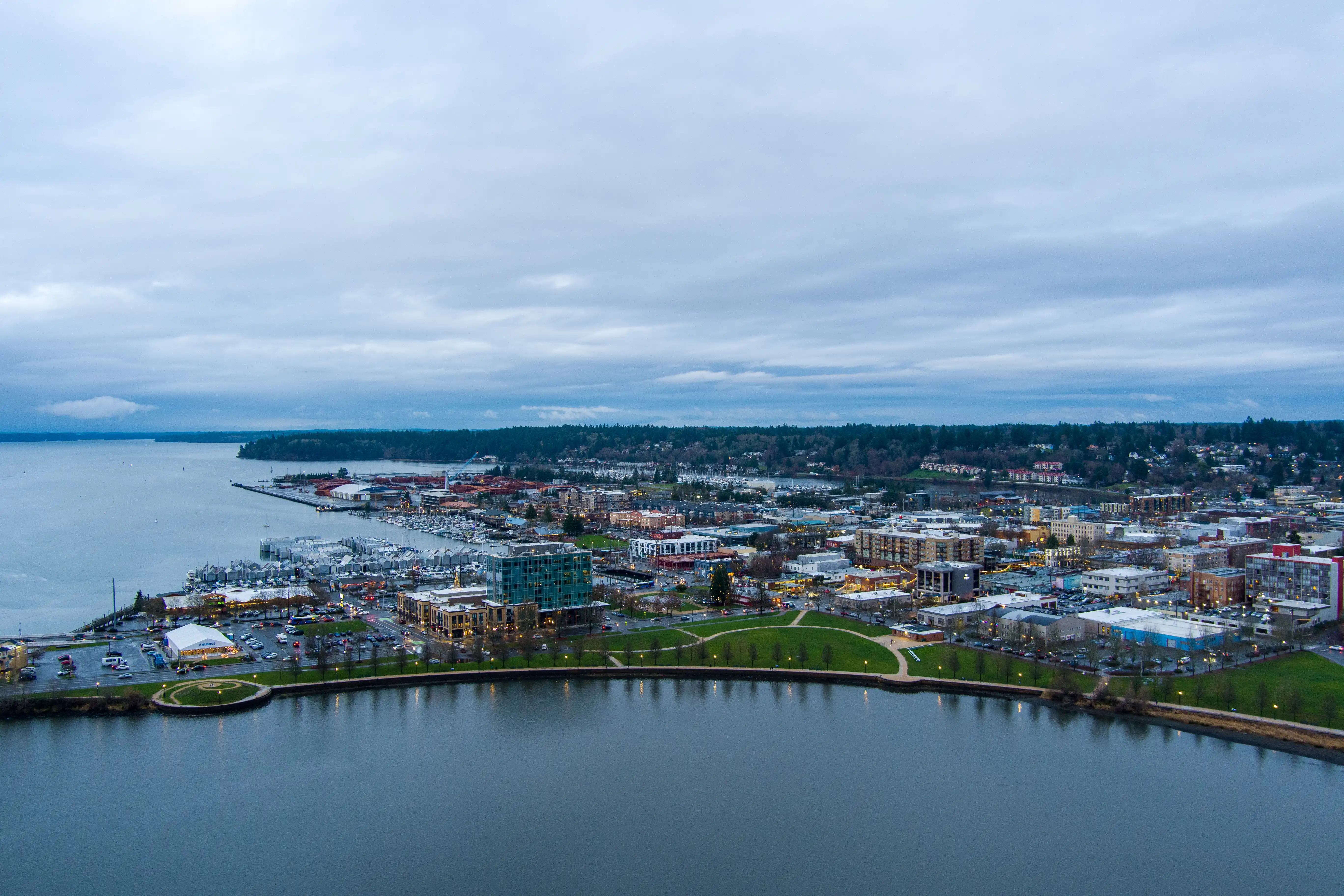
Eastside offers the lowest single-family home entry points in the city proper — buyers can occasionally find 2–3 bedroom homes in the $380,000–$440,000 range, though these often require updates. The neighborhood is close to downtown and has genuine walkability to the waterfront and Percival Landing Park. The catch is that the older housing stock demands careful inspection, and the price gap between move-in ready and fixer-upper is significant.
Westside sits in a similar range to Eastside but feels more suburban and spread out. Entry-level buyers can find homes in the $400,000–$470,000 range in the outer Westside pockets, and the neighborhood's access to US-101 makes it workable for buyers who occasionally need to travel toward Shelton or Hood Canal. It's less walkable than Eastside but tends to offer more square footage per dollar.
Northeast Olympia is worth considering for buyers with a $480,000–$540,000 budget who want newer construction bones and proximity to Lacey's commercial corridor without paying Lacey prices. Homes here tend to run a bit larger, and the proximity to Martin Way and the I-5 interchange makes commuting more flexible. It's not a neighborhood with the architectural character of South Capitol, but it delivers solid value and strong resale fundamentals.
Local Expert Takeaway: The most common mistake first-time buyers make in Olympia is treating the $513,000 median as a ceiling when it's actually the midpoint — and then getting surprised when the homes they can afford at $380,000–$430,000 require immediate repairs or are condos in buildings with shaky reserves. Before you tour, know which neighborhoods carry genuine resale strength at entry-level prices: Northwest Olympia and the better blocks of Northeast Olympia tend to hold value better than outer Westside or peripheral Eastside. And if you're at a 660 credit score, spend 60 days getting to 700 before you apply — the rate difference on a $450,000 loan is worth the wait.
✅ Olympia's median home price of $513,000 is roughly half of Seattle's — making it one of the most accessible ownership markets in the Puget Sound region for first-time buyers with stable incomes.
⚠️ The under-$450,000 market is inventory-constrained and competitive — well-priced entry-level homes frequently go pending within a week, and buyers need to be decision-ready before they start touring.
📍 Northwest Olympia, Eastside, and Northeast Olympia offer the most realistic entry points for first-time buyers — each with trade-offs on condition, size, and walkability that are worth understanding before you make an offer.
Can I buy a home in Olympia as a first-time buyer?
Yes — Olympia is one of the more realistic entry points for first-time buyers in Washington State, particularly compared to Seattle or the Eastside. With a median home price around $513,000, stable government employment, and an A-rated school district, the fundamentals are solid. The challenge is that the entry-level market below $450,000 is thin on inventory, so buyers need to be financially prepared and move quickly when the right home appears.
How much do I need to buy my first home in Olympia?
With a conventional 3% down loan on a $450,000 home, you'd need roughly $13,500 for the down payment plus another $8,000–$12,000 in closing costs — putting total cash to close somewhere around $20,000–$25,000. FHA at 3.5% down on the same price requires about $15,750 down. If cash is the limiting factor, the ONE+ program through this office lets you bring just 1% down with a 2% grant covering the rest, up to a $350,000 loan — which significantly lowers the barrier to entry.
What credit score do I need to buy a house in Washington state?
The minimum for a conventional loan is 620, and FHA requires 580 for the 3.5% down option. In practice, the rate tier that makes homeownership financially comfortable starts around 680–700. Buyers at 740 or above get the best available rates, which can mean $100–$150 less per month on a $450,000 loan compared to a 650 score. If your score is currently in the 620–650 range, spending a few months bringing it above 700 before applying is often worth it.
Explore the full Olympia series: The Ultimate Olympia Relocation Guide · Is Olympia Safe? · Cost of Living in Olympia · Best Neighborhoods in Olympia · Olympia Schools & Family Life · Olympia Youth Sports · Olympia Parks & Recreation · Retiring in Olympia · 1031 Tax-Deferred Exchange in Olympia · Olympia First-Time Homebuyers Guide · Moving to Olympia from California
Tell us what you need help with and we'll connect you with local resources.

About the Author
Todd Davidson is the founder of Living in Oregon and Living in Washington, where he publishes in-depth city guides, neighborhood resources, and local market insights covering more than 180 communities across the Pacific Northwest. While his background is in home financing and real estate, he created these digital platforms to help families research and compare regions before making a move.