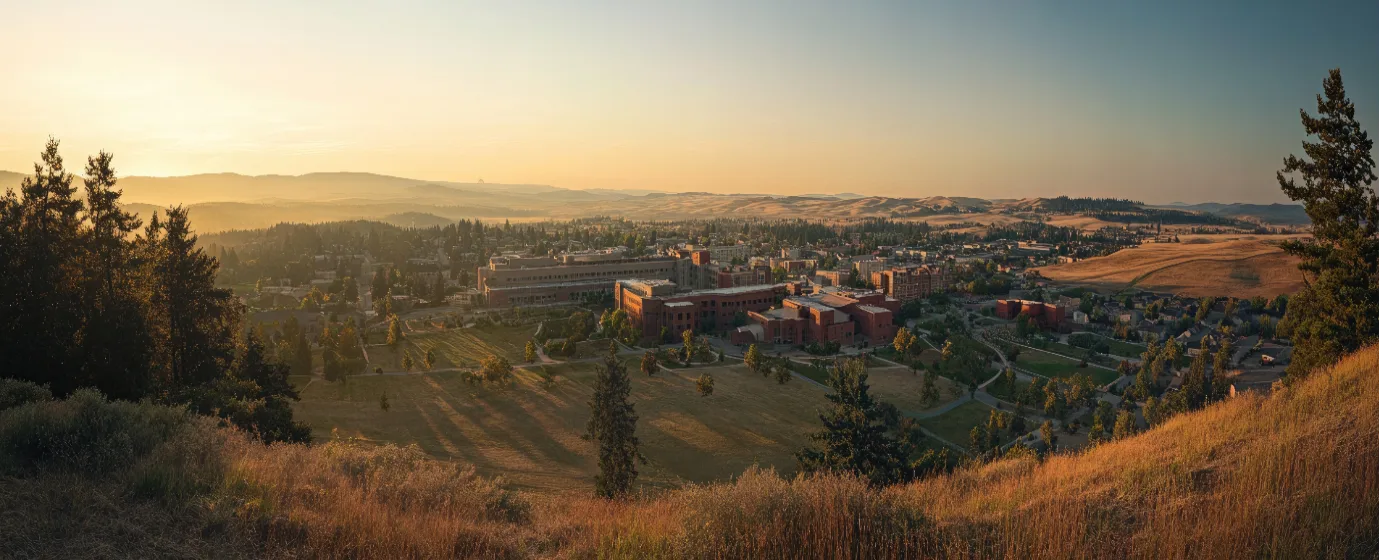
Eastern Washington · Washington
Not every investor doing a 1031 exchange is a seasoned portfolio operator. Many are California homeowners — Bay Area professionals, Sacramento families, Southern California landlords — who finally sold after years of appreciation and are staring at a capital gains bill that would swallow a quarter of their proceeds. Pullman, Washington isn't the first name that comes up in those conversations, but it's increasingly the one that sticks after serious investors run the numbers. A college town anchored by Washington State University, with a renter population exceeding 70% of all occupied housing, Pullman offers the kind of structural rental demand that most markets can only approximate.
The tenant base here is unusually durable. WSU enrolls roughly 19,000 students, and the academic calendar creates a rental cycle that fills units every August regardless of broader economic conditions. Add the university's 3,000-plus faculty and staff, employees at Schweitzer Engineering Laboratories, and workers at Pullman Regional Hospital, and you have multiple overlapping renter demographics all competing for a limited housing supply. The properties that trade most frequently as investment vehicles — near-campus duplexes, small multifamily buildings, and single-family rentals within walking distance of the academic core — are exactly the kind of assets that qualify as like-kind replacement property in a 1031 exchange.
This guide covers everything a 1031 investor needs to evaluate Pullman seriously: exchange mechanics, local cap rates by property type, the Washington state tax picture versus California, property management realities for out-of-state owners, and a due diligence checklist built for buyers on a 45-day identification clock. If you're deploying exchange proceeds from a California sale into a Pacific Northwest rental market, the case for Pullman is worth reading in full before you shortlist Portland or Seattle instead.

The exchange clock starts the day you close on your relinquished property — not when you list it, not when you accept an offer. From that closing date, you have 45 days to formally identify your replacement property in writing, and 180 days to close on it. The 45-day window is unforgiving. The IRS does not grant extensions for market conditions, delayed title work, or an investor who underestimated inventory in their target market. Investors who arrive in Pullman without a shortlist already built regularly lose their identification window to slow local inventory — and in a market with as few as 18 active listings at any given time, that risk is real.
The "like-kind" rule is broader than most people realize. Any real property held for investment or business purposes can exchange into any other real property held for the same purpose. A single-family rental in San Jose can exchange into a duplex in Pullman. A strip of commercial land can exchange into a small apartment building. The categories don't need to match — only the intent does. What trips investors up most often is the boot trap: if your replacement property is worth less than your relinquished property, or if you pull any cash out at closing, the difference is taxable in the year of the exchange. A qualified intermediary must hold the proceeds between transactions — you cannot touch the funds at any point without triggering the recognition event.
Three identification rules govern how you name replacement properties: the Three-Property Rule (identify up to three properties of any value), the 200% Rule (identify any number of properties as long as their combined value doesn't exceed 200% of the relinquished property's sale price), and the 95% Rule (identify unlimited properties if you close on at least 95% of their combined value). Most investors use the Three-Property Rule and name their primary target plus two backups. In a thin market like Pullman, naming all three from day one is not overcautious — it's standard practice.
Pullman's investment market is defined by one structural reality: the majority of the city's housing stock is renter-occupied, and the dominant buyer for income-producing properties is either a private investor or a 1031 exchanger. Owner-occupants are a minority here in a way that's unusual even by college-town standards. Roughly 70–74% of occupied housing units are renter-occupied, which means the investment property pipeline moves constantly — sellers are typically investors selling to investors, not homeowners cashing out to buy something bigger.
The properties that trade most actively are duplexes and small multifamily buildings within a mile of the WSU campus, followed by single-family rentals in College Hill and Military Hill. Larger apartment buildings do trade but at commercial price points that require a different buyer profile. Cap rates for apartment-scale multifamily in Pullman run approximately 5.26%–6.89%, consistent with what analysts classify as a Class B secondary market. Near-campus duplexes and quadplexes with strong rental histories can push above 6%, and some listings with proven cash flow show rates approaching 9% on older stock that hasn't been repriced to current conditions. Commercial-scale acquisitions typically trade in the 5%–5.26% range as institutional pricing compresses yields at the top of the market.
| Property Type | Typical Price Range | Est. Cap Rate | Avg Days to Close |
|---|---|---|---|
| Near-campus duplex | $350,000–$550,000 | 6%–8% | 35–50 days |
| Small multifamily (4–12 units) | $700,000–$1,800,000 | 5.26%–6.89% | 45–75 days |
| Single-family rental (SFR) | $380,000–$520,000 | 4%–6% | 30–45 days |
| Commercial apartment building | $1,700,000–$3,000,000+ | 5.00%–5.26% | 60–90 days |
Near-campus duplexes and small multifamily properties with documented rental histories move the fastest — often going under contract within two weeks of listing when priced correctly. SFRs in less walkable neighborhoods can sit considerably longer, particularly when asking prices reflect owner-occupant expectations rather than investor math.
The price-to-rent ratio in Pullman runs roughly 24–29x annual gross rent depending on the property type and purchase price — toward the higher end of what pencils easily on paper, but within the range that works when depreciation, Washington's tax structure, and the absence of state income tax are factored into real net returns.

Looking to buy in Estimate your payment.
Enter your numbers to see an estimated monthly mortgage payment.
Estimate only. Excludes HOA fees and mortgage insurance.
The math becomes obvious when you hold a California sale price next to Pullman's median. A California investor closing a 1031 doesn't need leverage to acquire multiple income-producing assets here — in many cases, they can buy debt-free and still have exchange proceeds left over.
A Bay Area investor selling a property at $1.4 million — not an unusual number for a modest San Jose rental — arrives in Pullman with enough exchange proceeds to acquire a near-campus duplex and a single-family rental simultaneously, entirely without financing. That combination could gross $4,500–$5,800 per month with zero debt service, producing a cash-on-cash return that a leveraged Bay Area acquisition at a 3% cap rate cannot approach. The Bay Area seller is also accustomed to renters with strong income verification — Pullman's graduate student and professional workforce segment provides exactly that.
Southern California investors typically arrive with proceeds from older duplexes or smaller rentals that have appreciated far beyond their income-producing value. A Long Beach or Pasadena duplex that sells for $850,000 but grosses $3,600 per month is a 5% cap rate fantasy — Pullman's near-campus properties at the same price range genuinely deliver. The downside Southern California investors frequently cite is the distance: Pullman is a 5.5-hour drive from Los Angeles or an indirect flight, which makes self-management impractical and underscores the importance of finding reliable local management before closing.
Sacramento and Inland Empire investors occupy a middle ground — they're often selling properties in the $550,000–$750,000 range and looking to exchange into something with stronger cash flow dynamics. Pullman's median home price of $429,000 (Zillow mid-tier index) means a Sacramento exchanger can often acquire a target property at or near their sale price without generating boot, simplifying the exchange structure considerably. This is the investor profile Pullman sees most frequently: not a portfolio operator, but a single-property landlord who got lucky on appreciation and wants to reinvest into something that actually cash-flows.
The headline advantage is straightforward: Washington has no state income tax, making it one of only nine states that don't tax personal income. Every dollar of net rental income an investor earns from a Pullman property stays whole — no 9.3% or 13.3% California rate applied to Schedule E income. For an investor netting $30,000 annually from a duplex, the difference between California and Washington treatment is real money every April.
Washington does impose a 7% capital gains tax, but only on long-term gains exceeding $262,000 per year as of 2026. For most individual investors managing one or two rental properties, annual gains from depreciation recapture and ordinary income sit well below that threshold. The tax applies to gains on asset sales — it does not affect rental income, which remains entirely untaxed at the state level.
| Tax Item | California | Washington |
|---|---|---|
| State income tax on rental income | Up to 13.3% | None |
| Property tax rate on new purchase | ~1.1%–1.2% effective (Prop 13 applies to prior owners, not new buyers) | ~1.45% (Whitman County) |
| Sales tax | 7.25%–10.75% | 6.5% + local (varies) |
| State capital gains on property sale | Up to 13.3% (ordinary income treatment) | 7% on gains over $262,000/year |
Washington's property tax rate in Whitman County runs approximately 1.45%. For a California buyer accustomed to Prop 13 protecting a long-held property at a low effective rate, this is a real line item on a new acquisition — on a $500,000 purchase, expect roughly $7,250 annually in property taxes. That figure is higher than what a California seller paid on a Prop 13-protected property, but it's in line with or below what a newly purchased California property would carry on a $500K+ assessment.
One structural point that catches investors off guard: a 1031 exchange carries over the depreciation basis of the relinquished property rather than stepping it up. The depreciation clock resets to the new property's remaining useful life, but the adjusted basis from the old property follows you. This matters when the replacement property eventually sells outside of a 1031 — recaptured depreciation will be taxed. For investors committed to perpetual exchanging, it's a deferred obligation rather than an immediate one.
Delaware Statutory Trusts (DSTs) deserve a mention for investors who want the tax deferral of a 1031 without the management responsibilities of direct ownership. A DST lets you exchange into a fractional interest in a professionally managed institutional property. It's a legitimate structure — but it trades the control and upside of direct Pullman ownership for passive income and typically lower yield.
Washington operates under a detailed landlord-tenant code that is more tenant-protective than many out-of-state investors expect. As of 2026, there is no statewide rent control in Washington, but notice requirements for rent increases, lease terminations, and entry are specific and must be followed precisely. Required notice periods for month-to-month terminations, rent increases, and eviction filings have been extended in recent years — research the current RCW 59.18 requirements before your first lease rolls over. The code is navigable, but it rewards landlords who use professional management rather than self-managing remotely.
Local property management in Pullman serves a market that's roughly 70% rental, so the infrastructure exists. Management fees typically run 8–10% of gross monthly rent for full-service management, plus leasing fees (often one month's rent or a percentage) when units turn over. On a duplex grossing $2,800 per month, you're looking at $224–$280 in monthly management fees before leasing costs. What out-of-state owners consistently underestimate is the turnover cadence — student-heavy properties often turn every 12 months in July, creating a predictable but concentrated maintenance and leasing cycle that requires a manager with established vendor relationships.
The vacancy numbers that appear in city-wide data — often cited in the 14–15% range — are heavily influenced by summer academic vacancy and should not be read as year-round market weakness. During the academic year, well-located near-campus properties operate near full occupancy. Investors who buy based on summer walk-bys and see empty parking lots are misreading the market.
| Item | What to Verify | Local Resource |
|---|---|---|
| Title search | Clean title, no encumbrances or undisclosed liens | Whitman County title company |
| Sewer vs. septic status | City sewer connection confirmed; septic systems require separate inspection | City of Pullman Public Works |
| Flood zone status | FEMA flood zone designation; Pullman has some creek-adjacent parcels | FEMA Flood Map Service Center |
| Rental permit / business license | Pullman requires rental registration; verify current compliance | City of Pullman Business Licensing |
| HOA restrictions on rentals | Some newer subdivisions restrict STRs or require owner-occupancy | CC&Rs review by local attorney |
| Zoning for ADU potential | Washington state ADU laws are investor-friendly; verify parcel zoning | City of Pullman Planning & Zoning |
| Short-term rental ordinances | Pullman has not broadly permitted STR use; verify current code | City of Pullman Code Enforcement |
| Current lease status | Confirm lease terms, expiration dates, security deposit amounts | Request seller's rent roll + leases |
| School district boundaries | WSU-adjacent properties draw graduate students; verify district for family tenant pool | Pullman School District |
| Deferred maintenance inspection | Aging 1970s–1980s stock requires sewer scoping, roof, HVAC review | Local licensed inspector |
| Property management referral | Identify manager before closing; pre-close relationship avoids vacancy gap | Local PM firm referral from agent |
| Title company familiarity with 1031 | Qualified intermediary must already hold funds; confirm title company can coordinate | Whitman County title companies |
| Rent roll and income verification | Request 24 months of actual rent collected; compare to advertised rates | Seller documentation |
| Zoning confirmation for current use | Verify unit count and use are legally conforming; older conversions may be non-conforming | City of Pullman Planning |

Local Expert Takeaway: The most common mistake California 1031 buyers make in Pullman is valuing a near-campus property based on current gross rents without stress-testing the summer vacancy period. A duplex on College Hill or Military Hill that rents easily at $1,600–$1,800 per unit during the academic year may sit partially vacant June through August — factor one to two months of reduced occupancy into your pro forma before closing, not after. Investors who model full-year occupancy at peak-semester rents consistently overpay relative to actual first-year cash flow.
✅ Pullman's 70%+ renter-occupied housing stock and WSU-anchored demand create structural rental durability that most secondary markets can't replicate — making it a legitimate replacement property target for California 1031 exchangers.
⚠️ The 45-day identification window is brutal in a thin-inventory market. With as few as 15–20 active investment listings at any given time, buyers who arrive without a shortlist and a management plan already in place regularly lose their window.
📍 Washington's zero state income tax is the single most underappreciated advantage for out-of-state investors — the difference between California's 13.3% top bracket and Washington's 0% on rental income compounds significantly over a multi-year hold.
Does a 1031 exchange work for out-of-state property?
Yes — like-kind exchanges under IRC Section 1031 apply to real property anywhere in the United States, regardless of where the relinquished or replacement property is located. A California investor can exchange into a Pullman rental with no geographic restriction, as long as both properties are held for investment or business use and the exchange timeline and qualified intermediary requirements are met.
What is the cap rate on rental property in Pullman?
Cap rates in Pullman vary meaningfully by property type. Near-campus duplexes and small multifamily properties with documented rental histories typically run 6%–8%, with some older well-located stock reaching higher. Commercial-scale apartment buildings trade in the 5%–6.89% range as institutional pricing applies. Single-family rentals in less central locations generally produce cap rates in the 4%–6% range depending on purchase price and actual rent levels.
Do I need a local property manager for a 1031 investment in Washington?
Out-of-state ownership without local management is technically possible but operationally difficult in Pullman's market. The academic rental cycle creates concentrated turnover in July and August, Washington's landlord-tenant code requires precise compliance with notice timelines, and the distance from California makes hands-on oversight impractical. Most successful out-of-state investors identify a local property manager before closing rather than after — it's part of the acquisition process, not an afterthought.
Explore the full Pullman series: The Ultimate Pullman Relocation Guide · Is Pullman Safe? · Cost of Living in Pullman · Best Neighborhoods in Pullman · Pullman Schools & Family Life · Pullman Youth Sports · Pullman Parks & Recreation · Retiring in Pullman · 1031 Tax-Deferred Exchange in Pullman · Pullman First-Time Homebuyers Guide · Moving to Pullman from California
Tell us what you need help with and we'll connect you with local resources.

About the Author
Todd Davidson is the founder of Living in Oregon and Living in Washington, where he publishes in-depth city guides, neighborhood resources, and local market insights covering more than 180 communities across the Pacific Northwest. While his background is in home financing and real estate, he created these digital platforms to help families research and compare regions before making a move.