
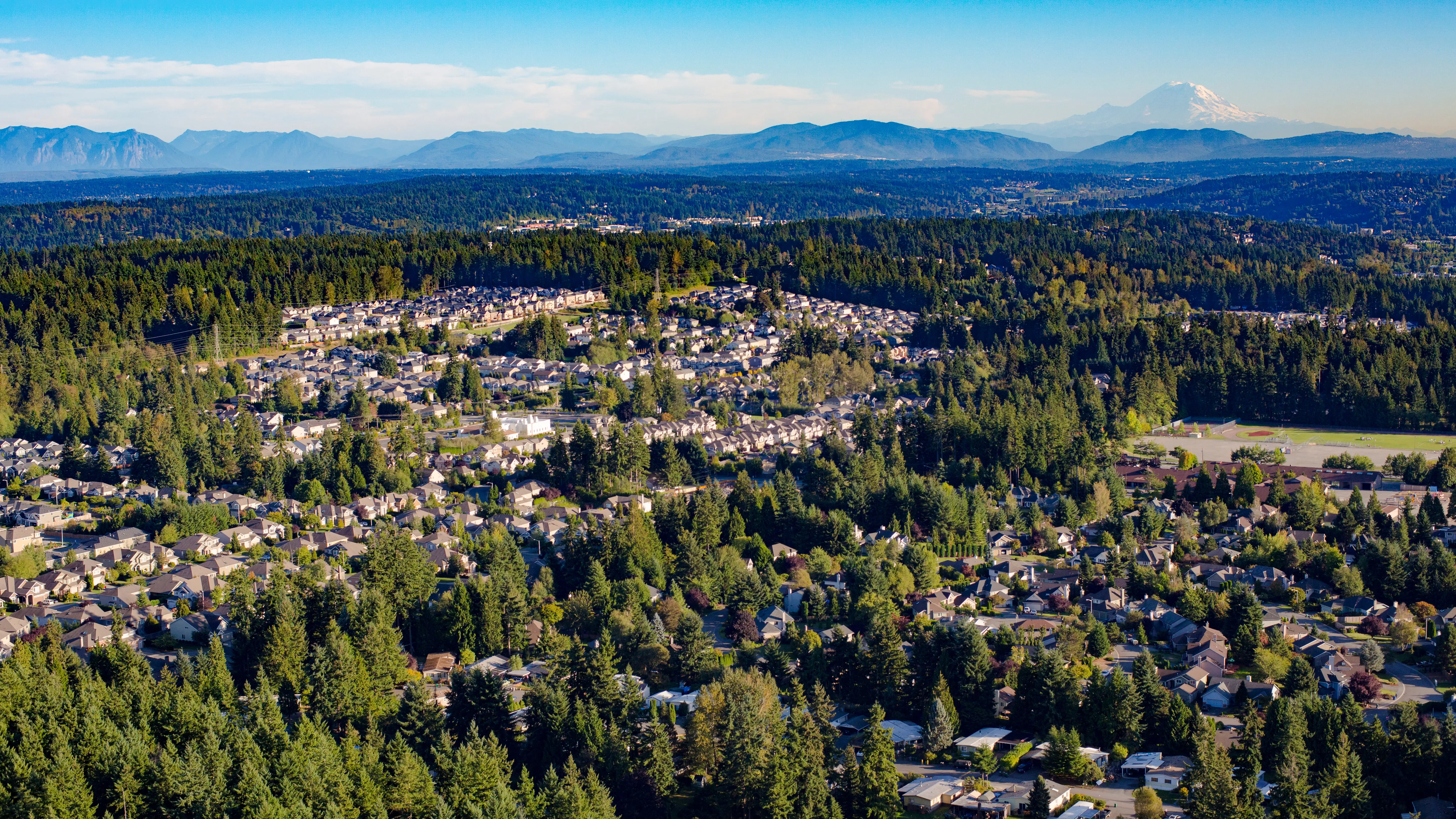
Puget Sound · Washington
Not everyone doing a 1031 exchange is a professional investor with a spreadsheet and a portfolio manager. Many of the buyers entering the Snohomish market right now are California homeowners — people who sold a house they've owned for 25 years and are staring down a tax bill that could eclipse $200,000 if they don't act. Snohomish, Washington gives them a compelling place to deploy those proceeds: a market where $750,000 still buys a substantial single-family rental, where Boeing and Providence Regional Medical Center anchor a stable employment base, and where families priced out of King County are actively looking for rentals. That's a landlord's market.
Rental demand here is driven by the same forces that define the broader Puget Sound economy — aerospace employment, healthcare, and a steady migration of households who want more space than Seattle offers but can't afford what's left of affordable King County. About 42% of Snohomish households are renter-occupied, a number that reflects both the city's working-class roots and its ongoing growth. The property types that trade most often as investment vehicles are single-family rentals, duplexes, and the occasional small multifamily — not large apartment complexes. This is a market of concrete driveways and three-bedroom houses, not elevator lobbies and amenity decks.
This guide covers what a 1031 buyer needs to know before making Snohomish their replacement property market: how the exchange mechanics actually work, what the local rental numbers look like, why California capital is moving north, Washington's specific tax advantages, the property management reality on the ground, and a due diligence checklist built for an investor operating on a 45-day clock.

The core of a 1031 exchange is straightforward: sell a qualifying investment property, and instead of paying capital gains tax on the proceeds, roll them into a "like-kind" replacement property. The IRS timeline is rigid. From the day you close on your relinquished property, you have 45 days to formally identify potential replacement properties in writing — no extensions, no exceptions. You then have 180 days from that same closing date to actually close on one of them. Identification and closing are two separate deadlines running simultaneously, not sequentially.
"Like-kind" is broader than most investors realize. Any real property held for investment qualifies — residential rentals, commercial buildings, raw land, and small multifamily all exchange freely against each other. You can sell a strip of raw Oregon land and buy a Snohomish duplex. What trips buyers up is the boot trap: if your replacement property purchase price is lower than your net sale proceeds, the difference is taxable. To defer 100% of your gain, you need to spend equal to or more than what you received, and you need to take on equal or greater debt — or pay the full amount in cash.
One requirement that surprises people: you cannot touch the money. A qualified intermediary (QI) must hold the proceeds from your sale, and you may not have constructive receipt of those funds at any point before they're applied to your replacement purchase. Choosing a reputable QI before you close your relinquished sale is not optional — it's the mechanism that makes the entire exchange legal. The QI must be engaged before closing.
The market moving into mid-2026 is competitive but navigating-able for a prepared buyer. The median sold price in Snohomish sits at approximately $750,000 — up 6.7% year-over-year through the three-month period ending May 2026 — and homes are moving fast, averaging just seven days on market. For a 1031 buyer racing a 45-day identification clock, that pace is both an opportunity and a pressure point. Properties that are priced right and show well are gone before many investors have even arrived for a tour.
| Property Type | Typical Price Range | Est. Cap Rate | Avg Days to Close |
|---|---|---|---|
| Single-Family Rental (3BR+) | $680,000–$850,000 | 4.5%–5.5% | 21–30 days |
| Duplex (owner-occupied exempt) | $750,000–$950,000 | 5.0%–6.5% | 25–35 days |
| Small Multifamily (3–8 units) | $1.1M–$2.2M | 5.2%–6.5% | 30–45 days |
| Commercial / Mixed-Use | $900,000–$2.5M | 5.5%–7.0% | 30–60 days |
Looking to buy in Estimate your payment.
Enter your numbers to see an estimated monthly mortgage payment.
Estimate only. Excludes HOA fees and mortgage insurance.
The math that drives California capital northward is simple: Washington has no state income tax, property is significantly cheaper per dollar of rent collected, and the Puget Sound job market is strong enough to keep tenants employed. What varies is why investors from specific California regions find Snohomish compelling in slightly different ways.
A Bay Area homeowner selling a property that was purchased in the 1990s is likely sitting on $1.2 million to $2 million in equity. At current Snohomish prices, that's enough to buy a duplex and a single-family rental simultaneously — debt-free — and still have cash left over for deferred maintenance reserves. The duplex cap rate alone exceeds what most Bay Area investors have seen in a decade of trying to make the local numbers work.
Los Angeles and Orange County sellers are often working with $800,000 to $1.4 million in proceeds after a long-held condo or small SFR sale. In Snohomish, that range purchases a clean three-bedroom rental in a neighborhood with strong school district access — exactly the tenant draw that keeps vacancy low and lease renewals high. The price-to-rent ratio here is meaningfully better than anything remaining in LA County below $1.5 million.
Sacramento and Inland Empire investors are often coming out of lower-priced properties — $450,000 to $750,000 — and looking to trade into a stronger rental market without significantly increasing leverage. Snohomish at $750,000 median is a step up in purchase price, but rents averaging $3,100 per month for single-family houses make that step defensible. The Inland Empire investor who has watched rents plateau closer to home often finds the yield story here more compelling than staying in their current market.
Washington's tax profile for landlords is one of the clearest advantages in the country. There is no state income tax — Washington is one of only nine states that doesn't impose one. Every dollar of net rental income stays fully in the investor's pocket rather than being split with the state at California's top marginal rate of 13.3%. For a landlord collecting $36,000 per year in net rental income, that difference compounds quickly over a holding period.
| Tax Item | California | Washington |
|---|---|---|
| State income tax on rental income | Up to 13.3% | None |
| Property tax rate (new purchase) | ~1.1%–1.2% (Prop 13 resets on sale) | ~0.93% |
| State sales tax | 7.25% base | 6.5% + local (typically ~10.4%) |
| Long-term capital gains | Up to 13.3% state + federal | 7% state on gains over $262,000/yr |
| Statewide rent control | Yes (AB 1482, 5% + CPI or 10%) | Yes (HB 1217, capped at 9.683% for 2026) |
On the depreciation side, a 1031 exchange preserves the existing depreciation basis from your relinquished property — it does not get stepped up to the new purchase price. That's a nuance worth flagging to your CPA before you close. For investors who want the tax shelter of real estate without the active management burden, Delaware Statutory Trusts (DSTs) offer a passive 1031-eligible structure that some out-of-state buyers use when they can't identify a direct-ownership replacement property within the 45-day window.
Washington passed rent stabilization under HB 1217 in May 2025, and it is now in effect through July 2040. Annual rent increases are capped at 7% plus the rate of inflation, or 10% — whichever is lower. For 2026, the maximum allowable increase is 9.683%. The cap applies after the first 12 months of a tenancy, meaning landlords retain full pricing flexibility when setting rents for incoming tenants. Owner-occupied duplexes, triplexes, and fourplexes are exempt, as is new construction with a certificate of occupancy within the last 12 years — a distinction that matters significantly when evaluating which property types to pursue.
Notice requirements have tightened: landlords must now provide 90 days written notice before any rent increase goes into effect. Washington also requires "just cause" for eviction under RCW 59.18.650 and a 14-day notice before initiating eviction proceedings. None of this is unworkable for a disciplined landlord, but it rewards careful tenant screening over reactive management. Out-of-state owners who attempt to self-manage remotely typically underestimate how much these procedural requirements matter when things go sideways.
Local property management companies operating in the Snohomish and greater Snohomish County market typically charge 8–10% of gross monthly rent. For a house renting at $3,100 per month, that's $248–$310 per month — a meaningful but predictable cost that a good manager earns back in avoided vacancy and faster leasing cycles. Investors who skip professional management to protect the margin often spend more than they save in the first vacancy event.
| Item | What to Verify | Local Resource |
|---|---|---|
| Title search | Clean title, no liens or encumbrances | Local title company (First American, Chicago Title active in county) |
| Sewer vs. septic | Many rural-edge parcels are on septic — affects maintenance costs | Snohomish County Environmental Services |
| Flood zone status | FEMA flood map check, especially near Snohomish River corridor | FEMA Flood Map Service Center |
| Rental permit requirements | City of Snohomish rental registration requirements | City of Snohomish Building/Planning Dept. |
| HOA restrictions | Some HOAs limit rental duration or require owner approval of tenants | HOA governing documents via title report |
| ADU potential | Washington's strong ADU laws allow most SFR lots to add an ADU — verify setbacks and utilities | Snohomish County Planning / City permit office |
| Zoning confirmation | Verify current use is legally conforming and permitted | Snohomish County Assessor / GIS map |
| School district boundaries | Snohomish School District (A- rated) affects tenant pool quality and demand | SnohomishSD.org boundary maps |
| Current lease status | Confirm lease terms, tenant history, and any outstanding notices | Request from seller's agent — review all documents |
| Inspection (deferred maintenance) | Roof, HVAC, foundation, windows — older Snohomish stock carries age-related issues | Local licensed inspector with investment property experience |
| Short-term rental ordinances | Snohomish County has STR rules; City of Snohomish has additional restrictions | City of Snohomish Municipal Code |
| Property management referral | Confirm management company is accepting new clients before close | Verify directly before finalizing purchase |
| Depreciation schedule | Carry-over basis from relinquished property must be calculated correctly | CPA with 1031 experience — not optional |
| Exchange timeline confirmation | Verify QI paperwork aligns with 45-day ID and 180-day close deadlines | QI engagement letter reviewed by real estate attorney |

Local Expert Takeaway: The single most common mistake California 1031 buyers make in Snohomish is targeting the lowest-priced SFR available to maximize cap rate — and ending up with a 1970s-era property on septic, outside city limits, with deferred maintenance that obliterates the first two years of income. The stronger play is a clean 1990s or newer home inside city limits, on city sewer, in the Snohomish School District attendance boundaries. You'll pay closer to the $750,000 median, the cap rate will be modest at 4.5%–5%, but tenant quality is higher, vacancy is lower, and the exit in five to seven years is dramatically cleaner.
✅ Washington's no-income-tax environment means 100% of your net rental income stays out of state hands — a structural advantage over California, Oregon, and most other Pacific Coast states for long-term hold investors.
⚠️ Washington's rent stabilization law (HB 1217) is now in effect — annual increases are capped at 9.683% for 2026, and 90-day written notice is required before any increase goes to an existing tenant. Price-setting freedom remains only at the start of a new tenancy.
📍 The 45-day identification window runs fast in Snohomish — homes averaged just seven days on market through spring 2026. Have your QI engaged, your financing pre-approved, and your target neighborhoods narrowed before your relinquished sale closes.
Does a 1031 exchange work for out-of-state property?
Yes — a 1031 exchange works across state lines. You can sell an investment property in California, Nevada, Oregon, or any other state and use the proceeds to purchase a replacement property in Washington. The like-kind requirement refers to property type (real estate for real estate), not location. Your qualified intermediary handles the proceeds during the exchange period regardless of where either property is located.
What is the cap rate on rental property in Snohomish?
Single-family rentals in Snohomish generally produce cap rates in the 4.5%–5.5% range as of mid-2026, with duplexes and small multifamily running slightly higher at 5%–6.5% depending on condition and location. These are not high-cap-rate numbers — Snohomish is a appreciation and stability market, not a pure yield play. Investors seeking 7%+ cap rates will need to look at smaller secondary markets in Eastern Washington or rural Snohomish County, where risk profiles are meaningfully different.
Do I need a local property manager for a 1031 investment in Washington?
You're not legally required to hire one, but for out-of-state owners, professional management is worth the 8–10% fee. Washington's landlord-tenant code has specific procedural requirements — 90-day rent increase notice, just-cause eviction rules, updated mailing protocols — that are easy to get wrong from a distance. A single procedural error can delay an eviction by months. A local manager who knows the current statute is inexpensive insurance against that outcome.
Explore the full Snohomish series: The Ultimate Snohomish Relocation Guide · Is Snohomish Safe? · Cost of Living in Snohomish · Best Neighborhoods in Snohomish · Snohomish Schools & Family Life · Snohomish Youth Sports · Snohomish Parks & Recreation · Retiring in Snohomish · 1031 Tax-Deferred Exchange in Snohomish · Snohomish First-Time Homebuyers Guide · Moving to Snohomish from California
Tell us what you need help with and we'll connect you with local resources.

About the Author
Todd Davidson is the founder of Living in Oregon and Living in Washington, where he publishes in-depth city guides, neighborhood resources, and local market insights covering more than 180 communities across the Pacific Northwest. While his background is in home financing and real estate, he created these digital platforms to help families research and compare regions before making a move.