
Puget Sound · Washington
Maybe your orders just came through at Joint Base Lewis-McChord and you have 30 days to find a place that doesn't drain your BAH the moment you sign the lease. Maybe you've been watching Tacoma prices creep upward and someone in a Facebook group said Spanaway is where you get the same house for $30,000 to $40,000 less. Maybe you looked it up and came away uncertain — unincorporated, no city hall, Pacific Avenue strip malls, a school district rated C+. The central tension in Spanaway is real: this is a place where affordability and accessibility are genuine, but where the trade-offs are equally genuine, and buyers who paper over that tension tend to be the ones who regret the purchase.
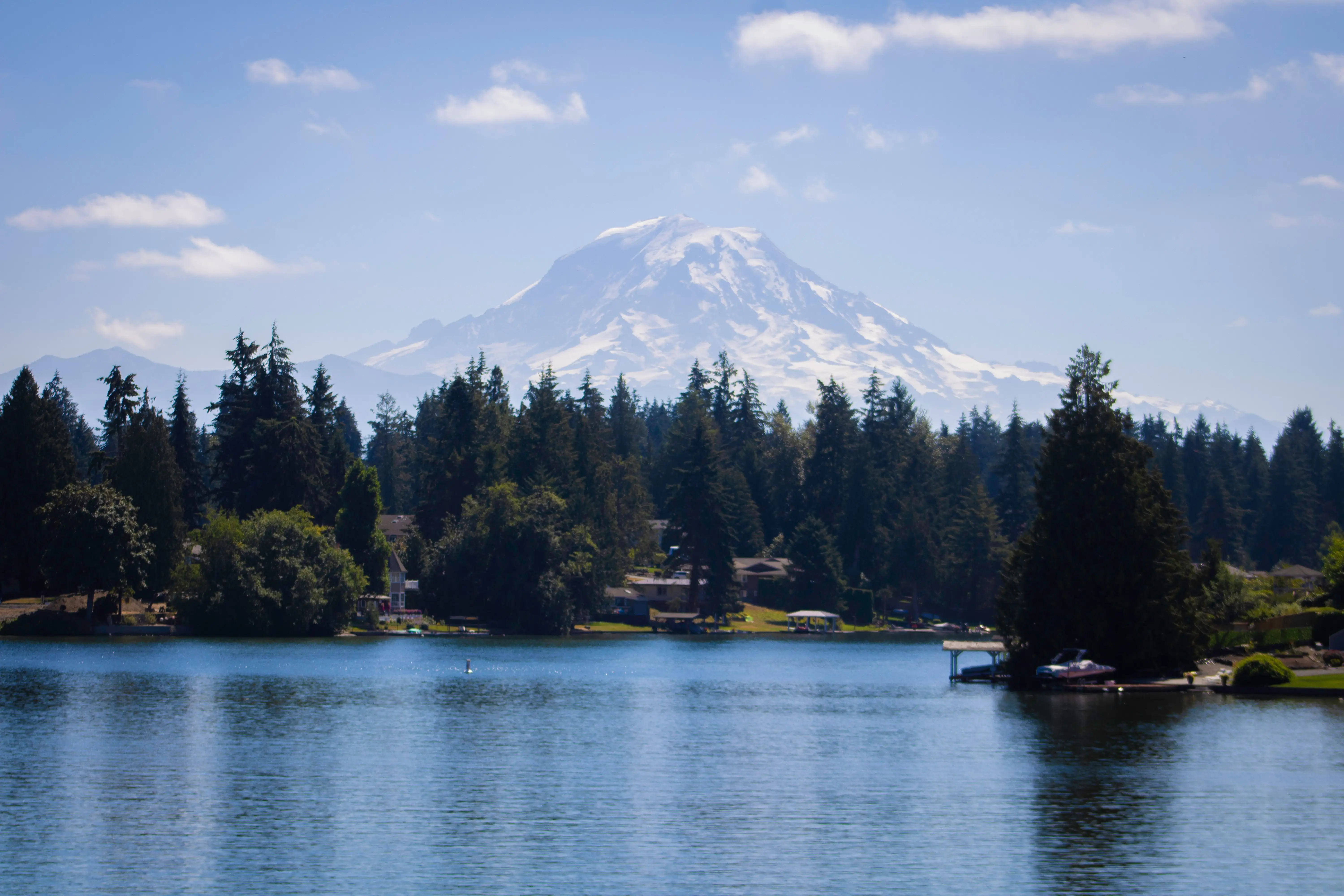
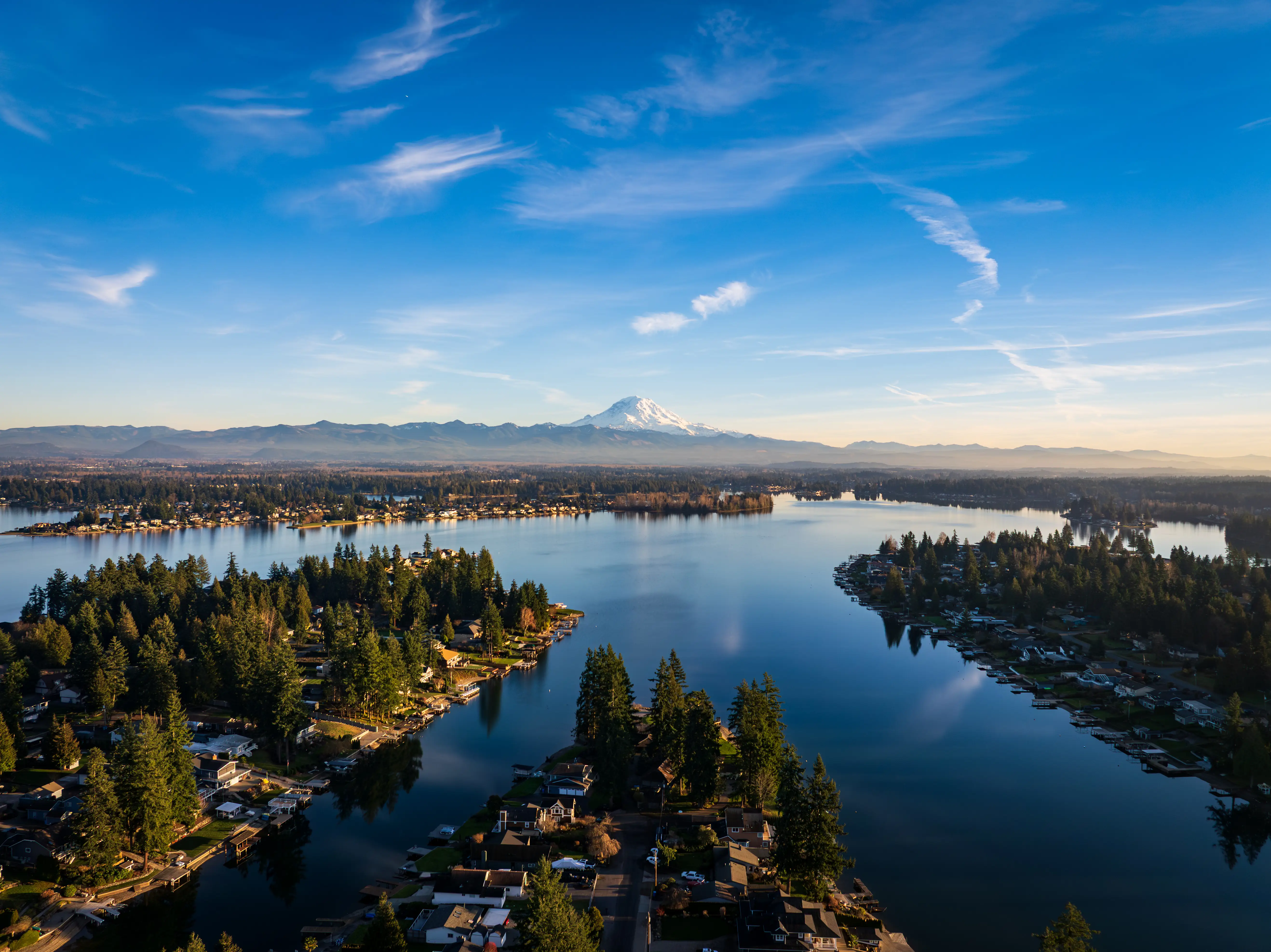
Spanaway sits in southwestern Pierce County, roughly 10 miles south of Tacoma along Pacific Avenue South — the commercial spine locals simply call "the Avenue." The community borders Joint Base Lewis-McChord to the west, which shapes everything from the demographics to the rental market to the rush-hour patterns on SR-7. It is an unincorporated census-designated place, which means no city government, no city services, and no incorporated identity — services run through Pierce County, and that distinction matters more than most buyers realize before they close. Spanaway Lake anchors the heart of the community, and the Cascade foothills begin to rise just to the southeast, giving the area a geography that is genuinely more interesting than the strip development along Pacific Avenue suggests.
This guide will help you answer the questions that matter before you make an offer: Is Spanaway actually a smart value play or a discount market with discount trade-offs? Which neighborhoods make sense for which buyer profiles? How does the commute to Seattle or Tacoma actually feel on a Tuesday morning? What do people who moved here love after two years — and what made the others leave? By the time you finish reading, you will have a clear picture of whether Spanaway fits your life.
Not every buyer who looks at Spanaway should buy in Spanaway. The honest answer is that this community rewards specific situations and frustrates others. Use this table as a starting filter before diving into the details.
| Best For | Why |
|---|---|
| Military families at JBLM | Spanaway borders the base's southern perimeter — gate access, familiar demographics, strong rental history if you PCS out |
| First-time buyers priced out of Tacoma | The $485,000 median gives buyers a detached home with a yard at a price point that has largely disappeared in Tacoma's stronger zip codes |
| Families comfortable with suburban car-dependence | Large lot sizes, master-planned communities like Brink Ranch, and Bethel School District options — if you're driving everywhere anyway, the trade-offs shrink |
| Remote workers who visit Seattle occasionally | The 50-minute drive to Seattle is manageable at off-peak hours; you're not doing it daily, and the mortgage savings are substantial |
| Value-focused move-up buyers | The spread between a modest Spanaway home and a well-finished one is wide — buyers willing to go bigger on square footage find real room in the budget |
| Retirees with JBLM connections | Commissary access, VA medical proximity, and lower property taxes relative to western Washington alternatives make the area practical for veterans aging in place |
Living in Spanaway feels less like living in a city and more like living in a well-established suburb that never quite finished deciding what it wanted to be. The commercial energy runs along Pacific Avenue — fast food, auto shops, Fred Meyer, the Sunbird Shopping Center — and the residential streets behind that corridor are quieter, larger-lot neighborhoods where the pace drops immediately. There is no downtown, no walkable main street, no coffee shop district. That is not a knock; it is a description. If you have moved from somewhere with a walkable core and expect to replicate that here, you will be disappointed. If you are arriving from a similarly car-dependent suburb and simply want more house per dollar, Spanaway delivers.
The commute reality is the conversation that shapes every buying decision here. Getting to downtown Tacoma takes 20 to 30 minutes on a normal day, but Pacific Avenue is a four-lane arterial with signal timing that punishes midday trips south. The 50-minute drive to Seattle assumes a departure before 7 a.m. or after 7 p.m. — the I-5 corridor through Fife and Tukwila absorbs and holds traffic in ways that can push that number past 80 minutes on a bad Friday afternoon. Buyers who are driving to Seattle three days a week should stress-test that commute before they commit to a home this far south.
The community vibe skews young, military-influenced, and family-oriented. The median age in Spanaway is approximately 31, and roughly 46% of households include children under 18 — numbers you feel in the school drop-off lines, in the youth sports programs at Sprinker Recreation Center, and in the neighborhood Facebook groups that are more active here than in older, more settled suburbs. There is a genuine working-class-to-middle-class energy; the median household income sits at approximately $98,000, and the community reads as a place where people are building, not inheriting.
One thing that surprises most people after six months here is how much of daily life revolves around Spanaway Lake Park. It is not just a park — it becomes the default answer to "what do we do this weekend?" in spring and summer, with the lake, the walking paths, the shelters, and the open lawn drawing families from across the community on any given Saturday. Buyers who are outdoors-oriented and willing to organize recreation around public green space rather than private amenities tend to find Spanaway genuinely satisfying in ways the Pacific Avenue first impression does not suggest.
The price-per-square-foot math is the primary reason buyers come — and it remains the primary reason they stay. At a median sold price of $485,000, Spanaway delivers detached homes with yards, garages, and often 1,700 to 2,200 square feet at a price point that has essentially vanished in Tacoma's established neighborhoods. Lakefront homes on Spanaway Lake push into the $600,000 range, and the most finished master-planned homes run higher, but the core market gives first-time and second-time buyers genuine room to breathe financially.
JBLM proximity is an underappreciated asset even for residents who are not military. The base stabilizes the local economy in ways that civilian-only suburbs cannot replicate — it keeps a floor under housing demand, supports a dense network of healthcare and service providers oriented around military families, and creates consistent employment across healthcare, logistics, and support services. MultiCare Health System and CHI Franciscan both operate significant facilities in the area, giving the healthcare employment base depth beyond the base itself.
Sprinker Recreation Center on Grace Street is one of the legitimate quality-of-life differentiators for families with school-age children. The facility includes an indoor ice rink, batting cages, a waterslide pool, and multi-use athletic fields — the kind of public recreation infrastructure that communities three times Spanaway's size often lack. Combine that with Spanaway Lake Park's swimming area and the Classic Golf Club on Military Road East, and the recreation footprint for families who don't need a walkable café district is genuinely solid.
Washington's lack of a state income tax functions as a quiet but persistent financial advantage for Spanaway buyers that compounds over time. At a household income of $98,000, the absence of a state income tax represents thousands of dollars annually that buyers arriving from California, Oregon, or the Midwest do not initially factor into their affordability calculation — but should. Paired with property taxes running at approximately 1.14% on the assessed value, the total ownership cost in Spanaway compares favorably to nearly any comparable community in the western states.

Looking to buy in Estimate your payment.
Enter your numbers to see an estimated monthly mortgage payment.
Estimate only. Excludes HOA fees and mortgage insurance.
The Bethel School District's academic performance data is the tradeoff that gives pause to families with school-age children. The district's math proficiency sits around 36% and reading around 49% — both trailing Washington state averages — and the overall graduation rate has declined over a five-year period. Individual schools vary, and Bethel High School specifically carries a stronger graduation rate than the district average suggests. But families who are relocating specifically for school quality should research the district carefully and look at individual school data before committing to a neighborhood.
Spanaway has a property crime rate that buyers deserve to know about before they close. The property crime figure per 1,000 residents is meaningfully higher than the state average, and parts of the Pacific Avenue corridor experience the kinds of petty crime patterns common to high-traffic commercial strips. The violent crime rate is comparatively lower than many urban areas, but the property crime reality is real enough that it influences insurance costs and shapes where experienced locals choose to park their cars. Neighborhoods set back from Pacific Avenue tend to report better experiences; the corridor itself carries more of the risk.
The car-dependence here is absolute, not moderate. There is no meaningful public transit system that connects Spanaway to Tacoma or JBLM in a way that functions as a daily commute option for most residents. Pierce Transit operates routes in the area, but the service frequency and coverage are oriented toward connecting to Tacoma's transit network rather than enabling car-free living within Spanaway. Buyers who relocated from transit-rich cities and assumed they could manage with one car will find that assumption tested within weeks.
The lack of incorporated city status creates a practical friction that surprises buyers from more structured communities. There is no city council to attend, no municipal permitting office to call, no city website to navigate — everything routes through Pierce County, and county government bureaucracy operates at a different pace and accessibility level than a responsive city hall. Permit timelines, code enforcement responsiveness, and neighborhood planning decisions are all shaped by county processes that feel more distant than what buyers accustomed to city government expect.
The properties closest to Spanaway Lake represent the community's premium tier, with lakefront and lake-view homes reaching into the $600,000 range and occasionally higher for turnkey waterfront. The catch is that the residential streets immediately adjacent to the park absorb summer weekend traffic in ways that can feel intrusive for buyers expecting quiet suburban seclusion. Families who prioritize outdoor access and are comfortable with seasonal activity tend to love it; buyers who want quiet and privacy may prefer to live a few blocks back.
Best for: Outdoor-focused buyers who want walkable lake access and don't mind summer crowds.
The Spanaway Loop area follows Spanaway Loop Road as it curves around the eastern and southern edges of the lake, offering a mix of established single-family homes on larger lots with a more rural feel than the neighborhoods closer to Pacific Avenue. Prices here tend to run slightly below the lakefront premium while still offering proximity to the park and the lake's recreational access. The road itself can feel isolated in winter when daylight is short, but in spring and summer it is one of the more pleasant drives in the community.
Best for: Buyers who want the Spanaway Lake adjacency without the full lakefront price tag.
East Spanaway stretches toward the foothills and includes some of the community's larger residential lots and newer construction pockets. The drive to Pacific Avenue for shopping and services adds a few minutes relative to more central neighborhoods, but buyers gain space and a slightly quieter residential character. The area around 176th Street and east of Military Road has seen consistent new construction activity from builders like Lennar targeting families with young children.
Best for: Families prioritizing lot size and new construction who are comfortable with a longer drive to daily errands.
Pacific Avenue is Spanaway's commercial spine and its most utilitarian address. Homes immediately adjacent to or visible from Pacific Avenue trade convenience — Fred Meyer, auto services, fast food, the Sunbird Shopping Center — for the noise, traffic, and visual character of a four-lane arterial. Prices along the corridor run on the lower end of the market, and the neighborhood draws buyers who prioritize commute access and errand convenience above all else. Property crime rates here run higher than in neighborhoods set back from the avenue.
Best for: Budget-focused buyers who need maximum commute convenience and are realistic about the trade-offs.
Clover Creek is one of Spanaway's more established suburban neighborhoods, organized around the creek corridor that provides natural buffers between properties and a network of walking paths that residents genuinely use. Homes here are predominantly 1990s and early 2000s construction, modestly sized but well-maintained, and the neighborhood association keeps the common areas in good shape. The price range sits comfortably within the broader Spanaway median, making it one of the more stable and accessible entry points into the community.
Best for: First-time buyers who want an established neighborhood with natural amenity and a functioning community feel.
Nancy Estates is a quieter, more mature residential neighborhood with tree-lined streets and homes built primarily in the 1970s through 1990s. Lot sizes are generous by suburban standards, and the neighborhood's established canopy gives it a settled character that newer master-planned communities lack. Prices are generally at or slightly below the community median, and the area attracts buyers who want more privacy and space without the HOA structure of newer developments.
Best for: Buyers who prefer established trees, larger lots, and no HOA obligations.
Ridgeview Estates sits on elevated terrain that provides partial views toward the Cascades and a slightly more elevated market position relative to the Spanaway floor. Homes here tend toward larger footprints and more recent construction, and the neighborhood attracts buyers who are looking for something that feels more finished and suburban-premium while remaining within the South Sound value band. It is one of the neighborhoods where buyers arriving from Puyallup or South Hill find a familiar level of finish.
Best for: Move-up buyers who want a more polished suburban feel without crossing into Puyallup price territory.
Spiritwood is a newer planned community in the southern portion of Spanaway that appeals primarily to buyers who want new construction, HOA-managed common areas, and a cohesive neighborhood aesthetic. The trade-off for that polish is a longer drive to the commercial core along Pacific Avenue and a community that feels newer and less established than areas like Clover Creek or Nancy Estates. HOA fees are a factor here, and buyers should verify current fee structures before comparing sticker prices to older neighborhoods.
Best for: Buyers prioritizing new construction and neighborhood uniformity over established character and zero HOA.
| City | Best For | Median Home Price | Commute to Seattle | Vibe |
|---|---|---|---|---|
| Spanaway | Value buyers, JBLM families, first-time buyers | $485,000 | ~50 min | Suburban, car-dependent, military-adjacent |
| Tacoma | Walkability, urban amenities, established neighborhoods | $415,000–$520,000 | ~40 min | Urban-suburban hybrid, arts scene, diverse |
| Parkland | PLU proximity, affordable entry, renters transitioning to owners | $390,000–$450,000 | ~45 min | Dense suburban, transit access, mixed commercial |
| Puyallup | Families, strong school district, historic downtown | $525,000–$575,000 | ~45 min | Family-suburban, active downtown, higher income |
| Lakewood | JBLM west gate access, older suburban stock, affordability | $400,000–$450,000 | ~45 min | Blue-collar suburban, transitioning, improving |
| Graham | Rural lifestyle, large lots, maximum privacy | $480,000–$530,000 | ~55–65 min | Rural-suburban, acreage, slower growth |
| Metric | Detail |
|---|---|
| Population | Approximately 35,000 (unincorporated CDP) |
| Median Sold Home Price | $485,000 (2026 baseline) |
| Property Tax Rate | Approximately 1.14% |
| Median Household Income | ~$98,251 |
| Commute to Seattle | ~50 minutes (off-peak) |
| Commute to Tacoma | ~20–30 minutes |
| School District | Bethel School District (C+ rating) |
| Violent Crime per 1,000 | ~4 |
| Property Crime per 1,000 | ~28 |
| Median Rent | ~$1,782/month |
| County | Pierce County (unincorporated) |
| Major Employer | Joint Base Lewis-McChord |
Spanaway Lake Park transforms on the Fourth of July weekend in a way that no amount of advance warning fully prepares new residents for. The park fills to capacity, lakeside streets become parking overflow lots, and the community turns out in numbers that make the park feel like the center of something much larger than a 35,000-person suburb. Locals who have been here more than a year know to arrive by 9 a.m. or commit to watching the fireworks from a backyard a few blocks away — the parking situation past noon is genuinely chaotic.
Sprinker Recreation Center runs one of the most active youth hockey programs in Pierce County, and the ice rink on Grace Street has built a following that draws families from Parkland, Frederickson, and even south Tacoma specifically for the programs there. If you are moving with kids who already skate, or who want to learn, the facility's accessibility and programming quality is a genuine quality-of-life differentiator that does not show up in most Spanaway coverage.
The Spanaway community's military character expresses itself in practical, visible ways — the rhythm of PCS season in late spring and early summer creates a predictable surge in both listings and buyer activity. Long-term residents know that May and June bring more inventory than any other window of the year, and buyers who are not on military timelines can use that seasonal pattern strategically to find motivated sellers.
What I would not do if moving to Spanaway: I would not buy on a street immediately adjacent to Pacific Avenue without accounting for exactly how that location feels on a weekday afternoon in October — not July, when the light is flattering and the windows are open, but October, when you are sitting in your car at the signal on Spanaway Loop Road at 5:30 p.m. watching the backup extend in both directions. The convenience of the avenue is real, but the noise, the traffic, and the visual environment on those arterial-adjacent blocks are a different living experience than anything two blocks back, and the price discount does not always compensate.
Local Expert Takeaway: The buyers who get Spanaway right are the ones who treat it as a specific market with specific rules rather than a generic affordable suburb. Target neighborhoods set back from Pacific Avenue — Clover Creek, Nancy Estates, and the established blocks east of Military Road give you the value without the corridor trade-offs. If you have children, spend time researching individual Bethel schools rather than reacting to the district-wide rating, because the school-to-school variation is real and meaningful. And if you are comparing Spanaway to Graham or Eatonville for a rural lifestyle, understand that Spanaway is suburban first — the space is larger than Tacoma, but this is not a rural community.
✅ Spanaway delivers genuine value for buyers who are JBLM-adjacent, price-sensitive, or willing to trade walkability for square footage — the mortgage savings versus comparable Tacoma neighborhoods are real and durable.
⚠️ Property crime and school performance are honest concerns that deserve research before you commit — not dealbreakers for every buyer, but factors that should be eyes-open rather than ignored.
📍 Neighborhood selection matters more here than in most markets — the gap in daily experience between a block near Pacific Avenue and a street in Clover Creek or Ridgeview Estates is larger than the price difference suggests.
Is Spanaway a good place to raise a family?
It depends heavily on your expectations for school performance and your tolerance for car-dependence. Families with children who are active in youth sports, comfortable driving for most daily needs, and willing to research individual school options within Bethel School District tend to find Spanaway genuinely workable — the recreation infrastructure at Sprinker, the space at Spanaway Lake Park, and the affordability that lets parents buy a home with a real yard rather than a townhouse are real advantages. Families who are relocating specifically for top-tier schools will find the district's academic metrics challenging.
What is the crime situation in Spanaway?
The violent crime rate in Spanaway runs relatively low — approximately 4 incidents per 1,000 residents — and sits below many comparable suburban communities in the region. Property crime is the more meaningful concern, running at approximately 28 per 1,000 residents, which is elevated relative to state and national benchmarks. That figure is concentrated most heavily along the Pacific Avenue commercial corridor; residential neighborhoods set back from the avenue report notably better experiences, and buyers who choose those locations find the day-to-day security picture more reassuring.
How does Spanaway compare to Puyallup or Lakewood for families?
Puyallup offers a stronger school district, a more established walkable downtown, and a higher median income profile, but that comes with home prices running $40,000 to $90,000 above the Spanaway median. Lakewood offers comparable or lower prices with easier access to JBLM's western gates, but the community has historically struggled with the same commercial corridor crime patterns that affect parts of Spanaway. Families who are making that three-way comparison typically land in Spanaway when budget is the primary driver, Puyallup when school district is the priority, and Lakewood when JBLM west gate access outweighs other factors.
Explore the full Spanaway series: The Ultimate Spanaway Relocation Guide · Is Spanaway Safe? · Cost of Living in Spanaway · Best Neighborhoods in Spanaway · Spanaway Schools & Family Life · Spanaway Youth Sports · Spanaway Parks & Recreation · Retiring in Spanaway · 1031 Tax-Deferred Exchange in Spanaway · Spanaway First-Time Homebuyers Guide · Moving to Spanaway from California
Tell us what you need help with and we'll connect you with local resources.

About the Author
Todd Davidson is the founder of Living in Oregon and Living in Washington, where he publishes in-depth city guides, neighborhood resources, and local market insights covering more than 180 communities across the Pacific Northwest. While his background is in home financing and real estate, he created these digital platforms to help families research and compare regions before making a move.