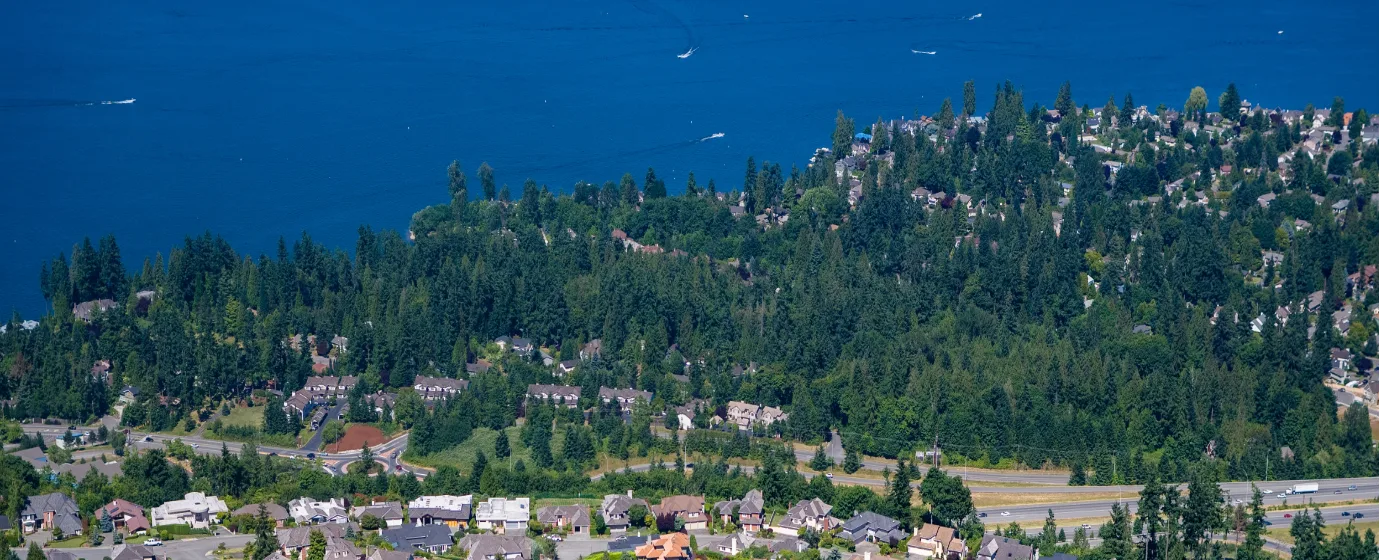
Puget Sound · Washington
Issaquah's safety reputation tends to arrive before the facts do. Ask anyone in the Seattle metro who's considered moving east along I-90, and they'll mention Issaquah in the same breath as "safe suburbs" — but the complete picture is more layered than that. Violent crime here is genuinely and measurably low, placing Issaquah among Washington's safer cities by nearly any methodology. Property crime, however, runs well above national averages, and that gap is something every buyer should understand before making decisions based on a neighborhood's leafy streets and good school ratings alone.
What those numbers mean in daily life is less dramatic than the raw figures suggest. A property crime rate that runs high compared to national baselines is driven significantly by Issaquah's commercial corridors — the shopping centers, big-box retail, and high-traffic areas concentrated along the western side of the city. The per-resident calculation makes retail-heavy areas look riskier than they feel on the ground for most residents. The northeast residential quadrants, by contrast, sit among the lowest crime concentrations in the entire city.
This guide breaks down what the crime data actually reflects, which neighborhoods consistently outperform city averages, how Issaquah compares to its Eastside neighbors, and what practical habits locals have quietly adopted that you won't find in any app.
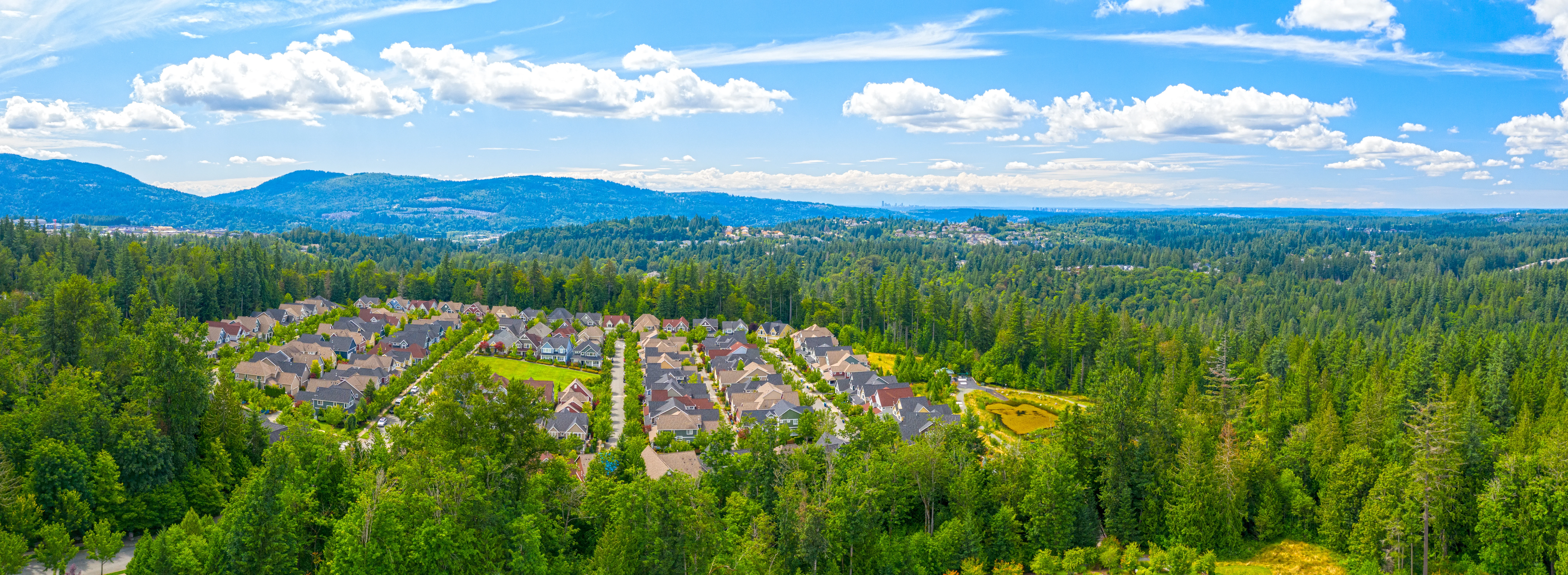
FBI UCR 2024 data — the most defensible benchmark available — places Issaquah's violent crime rate at roughly 107 per 100,000 residents, which runs about 67% below Washington state's violent crime average and nearly 70% below the national figure. That's not a rounding-error advantage; it's a meaningful structural difference in how safe day-to-day life feels here. Over the past five years, the city has recorded zero homicides, and the violent crime rate has tracked consistently below both state and national benchmarks across every reporting cycle.
Property crime is the more honest conversation. IPD-reported figures place property crime at approximately 34 incidents per 1,000 residents — a rate that exceeds the national average by a considerable margin. The dominant crimes in this category are shoplifting, vehicle theft, burglary, and fraud, and their concentration is not evenly distributed across the city. The western commercial zones — areas anchored by big-box retail and high daily visitor counts — account for a disproportionate share of property crime incidents. Measuring those incidents per resident rather than per visitor artificially inflates the apparent risk for people who live east of those corridors.
Structural context matters here. Issaquah's economy includes major retail anchors like Costco, substantial foot traffic from Lake Sammamish State Park, and a significant commuter population moving through the city daily. The crime rate reflects that activity volume, not just residential behavior. The City of Issaquah reported overall crime dropped 1.5% in 2024 compared to the previous year, and the April 2025 IPD activity report noted an 18% decrease in property crimes over the same comparative period — a trend partly credited to policy changes at major commercial businesses rather than changes in underlying risk. Taken together, the data tells a story of a city with low personal safety risk and a property crime challenge concentrated in predictable, specific areas.
Issaquah's violent crime rate — commonly estimated around 2.7 incidents per 1,000 residents based on local police data — puts it firmly in the category of cities where personal safety concerns are not a realistic part of daily decision-making for most residents. Your statistical chance of being a victim of violent crime in any given year here runs roughly three times better than the statewide odds. Assaults make up the bulk of violent incidents, and IPD data indicates that a significant share of those originate from domestic disturbances rather than stranger-danger scenarios. For families evaluating neighborhoods, that distinction matters.
Shoplifting, vehicle break-ins, and fraud account for the overwhelming majority of property crimes in Issaquah, and they cluster predictably near the city's commercial centers. The northwest quadrant — which contains the highest concentration of retail — sees approximately 215 property crime incidents per year compared to roughly 79 in the quieter southeast residential areas. Fraud cases have risen noticeably, with IPD reporting an 82% surge in fraud incidents in Issaquah Highlands alone between 2024 and 2025, shifting from 17 to 31 cases — a pattern consistent with broader national trends in digital and identity theft rather than anything specific to local street conditions.
Issaquah Highlands sits in the 91st percentile for safety nationally, according to CrimeGrade analysis — meaning it outperforms roughly 91% of neighborhoods across the country on violent crime metrics. The planned community's layout contributes directly to that number: interconnected trails, high residential density in the traditional sense of neighbors knowing neighbors, and an active community association that keeps common spaces well-maintained and well-lit. The one trend worth watching is the rise in fraud cases, which climbed significantly in 2025 — a pattern that has more to do with digital targeting than anything about the physical neighborhood.
Best for: Buyers who want verified safety data to match what they see on the ground.
Klahanie consistently earns an A+ safety grade and pairs it with household income levels that reflect a stable, invested ownership community. Its position on the eastern edge of Issaquah, away from the commercial corridors that drive property crime concentration, means residents here genuinely experience lower incident exposure than the city-wide average suggests. The neighborhood's mature tree canopy and cul-de-sac street patterns also reduce through-traffic, which is one of the quiet structural factors that keeps opportunistic property crime low.
Best for: Families prioritizing residential quiet and neighborhood cohesion.
Talus earns an A- safety rating — still excellent by any regional standard, though slightly lower than the top tier. Its proximity to the I-90 interchange creates more traffic movement through the area than you'd find in more interior neighborhoods, and that access pattern occasionally draws vehicle-related property crime. Buyers here tend to be aware of the trade-off: closer freeway access makes the commute to Seattle or Bellevue genuinely efficient, and the safety profile remains well above what most buyers would encounter in comparable price ranges across the metro.
Best for: Commuters who want Eastside safety without sacrificing access.
Downtown Issaquah operates in two registers simultaneously — a walkable historic core centered on Gilman Village and the Issaquah Depot Museum, and a commercial zone with the accompanying foot traffic that invites opportunistic property incidents. It's not unsafe to walk at night; residents do it regularly. But vehicle break-ins occur more frequently here than in the residential neighborhoods to the northeast, and that's worth factoring in if street parking is part of your daily reality. The community events that animate downtown — the Salmon Days festival drawing tens of thousands in October, farmers market foot traffic, and the general activity around the hatchery — create a vibrant but active public environment.
Best for: Buyers who prioritize walkability and cultural access and are realistic about urban-adjacent property crime exposure.
Mirrormont sits among the highest-rated neighborhoods in Issaquah on virtually every safety metric, earning consistent A+ grades and benefiting from geographic separation that naturally limits outside traffic. The southeast location places it away from both the commercial northwest and the I-90 interchange activity, and the forested surroundings near Cougar Mountain create a neighborhood character where most activity is residential by definition. The median household income level here reflects an ownership community with strong long-term investment in the area.
Best for: Buyers drawn to wooded seclusion without sacrificing access to Eastside amenities.
Gilman occupies the middle ground on Issaquah's safety spectrum — rated A- rather than A+, which in practical terms means it's safer than the vast majority of neighborhoods nationally but shows slightly more property crime activity than the city's northeastern residential core. Its position adjacent to the NW Gilman Boulevard commercial corridor explains most of that difference; the retail density nearby drives visitor volume that doesn't get factored out of per-resident calculations. The neighborhood itself feels settled and residential, and the historic character of the surrounding area gives it a sense of permanence that newer planned developments sometimes lack.
Best for: Buyers who want walkable historic character and accept that commercial adjacency comes with its own trade-offs.

Looking to buy in Estimate your payment.
Enter your numbers to see an estimated monthly mortgage payment.
Estimate only. Excludes HOA fees and mortgage insurance.
| City | Violent Crime/1K | Property Crime/1K | Overall Safety Profile |
|---|---|---|---|
| Issaquah | ~2.7 | ~34 | Among safer Eastside cities; property crime elevated by commercial activity |
| Sammamish | ~1.2 | ~14 | Among the lowest crime rates in Washington state |
| Bellevue | ~1.8 | ~28 | Strong safety profile; higher density creates more incident volume |
| Newcastle | ~1.4 | ~16 | Quiet residential; limited commercial zone keeps property crime low |
| Mercer Island | ~1.1 | ~12 | Island geography and affluence produce exceptional safety metrics |
| Renton | ~4.8 | ~52 | Higher crime across both categories; broader economic diversity |
| Snoqualmie | ~1.5 | ~15 | Small-town feel with suburban safety profile; growing rapidly |
The comparison that matters most for buyers choosing between Issaquah and Sammamish is that Sammamish's lower property crime rate reflects fewer commercial anchors, not a fundamentally different residential safety reality. Day-to-day life in Issaquah's residential neighborhoods — particularly east of downtown — feels comparable to Sammamish on the ground, even if the aggregate city-wide numbers read differently. Mercer Island's exceptional metrics are partly a function of island geography limiting entry points, a structural advantage no mainland suburb can replicate.
The apps won't tell you that NW Gilman Boulevard and the retail stretch near the Costco off East Lake Sammamish Parkway are where most of Issaquah's property crime actually happens — and that residents who live in Talus or Issaquah Highlands rarely encounter anything that feels like a crime problem. What locals have quietly adopted is standard vehicle hygiene: nothing visible in parked cars, particularly in the park-and-ride lots along the I-90 corridor and near trailheads at Tiger Mountain State Forest and Cougar Mountain. Trailhead break-ins are real and frustratingly common at high-use access points, and that's the version of property crime that most affects people who moved here for the outdoor lifestyle.
The fraud trend is worth naming plainly. Issaquah's demographic profile — high household income, high tech-sector employment, heavy online purchasing activity — makes residents attractive targets for sophisticated digital fraud schemes. The 2025 IPD data showing a dramatic rise in fraud incidents isn't a sign of neighborhood deterioration; it's a reflection of the city's economic profile and national trends in identity-based crime. Locals who work at Microsoft or in tech generally treat email and account security practices the way they treat locked car doors — basic, automatic habit.
What surprises most people after six months of living here is how little the crime narrative matches daily life. Residents in Klahanie, Mirrormont, or Issaquah Highlands often go years without any meaningful crime encounter. The aggregate city number reads elevated because of what happens near the retail centers — and those centers are often not where people who moved here for the schools, the trails, and the Eastside lifestyle spend most of their time.
Local Expert Takeaway: If you're evaluating Issaquah specifically on safety, focus your neighborhood search east of downtown — Issaquah Highlands, Grand Ridge, and Klahanie show the cleanest residential crime profiles in the city. At trailheads on Tiger Mountain and Cougar Mountain, leave nothing visible in your vehicle; that single habit eliminates most of the actual risk locals encounter. Fraud awareness matters here more than most suburbs — residents in high-income tech households are disproportionately targeted by digital schemes, so treat your financial accounts with the same attention you'd give a locked door.
✅ Violent crime in Issaquah runs roughly 67% below the Washington state average — personal safety risks here are low by any honest regional comparison, and the city has recorded zero homicides over the past five-year reporting period.
⚠️ Property crime is the real story — it runs above national averages, concentrated in commercial corridors near the western retail zone and trailhead parking areas rather than residential neighborhoods.
📍 The northeast neighborhoods consistently outperform — Issaquah Highlands, Klahanie, and Mirrormont all carry A or A+ safety grades and sit in the 91st percentile or higher for national neighborhood comparisons.
Is Issaquah a safe place to live?
Yes, by most meaningful measures. Violent crime runs well below state and national averages, the city recorded zero homicides over the most recent five-year reporting period, and residential neighborhoods throughout the northeast and east side of the city earn top-tier safety grades. The elevated property crime rate that sometimes appears in aggregated rankings reflects commercial zone activity rather than a residential safety problem most buyers will actually encounter.
What are the safest neighborhoods in Issaquah?
Mirrormont, Klahanie, and Issaquah Highlands consistently rank among the highest-rated neighborhoods in the city, with CrimeGrade giving Issaquah Highlands a 91st-percentile safety score nationally. Neighborhoods in the northeast and southeast quadrants — including Lake Kathleen and Tibbetts Creek Valley — also carry A+ safety grades. The areas immediately adjacent to the commercial corridors along NW Gilman Boulevard and the western retail zone show slightly lower scores, though still well above what buyers encounter in most other Seattle-area markets.
How does Issaquah compare to nearby cities for safety?
Issaquah's violent crime rate is lower than Renton's and comparable to Bellevue's, while its property crime rate runs higher than neighbors like Sammamish, Newcastle, and Snoqualmie — cities with less commercial density. Mercer Island and Sammamish consistently post the lowest overall crime figures in the immediate region. For buyers weighing Issaquah against Sammamish specifically, the practical residential safety experience is closer than the aggregate city-wide numbers suggest, with the gap driven primarily by Issaquah's larger commercial footprint.
Explore the full Issaquah series: The Ultimate Issaquah Relocation Guide · Is It Safe? · Cost of Living · Best Neighborhoods · Schools & Family Life · Youth Sports · Parks & Rec · Retiring in Issaquah · 1031 Tax-Deferred Exchange in Issaquah · Issaquah First-Time Homebuyers Guide · Moving to Issaquah from California
Tell us what you need help with and we'll connect you with local resources.

About the Author
Todd Davidson is the founder of Living in Oregon and Living in Washington, where he publishes in-depth city guides, neighborhood resources, and local market insights covering more than 180 communities across the Pacific Northwest. While his background is in home financing and real estate, he created these digital platforms to help families research and compare regions before making a move.