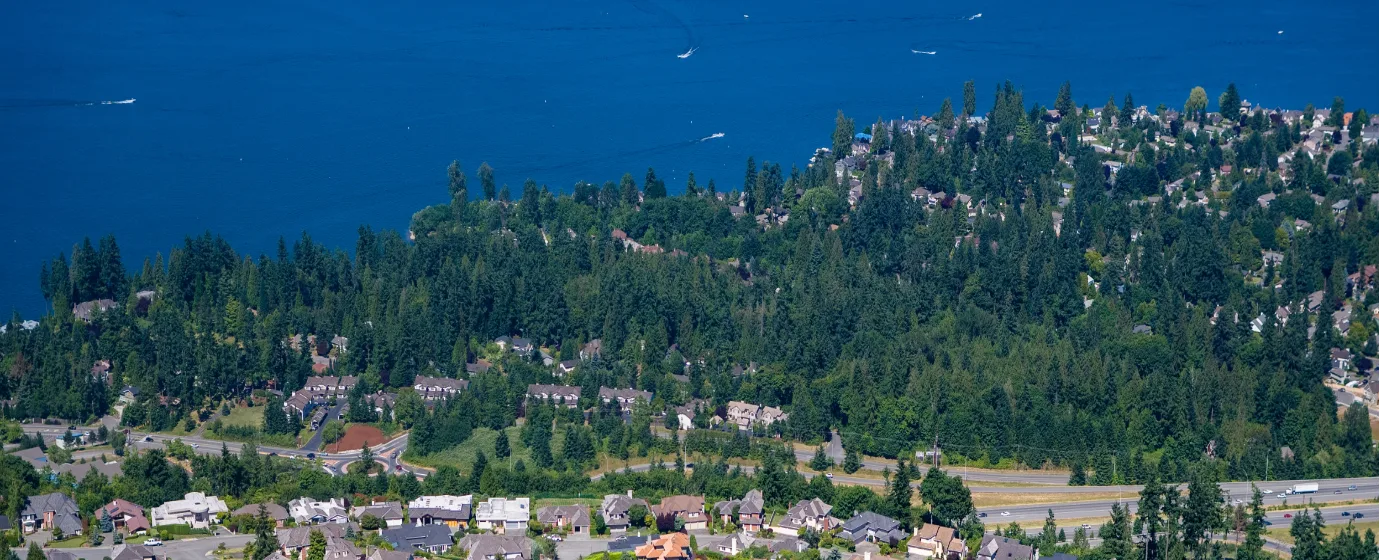
Puget Sound · Washington
Not every 1031 buyer is a seasoned real estate investor with a portfolio manager on speed dial. A significant share of the capital flowing into Issaquah right now comes from California homeowners who finally sold — Bay Area bungalows that doubled, Sacramento duplexes held for two decades, Inland Empire rentals that appreciated past the point where holding made sense. They closed escrow, handed the proceeds to a qualified intermediary, and started Googling Pacific Northwest markets. Issaquah keeps appearing for good reason: a $1,070,000 median sold price in a metro anchored by Microsoft, Costco, and Boeing creates a very different investment equation than anything left on the California coast.
Rental demand here is structural, not cyclical. Issaquah's tenant pool skews toward dual-income tech and healthcare households — roughly 58% of renters hold a bachelor's degree or higher — and the Issaquah School District's A-rated reputation means families with school-age children actively seek long-term leases rather than bounce between apartments. King County's vacancy rate sits around 3.6%, well below the broader Puget Sound average, and a construction pipeline that collapsed to a decade low in completions through 2025 means that supply pressure won't ease quickly. Investors who place a well-priced rental here typically find it leased before the sign goes in the ground.
This guide covers what a 1031 investor specifically needs: the mechanics of the exchange itself, the Issaquah investment property landscape by type, why California capital is targeting this zip code over other Pacific Northwest alternatives, Washington's meaningful tax advantages, and the due diligence checklist every out-of-state buyer needs before the 45-day identification window closes. If you're trying to decide whether Issaquah makes sense as a replacement property market, this is where to start.

The clock starts the moment your relinquished property closes. From that day, you have 45 calendar days to identify potential replacement properties in writing — no extensions, no exceptions for weekends or holidays. Most investors identify three properties (the three-property rule), though you can identify more if the combined fair market value doesn't exceed 200% of the relinquished property value. The identification letter goes to your qualified intermediary, not to the sellers.
From the original closing date, you then have 180 calendar days to close on your replacement property. The 45-day identification deadline falls inside that 180-day window — meaning your clock is always running, and finding a property in Issaquah's competitive market with 28 days of median time-on-market is achievable but requires preparation in advance. The qualified intermediary (QI) holds your proceeds throughout the process; you cannot touch the funds or the exchange is invalidated.
The "like-kind" rule is more flexible than most investors expect. Any real property held for investment or business use qualifies — a California duplex can roll into a Washington single-family rental, a commercial strip center can become a multifamily building, a vacant lot can become an apartment. What you must avoid is "boot" — taxable excess that occurs when the replacement property purchase price is less than the relinquished property net sale price, or when the investor receives cash back from the exchange. Structure the purchase price at or above the relinquished sale price to avoid triggering a taxable event on the difference.
Issaquah is not a traditional investor's market in the way that Tacoma or Renton might be — cap rates are thinner, entry prices are higher, and finding a true value-add duplex takes patience. What investors are buying here is a combination of durable rental demand, a highly educated tenant pool, and long-term appreciation in a supply-constrained submarket. The median sold price across all property types sits at $1,070,000, and the market has recovered from a mid-2025 correction; year-over-year price growth is back at approximately 9% as of mid-2026.
Small multifamily is genuinely scarce. Duplexes and small apartment buildings account for only about 6% of Issaquah's housing stock, which means when they do come to market, competition is real. Single-family rentals dominate the investor landscape — roughly 37% of housing units are detached single-family homes, and a meaningful percentage of those trade as investment properties given the strength of the rental market. Commercial and mixed-use plays exist but are concentrated primarily around the Central Issaquah plan corridor and the Gilman Village area.
| Property Type | Typical Price Range | Est. Cap Rate | Avg Days to Close |
|---|---|---|---|
| Single-Family Rental (SFR) | $900,000 – $1,400,000 | 3.5% – 4.5% | 21 – 35 days |
| Duplex / Small Multifamily | $1,100,000 – $1,600,000 | 4.5% – 5.5% | 25 – 40 days |
| Condo / Townhome Rental | $550,000 – $850,000 | 3.0% – 4.0% | 14 – 28 days |
| Class B Suburban Apartment (5+ units) | $2,500,000+ | 7.5% – 8.0% | 45 – 75 days |
Single-family rentals move fastest — a well-presented property in Issaquah Highlands or Klahanie is typically under contract before 1031 investors on a tight timeline can complete due diligence without advance preparation. Small multifamily sits longer, partly due to the higher price points and partly because fewer buyers can execute cleanly at that price range.

Looking to buy in Estimate your payment.
Enter your numbers to see an estimated monthly mortgage payment.
Estimate only. Excludes HOA fees and mortgage insurance.
California's capital gains environment has become a meaningful driver of 1031 activity in the Pacific Northwest. An investor selling a California rental property with $800,000 in embedded gain faces a combined federal and state tax bill that can exceed $280,000 without a 1031. Washington has no state income tax. That arithmetic is straightforward.
A Bay Area investor closing on a San Jose single-family rental at $1.4 million can roll the full net proceeds into Issaquah and, depending on leverage, acquire either a strong SFR in Issaquah Highlands and a condo-style rental outright, or a duplex with equity to spare. The comparable rental income — $3,200 to $3,800 per month for a quality three-bedroom SFR in Issaquah versus a Bay Area property that might generate similar rent at twice the purchase price — isn't the point. The point is the depreciation basis reset, the tax-free exchange, and a tenant pool in a growing Pacific Northwest tech suburb.
Southern California investors — particularly those selling in Orange County, the San Fernando Valley, or coastal San Diego — often arrive with proceeds in the $900,000 to $1,400,000 range and are well-positioned to enter Issaquah at median-price SFR or strong townhome territory. Properties in the $950,000 to $1,100,000 range in Klahanie or central Issaquah neighborhoods routinely generate $3,200 to $3,600 in monthly rent, with lease-up times under 30 days in the current environment.
Sacramento and Inland Empire investors selling modestly priced rentals — properties that have appreciated dramatically since 2015 but generate lower absolute sale prices — often find Issaquah's entry point attractive when leveraged. A $650,000 to $800,000 exchange amount, combined with a DSCR loan or conventional investment financing, can place an investor into a condo or townhome rental that generates positive monthly cash flow while preserving the capital gains deferral.
Washington's zero state income tax is the headline — and it's a meaningful one. Every dollar of net rental income from an Issaquah property stays whole; in California, a high-income investor in the top bracket hands 13.3% of that income to Sacramento before federal taxes are applied. On $40,000 per year in net rental income, that's a $5,320 annual difference that compounds directly into returns.
| Tax Item | California | Washington |
|---|---|---|
| State income tax on rental income | Up to 13.3% | None |
| Property tax rate on new purchase | ~1.1% – 1.25% (post-Prop 13 reassessment) | ~0.96% (King County) |
| Sales tax | None (no sales tax) | 6.5% state + local (on materials/furnishings) |
| Long-term capital gains (state) | Up to 13.3% | 7% on gains over $262,000/year |
| Capital gains below threshold | Taxed as ordinary income (state) | Exempt from WA capital gains tax |
Washington does impose a 7% state capital gains tax, but the threshold matters: it applies only to long-term capital gains exceeding $262,000 per year. For most individual rental investors, annual capital gains from an Issaquah property won't cross that threshold — particularly if proceeds are being held and not harvested. The more relevant figure for day-to-day investors is the property tax rate: approximately 0.96% of assessed value in King County, which on a $1,070,000 property translates to roughly $10,272 per year.
One planning note worth understanding before the exchange closes: depreciation basis does not reset in a 1031 exchange. The carryover basis from the relinquished California property follows you — the accumulated depreciation recapture obligation doesn't disappear, it defers. For investors who want to exit the active management equation entirely, Delaware Statutory Trusts (DSTs) are a 1031-eligible passive investment structure that some advisors are using to absorb exchange proceeds while the investor identifies a direct replacement property.
Washington's landlord-tenant law is generally balanced but has specific procedural requirements that out-of-state owners consistently underestimate. Notice requirements for rent increases, entry, and terminations are codified with specific timelines — serving an improper notice doesn't just delay the process, it can restart the clock entirely. As of 2026, there is no statewide rent control in Washington, though the issue has surfaced in the Legislature periodically. King County and Issaquah itself have not enacted local rent caps.
Typical property management fees in the Issaquah market run 8% to 10% of gross monthly rent. On a $3,500 monthly rental, that's $280 to $350 per month — a meaningful line item in a compressed-cap-rate environment, but a reasonable cost for an out-of-state owner who won't be available for a 2 a.m. maintenance call or a lease renewal negotiation. Local property management companies serving the Eastside market include Windermere Property Management (with a Bellevue office serving Issaquah-area properties) and Renters Warehouse Seattle, both of which have active Issaquah portfolios.
What out-of-state owners consistently underestimate is the HOA dimension. A meaningful percentage of Issaquah's investment-grade properties — particularly in Issaquah Highlands and Klahanie — sit within HOA-governed communities that have their own rental restrictions, approval requirements, and caps on rental unit percentages. An HOA that has hit its rental cap effectively makes a property non-rentable until an owner-occupant sells. Verify HOA rental policies before writing the offer, not during due diligence.
| Item | What to Verify | Local Resource |
|---|---|---|
| Title search | Clean title, no liens, no easement conflicts | Fidelity National Title or Chicago Title (Bellevue offices) |
| Sewer vs. septic | Most Issaquah properties are on city sewer; older/rural parcels may have septic | City of Issaquah Utilities Department |
| Flood zone status | Check FEMA flood map — Lake Sammamish proximity can affect some parcels | FEMA Flood Map Service Center |
| Rental permit requirements | City of Issaquah does not currently require a separate rental license, but verify | City of Issaquah Planning & Development |
| HOA rental restrictions | Cap on rentals, approval process, minimum lease terms | Request HOA governing documents from listing agent |
| Zoning for ADU potential | Washington's ADU law (HB 1337) permits ADUs on most SFR lots — confirm lot size and setbacks | King County Parcel Viewer + City of Issaquah zoning |
| School district boundary | Confirms Issaquah School District enrollment — key to tenant pool quality | Issaquah School District boundary maps |
| Current lease status | Month-to-month vs. fixed term, current rent vs. market, deposit held | Estoppel certificate from seller |
| Deferred maintenance inspection | Roof age, HVAC system, sewer scope, foundation | Licensed WA home inspector; budget for sewer scope separately |
| Short-term rental ordinances | Issaquah does not have an aggressive STR ban but HOA rules often override — verify both | City of Issaquah + HOA documents |
| Property management referral | Identify manager before close — good PMs have waitlists in this market | Windermere PM or Renters Warehouse Eastside |
| Title company coordination with QI | Exchange proceeds must flow through QI — title company must be briefed | Coordinate at time of offer acceptance |
| Capital gains tax planning | Confirm WA capital gains threshold applicability for your gain profile | CPA familiar with WA tax law |
| Insurance quote | Landlord policy (DP3) required; HOA master policy may cover some perils | Get quote before removing contingencies |

Local Expert Takeaway: The most common mistake California 1031 buyers make in Issaquah is treating the HOA rental cap as a due diligence afterthought. Issaquah Highlands and Klahanie — the two neighborhoods with the strongest tenant pools and highest rents — are also the two with the most restrictive HOA rental policies. Identify your target neighborhood, pull the HOA financials and rental cap status before you make an offer, and have a second-choice property identified before your 45-day window is half spent. The investors who close cleanly here prepared two weeks before the relinquished property recorded.
If you're entering a 1031 exchange and targeting Issaquah as your replacement market, the single most important move you can make before day one of the clock is getting your financing commitment in place. DSCR loans — which qualify based on the rental property's income rather than your personal debt-to-income ratio — are an excellent tool for 1031 buyers who want to preserve liquidity or keep the investment transaction off their primary mortgage profile. Todd works regularly with 1031 investors on tight timelines and knows which Issaquah neighborhoods clear HOA rental caps and which don't. Reach out now, before escrow closes on your relinquished property.
✅ Issaquah's rental vacancy sits well below the national average, with King County maintaining roughly 3.6% vacancy — one of the tightest rental markets in the country, which directly supports rent stability and low turnover for investment property owners.
⚠️ HOA rental caps are the hidden landmine in Issaquah's most desirable investment neighborhoods. Issaquah Highlands and Klahanie carry premium rents but also carry the most restrictive HOA rental policies — verify rental eligibility before writing any offer on a 1031 timeline.
📍 Washington's zero state income tax means every dollar of net rental income stays whole, and the 0.96% King County property tax rate is below the effective rate a California buyer would face on a newly purchased replacement property under post-Prop 13 reassessment rules.
Does a 1031 exchange work for out-of-state property?
Yes — a 1031 exchange has no geographic restriction on the replacement property. A California investor can sell a relinquished property in San Jose and acquire a replacement property in Issaquah, Washington without any problem. The key requirements are that both properties are held for investment or business use, the proceeds are held by a qualified intermediary, and the identification and closing deadlines are met.
What is the cap rate on rental property in Issaquah?
Cap rates in Issaquah run thinner than markets like Tacoma or Spokane, reflecting the premium price point and strong tenant demand. Single-family rentals typically yield in the 3.5% to 4.5% range; duplexes and small multifamily properties run 4.5% to 5.5%. Larger Class B suburban apartment assets trade closer to 7.5% to 8.0% at the Seattle metro level, but those rarely come to market in Issaquah itself.
Do I need a local property manager for a 1031 investment in Washington?
Out-of-state owners who try to self-manage Washington rentals from California consistently underestimate the procedural requirements of Washington's landlord-tenant code. A local property manager at 8% to 10% of gross rent is a meaningful expense — but so is a botched notice that restarts a 90-day process. For most investors on a 1031 exchange who aren't planning to relocate, professional management is the right call from day one.
Explore the full Issaquah series: The Ultimate Issaquah Relocation Guide · Is Issaquah Safe? · Cost of Living in Issaquah · Best Neighborhoods in Issaquah · Issaquah Schools & Family Life · Issaquah Youth Sports · Issaquah Parks & Recreation · Retiring in Issaquah · 1031 Tax-Deferred Exchange in Issaquah · Issaquah First-Time Homebuyers Guide · Moving to Issaquah from California
Tell us what you need help with and we'll connect you with local resources.

About the Author
Todd Davidson is the founder of Living in Oregon and Living in Washington, where he publishes in-depth city guides, neighborhood resources, and local market insights covering more than 180 communities across the Pacific Northwest. While his background is in home financing and real estate, he created these digital platforms to help families research and compare regions before making a move.