
Puget Sound · Washington
Maybe your company is sending you to the Puget Sound corridor and someone mentioned Mount Vernon as the smarter alternative to Everett or Bellingham. Maybe you've watched Seattle prices push north for a decade and you're finally ready to stop waiting. Maybe you drove through on I-5 and saw the tulip fields in April and thought, people actually live here — and now you want to know if they're happy about it.
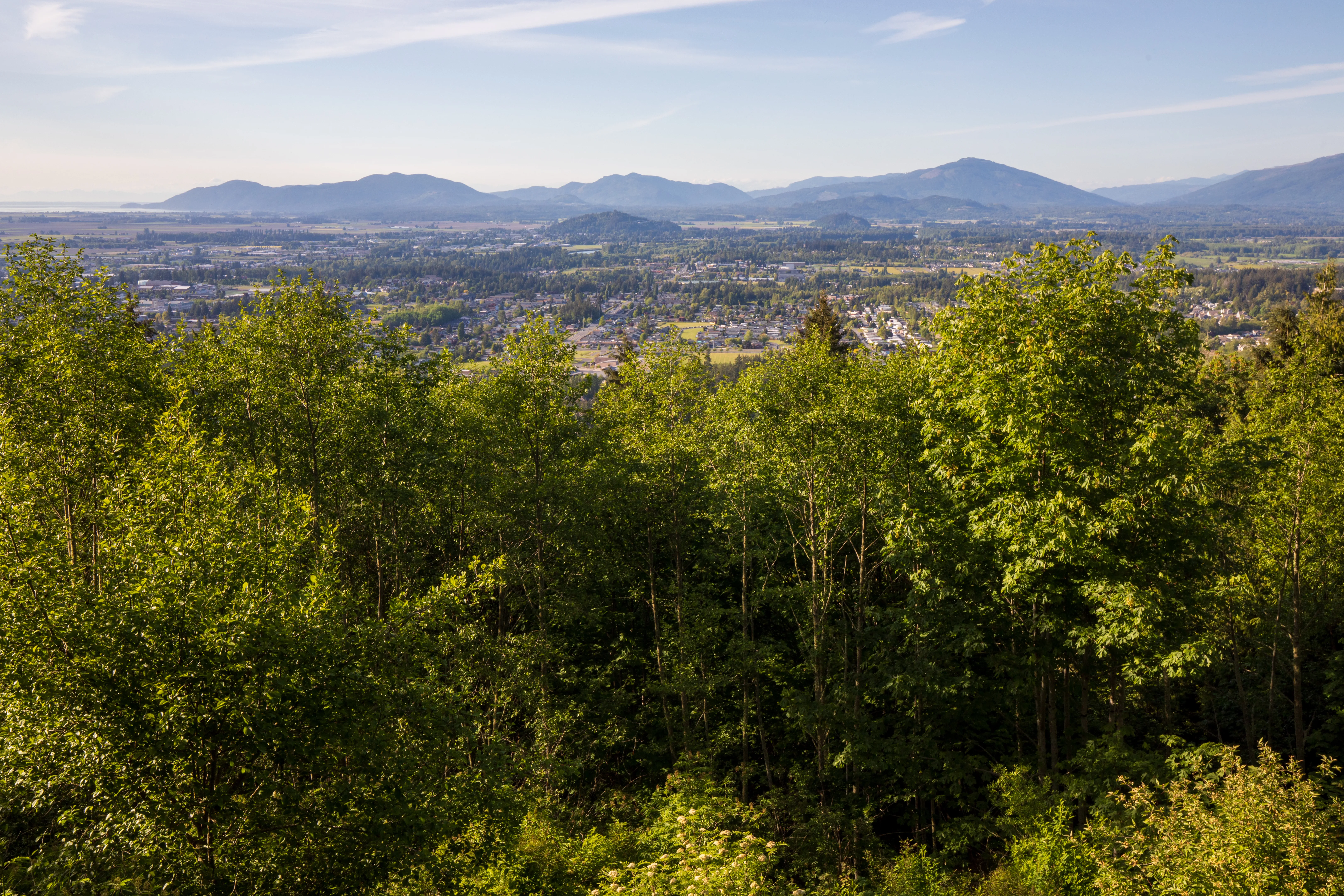
Mount Vernon sits 60 miles north of Seattle at the geographic and cultural intersection of two worlds. To the west, the Skagit Valley opens into some of the most productive agricultural land in the Pacific Northwest. To the east, the Cascades define the horizon. The city itself is compact and practical — a county seat with a functioning downtown, a regional hospital, and a walkable riverwalk along the Skagit that surprises people who expected nothing but strip malls. The honest geographic reality is that Mount Vernon is defined as much by I-5 as by the river: the freeway bisects commuter logic, determines which grocery store you'll use, and shapes the character of every neighborhood on both sides of it.
This guide will help you answer the questions that matter before you make an offer: which neighborhoods align with your actual budget, what the 63-minute drive to Seattle really costs you on a Tuesday morning, where families with school-age children tend to land, and what the locals know that doesn't show up in the listing description. If Mount Vernon is genuinely the right fit for you, the next several thousand words will make that clear. If it isn't, you'll know that too.

| Best For | Why |
|---|---|
| Commuters to Bellingham or Burlington | Under 20 minutes to either city; I-5 access without the full Puget Sound price premium |
| Families with school-age children | Mount Vernon School District earns a solid B rating; multiple established residential neighborhoods with parks and community feel |
| First-time buyers | Entry-level homes in West Mount Vernon and South Mount Vernon start well below the citywide median; more inventory than most Puget Sound cities |
| Remote workers | Lower cost of living, access to outdoor recreation, and a functioning downtown without the isolation of rural living |
| Retirees seeking an active lifestyle | Little Mountain Park, Skagit Riverwalk Trail, and proximity to Anacortes and the San Juan Islands; regional healthcare anchored by Skagit Regional Health |
| Buyers priced out of Bellingham | Mount Vernon offers comparable amenities at meaningfully lower median prices, roughly 30 minutes closer to Seattle |
The first thing people notice after moving here is that Mount Vernon has more layers than they expected. Downtown along First Street is genuinely walkable — the Lincoln Theatre anchors the cultural block, the Library Commons draws families and students on weekday afternoons, and the Skagit Riverwalk Trail gives you a legitimately beautiful place to decompress after work. On a summer evening with the river running and the mountains in the background, it's easy to understand why people who planned to stay two years end up staying fifteen.
The second thing they notice is the commute math. Sixty-three minutes to Seattle on paper means 75 to 85 minutes door-to-door on a normal weekday morning, and something closer to 90 minutes if you're trying to make an 8 a.m. meeting from the west side of the city. The choke point is the same one it's always been: I-5 south through Everett, specifically the stretch between Exit 186 and the Lynnwood interchange. Buyers who work in South Seattle or Bellevue should road-test the commute before committing. Buyers whose employers are in Burlington, Anacortes, or Bellingham are looking at a genuinely easy daily drive.
The community vibe lands somewhere between small-city utility and genuine civic pride. The Skagit Valley Tulip Festival every April brings more than a million visitors to the region and creates a brief but remarkable window when the whole valley feels like a postcard. Locals develop real opinions about the best viewing roads — South Best Road and Bradshaw Road in the flats west of town are perennial favorites — and the festivals along Downtown Mount Vernon's waterfront in summer fill a calendar that punches above its weight for a city of 35,000. The cultural fabric is also notably diverse: approximately 37% of residents identify as Hispanic, and that shows up in the food, the businesses, and the character of neighborhoods on the south and west sides in ways that make the city feel less generically Pacific Northwest than many of its neighbors.
The human friction moment most newcomers hit around month four is the grocery and errand reality west of I-5. East-side residents near Fir Hill or Centennial Ridge have easy access to the big-box corridor along College Way — Costco, Fred Meyer, and the commercial strip that runs toward Burlington. Residents on the west side or downtown corridor are working with a shorter list of options and navigating surface streets that feel slower than they look on the map.
Outdoor access that beats any comparable-priced market in the state. Little Mountain Park sits directly within the city limits, offering 508 acres of trails and a summit viewpoint that looks out over the entire valley, the San Juan Islands, and on a clear day, the Olympic range to the southwest. The Skagit Riverwalk Trail connects downtown to neighborhoods along the river in a way that feels rare for a city this size. Within an hour's drive you have the North Cascades, Deception Pass State Park, and the ferry connections to the San Juan Islands out of Anacortes.
The regional healthcare infrastructure is another reason residents stay. Skagit Regional Health and PeaceHealth anchor the medical corridor, providing services that most small cities simply don't have locally. For families and retirees especially, not having to drive to Seattle or Bellingham for specialist care is a practical quality-of-life factor that doesn't appear in any ranking table but matters enormously in daily life.
Downtown Mount Vernon is legitimately functional. The Lincoln Theatre hosts live music, film series, and community events year-round. The Library Commons is the kind of civic anchor that newer developments fail to replicate — it draws foot traffic across age groups and feels like the center of the city because it actually is. The farmers market runs from May through October and functions as a genuine community gathering point, not a tourist attraction. That distinction matters more than it sounds.
The cost differential versus Bellingham is real and persistent. At a median home value of $590,000, Mount Vernon consistently runs below Bellingham on comparable product, while offering faster commute times to the employment centers most Mount Vernon residents actually use. For buyers who've been touring both markets, the math increasingly favors Mount Vernon — especially in neighborhoods like Fir Hill and Digby Heights where the suburban quality of life genuinely rivals anything in Whatcom County at that price point.
Washington's lack of a state income tax amplifies that cost advantage. A household earning $76,000 keeps a meaningful amount more in-pocket compared to peers in Oregon or California, and that effect compounds noticeably over a 10- to 20-year homeownership horizon.
Looking to buy in Estimate your payment.
Enter your numbers to see an estimated monthly mortgage payment.
Estimate only. Excludes HOA fees and mortgage insurance.
The commute to Seattle is the most significant limitation for anyone whose employer sits downtown or on the Eastside. Sixty-three minutes under ideal conditions is still a drive most Puget Sound cities don't impose, and Mount Vernon sits at the outer edge of what most buyers with young children and full-time office jobs find sustainable five days a week. The buyers who make it work long-term are either hybrid workers doing two or three days per week, people whose primary employer is local, or households where one partner works in Burlington or Anacortes and the Seattle commute is genuinely occasional.
Property crime runs approximately 21 incidents per 1,000 residents — higher than most of Whatcom County and higher than Anacortes, though lower than similarly sized cities in King County. The pattern is concentrated rather than evenly distributed across the city, with the commercial corridors along College Way and the downtown core seeing more vehicle break-ins and retail theft than the residential hillside neighborhoods. This is worth understanding before choosing a neighborhood, not a reason to eliminate the city.
Why some people leave comes down to a fairly short list of honest reasons. Families who want the full suburban amenity package — newer school buildings, a wider selection of youth sports leagues, a denser commercial scene within walking distance — sometimes find that Bellingham or even Burlington fits better over the long term. Professionals who accepted a Mount Vernon house price expecting a Mount Vernon lifestyle and a Seattle-level commute sometimes discover the daily arithmetic doesn't hold. And buyers who purchase in the lower-cost corridors without researching the specific neighborhood dynamics occasionally find themselves in areas where they didn't fully understand the tradeoffs between price and proximity to services.
The limited transit infrastructure is a genuine constraint for households who prefer not to be car-dependent. Skagit Transit covers the city, but the network is oriented around commuter routes and not the kind of frequent, all-day service that allows lifestyle flexibility without a vehicle. If walkable transit-oriented living is a priority, downtown Seattle, Capitol Hill, and Bellingham's Fairhaven neighborhood remain better fits.
Fir Hill is one of the most consistently sought-after residential areas in the city, and for good reason — it offers established tree-lined streets, well-maintained homes, and a suburban character that feels settled rather than transitory. Price ranges run through the mid-$500s to the low $700s for typical single-family stock, with larger lots and updated homes pushing to the top of that range. The catch is that it lacks walkable retail of its own, making car dependency a daily reality. Best for: Families who want a quiet, established neighborhood with good bones and don't mind the drive for errands.
West Hill appeals strongly to households with children — the neighborhood has a family-oriented feel, proximity to parks and schools, and a price range in the mid-$400s to low $600s that makes it accessible to a wide buyer pool. Homes here tend toward practical suburban builds from the 1980s and 1990s, with occasional newer infill. It sits on the western side of the I-5 corridor, which shapes the commute experience for anyone heading to Burlington or Anacortes. Best for: Families with school-age children who want a true neighborhood feel at a below-median price point.
Eaglemont is where Mount Vernon's premium market lives. Homes here range from approximately $700,000 into seven figures, with larger lots, greenbelt adjacency, and the private-feeling quality that buyers at this price point expect. The Beaver Pond Trailhead provides direct access to natural areas, and the neighborhood's elevated position gives views the rest of the city simply can't offer. The honest downside is the distance from downtown amenities and the fact that the premium is real — buyers should budget for it and not arrive expecting Fir Hill prices. Best for: Move-up buyers and professional households seeking premium finishes, privacy, and natural surroundings.
Digby Heights is a solid mid-range neighborhood that delivers suburban comfort without the Eaglemont price tag. Homes trade in the $450,000 to $650,000 range, with a mix of late-1990s and early-2000s construction that holds up well. The neighborhood consistently ranks among the more popular search destinations on local real estate platforms, driven by its balance of price, condition, and location. Like most of east-side Mount Vernon, it's oriented around car-based daily life. Best for: Buyers seeking mid-range suburban value with low drama and predictable neighborhood quality.
South Mount Vernon offers some of the most affordable entry points in the city, with homes ranging from the low $400s into the mid-$500s on older stock and newer infill. The neighborhood is more mixed in character than the hillside areas — a blend of long-term residents, working families, and newer arrivals — and its proximity to the south commercial corridor adds convenience that some buyers prioritize over neighborhood polish. Best for: First-time buyers and budget-conscious households willing to trade aesthetic uniformity for price and location.
The Hilltop area sits on elevated ground with views that justify a walk around the neighborhood before any offer. Homes here vary more in condition and vintage than in Fir Hill or Digby Heights, creating opportunities for buyers who don't mind a renovation project. Prices generally track in the mid-$400s to the low $600s depending on the specific lot and condition. The community has a quieter character than some of the larger subdivisions, with smaller streets and an older, more established feel. Best for: Buyers who value views and quiet streets over newer construction and are comfortable with some variability in home condition.
Centennial Ridge represents the newer-construction suburban end of the Mount Vernon market, with homes built predominantly in the 2000s and later that appeal to buyers who want updated systems, open floor plans, and the predictability of a planned community. Prices in the $500,000 to $700,000 range reflect the condition premium. The neighborhood is well-positioned for access to the College Way commercial corridor. Best for: Buyers who prioritize newer construction and turnkey condition over lot size or neighborhood character.
West Mount Vernon is the city's most accessible entry-level market, with a median sold price around $430,000 — meaningfully below the citywide figure. The catch is that housing stock here is older, the neighborhood character is more blue-collar and historic than the hillside subdivisions, and proximity to the Skagit River corridor means buyers should understand floodplain designations before going under contract. For buyers who've been told they can't afford Mount Vernon, this is the neighborhood that rewrites that assumption. Best for: First-time buyers and investors who understand what they're buying and are prioritizing price over polish.
| City | Best For | Home Price | Commute to Seattle | Vibe |
|---|---|---|---|---|
| Mount Vernon | Balance of price, access, and outdoor lifestyle | $590,000 median | ~63 min | Small-city practical with strong community identity |
| Burlington | Budget buyers who want retail access without city complexity | ~$520,000 | ~70 min | Commercial-adjacent suburb, quieter residential pockets |
| Anacortes | Retirees, waterfront buyers, outdoor enthusiasts | ~$650,000 | ~80 min | Island-adjacent, maritime, very little urban grit |
| Bellingham | Urban amenities, Western Washington University proximity | ~$640,000 | ~85 min | College city energy, walkable districts, politically active |
| Sedro-Woolley | Buyers who want space and acreage at lower prices | ~$450,000 | ~75 min | Rural-adjacent, slower pace, fewer services |
| La Conner | Niche buyers seeking charm and community character | ~$500,000 | ~75 min | Arts-focused small town, limited practical amenities |
| Category | Data |
|---|---|
| Population (2026) | Approximately 35,360 |
| Median Home Value | $590,000 (Zillow ZHVI, mid-2026) |
| Median Household Income | Approximately $76,000 |
| Property Tax Rate | Approximately 0.97% |
| Commute to Seattle | ~63 minutes (I-5 southbound, off-peak) |
| Violent Crime per 1,000 | 3.7 |
| Property Crime per 1,000 | 21 |
| School District | Mount Vernon School District (B rating) |
| Major Employers | Skagit Regional Health, Mount Vernon School District, Janicki Industries, Skagit Valley College, PeaceHealth |
| County | Skagit County |
The Tulip Festival changes everything for six weeks. The Skagit Valley Tulip Festival runs every April and draws more than a million visitors to the valley. For residents, this is a point of genuine local pride — and a practical lesson in which roads to avoid between 10 a.m. and 3 p.m. on a weekend. South Best Road and Bradshaw Road attract heavy tourist traffic during peak bloom, and locals develop their own routing habits accordingly. The festival itself brings community events, street fairs in downtown Mount Vernon, and an energy that makes April one of the better months to experience the city as a newcomer.
The Lincoln Theatre is a real anchor, not just a historic footnote. Built in 1926 and still operating on First Street, the Lincoln hosts live music, film series, community events, and occasional touring acts that you wouldn't expect in a city of 35,000. Locals treat it as a genuine gathering place rather than a landmark they walk past. If you want to understand what Mount Vernon residents mean when they talk about their downtown, attending a Friday night event at the Lincoln within your first month is more informative than any neighborhood tour.
The city's Hispanic community has shaped the food landscape in ways that consistently surprise newcomers. With approximately 37% of residents identifying as Hispanic — the majority of Mexican origin — Mount Vernon has a roster of taquerias, panaderías, and family-run restaurants along the south and west corridors that represent some of the best value eating in the county. This isn't fusion or approximation. It's the real thing, built by a community with deep roots in the agricultural valley going back generations. Newcomers who arrive expecting a generic Pacific Northwest dining scene find themselves revising that assumption quickly.
What I Would Not Do if Moving to Mount Vernon: I would not buy in the West Mount Vernon river corridor without first pulling the FEMA floodplain map for the specific parcel. Portions of the neighborhood sit in Zone AE — the highest-risk flood designation — and the flood insurance cost can add meaningfully to the monthly carrying cost of an otherwise affordable purchase. The price looks compelling until you add the annual insurance premium. This is a specific, verifiable fact that belongs in the financial model before the offer goes in, not after.

Local Expert Takeaway: If you're comparing Mount Vernon to Bellingham, make the drive on a Tuesday morning at 7:30 a.m. and time both commutes honestly. Mount Vernon saves most buyers $40,000 to $80,000 on comparable product and cuts the Seattle commute by 20 minutes — but that calculus only holds if your daily life is actually oriented toward Burlington, Anacortes, or remote work, rather than a downtown Seattle office. Neighborhoods like Fir Hill and Centennial Ridge are the sweet spot for buyers who want move-in condition at or near the median; first-time buyers willing to do homework should look at South Mount Vernon and West Hill before assuming they're priced out.
✅ Mount Vernon's median home value of $590,000 and strong outdoor access make it the most cost-efficient entry point on the I-5 corridor north of Everett — especially for hybrid workers who don't need a daily Seattle commute.
⚠️ The 63-minute drive to Seattle is real and adds up — buyers who office five days a week downtown should model the time and fuel cost before falling in love with a listing in Eaglemont.
📍 Neighborhood selection matters more here than in most comparable cities — the spread from West Mount Vernon's $430,000 median to Eaglemont's $875,000 listing range means buyers who don't research sub-markets often end up in the wrong fit for their budget and lifestyle.
Is Mount Vernon a good place for families?
Mount Vernon offers a solid foundation for families with children. The Mount Vernon School District carries a B rating, multiple established neighborhoods like Fir Hill and West Hill are oriented around family life, and Little Mountain Park provides genuine outdoor space within the city limits. The community's cultural diversity also exposes children to a richer civic environment than many Pacific Northwest cities of similar size.
What is the crime rate in Mount Vernon?
Violent crime runs approximately 3.7 incidents per 1,000 residents — a moderate figure that compares favorably to most Puget Sound cities of similar size. Property crime at approximately 21 per 1,000 residents is the more relevant concern for most households, and tends to be concentrated in commercial corridors rather than spread evenly across residential neighborhoods. Hillside areas like Fir Hill and Eaglemont report notably lower property crime exposure than the downtown core.
How does Mount Vernon compare to Bellingham?
Bellingham carries a stronger urban energy, a broader dining and arts scene, and the demographic diversity that comes with a major university. Mount Vernon's median home price runs somewhat lower for comparable product, the Seattle commute is roughly 20 minutes shorter, and the community scale — at 35,000 residents versus Bellingham's 95,000 — creates a notably different daily texture. Buyers who want walkable urban living with more nightlife options generally prefer Bellingham; buyers who prioritize cost, outdoor access, and a quieter community character increasingly land in Mount Vernon.
Explore the full Mount Vernon series: The Ultimate Mount Vernon Relocation Guide · Is Mount Vernon Safe? · Cost of Living in Mount Vernon · Best Neighborhoods in Mount Vernon · Mount Vernon Schools & Family Life · Mount Vernon Youth Sports · Mount Vernon Parks & Recreation · Retiring in Mount Vernon · 1031 Tax-Deferred Exchange in Mount Vernon · Mount Vernon First-Time Homebuyers Guide · Moving to Mount Vernon from California
Tell us what you need help with and we'll connect you with local resources.

About the Author
Todd Davidson is the founder of Living in Oregon and Living in Washington, where he publishes in-depth city guides, neighborhood resources, and local market insights covering more than 180 communities across the Pacific Northwest. While his background is in home financing and real estate, he created these digital platforms to help families research and compare regions before making a move.