
Puget Sound · Washington
There's a moment most first-time buyers describe the same way: you're sitting across from a lender, you've done the math in your head a dozen times, and then they say a number out loud that makes the whole thing suddenly real. In Shoreline, that number tends to land around $770,000 — the city's median home price — and for a lot of first-timers, it produces a sharp intake of breath. But here's what doesn't get said often enough: Shoreline is one of the few cities this close to Seattle where a first-time buyer can still find a realistic path to ownership. The commute is 22 minutes to downtown Seattle, the schools carry an A rating, and the neighborhoods feel like real communities rather than transit corridors. The effort is real. So is the payoff.
At $770,000, the Shoreline median reflects a range — from modest 1960s ramblers in Richmond Highlands to updated three-bedroom colonials in Echo Lake to the kind of luxury waterfront that skews everything upward. For a first-time buyer, the realistic entry point sits below that median: condos and smaller homes in the $500,000s, townhomes in the mid-$600,000s, and detached single-family homes becoming available in the low $700,000s in the city's more affordable pockets. Renting a two-bedroom in Shoreline runs roughly $2,100–$2,500 a month. Owning a comparable home at $580,000 with 5% down, at current rates, lands in similar territory once you factor in equity accumulation — which renting never provides.
This guide walks you through what it actually takes to buy your first home in Shoreline in 2026: the budget tiers, the loan options, the step-by-step timeline, the down payment assistance programs available, and the five mistakes that cost first-time buyers money or opportunities in this specific market. Shoreline has its own quirks — an aging housing stock in some areas, a competitive offer environment in others, and school district boundaries that genuinely affect resale values in ways most buyers don't understand until it's too late. This guide covers all of it.
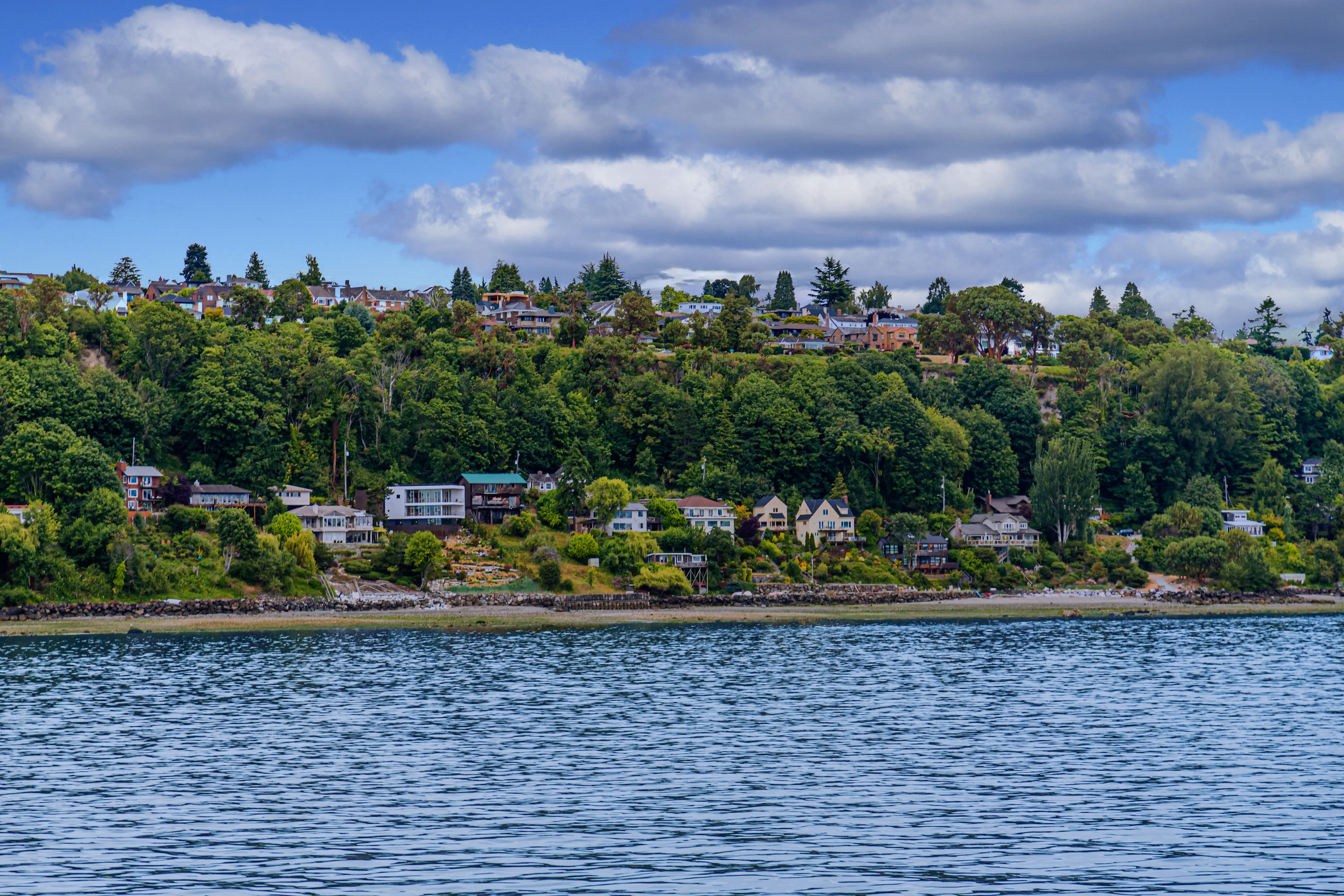
Shoreline sits in a useful middle ground for first-time buyers: it's not as expensive as Kirkland or Bellevue, not as competitive as Capitol Hill, and not as far-flung as Snohomish County. That positioning matters. Buyers priced out of Seattle proper often find that Shoreline gives them the proximity — 22 minutes to downtown — without the price premium of the in-city neighborhoods they were originally targeting. The school district's A rating makes Shoreline a realistic long-term hold even if your household doesn't have kids yet, because strong schools protect resale values in ways that are hard to overstate in King County.
That said, first-time buyers need to be clear-eyed about what the entry level actually looks like. Below $600,000, the inventory in Shoreline tends to be condos, older townhomes, or single-family homes that need meaningful work. The neighborhoods most accessible at first-time buyer price points — places like Richmond Highlands, Ridgecrest, and parts of Highland Terrace — offer solid value and reasonable commutes, but they're not the curated, walkable blocks you might be picturing from listing photos. Homes in the $500,000s here often come with deferred maintenance on roofs, systems, and windows that buyers need to budget for honestly.
The competition level has moderated compared to 2021 and 2022, but Shoreline is not a buyer's market. Homes that are priced right and show well still move in under two weeks, and multiple-offer situations remain common for anything below $700,000 in desirable neighborhoods. First-time buyers who enter this market thinking they can low-ball or wait for deals frequently find themselves losing the same house twice before adjusting their strategy.
| Price Range | What You Typically Find | Neighborhood Examples | Competition Level |
|---|---|---|---|
| Under $350K | Rare — condos only, limited inventory, likely needs work | Occasional finds near Aurora Ave corridor | Low inventory, but limited demand |
| $350K–$450K | Studio/1BR condos, older construction, some HOA fees | Westminster Triangle area, scattered condo complexes | Moderate |
| $450K–$550K | 2BR condos, smaller townhomes, entry SFH needing significant updates | Richmond Highlands, Ridgecrest | Moderate to competitive |
| $550K–$650K | 2–3BR townhomes, 3BR SFH fixer-uppers, some move-in ready condos | Highland Terrace, parts of Ballinger | Competitive |
| $650K+ | 3BR+ SFH, updated ranchers, newer townhomes, access to most neighborhoods | Echo Lake, North City, Briarcrest | Most competitive tier |
The realistic first-time buyer budget in Shoreline in 2026 lands somewhere between $480,000 and $650,000. At the lower end of that range, you're likely looking at a condo or a smaller single-family home with clear cosmetic or systems needs. At the upper end, you start accessing the 3-bedroom detached homes that hold value well and give you room to grow — which is the tier where long-term financial sense tends to live for buyers who plan to stay 5–7 years.
The best value entry point right now is the $550,000–$650,000 range, particularly in Highland Terrace and the quieter streets of Richmond Highlands. Homes in this tier are often 1960s–1980s construction with solid bones but dated interiors — exactly the kind of property where first-time buyers who are willing to update over time can build equity faster than the market alone would generate. The $650,000+ tier is where the competition sharpens considerably, but it's also where you get the neighborhood quality and resale safety that makes Shoreline worth owning in the first place.
| Step | What Happens | Typical Timeline | What First-Timers Get Wrong |
|---|---|---|---|
| Get finances in order | Pull credit reports, pay down debt, establish savings documentation | 1–6 months before buying | Underestimating how much cash they need beyond the down payment |
| Pre-approval | Lender reviews income, assets, credit — issues a pre-approval letter | 1–5 business days | Getting pre-qualified (not the same thing) |
| Find an agent | Interview 2–3 buyer's agents with Shoreline-specific experience | 1–2 weeks | Choosing an agent based on friendliness rather than local expertise |
| Active search | Tour homes, track listings, refine criteria based on what you actually see | 4–12 weeks | Waiting for the "perfect" home instead of the "right" home |
| Making offers | Write competitive offers with your agent's guidance | Days to weeks | Offering list price in a market where some homes still attract multiples |
| Under contract | Seller accepts — earnest money is deposited, timelines begin | Day 1 of contract | Missing earnest money deadlines or depositing late |
| Inspection | Hire a licensed inspector; review findings and negotiate | Days 5–10 | Waiving inspection on older Shoreline homes to be competitive |
| Appraisal | Lender orders an appraisal to confirm value | Days 10–21 | Not understanding what happens when appraisal comes in low |
| Final walkthrough | Confirm home is in agreed condition before closing | 1–2 days before closing | Skipping it because "nothing will change" |
| Closing | Sign documents, transfer funds, get keys | Day 30–45 | Being surprised by cash-to-close totaling 3–5% of purchase price |
In Shoreline specifically, the earnest money norm runs 1–3% of the purchase price — which on a $600,000 home means $6,000–$18,000 in funds that must be liquid and deposited within 2–3 business days of mutual acceptance. That's not a detail to gloss over. Buyers who haven't clearly separated their down payment savings from their earnest money sometimes find themselves scrambling at exactly the wrong moment.
The inspection question is the most important judgment call you'll make. Shoreline has a significant inventory of homes built in the 1960s–1980s, and those homes carry real inspection risk — original electrical panels, older sewer lines, windows that need replacing, crawl spaces with moisture issues. Waiving inspection to compete was common in 2021. In the current market, most buyers are retaining inspection rights, and sellers have largely adjusted their expectations. Skipping inspection on a 1968 rambler in Richmond Highlands to save your offer is a gamble with potentially five-figure consequences.
King County closings typically run 30–45 days from mutual acceptance. Your agent will help you structure timelines, but build your life around the 45-day window to avoid stress. Cash-to-close on a typical Shoreline purchase — including down payment, closing costs, and prepaid expenses — commonly runs 4–6% of the purchase price total. On a $600,000 home with 5% down, you're looking at roughly $30,000–$36,000 out of pocket before you get the keys.
Looking to buy in Estimate your payment.
Enter your numbers to see an estimated monthly mortgage payment.
Estimate only. Excludes HOA fees and mortgage insurance.
A conventional loan requires a minimum 620 credit score, but the rate improvement between a 650 and a 740 score is meaningful enough to justify the work of getting there. On a $450,000 loan, the difference between a 6.75% rate (650-range score) and a 6.25% rate (740+ score) is roughly $145 a month — which compounds to over $52,000 across a 30-year loan. If you're 3–6 months from buying, paying down a credit card to drop your utilization below 30% can move your score enough to matter.
FHA loans accept scores as low as 580 for the 3.5% down payment option. The catch is mortgage insurance — FHA charges both an upfront premium (1.75% of the loan, rolled into the loan) and an annual premium that runs roughly 0.55% of the balance per year. On a $500,000 loan, that annual premium runs about $229 a month added to your payment, and it stays for the life of the loan unless you refinance into a conventional product later. FHA still makes sense for buyers whose credit or down payment situation makes it the right tool — just go in knowing the full cost.
On income, the rule that matters most is front-end debt-to-income ratio — lenders want your total housing payment (principal, interest, taxes, and insurance) to be no more than 28% of your gross monthly income. At a $400,000 purchase price with 5% down, you're financing $380,000, and at current rates your total monthly payment runs roughly $2,800–$3,000. That means you need gross household income of at least $10,700–$10,800 a month, or about $129,000–$130,000 annually. Scale that up: a $500,000 purchase needs roughly $160,000 in annual income, and a $600,000 purchase pushes toward $192,000 or you'll need a larger down payment to bring the payment down.
One thing relocating buyers consistently overlook: Washington has no state income tax. If you're moving from California, Oregon, or any other state with a meaningful income tax, your take-home pay increases the moment you cross the border. That additional take-home directly improves your qualifying position and your monthly cash flow — it's not a small difference at the income levels most Shoreline buyers are working with.
Mistake 1: Confusing list price with what homes actually close at. In Shoreline's competitive sub-$700,000 tier, well-presented homes routinely close above asking price. A home listed at $649,000 in Echo Lake or North City might close at $680,000 — and buyers who budget to list price find their offers structurally uncompetitive. Ask your agent to pull recent sold prices versus list prices in your target neighborhoods before you write your first offer.
Mistake 2: Waiving inspection on older homes to win. Shoreline's housing stock skews older, and the neighborhoods most accessible to first-time buyers — Richmond Highlands, Highland Terrace, Ridgecrest — have concentrations of homes built decades before modern electrical, plumbing, and efficiency standards. The current market does not require you to waive inspection on most homes. Buyers who do it anyway to feel competitive are trading a real risk for an imagined advantage.
Mistake 3: Shopping at the top of their qualification number instead of the top of their comfort number. Lenders can often approve buyers for significantly more than those buyers can comfortably afford on a monthly basis. Being approved for $750,000 means a lender believes you can technically make the payment — it doesn't mean that payment won't create financial stress. The 28% front-end DTI guideline is a ceiling, not a target. Most buyers are more comfortable closer to 22–24%.
Mistake 4: Not understanding how school district boundaries affect value. The Shoreline School District boundary is not coterminous with city limits, and in some areas, homes a few blocks apart sit in different districts. Buyers who don't verify the specific school boundary before going under contract have ended up in homes they love on paper that lost resale value because the school assignment surprised the next buyer.
Mistake 5: Waiting for prices to drop in a supply-constrained market. Shoreline has softened slightly year-over-year, and some buyers are sitting out of the market expecting further declines. The city's proximity to Seattle, transit improvements near the light rail corridor, and persistently low housing supply all argue against a meaningful sustained correction. Buyers who wait for a 10–15% drop commonly find themselves two years later paying the same price — or more — having spent those two years renting instead of building equity.
First-time buyers in Shoreline are most realistically served by four neighborhoods, and the right one depends on what you're optimizing for.
Richmond Highlands is where the most accessible price points tend to cluster — older single-family homes in the $500,000s–$600,000s, solid tree-lined streets, and good access to Aurora Avenue for transit and errands. The housing stock is honest rather than glamorous, which means buyers who are comfortable with cosmetic updates get real equity upside. It's not the most polished neighborhood in Shoreline, but it's one of the most realistic entry points for first-time buyers working with conventional budgets.
Highland Terrace sits slightly east and offers a similar price range with slightly more updated stock. The neighborhood is quieter than the Aurora corridor and gives access to Hamlin Park's extensive trail system — a genuine daily quality-of-life asset. First-time buyers who want a detached home without sacrificing green space should put Highland Terrace on their list.
Ridgecrest offers the combination of accessibility and quiet residential character that many first-time buyers are actually looking for. Homes here tend to be modest in size but well-maintained, and the neighborhood's central Shoreline location keeps commute options open whether you're driving or using transit. Price points typically run in the $550,000–$680,000 range for detached homes.
Briarcrest sits toward the upper end of what first-time buyers can typically access — expect prices in the $650,000–$750,000 range for solid single-family homes. The neighborhood's mix of established landscaping, proximity to good schools, and quieter residential feel make it a sensible stretch target for buyers who can get there financially. It's also a neighborhood that tends to hold value well in softer markets, which matters when you're thinking about a 5–7 year horizon.

Local Expert Takeaway: The most expensive mistake first-time buyers make in Shoreline is falling in love with a listing in Echo Lake or North City, writing an offer at list price, losing to a buyer who understood the current comp structure, and then retreating to a less desirable neighborhood out of discouragement. Before you write your first offer anywhere in Shoreline, pull the last 90 days of sold data for that specific neighborhood and understand the spread between list and close price. In Richmond Highlands and Highland Terrace, you have more room to negotiate; in North City and the streets near the light rail corridor, you often don't. Knowing which situation you're in before you fall in love with a property changes how you approach every offer.
✅ Shoreline offers genuine first-time buyer options — below-median entry points exist in Richmond Highlands, Highland Terrace, and Ridgecrest, with real 3-bedroom homes available in the $550,000–$650,000 range for buyers who are prepared.
⚠️ Cash-to-close is the number that surprises most buyers — budget 4–6% of the purchase price in total out-of-pocket costs at closing, which on a $600,000 home means $24,000–$36,000 beyond the down payment alone.
📍 School district boundaries affect resale value in Shoreline — verify the exact school boundary on any home before going under contract, not after. The Shoreline School District line doesn't follow city limits, and buyers who discover the discrepancy after closing have limited options.
Can I buy a home in Shoreline as a first-time buyer?
Yes — first-time buyers are actively purchasing homes in Shoreline, particularly in neighborhoods like Richmond Highlands, Highland Terrace, and Ridgecrest where entry-level single-family homes and townhomes are available below the $770,000 city median. The path is real, but it requires solid pre-approval, honest cash-to-close planning, and a clear-eyed understanding of what each price tier actually delivers.
How much do I need to buy my first home in Shoreline?
At a $575,000 purchase price with 5% down, you're bringing approximately $28,750 as a down payment plus another $10,000–$15,000 in closing costs and prepaid expenses — roughly $38,000–$44,000 total out of pocket. FHA at 3.5% down reduces the down payment to about $20,000 at that price, though mortgage insurance increases your monthly payment. ONE+ by Rocket Mortgage can reduce the buyer's down payment contribution to 1% on loans up to $350,000 for qualifying buyers.
What credit score do I need to buy a house in Washington state?
Conventional loans require a 620 minimum credit score, though scores above 680 unlock meaningfully better interest rates. FHA loans accept scores as low as 580 with 3.5% down. Most competitive buyers in the Shoreline market carry scores in the 680–740 range, which positions them for the best conventional rates available. If your score is below 680 right now, three to six months of focused credit improvement — paying down revolving balances, correcting any errors, avoiding new credit applications — can move the needle enough to reduce your monthly payment by $100 or more.
Explore the full Shoreline series: The Ultimate Shoreline Relocation Guide · Is Shoreline Safe? · Cost of Living in Shoreline · Best Neighborhoods in Shoreline · Shoreline Schools & Family Life · Shoreline Youth Sports · Shoreline Parks & Recreation · Retiring in Shoreline · 1031 Tax-Deferred Exchange in Shoreline · Shoreline First-Time Homebuyers Guide · Moving to Shoreline from California
Tell us what you need help with and we'll connect you with local resources.

About the Author
Todd Davidson is the founder of Living in Oregon and Living in Washington, where he publishes in-depth city guides, neighborhood resources, and local market insights covering more than 180 communities across the Pacific Northwest. While his background is in home financing and real estate, he created these digital platforms to help families research and compare regions before making a move.