
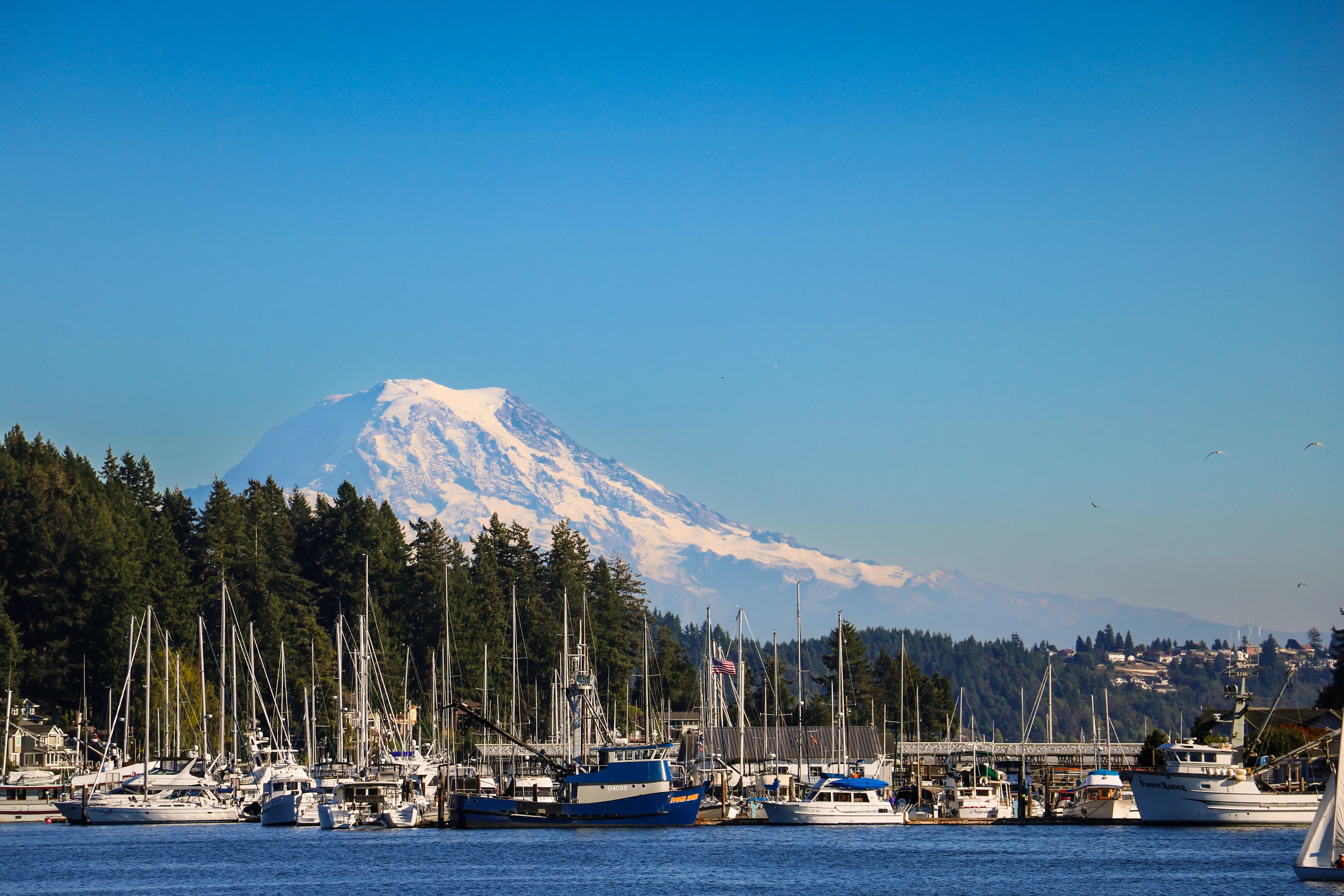
Puget Sound · Washington
The Bay Area software engineer who finally has a yard and kept her $185K salary. The San Diego family who stopped calculating wildfire evacuation routes every August. The Sacramento couple who sold their 1,400-square-foot townhome, bought a four-bedroom house on a half-acre overlooking Puget Sound, and still had money left over. These are real stories, and they're why California has been the top outbound state two years running — and why Gig Harbor keeps appearing on the shortlist for buyers who've decided the math no longer works at home.
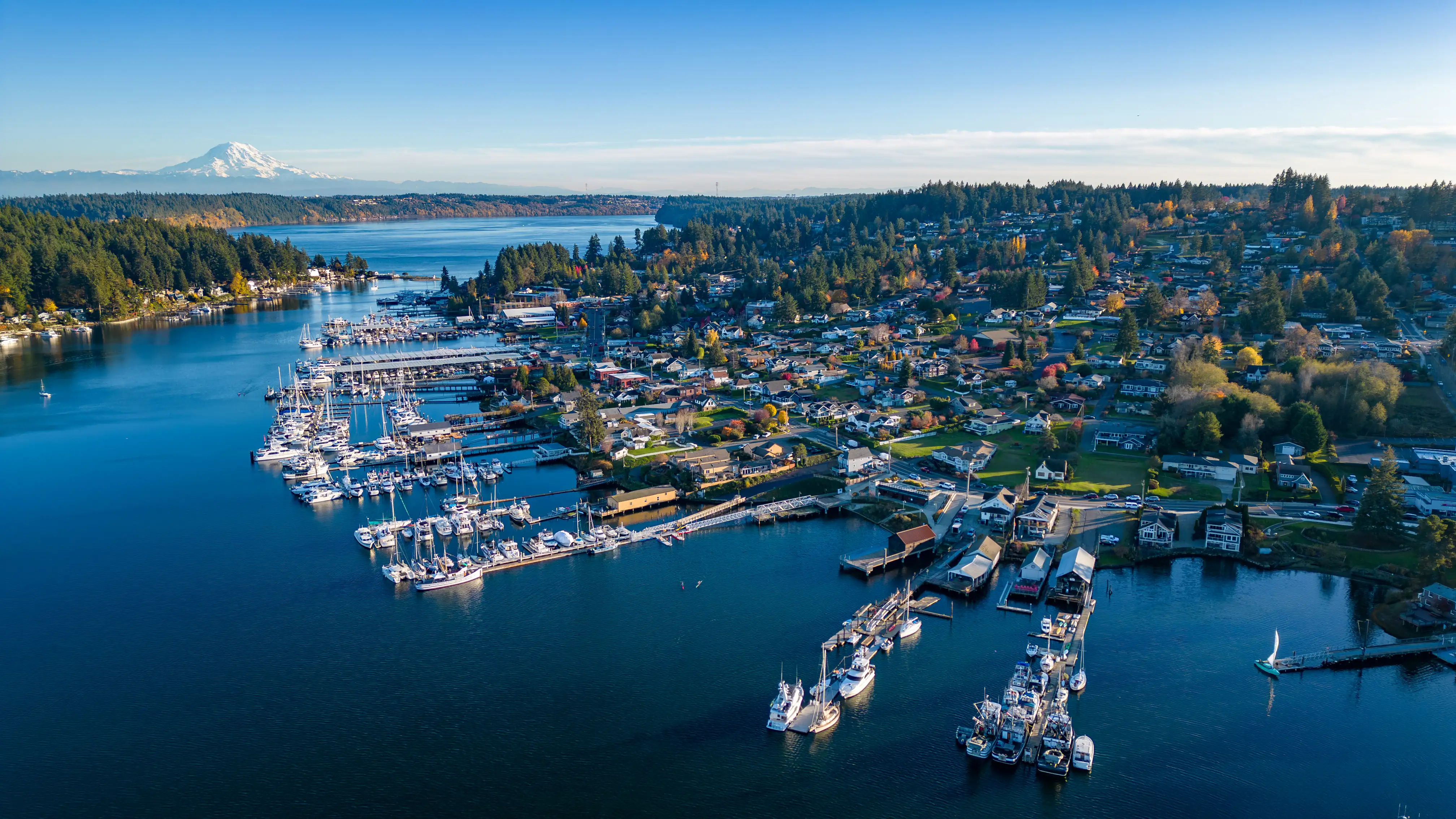
Gig Harbor is not California in a fleece vest. The winters are long, gray, and genuinely overcast. The pace is slower in ways that feel wonderful at first and occasionally restless after year two. The food scene is good but not San Francisco. The summers, however, are something special — dry, bright, 77-degree days that stretch until 9 p.m., with a waterfront that makes the Olympic Peninsula look close enough to touch. The move rewards people who've thought it through and punishes those who moved on vibes alone.
This guide covers the full picture: cost of living by California region, what your equity actually buys in Gig Harbor's neighborhoods, the tax math broken down by income, the honest weather reality, and what California transplants consistently get wrong in the first year. Use the comparison tool in Section 6 to look up your specific California city side-by-side with Gig Harbor.

| Gig Harbor, WA | Bay Area | Southern CA | Sacramento Metro | Central Valley | |
|---|---|---|---|---|---|
| Median Home Price (approx. 2026) | $778,875–$935K | $1.3M–$1.8M | $750K–$1.1M | $480K–$600K | $340K–$450K |
| Property Tax Rate (effective) | ~0.98% | ~1.1–1.25% | ~1.1–1.25% | ~1.1–1.2% | ~1.0–1.15% |
| State Income Tax | None | 1%–13.3% | 1%–13.3% | 1%–13.3% | 1%–13.3% |
| State Sales Tax | 8.0–10.5% | 8.625–10.75% | 7.25–10.25% | 7.25–8.75% | 7.25–9.0% |
| Avg. Utilities (monthly est.) | $175–$220 | $220–$320 | $250–$380 | $200–$280 | $190–$260 |
| Avg. 1BR Rent | ~$1,983 | $2,900–$3,800 | $2,200–$3,200 | $1,500–$1,900 | $1,100–$1,500 |
A buyer leaving Walnut Creek or Redwood City and selling a home at $1.4 million can purchase in Gig Harbor outright — no mortgage — and still have $400,000 to $600,000 remaining for investments, renovation, or a boat slip on the harbor. That's not a hypothetical; it's a transaction that happens regularly in this market. Even at Gig Harbor's upper single-family median near $935,000, a Bay Area seller is buying down significantly and often freeing cash flow they haven't had in fifteen years.
The Washington no-income-tax advantage is the one that surprises California buyers most on paper, then surprises them again when they see their first paycheck. A buyer earning $150,000 in California was paying somewhere between $11,000 and $13,000 annually in state income tax. In Washington, that number is zero. For a household earning $200,000, the swing is closer to $16,000 to $20,000 per year — which translates directly into buying power, mortgage paydown, or simply a lifestyle that doesn't require constant financial optimization.
Washington's no-income-tax status is the headline — but the full picture is more nuanced, and California transplants who understand it make smarter decisions in their first year.
A single earner in California making $120,000 pays approximately $8,000–$9,500 in state income tax. At $150,000, that rises to roughly $11,000–$13,500. At $200,000, California's 9.3% bracket kicks in and the annual bill climbs to approximately $16,000–$19,000. Move to Washington and every dollar of that stays in your account. Washington's higher sales tax — typically 8.0% to 10.5% depending on municipality — offsets this advantage slightly, but only on purchases. On income, the net benefit is strongly and consistently in Washington's favor for virtually every transplant earning above $80,000.
| Tax Item | California | Washington | Net Impact for Transplant |
|---|---|---|---|
| State Income Tax | 1%–13.3% (graduated) | None | +$8K–$20K/year for most buyers |
| Capital Gains Tax | Taxed as ordinary income | 7% on gains over $262K/year | Roughly neutral for most W-2 earners |
| Sales Tax | 7.25%–10.75% | 6.5%+local (8.0–10.5%) | Near-neutral; slight WA disadvantage |
| Property Tax Rate | 1.1%–1.25% effective (purchased price) | ~0.98% in Pierce County | Slight WA advantage |
| Property Tax (base law) | Prop 13 limits increases | Market assessed, but WA rates are low | Context-dependent |
| Senior Tax Exemption | Income-based, varies | Yes, for 61+ (income-based) | WA advantage for retirees |
Washington does have a 7% capital gains tax, but it applies only to long-term capital gains above $262,000 per year — meaning a W-2 earner or remote worker with no significant investment sales typically never encounters it. Most California transplants are unaffected. Where it matters is for equity investors or business sellers liquidating large positions, who should structure accordingly before the move.
Property taxes in Pierce County run approximately 0.98% of assessed value — below the national average. California's Proposition 13 complicates direct comparison: longtime California homeowners pay taxes on their original purchase price, which can mean artificially low bills. But buyers who purchased in the last five years are often already paying near-market rates, and Washington's rate compares favorably to what they're paying now.
A buyer leaving Palo Alto or San Jose with $1.5 million in equity is stepping into a different reality in Gig Harbor. That figure buys a waterfront or bluff-view home outright — the kinds of properties in Canterwood or along the harbor's edge that would require a generational transfer in the Bay Area. At $1.2 million cash, you're positioned to buy any home in Gig Harbor's top tier and remain debt-free, which for remote workers means converting their California mortgage payment directly into take-home pay.
Buyers in this equity band should look hard at Canterwood, a gated golf-course community where homes run $1.1 million to $2.5 million, or at the waterfront properties along Grandview Drive and Burnham Drive where views of the Tacoma Narrows and the Olympic Mountains come standard. Artondale and Rosedale offer properties in the $800,000 to $1.3 million range with genuine acreage and privacy — the kind of square footage and land that simply doesn't exist at any price in most Bay Area zip codes.
A family leaving Irvine or Pasadena with $900,000 in equity lands in Gig Harbor's sweet spot. That equity covers the city-wide median and then some, allowing a buyer to purchase a newer construction home in Gig Harbor North or a craftsman on a view lot near the waterfront without taking on a payment that strains the household. With a $500,000 down payment and $400,000 retained, many buyers in this band opt for a 15-year mortgage at a dramatically reduced rate than what they carried in California.
Southern California buyers tend to cluster in Gig Harbor North and Harbor Hill — both offer newer construction, proximity to the Highway 16 corridor for commuters, and a neighborhood density that feels familiar to buyers from master-planned communities in Orange County or the Inland Empire. Homes here run $750,000 to $1.1 million for single-family, which for the SoCal transplant represents a meaningful step up in house while potentially stepping down in payment.
This buyer group faces a closer relative comparison — Gig Harbor is 16% more expensive than Sacramento by cost-of-living index — but the no-income-tax advantage reshapes the math. A Sacramento household earning $140,000 saves approximately $10,000 to $12,000 per year in state income tax alone. Over ten years, that's the equivalent of a $100,000 price reduction on the home before accounting for any appreciation.
Buyers with $450,000 to $600,000 in equity can land strong conventional mortgages on Gig Harbor homes priced in the $750,000 to $900,000 range, often without jumping into jumbo territory. Rosedale, Wollochet, and the northern residential corridors offer solid value in this range — established neighborhoods with good Peninsula School District schools and reasonable access to Highway 16. The entry point for a move-in-ready single-family home currently sits around $680,000 to $750,000, meaning Sacramento sellers with average equity can buy without scraping.
The relative financial advantage is most modest here, and it's worth naming honestly. A buyer selling a Fresno or Bakersfield home at $380,000 with $320,000 in equity is still facing Gig Harbor's median north of $778,875 — which means they're carrying a meaningful mortgage even with their full equity deployed. What they're gaining is a dramatically different quality of life, a school district rated well above most Central Valley districts, and the long-term compounding benefit of no state income tax.
At this equity level, the practical neighborhoods are North Creek, Heritage, and some of the newer subdivisions on the northern edge of the city where entry prices run $680,000 to $780,000 for townhomes and smaller single-family homes. Washington State Housing Finance Commission programs — particularly the WSHFC Home Advantage loan — can also help buyers in this range close the gap, especially for first-time buyers or those who haven't owned in the last three years.
Looking to buy in Estimate your payment.
Enter your numbers to see an estimated monthly mortgage payment.
Estimate only. Excludes HOA fees and mortgage insurance.
Here's what your friend who moved from San Diego three years ago would actually tell you: the summers are genuinely spectacular, and the rest of the year requires a personality adjustment. Gig Harbor averages roughly 139 sunny days per year — compared to 266 days in San Diego and 274 in Sacramento. That's not a small gap. July delivers 312 hours of sunshine; November delivers 60. The rain total of about 47 inches annually is not actually extreme — Seattle neighbors like to point out that Houston and New Orleans get more. But the overcast is relentless from November through March, and no amount of "it's just drizzle" prep fully inoculates a Southern California native against six consecutive weeks of gray sky.
What California transplants consistently say they love after year one: the summers, without reservation. Dry heat in the mid-70s, no humidity, water everywhere, and a community that goes full outdoor recreation from June through September — kayaking off the Cushman Trail waterfront, hiking Kopachuck State Park, evening walks along the harbor at Skansie Brothers Park. They also love the traffic relief. A Sacramento buyer accustomed to I-80 at 5 p.m. finds Highway 16 manageable by comparison. And the housing space — the yard, the garage, the room to breathe — reshapes daily life in ways they didn't fully anticipate before moving.
What they miss: year-round beach access and the reliable sun that makes Southern California outdoor culture feel effortless regardless of month. Bay Area transplants miss the restaurant density and the particular social energy of San Francisco or Oakland — Gig Harbor's food scene is good, with genuine standouts along the waterfront, but it's not a city that hums at that frequency. Sacramento transplants sometimes find the pace slower than expected; Gig Harbor is genuinely small at around 12,900 people, and the social infrastructure reflects that. The trade-off — and it's a real one — is that the slowness is also the point.
If you want to see how Gig Harbor compares directly to the city you're leaving, use the tool below — it covers the 120 largest California cities with current housing and tax data.
Home prices: Redfin median sale data, Q1–Q2 2026. Select your city to compare.
Ready to talk through what your specific California equity could do in Gig Harbor? Todd can model your exact scenario in a single call.
Mistake 1: Assuming the whole city has the same character. Gig Harbor's downtown waterfront — the harbor itself, Skansie Brothers Park, the boutiques and restaurants along North Harborview Drive — is genuinely walkable and distinct. The northern end near Highway 16 and the big-box corridor near Point Fosdick Drive feels entirely different: suburban, car-dependent, and unremarkable. California buyers who tour the waterfront district and buy in the northern commercial corridor six months later sometimes feel they moved to a different city. Visit both halves before making a decision.
Mistake 2: Not understanding the bridge dynamic. Everything in Gig Harbor routes to the Tacoma Narrows Bridge to reach the greater Seattle-Tacoma area. The bridge isn't typically a bottleneck, but the commute to Seattle — roughly 80 minutes on a good day — is a longer haul than most California transplants account for when they're comparing it to a 45-minute Bay Area commute. The buyers who manage this best are the ones who have already negotiated remote or hybrid work before moving, not the ones planning to figure it out afterward.
Mistake 3: Expecting California-style year-round outdoor access. Southern California buyers often plan their move imagining summers extended through October. Gig Harbor's shoulder seasons — April, May, October — are mild and often beautiful, but they're not reliable. Trail running through Sehmel Homestead Park in February requires a different gear relationship than anything a San Diego outdoors culture demands. The buyers who thrive here generally have a Pacific Northwest outdoor mentality already or are willing to build one quickly.
Mistake 4: Underestimating how the no-income-tax advantage actually feels monthly. California transplants understand the income tax advantage intellectually before moving. What surprises them is how it lands experientially — the first paycheck in Washington, larger than expected, without the state withholding line. For a dual-income household each earning $120,000, the combined annual benefit exceeds $16,000 to $20,000. That's a car payment eliminated. That's the mortgage principal paid down aggressively each year. The buyers who factor this into their purchase decision — rather than treating it as a bonus — make smarter offers and more comfortable purchases.
Bay Area sellers with large equity often arrive at the transaction with enough liquidity to buy all-cash or with an LTV below 50%. For these buyers, rate is secondary to terms and timeline — an all-cash offer in Gig Harbor's market, where homes typically go pending in around 34 days with multiple offers, is a meaningful competitive advantage. If the California property being sold was held as an investment, the 1031 exchange option is worth exploring before closing; see the Gig Harbor 1031 Exchange guide for specifics on how to structure the replacement property timeline.
Southern California sellers typically arrive with a strong down payment — often 40% to 60% of the Gig Harbor purchase price — and fall comfortably into conventional financing territory. Most Gig Harbor single-family homes price below the 2026 conforming loan limit, meaning jumbo financing is avoidable for buyers putting 20% or more down. This matters: conventional terms are more favorable, and seller acceptance of conventional offers is higher than jumbo in competitive multiple-offer situations.
Sacramento and Inland Empire buyers may find themselves working with a more modest equity position and should explore the Washington State Housing Finance Commission's Home Advantage program, which offers below-market interest rates and can be paired with down payment assistance for qualifying buyers. Income limits apply, and the program is best suited to buyers purchasing in the $680,000 to $800,000 range — exactly where Gig Harbor's entry-level single-family inventory currently sits. A lender familiar with WSHFC programs can run eligibility in a single conversation.
Local Expert Takeaway: The no-income-tax advantage changes your monthly cash flow immediately and permanently — but California buyers who fully capitalize on it treat the difference as a structural buying power increase, not a windfall. If you're a dual-income household earning $250,000 combined, you're looking at $18,000 to $25,000 per year in additional take-home pay. Deploy that strategically: pay down the mortgage faster, buy into a neighborhood one tier above your California instincts, or hold the difference as liquidity in a market where well-priced waterfront homes still move in under two weeks. Gig Harbor specifically rewards buyers who know the geographic divide between the waterfront district and the northern corridor — those who buy in the wrong half often feel it within eighteen months.
✅ Washington's no-income-tax advantage is worth $8,000–$20,000+ annually for most California transplants — a real, recurring financial gain that compounds over time.
⚠️ Gig Harbor winters are genuinely gray. With only 139 sunny days per year compared to Sacramento's 274, the seasonal adjustment is real. The buyers who struggle most are those who expected the mild reputation and got the overcast reality.
📍 Know both sides of Gig Harbor before buying. The waterfront district and the northern Highway 16 corridor are different cities in practice. Your California real estate intuition will help you in Gig Harbor — just make sure you're evaluating the right neighborhood for your lifestyle.
Is moving from California to Gig Harbor worth it?
For most households earning above $100,000, the financial case is strong — particularly the income tax elimination and the housing cost differential relative to Bay Area or Southern California. The lifestyle case is equally compelling for buyers who embrace Pacific Northwest outdoor culture and smaller-city community. The buyers who struggle are those who underestimate the weather adjustment or assumed remote work flexibility they don't yet have locked in.
How much cheaper is housing in Gig Harbor vs. California?
Relative to the Bay Area, the discount is dramatic — Bay Area medians run $1.3M to $1.8M while Gig Harbor single-family homes track in the $778,875 to $935,000 range. Against Southern California, the gap narrows but remains meaningful, particularly on square footage and lot size. Against Sacramento, Gig Harbor is roughly comparable in price or slightly higher — the financial win there comes primarily from the income tax differential rather than home price savings alone.
What do I need to know about moving from California to Washington?
Washington has no state income tax, no estate tax below $2.22 million, and property taxes in Pierce County run approximately 0.98%. You'll pay more in sales tax — typically 8% to 10.5% — but the net annual benefit for most California earners is strongly positive. You'll also need to register your vehicle and update your driver's license within 30 days of establishing residency. For buyers coming from community property states like California, Washington is also a community property state, so estate and titling nuances are worth reviewing with a local real estate attorney before closing.
Explore the full Gig Harbor series: The Ultimate Gig Harbor Relocation Guide · Is Gig Harbor Safe? · Cost of Living in Gig Harbor · Best Neighborhoods in Gig Harbor · Gig Harbor Schools & Family Life · Gig Harbor Youth Sports · Gig Harbor Parks & Recreation · Retiring in Gig Harbor · 1031 Tax-Deferred Exchange in Gig Harbor · Gig Harbor First-Time Homebuyers Guide · Moving to Gig Harbor from California
Tell us what you need help with and we'll connect you with local resources.

About the Author
Todd Davidson is the founder of Living in Oregon and Living in Washington, where he publishes in-depth city guides, neighborhood resources, and local market insights covering more than 180 communities across the Pacific Northwest. While his background is in home financing and real estate, he created these digital platforms to help families research and compare regions before making a move.