
Puget Sound · Washington
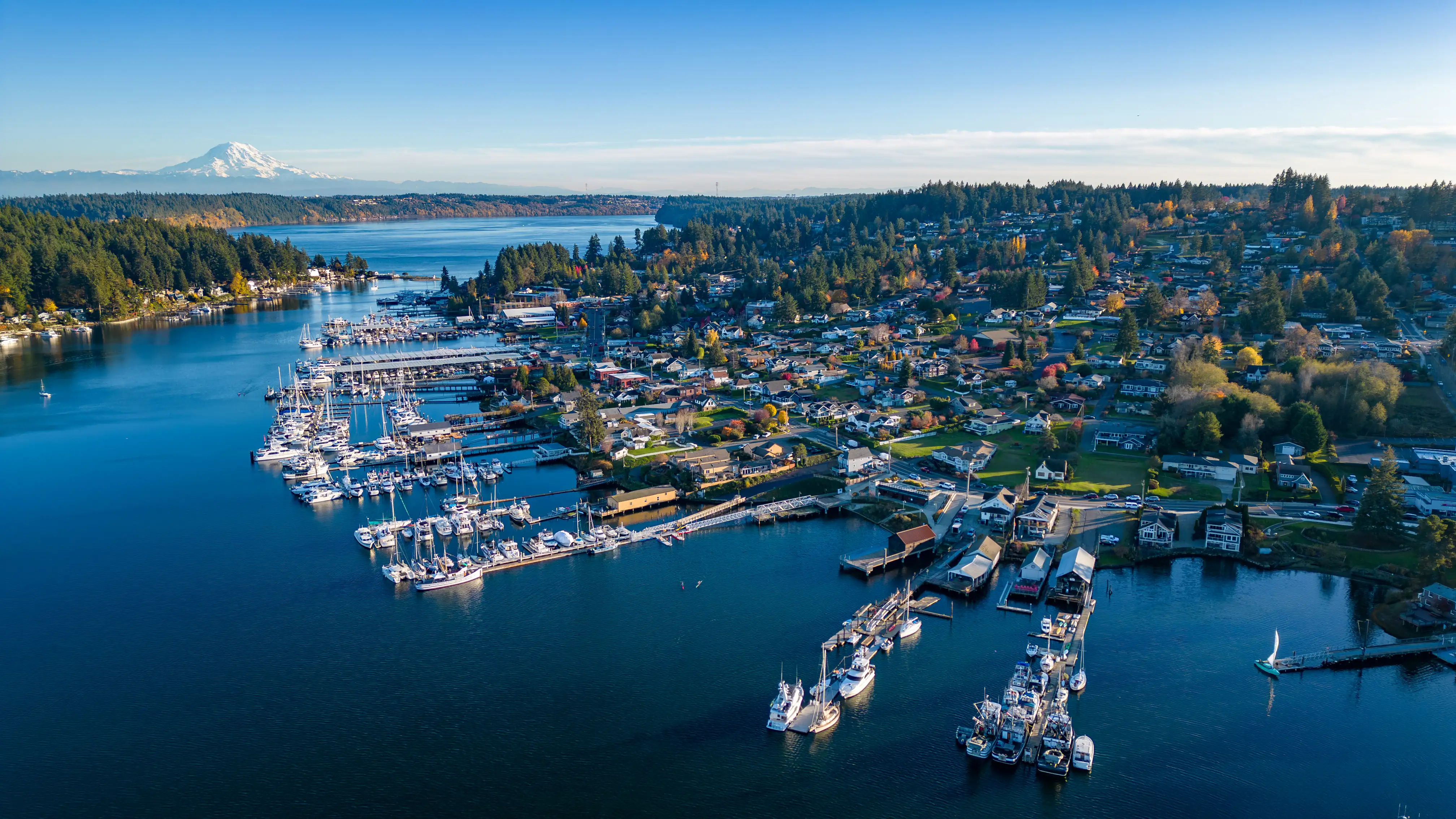
Gig Harbor isn't just retirement-friendly — it's been ranked among the best places in the country to retire, and for once the rankings actually match the reality. With no state income tax, a walkable waterfront downtown, one of the most respected life-plan retirement communities in the Pacific Northwest, and a resident population where roughly one in four people is already retired, Gig Harbor has quietly become one of Washington's most intentional retirement destinations.
The retiree who thrives here tends to value natural beauty and a slower pace over urban density, appreciates a genuine small-town social fabric, and either owns a car or is comfortable relying on one. Gig Harbor rewards active retirees — people who kayak, golf, walk harborside trails, and want a tight-knit community without feeling like they're disappearing into the suburbs. It's a harder fit if you're counting on public transit, need immediate access to a Level I trauma center, or want the cultural intensity of a major city within a short drive.
This guide covers the full picture: the tax advantages of retiring in Washington State, what healthcare actually looks like in Gig Harbor, the senior living communities worth considering, what daily life feels like after the moving boxes are unpacked, and how Gig Harbor stacks up against nearby alternatives for your retirement dollar.

Washington State's tax structure is one of the most retiree-friendly in the country, and that isn't an accident — it's the single most important financial reason people relocate here from California, Oregon, and other high-tax states.
| Income Type | Washington State Tax Treatment |
|---|---|
| Social Security Benefits | Not taxed |
| Pension Income (public or private) | Not taxed |
| IRA / 401(k) Withdrawals | Not taxed |
| Investment Income / Capital Gains | 7% tax on gains over $270,000 (high earners only) |
| Dividend Income | Not taxed |
| Part-Time or Consulting Work | Not taxed at state level |
| Property Tax | ~0.98% effective rate (senior exemptions available) |
| Sales Tax | 8.5–10.2% (varies by city) |
| Estate Tax | Washington taxes estates over $2.09 million |
For most retirees drawing from Social Security, a pension, and retirement accounts, Washington means zero state income tax on the bulk of their income. That's a real number — a couple withdrawing $120,000 annually from retirement accounts would have owed Oregon roughly $8,000–$9,000 in state taxes on that same income. In Washington, they keep it.
Senior property tax relief adds another layer. Washington's senior property tax exemption is available to homeowners 61 and older who meet income thresholds — eligible seniors can receive a significant reduction or freeze on the taxable value of their primary residence. At Gig Harbor's effective rate of approximately 0.98%, a home at the median sold price generates roughly $7,600 annually in property taxes before any exemption, which is competitive for the quality of community it funds.
St. Anthony Hospital at 11567 Canterwood Blvd NW is Gig Harbor's primary healthcare anchor. Operated under the Virginia Mason Franciscan Health system — one of the largest health networks in the Puget Sound region — the hospital opened in 2009 as a full acute care facility with 24/7 emergency services. Its nationally recognized programs include cancer care, surgical services, and a breast care clinic within the Milgard Medical Pavilion. The American Nurses Credentialing Center has designated St. Anthony a Pathway to Excellence organization, which reflects nursing staff quality rather than just facility size.
For most of what retirees need day-to-day — emergency care, outpatient surgery, cancer treatment, routine specialist visits — St. Anthony performs reliably. The Franciscan system also means access to specialist networks across the region through a single coordinated provider relationship. Where the hospital has limits is at the trauma level: for complex neurological events, major cardiac surgery, or pediatric trauma, patients are typically transported to Tacoma General or another Level I facility across the Narrows Bridge. That transfer is typically 15–25 minutes depending on traffic, which is meaningful context if you or a spouse have a higher-risk cardiovascular or neurological profile.
Virginia Mason Medical Center in Seattle — one of the country's most recognized specialty care institutions — is accessible from Gig Harbor in roughly 80 minutes on a clear day. Most retirees build their care plan around St. Anthony as a primary hub and know in advance which specialist affiliations would route them to Tacoma or Seattle for complex needs.
Gig Harbor has one of the highest concentrations of senior living infrastructure in the South Sound, with roughly 26 assisted living facilities and five continuing care retirement communities within or immediately adjacent to the city. The range runs from boutique six-resident assisted living homes to large-scale life plan communities with multi-phase campus expansions underway.
| Community | Type | Location | Est. Monthly Cost |
|---|---|---|---|
| Heron's Key | Life Plan Community (CCRC) | 4340 Borgen Blvd NW | $4,500–$7,500+ (independent) |
| Harbor Place at Cottesmore | CCRC / Full Continuum | 1016 29th St NW | $3,800–$6,500+ |
| Penrose Harbor | CCRC (part of Heron's Key) | Borgen Blvd area | Inquire directly |
| Brookdale Harbor Bay | Assisted Living / 55+ | 9324 N Harborview Dr | $4,000–$6,000+ |
| Kensington Gardens Manor | Assisted Living / Memory Care | 7107 99th St Ct NW | $3,500–$5,500+ |
| Gig Harbor Court | Assisted Living | Borgen Blvd area | $3,200–$5,000+ |
Harbor Place at Cottesmore offers a full continuum across 40 retirement apartments, 60 assisted living apartments, and a 104-bed nursing center — a scale that suits couples who anticipate different care trajectories over time. It was named a 2025 U.S. News & World Report Best Assisted and Independent Living Community, which provides useful independent validation on quality.
For retirees who prefer a smaller setting, Kensington Gardens Manor on 99th Street Court accommodates up to six residents in a more residential-scale environment, with on-site nursing, transportation, and memory care services.

Looking to buy in Estimate your payment.
Enter your numbers to see an estimated monthly mortgage payment.
Estimate only. Excludes HOA fees and mortgage insurance.
The honest truth about Gig Harbor's walkability is that it depends entirely on which neighborhood you choose. Downtown Gig Harbor along Harborview Drive offers genuine on-foot access — cafés, restaurants, the Harbor History Museum, boutique shopping, and the waterfront path from Skansie Brothers Park are all within a few blocks of each other. If you're settled near downtown and healthy enough to navigate some hills, life without a car is genuinely feasible for daily pleasures.
Outside of downtown, Gig Harbor is a driving community. Gig Harbor North near Highway 16 has strong retail density — Costco, Target, and major grocery anchors — but you'll reach them through arterials designed for cars, not pedestrians. Wollochet and Artondale are quiet, wooded residential areas that are beautiful to live in and impractical to navigate without a vehicle. This is the variable to plan around most carefully in retirement: if you anticipate a future where one of you stops driving, the neighborhood choice becomes a healthcare and lifestyle decision, not just a real estate one.
The cultural calendar rewards retirees who make an effort to plug in. The Gig Harbor Farmers Market runs through the summer at Skansie Brothers Park, drawing locals in a way that feels more like a neighborhood gathering than a tourist event. The Galaxy Theatre offers senior pricing every Tuesday, and Canterwood Golf & Country Club and Gig Harbor Golf Club both have active member communities for those who want to build social ties quickly. The Gig Harbor Senior Center anchors a different but equally important social layer — fitness programs, organized activities, and a community that already knows how to welcome newcomers.
What surprises most retirees after six months of living here is how quickly they stop thinking of Gig Harbor as a small town and start thinking of it as enough. The harborfront on a clear morning, the weekly rhythm of the farmers market, the relationships built through the Senior Center or a golf membership — it adds up to a life that doesn't leave people reaching for Seattle every weekend. The retirees who struggle are the ones who moved here expecting to remain city-oriented. Gig Harbor is its own thing, and it works best when you let it be.
For daily convenience, grocery access is strong across most of the city. Safeway and QFC serve the core neighborhoods, and the Gig Harbor North corridor handles big-box needs. The Pierce County Connector bus route crosses the Narrows Bridge and connects Gig Harbor to Tacoma's transit network, which matters primarily for retirees who want occasional access to Tacoma's Pantages Theater, specialty medical facilities, or the Amtrak station without driving.
| City | Median Home Price | Nearest Hospital | Walkability | Senior Living Depth | Retirement Appeal |
|---|---|---|---|---|---|
| Gig Harbor, WA | $778,875 | St. Anthony (on-site) | Moderate (downtown only) | High — 26+ communities | ⭐⭐⭐⭐⭐ |
| Port Orchard, WA | ~$480,000 | St. Anthony (20 min) | Low | Moderate | ⭐⭐⭐ |
| Tacoma, WA | ~$430,000 | Tacoma General (Level I) | High (downtown) | Very High | ⭐⭐⭐⭐ |
| Bremerton, WA | ~$410,000 | Harrison Medical | Moderate | Moderate | ⭐⭐⭐ |
| University Place, WA | ~$530,000 | St. Anthony (15 min) | Low-Moderate | Moderate | ⭐⭐⭐ |
| Fox Island, WA | ~$700,000 | St. Anthony (15 min) | Very Low | Low | ⭐⭐⭐ |
Local Expert Takeaway: Retirees who thrive in Gig Harbor typically land in one of three pockets: downtown or the streets immediately above the harbor for walkable daily life, Canterwood for golf-community structure and social connection, or the Wollochet area for quieter waterfront-adjacent living with room to spread out. The buyers I see struggle most are those who choose based on price alone and end up in Gig Harbor North — it's convenient, but it lacks the character that makes retirement here feel different from living in any suburban ZIP code. If you're weighing Heron's Key as part of your long-term plan, start that conversation now; the Phase II waitlist tells you everything about how this market views that community's value.
Is Gig Harbor a good place to retire?
By most meaningful measures, yes. SmartAsset has ranked Gig Harbor the top retirement destination in Washington State for several years based on taxes, medical access, and quality of life — and roughly 25 percent of the city's current population is already retired, which means the social infrastructure, healthcare ecosystem, and community rhythm are genuinely oriented around that demographic.
What healthcare is available for retirees in Gig Harbor?
St. Anthony Hospital, operated by Virginia Mason Franciscan Health, provides 24/7 emergency care, cancer treatment, and surgical services directly within city limits. For complex neurological or cardiac cases requiring a Level I trauma center, Tacoma General is typically 15–25 minutes across the Narrows Bridge, and Virginia Mason Medical Center in Seattle is accessible in about 80 minutes.
How does Gig Harbor compare to Port Orchard or Tacoma for retirement?
Gig Harbor costs more — the median sold price sits at $778,875 compared to roughly $480,000 in Port Orchard and $430,000 in Tacoma. What buyers get for that premium is a walkable waterfront downtown, a dense network of senior living options including nationally recognized communities, and a small-town social fabric that Tacoma can't replicate. Tacoma's Level I trauma center is a genuine advantage for retirees with complex health needs, and its lower price point makes it a serious alternative for buyers stretching their budget.
Explore the full Gig Harbor series: The Ultimate Gig Harbor Relocation Guide · Is Gig Harbor Safe? · Cost of Living in Gig Harbor · Best Neighborhoods in Gig Harbor · Gig Harbor Schools & Family Life · Gig Harbor Youth Sports · Gig Harbor Parks & Recreation · Retiring in Gig Harbor · 1031 Tax-Deferred Exchange in Gig Harbor · Gig Harbor First-Time Homebuyers Guide · Moving to Gig Harbor from California
Tell us what you need help with and we'll connect you with local resources.

About the Author
Todd Davidson is the founder of Living in Oregon and Living in Washington, where he publishes in-depth city guides, neighborhood resources, and local market insights covering more than 180 communities across the Pacific Northwest. While his background is in home financing and real estate, he created these digital platforms to help families research and compare regions before making a move.