
Puget Sound · Washington
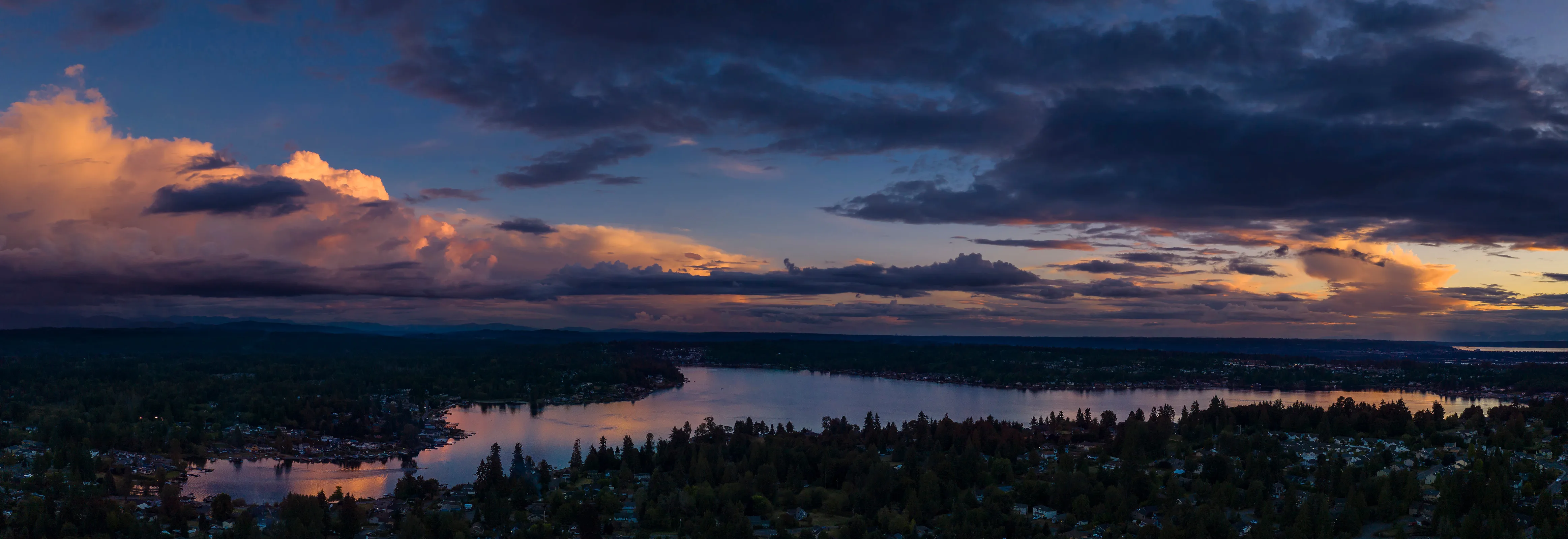
The Bay Area software engineer who kept their $180K salary, went fully remote, and suddenly found themselves staring at a backyard in Lake Stevens — that's not an edge case anymore. It's a pattern. Across Snohomish County, California license plates are a fixture at open houses, and the math driving those moves is hard to argue with: a buyer leaving Walnut Creek or Irvine arrives in Lake Stevens and finds a $687,000 median home price in a waterfront community with strong schools, manageable commutes to Everett and Seattle, and — critically — no state income tax waiting for them on April 15th.
What this guide won't do is pretend the move is frictionless. Lake Stevens is not a sunbelt suburb with a different zip code. The winters here are genuinely gray in a way that Southern California transplants often underestimate until they've lived through a January. The lifestyle shift from San Diego's beach culture or the Bay Area's density-driven social scene is real. The food options, the walkability, the year-round outdoor access that California buyers assume will translate — these things require adjustment. A guide that doesn't say that isn't useful.
What follows covers the complete financial comparison by California region, what your equity actually buys in Lake Stevens's different price tiers, the tax picture in plain terms, the lifestyle reality from people who've made this move, and a comparison tool where you can pull up your specific California city side-by-side.

| Lake Stevens, WA | Bay Area | Southern CA | Sacramento Metro | Central Valley | |
|---|---|---|---|---|---|
| Median Home Price (approx. 2026) | $687,000 | $1,300,000–$1,600,000 | $850,000–$1,100,000 | $520,000–$620,000 | $360,000–$460,000 |
| Property Tax Rate (effective) | ~1.19% | ~1.1–1.2% | ~1.1–1.2% | ~1.1–1.2% | ~1.0–1.1% |
| State Income Tax | None | Up to 13.3% | Up to 13.3% | Up to 13.3% | Up to 13.3% |
| State Sales Tax | 8.9% (Snohomish Co.) | 8.625–10.25% | 7.25–10.25% | 7.25–8.75% | 7.25–8.75% |
| Avg Utilities (monthly est.) | $200–$250 | $250–$350 | $280–$380 | $220–$300 | $240–$320 |
| Avg 1BR Rent | $1,800–$2,100 | $2,800–$3,600 | $2,200–$3,000 | $1,600–$2,000 | $1,200–$1,600 |
A Bay Area buyer selling a $1.4M house and putting that equity into Lake Stevens at $687,000 isn't just downsizing in price — they may be eliminating their mortgage payment entirely, or carrying a very low balance at a rate that barely registers against their monthly budget. The remaining equity sitting in savings or invested elsewhere changes the entire financial picture of their household.
The income tax advantage deserves its own sentence. Washington has no state income tax. For a California resident earning $150,000 per year, the California Franchise Tax Board was collecting roughly $11,000–$13,000 annually. On a $200,000 income, that figure climbs past $17,000. That money doesn't disappear into a different tax — it stays in the buyer's pocket, month after month, permanently. The sales tax difference (roughly 1–2% higher in Washington) offsets some of this, but for any income above $80,000, the net math heavily favors Washington.
Washington's status as one of only nine states with no state income tax is the single most underappreciated financial advantage for California transplants. Californians are accustomed to treating state income tax as an unavoidable cost of living. Moving to Washington removes it entirely from the equation.
| Tax Item | California | Washington | Net Impact for Transplant |
|---|---|---|---|
| State Income Tax | 1–13.3% (graduated) | None | Save $8K–$17K+/year depending on income |
| Capital Gains Tax | Up to 13.3% (ordinary income) | 7% on gains over $262,000/year | Significant savings for most earners |
| Sales Tax | 7.25–10.25% | 6.5% + local (~8.9% Snohomish Co.) | Slight disadvantage in WA |
| Property Tax Rate | ~1.1–1.2% (newly purchased) | ~1.19% (Snohomish County) | Roughly equivalent |
| Estate/Inheritance Tax | None | WA estate tax on estates over $2.09M | May matter for high-net-worth buyers |
| Senior Property Tax Exemption | Limited/income-based | Yes, age 61+, income-based | Advantage for retirees in WA |
To make this concrete: a Lake Stevens household earning $120,000 who relocated from San Jose saves approximately $8,000–$9,500 per year in state income tax alone. At $150,000 in income, that figure is closer to $11,500–$13,500. At $200,000, the annual savings typically exceed $17,000. Spread over a decade of living in Washington, this compounds into a six-figure wealth advantage that pure home-price comparisons miss entirely.
Washington does impose a 7% capital gains tax on long-term capital gains exceeding $262,000 per year — a provision that matters primarily for high earners with significant investment income or business sales. For the vast majority of California transplants who are W-2 employees or moderately-invested households, this threshold doesn't come into play annually. The property tax picture is nearly a wash — both states land around 1.1–1.2% on newly purchased homes. Where Washington wins decisively is on income, and for remote workers, that advantage begins on their first paycheck after crossing the state line.
A buyer leaving Palo Alto, San Jose, or Walnut Creek with $1.4M in net equity from a sale arrives in Lake Stevens in a genuinely unusual position: they can purchase at or near the top of the local market with cash, or buy a premium home and invest the remainder. The $687,000 city-wide median becomes almost academic — Bay Area sellers are typically looking at Lake Stevens Waterfront properties (median sold near $1.2M), Mountain Crest, or Cavelero Hill in the $700K–$800K range, and still walking away with $400K–$600K in remaining equity.
For this buyer, the strategic question isn't affordability — it's which neighborhood matches their lifestyle. Waterfront properties on the lake offer private dock access, stunning summer views, and an entry into what feels like a genuinely different tier of Pacific Northwest living. Cavelero Hill and Mountain Crest offer newer construction, territorial views, and family-friendly surroundings at prices that a Bay Area transplant will experience as almost improbably reasonable. The remaining equity, freed from California's high cost of living and now sheltered from income tax, compounds differently here.
A buyer leaving Irvine, Pasadena, or Carlsbad with $900K in equity has substantial purchasing power in Lake Stevens and lands comfortably above the city's price ceiling. At $687,000 median, a Southern California seller with this equity level can buy outright in most neighborhoods — West Lake Stevens, South Lake Stevens, Eastlake Park, Soper Hill — and still retain meaningful liquidity. If they want to carry a small mortgage to preserve cash, they can finance $200K–$300K and keep the rest invested.
What puts this buyer in the top tier of the Lake Stevens market is that they're not stretching to access the nicest neighborhoods. The $650K–$800K range that represents Cavelero Hill's better streets and North Lake Stevens's newer inventory is well within reach without depleting equity. Southern California buyers often report the biggest lifestyle surprise isn't the house — it's realizing their monthly housing cost (mortgage + taxes + no state income tax) is $2,000–$3,000 lower than their California payment for a substantially larger home.
Sacramento and Riverside-area buyers have a more measured financial step-up, but the no-income-tax math is arguably more impactful here precisely because their equity doesn't cover the full purchase price. A buyer leaving Elk Grove or Rancho Cucamonga with $500K in equity is likely financing $150K–$250K in Lake Stevens — a manageable conventional loan — while entering a school district rated A- and a community with substantially lower density than their California origin.
For households in this equity range, the income tax savings of $8,000–$11,000 annually function as an effective mortgage payment reduction. A buyer financing $200,000 at current rates who also saves $10,000/year on state income tax is effectively cutting their housing costs in half compared to a California buyer in the same income bracket. West Lake Stevens and South Lake Stevens neighborhoods around the $620K–$635K median are the natural landing zone for this buyer.
A buyer leaving Fresno, Stockton, or Modesto with $350K–$400K in equity isn't arriving with a blank check, but they're arriving with more purchasing power than the numbers suggest at first glance. Condos and townhomes enter the Lake Stevens market in the $400K–$470K range — meaning some Central Valley buyers can purchase attached housing with their equity largely intact. For single-family homes, they're typically looking at Bunk Foss, Lochsloy, or Frontier Manor, where larger lots and more land are available at the lower end of the $500K–$680K range.
The lifestyle comparison is stark in a different way for Central Valley transplants. Lake Stevens summers don't come with triple-digit heat events or wildfire smoke blanketing the valley for weeks. Many buyers from this region cite air quality and heat as the primary push factors — the Pacific Northwest's temperate summers are a genuine quality-of-life upgrade. The financial gain is smaller relative to Bay Area sellers, but the quality-of-life case is arguably stronger.
Looking to buy in Estimate your payment.
Enter your numbers to see an estimated monthly mortgage payment.
Estimate only. Excludes HOA fees and mortgage insurance.
Here's what a friend who made this move three years ago from San Diego would tell you over coffee: the summers are genuinely spectacular, and they'll spoil you. Lake Stevens logs around 164 sunny days per year — below the national average of 205 — but the period from late June through September is long-light, clear-sky Pacific Northwest summer at its best. August averages highs around 73°F with more than 10 hours of sunshine per day. The lake becomes a gathering point for the entire community. Nobody's running their AC all month, and nobody's driving through smoke to get to a trail.
November through February is the honest part. The city averages roughly 179 days of measurable precipitation per year, and the January and December light situation — averaging just over four hours of sunshine per day — is genuinely difficult for people arriving from San Diego or the Central Valley. It's not the rain volume that gets people; total annual precipitation runs around 30–44 inches depending on how it's measured, which is less than Portland and less than you might assume. It's the persistent overcast, the flat gray light, and the psychological adjustment to a sky that just doesn't change for weeks at a time. Bay Area transplants who came from Oakland or San Jose, where winters are mild and wet rather than sunny, often adapt faster than Southern California buyers.
What California transplants consistently report loving after 12–18 months in Lake Stevens is the space. The yard. The fact that $687K buys a four-bedroom house on a real lot, not a condo with a parking spot. The community feel — farmers markets, youth sports culture, neighborhoods where people actually know their neighbors — reads differently than they expected. What they miss is specific: the restaurant density, the ability to drive 20 minutes and reach a completely different cultural scene, the ease of year-round outdoor recreation that doesn't require planning around weather windows. The Pacific Northwest asks you to adjust your outdoor calendar. Most people who stay say it was worth it.
If you want to see how Lake Stevens compares directly to the city you're leaving, use the tool below — it covers the 120 largest California cities with current housing and tax data.
Home prices: Redfin median sale data, Q1–Q2 2026. Select your city to compare.
Ready to talk through what your specific California equity could do in Lake Stevens? Todd can model your exact scenario in a single call.
Assuming the city is uniform. Lake Stevens has meaningful character variation between neighborhoods that a Zillow search won't capture. The older, more established streets in South Lake Stevens feel completely different from the newer construction in North Lake Stevens or the semi-rural atmosphere in Machias and Bunk Foss. Buyers who tour one part of the city and assume they've seen it all commonly end up in the wrong neighborhood for their lifestyle. Drive SR-9 from the waterfront north toward Machias on a Tuesday morning and you'll understand what that difference looks like in practice.
Not accounting for winter driving. California drivers arriving in Lake Stevens for the first time in November are often unprepared for what SR-9, US-2, and the hill roads around Cavelero Hill and Soper Hill do in a snow event. Lake Stevens gets occasional snow accumulation — not Seattle amounts, but enough that the elevation changes on residential streets create genuine traction challenges. Buyers who buy a car-dependent home on a steep residential street without considering all-season or winter tires are making a mistake that becomes obvious in January.
Underestimating the monthly cash flow shift from no income tax. California buyers consistently tell agents they understood the income tax advantage intellectually but didn't feel it until the first Washington paycheck. A $150,000 household income that was netting roughly $9,800/month after California state income tax is netting over $10,800/month in Washington — a $1,000+ monthly difference that shows up immediately in the budget. Buyers who don't factor this into their mortgage pre-qualification are leaving purchasing power on the table, and buyers who set their Lake Stevens budget based on California take-home math are being unnecessarily conservative.
Treating Lake Stevens as a bedroom community without understanding the commute reality. The 44-minute average commute to Seattle is real, but it assumes off-peak timing. SR-9 to US-2 to I-405/I-5 during the morning window can stretch significantly when there's an incident on the corridor. Buyers who are commuting to Seattle three or four days per week should model the worst-case version of that drive, not the average. Remote workers and Everett commuters (20–25 minutes on a typical day) are much better positioned to enjoy Lake Stevens without the commute being a chronic stressor.
Bay Area sellers with large equity are often the most interesting mortgage cases in Lake Stevens — not because they need help qualifying, but because their range of options is unusually wide. An all-cash offer in a market where homes sell for around list price in 34 days and competitive homes go pending in 8 days is a meaningful tactical advantage. Buyers in this position should discuss with their lender whether carrying a small mortgage (even at current rates) to preserve liquidity makes sense, or whether eliminating debt entirely better serves their retirement or investment timeline. If the California property being sold was an investment or rental, a 1031 exchange may defer a substantial capital gains obligation — worth exploring before closing escrow in California.
Southern California sellers arriving with $700K–$1.2M in equity will find that most Lake Stevens purchases don't require a jumbo loan. At the $687,000 median, a 20% down payment puts the loan amount around $550,000 — within conventional conforming limits, which simplifies underwriting and keeps rate options competitive. Buyers in this equity range often have the option to put more down and carry less debt while still maintaining comfortable cash reserves.
Sacramento and Inland Empire buyers with more modest equity should look carefully at Washington State Housing Finance Commission (WSHFC) programs, including the Home Advantage program, which can layer down payment assistance onto a conventional purchase for qualifying income levels. These programs aren't just for first-time buyers — they're available to buyers who haven't owned in the past three years, which applies to some renters-turned-buyers making this move. The income limits for Snohomish County are meaningfully higher than many buyers expect.
Local Expert Takeaway: The mistake California buyers make most consistently in Lake Stevens is pre-qualifying based on their California take-home pay. Your Washington paycheck is larger — potentially $800–$1,400/month larger if you're a dual-income household in the $120K–$200K range — and that changes what you can comfortably carry on a mortgage. Before you anchor to a price ceiling based on California math, run your numbers with your first Washington paycheck in mind. And if you're choosing between West Lake Stevens and South Lake Stevens at similar price points, note that West Lake Stevens has been moving in roughly 23 days versus 60 days in South Lake Stevens — that's not a quality signal, it's a location-to-school and location-to-Costco signal, and it's worth understanding before you make your offer.
Is moving from California to Lake Stevens worth it?
For most California buyers, the financial case is strong enough to be nearly unchallengeable. The combination of a $687,000 median home price (compared to $1.3M+ in the Bay Area), complete elimination of state income tax, and access to a highly-rated school district creates a financial picture that's difficult to replicate anywhere in California at current prices. The lifestyle adjustment is real — particularly around weather — but most transplants who stay past the first winter report that the space, community, and monthly cash flow change more than offsets what they left behind.
How much cheaper is housing in Lake Stevens vs. California?
A Bay Area buyer comparing median prices is looking at roughly 45–55% lower home prices — a $1.4M Bay Area home has a Lake Stevens equivalent at $687,000. Southern California buyers from markets like Irvine or Pasadena are typically looking at 20–35% lower median prices depending on their origin city. Sacramento buyers see the smallest direct housing discount, though the income tax savings remain identical regardless of origin city. Lake Stevens's waterfront properties (median near $1.2M) represent the premium exception to these comparisons.
What do I need to know about moving from California to Washington?
Washington has no state income tax, which affects your paycheck immediately — plan your budget based on Washington take-home, not California take-home. The state does have a capital gains tax on long-term gains above $262,000 per year, but this doesn't affect most W-2 earners. You'll need to register your vehicle and update your driver's license within 30 days of establishing residency. Washington doesn't require a smog check. And if you're buying in Lake Stevens specifically, understand that SR-9 and US-2 are your primary commute corridors — getting to know those roads in different seasons before you choose a neighborhood is time well spent.
Explore the full Lake Stevens series: The Ultimate Lake Stevens Relocation Guide · Is Lake Stevens Safe? · Cost of Living in Lake Stevens · Best Neighborhoods in Lake Stevens · Lake Stevens Schools & Family Life · Lake Stevens Youth Sports · Lake Stevens Parks & Recreation · Retiring in Lake Stevens · 1031 Tax-Deferred Exchange in Lake Stevens · Lake Stevens First-Time Homebuyers Guide · Moving to Lake Stevens from California
Tell us what you need help with and we'll connect you with local resources.

About the Author
Todd Davidson is the founder of Living in Oregon and Living in Washington, where he publishes in-depth city guides, neighborhood resources, and local market insights covering more than 180 communities across the Pacific Northwest. While his background is in home financing and real estate, he created these digital platforms to help families research and compare regions before making a move.