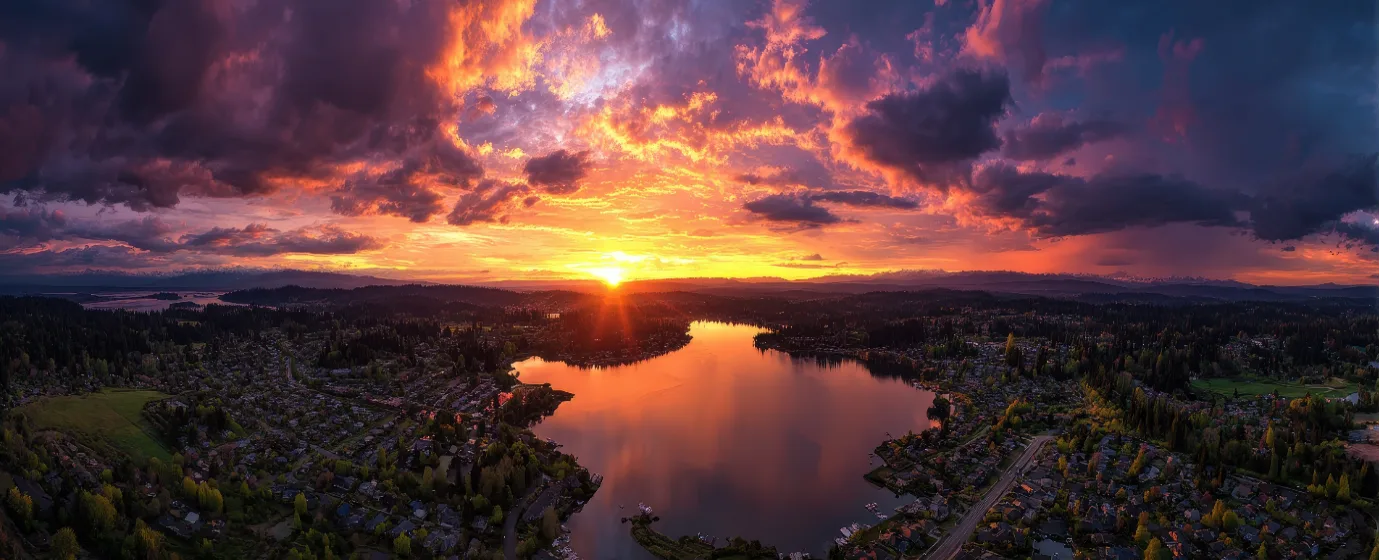
Puget Sound · Washington
Maybe your company is relocating you to the Puget Sound corridor and someone in HR mentioned Lake Stevens as the place where the square footage actually makes sense. Maybe you've been priced out of Kirkland and Bothell and a friend who moved here three years ago keeps texting you photos of sunsets over the water. Maybe you drove through on US-2 and thought it looked like just another Snohomish County bedroom community — houses, a Target, a Fred Meyer, and not much else. All three of those impressions are partially right, which is exactly what makes Lake Stevens worth understanding on its own terms. The central tension here is that this is a genuine lake town that also happens to be one of the fastest-growing suburbs in Washington — and those two identities pull against each other in ways that affect your daily life, your commute, and what you're actually getting for $687,000.
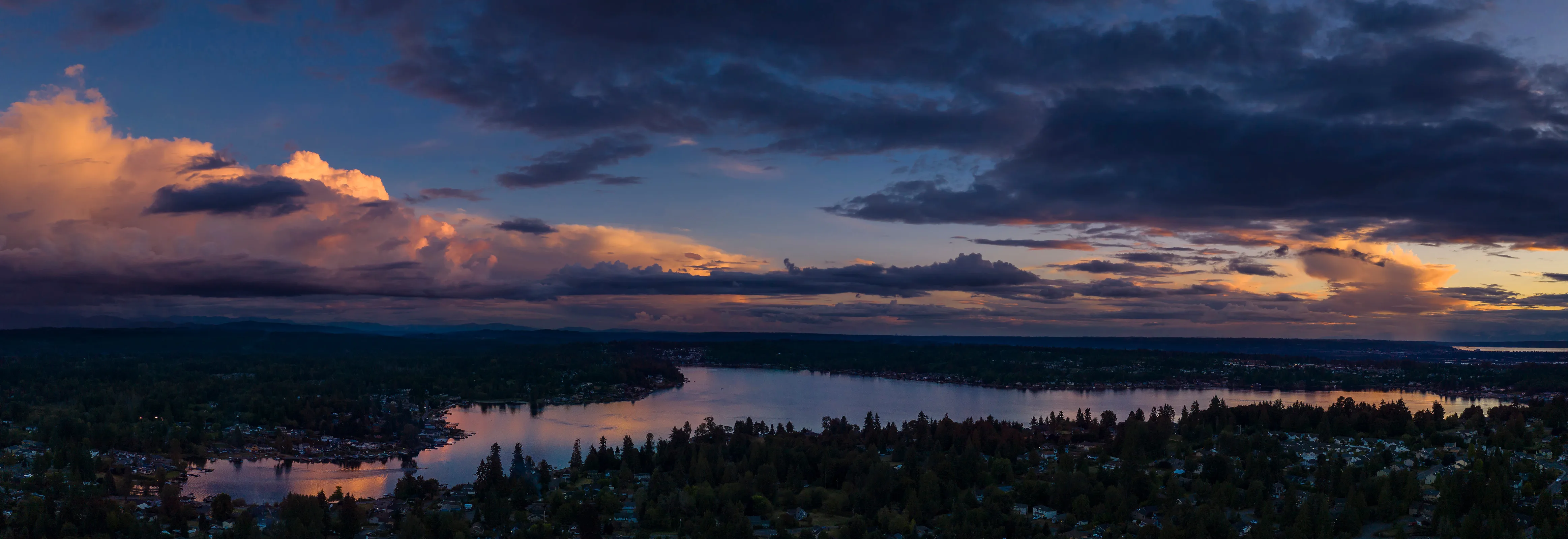
Geographically, Lake Stevens sits about six miles east of Everett, tucked around a 1,040-acre natural lake that is the largest and deepest in Snohomish County. The city isn't a grid — it wraps around the lake in a loose ring, with neighborhoods that have very different characters depending on whether they sit on the waterfront, up on the hillsides, or out toward the rural eastern fringe near Machias and Bunk Foss. That geography shapes everything: your commute route, your access to trails, how close you are to a grocery store, and whether your neighbors are on five-acre lots or 20-foot-lot subdivisions. The 44-minute average commute to Seattle is real on a good day, but the SR-9 and US-2 chokepoints are real every day, and knowing which side of the lake you're buying on matters more than most relocation guides will tell you.
This guide will help you figure out whether Lake Stevens actually fits your life — not just your spreadsheet. You'll get an honest read on the commute, the neighborhoods, the school district, the tradeoffs, and the local quirks that don't show up on Zillow listings. If Lake Stevens is the right call, you'll know it by the end. If it's not, you'll know that too.
Not every buyer is the right fit for a lake-centered suburban community with a growing downtown and a serious commute to consider. Here's a fast read on who tends to thrive here — and who tends to struggle.
| Best For | Why |
|---|---|
| Commuters to Everett or Boeing | 6 miles from Everett; Boeing Paine Field is a realistic 15–20 minute drive most mornings |
| Families with school-age children | Lake Stevens School District ranks in the top 20% statewide; strong graduation rate and above-average per-pupil spending |
| First-time buyers priced out of Bothell/Mill Creek | Entry-level homes exist in the $550K–$625K range; more square footage per dollar than most of the 405 corridor |
| Outdoor-oriented households | Year-round lake access, 20 Bridges trail system, fishing, boating, and kayaking without leaving city limits |
| Remote workers who want space | Larger lots and newer construction in areas like Machias and North Lake Stevens; high-speed internet increasingly available |
| Retirees seeking lake lifestyle | Waterfront retirement living is rare in Western Washington at this price point; lakeside condos and single-level homes do exist |
The first thing that surprises most people after six months here is how much the lake anchors daily life in ways they didn't expect. It's not a decorative amenity — residents actually use it. On summer weekday mornings, you'll see people launching kayaks at Davies Beach Park before work. On Friday evenings, the boat launches at Wyatt Park fill up fast. The lake is counter-clockwise for boat traffic, a rule that locals know by heart and newcomers learn quickly.
The town center is still developing, which is either a charm or a frustration depending on your perspective. Hart Road and the US-2 corridor near the 99th Street intersection function as the commercial spine — you've got the Fred Meyer, the Safeway, the chain restaurants, and the newer retail that's arrived as the population has grown. Downtown Lake Stevens, around 83rd Avenue NE, has a more small-town feel with local businesses, the farmers market during summer months, and the kind of walkability that doesn't require a car for every errand. The honest read: it's not a walkable town by urban standards, but it's far more connected than the rural fringe communities around it.
Traffic is the friction point that nobody warns you about. SR-9 southbound toward Everett backs up reliably from 7 to 8:30 a.m., and the US-2 junction can add 10 to 20 minutes to a Seattle commute on a bad day. Buyers who land jobs on the Eastside often discover that the 44-minute-to-Seattle figure doesn't map cleanly onto an Issaquah or Bellevue commute — budget 55 to 70 minutes for that scenario. The workaround many longtime residents use is to leave before 6:45 a.m. or shift to remote schedules on peak traffic days; the evening commute on SR-9 northbound typically clears by 6:30 p.m.
The community vibe skews young and family-oriented — the median age of 34.7 reflects a city that's been actively growing through the family formation years. You'll find a strong presence at the school events, the lake parks on weekends, and the informal social fabric that comes with a place where 78% of households are families. It's not the kind of city where you feel anonymous, which is either a selling point or a warning depending on what you're looking for.
The lake is legitimately special. At over 1,000 acres with an average depth of 64 feet, Lake Stevens isn't a pond with a marketing budget — it's a real recreational lake with clean water maintained by an artificial aeration system and a small, minimally developed watershed that limits runoff. Year-round fishing, summer swimming at Davies Beach, and recreational boating within city limits is not something you can say about most suburbs at this price point in Western Washington.
The school district is the second reason most families who come here stay. Lake Stevens School District consistently ranks in the top 20% of Washington's 306 districts on combined math and reading proficiency, and its 93.6% four-year graduation rate significantly exceeds the state average of 82.6%. The district spends approximately $18,088 per student annually — well above national averages — and the Niche rating of A- reflects a system that performs better than its suburban-ring geography might suggest. For families making a long-term decision, that consistency matters.
The price-to-space equation still favors buyers here compared to most of the 405 corridor. The median home price delivers genuinely livable square footage — most homes in the $680K–$720K range are four-bedroom, two-bath homes built after 2000 with two-car garages and yard space. Try pricing that configuration in Kirkland, Bothell, or Mill Creek and you'll understand immediately why families who've run those comparisons end up in Lake Stevens.
The community infrastructure has grown with the population in ways that feel deliberate rather than accidental. The 20 Bridges Park trail system is an underappreciated asset — a connected loop trail network around the lake that gives residents a dedicated recreational corridor without needing to drive to a trailhead. Mills Cove Reserve, North Cove Park, and Lundeen Park provide additional green space distributed around the lake's perimeter, so access to nature isn't concentrated in one corner of the city.
Looking to buy in Estimate your payment.
Enter your numbers to see an estimated monthly mortgage payment.
Estimate only. Excludes HOA fees and mortgage insurance.
The commute is the thing most people rationalize on the way in and resent on the way out. Forty-four minutes to Seattle on a good day is achievable, but Lake Stevens doesn't have a Sounder station, and the express bus options require a park-and-ride connection that adds time and planning. Households where both partners commute to different locations — one to Everett, one to the Eastside — will find the logistics demanding. Several families who've left Lake Stevens in the past few years have cited commute fatigue, not the city itself, as the reason.
The dining and entertainment scene is thin for a city of 42,000. The restaurant corridor along US-2 and Hart Road covers the basics — national chains, a few local spots, and the breweries and food trucks that have started to fill gaps. But if you're coming from a city like Bellevue or even Redmond with expectations about walkable restaurant density, independent coffee shops, and evening entertainment options, Lake Stevens will feel limited. The closest meaningful urban food and cultural amenities are in downtown Everett, about 15 minutes west.
Flooding and seasonal road conditions on the eastern edges of the city — particularly around the Machias and Bunk Foss corridors near lower-lying agricultural land — are worth knowing about before you fall in love with a rural-feeling five-acre property. The Pilchuck River drainage and the creeks feeding the lake have historically created localized flooding concerns in wet years. This isn't city-wide, but it affects specific parcels and neighborhoods.
The property crime rate of 15.6 per 1,000 residents sits higher than many buyers expect for a family-focused suburban community. It's not alarmingly high by Washington state standards, but it does reflect the realities of a rapidly growing city where retail corridors and transitional neighborhoods have attracted opportunistic theft. The violent crime rate of 2.1 per 1,000 is low and consistent with what you'd expect from a community with this demographic profile. The honest answer is that Lake Stevens is a safe place to raise a family — the property crime figure is worth noting, not worth fearing.
The city wraps around the lake in a loose geographic ring, with distinct neighborhoods that vary significantly in character, price, and commute logic. Here are the eight neighborhoods that matter most for buyers making a relocation decision.
South Lake Stevens is the closest thing the city has to a traditional walkable neighborhood core, situated near the lake's southern shore and within reasonable distance of the downtown commercial area along 83rd Avenue NE. Homes here tend to be a mix of older established construction from the 1980s and 1990s alongside newer infill, and the price range typically runs in the mid-$600s to low $700s for single-family homes. The SR-9 access is convenient, which makes this one of the better-positioned areas for commuters heading toward Everett or Seattle.
Best for: Buyers who want proximity to the lake and downtown amenities without paying the waterfront premium.
West Lake Stevens sits along the lake's western shore, where the terrain rises into hillside residential streets with water views that don't always require waterfront prices. This is one of the denser, more established parts of the city, with older neighborhoods that have been absorbing new residents as the city grows. Prices here range from the high $600s to the mid-$700s depending on view and lot size, with the more elevated parcels commanding a meaningful premium.
Best for: Households that want lake views and established neighborhood feel with faster access to Everett and I-5.
Eastlake Park occupies the eastern shoreline and has a more residential, quieter character than the busier western side. The neighborhood mix leans toward established single-family homes and some lakefront properties, and the streets have the kind of scale that suggests a community built for people who knew they were staying. Access to Davies Beach Park makes this a popular area for families with kids who want to be near public swim access.
Best for: Families with school-age children who want quieter streets and proximity to lake parks.
Machias is Lake Stevens' rural eastern fringe — an unincorporated community that borders the city where five-acre parcels, hobby farms, and agricultural land still dominate the landscape. Homes here can deliver significantly more land per dollar than the lakeside neighborhoods, with some properties in the $600K range offering acreage that would cost $1.2 million closer to Bellevue. The commute calculus is harder here, and buyers should factor in that the feel is genuinely rural rather than suburban.
Best for: Remote workers or Everett-area employees who prioritize land, privacy, and a slower pace over walkability.
Bunk Foss sits northeast of the lake in a semi-rural corridor where the city transitions into countryside at a noticeable rate. Like Machias, this area offers larger lots and some of the most affordable entry points into Lake Stevens-area living, with prices that can dip below $600,000 for homes with meaningful yard space. The commute to Everett or Seattle is the longest from this corridor, and residents should expect to drive for most daily needs.
Best for: Buyers prioritizing budget and space who are comfortable with a rural commute and limited walkability.
North Lake Stevens has absorbed a significant share of the city's newer construction over the past decade, with planned subdivisions, newer infrastructure, and a demographic profile that skews toward young families. The price range here runs from the low $700s to the mid-$800s for newer four- and five-bedroom homes, and the school access is strong given the proximity to several Lake Stevens School District campuses. SR-9 access northward toward Marysville is easy; the southbound commute is the tradeoff.
Best for: Families with children who want newer construction and don't mind the SR-9 morning backup.
Cavelero Hill rises above the northern edge of the lake, offering elevated terrain and some of the more dramatic views in the city. The neighborhood has a mix of older established homes and some newer builds, with a community character that feels more residential and quiet than the busier lake-adjacent corridors. Prices here span a broad range from the $650s into the $800s depending on view, age, and lot configuration.
Best for: Buyers who want elevation, views, and a quieter neighborhood feel within the Lake Stevens city boundary.
The waterfront properties along the lake's perimeter are the city's prestige tier and an entirely different market from everything else in Lake Stevens. The median listing price for waterfront homes runs around $2.8 million, with most properties featuring private docks and unobstructed lake access. These are primarily fully rebuilt or newly constructed homes — the original cabins that once populated the shoreline have been largely replaced by primary residences in the multi-million dollar range. This is not a market for first-time buyers, but it explains why Lake Stevens attracts a cohort of buyers who specifically come for the lake lifestyle.
Best for: Buyers seeking private dock access and waterfront living who are comfortable in the $2.5M–$4M+ range.
| City | Best For | Median Home Price | Commute to Seattle | Vibe |
|---|---|---|---|---|
| Lake Stevens | Families wanting lake lifestyle + school quality | $687,000 | ~44 min | Suburban lake town, growing fast |
| Everett | Affordability + Boeing/Paine Field access | ~$535,000 | ~35 min | Urban-suburban mix, rougher edges |
| Marysville | Budget buyers, newer construction | ~$550,000 | ~45 min | Pure bedroom suburb, limited character |
| Snohomish | Charm, walkable historic downtown | ~$660,000 | ~50 min | Small-town feel, slower pace |
| Monroe | Affordability + rural edge, US-2 corridor | ~$565,000 | ~55 min | Rural-suburban, tight community |
| Mill Creek | Walkability, top-tier schools, upscale retail | ~$775,000 | ~38 min | Polished, family-oriented, expensive |
The most common direct comparison buyers make is between Lake Stevens and Mill Creek, and it usually comes down to whether you value the lake lifestyle enough to accept the longer commute and the less polished commercial scene. Mill Creek is more expensive, more walkable, and has a more developed restaurant and retail environment. Lake Stevens gives you the water, more square footage per dollar, and a school district that performs comparably — what you give up is the suburban polish and the 38-minute drive.
| Metric | Data |
|---|---|
| Population | ~42,620 (2026 est.) |
| Median Home Price | $687,000 |
| Property Tax Rate | ~1.19% |
| Median Household Income | $122,336 |
| Commute to Seattle | ~44 minutes |
| Violent Crime per 1,000 | 2.1 |
| Property Crime per 1,000 | 15.6 |
| School District Rating | A- (Niche) |
| 4-Year Graduation Rate | 93.6% |
| Cost of Living Index | ~140 (national avg = 100) |
The counter-clockwise rule is a real thing. Lake Stevens is one of the few recreational lakes in Western Washington with an official designated traffic direction for boat traffic — counter-clockwise when underway. Locals know this instinctively and will notice immediately if you're a newcomer circling the wrong way on a summer Saturday. If you're buying near the lake and planning to put a boat on it, learning this before your first summer weekend will save you an embarrassing confrontation near the Wyatt Park launch.
The Lake Stevens Farmers Market runs through the summer season along the downtown corridor and has become a genuine community gathering point rather than just a tourist attraction. It's where you'll actually meet your neighbors, find local produce vendors from the Snohomish Valley, and get a read on the community character of the city before committing to a specific neighborhood. The market draws residents from across the lake, making it one of the few places where all the different pockets of the city converge.
The 20 Bridges trail loop is the local secret that residents guard modestly. It's a connected multi-use trail system that circuits the lake, passing through parks and green corridors in a way that lets you cover several miles without repeating terrain. Serious trail runners and cyclists use it as a primary training loop; dog walkers and families with strollers use it on weekends. The trail quality isn't uniform around the entire circuit, but the sections near Lake Stevens Community Park and Mills Cove Reserve are well maintained and genuinely pleasant.
What I Would Not Do if moving to Lake Stevens: I would not buy a home east of SR-9 near the Machias or Bunk Foss corridors without spending a full winter morning driving the commute at 7:15 a.m. first. The rural properties in that eastern corridor look compelling on paper — more land, lower prices, quiet streets — but the commute to Everett or Seattle from those addresses is a different experience in January rain than it is on a clear September afternoon when you're touring homes. Several buyers who've landed in those eastern addresses have found the isolation and commute compounding effect harder to live with than anticipated.
Local Expert Takeaway: If you're weighing Lake Stevens seriously, focus your search on the neighborhoods with the best SR-9 access — South Lake Stevens, West Lake Stevens, and the closer-in sections of North Lake Stevens — rather than chasing rural feel in the eastern corridors. The lake access you're paying for is most valuable when you can actually reach it easily after work, and the school district's strength is consistent across the city, so you don't need to sacrifice commute logic to land in the best attendance zone. At the $687,000 median, you're getting a legitimate four-bedroom home in a top-20% Washington school district with year-round lake recreation built into daily life — that combination is genuinely rare in the Puget Sound region.
✅ Lake Stevens delivers what most Snohomish County suburbs can't: a genuine recreational lake, a top-20% school district, and a median home price that's still achievable for dual-income households — all in the same city.
⚠️ The commute is the variable that breaks or makes this decision. If your destination is Everett or Paine Field, Lake Stevens is a reasonable choice. If it's Bellevue, Redmond, or Issaquah, build a realistic commute model before you make an offer.
📍 The waterfront market ($2.5M+) and the suburban market ($650K–$750K) coexist in the same city but operate in entirely different worlds — know which one you're shopping in before you form expectations.
Is Lake Stevens a good place for families?
Yes, Lake Stevens offers a combination of school district quality, outdoor access, and housing affordability that makes it genuinely compelling for households with children. The Lake Stevens School District graduation rate of 93.6% exceeds the state average by a wide margin, and the city's park system and lake access give kids recreational infrastructure that many larger suburbs lack.
What is the crime rate in Lake Stevens?
Lake Stevens has a violent crime rate of 2.1 per 1,000 residents, which is low by Washington state standards and consistent with a family-oriented suburban community. The property crime rate of 15.6 per 1,000 is higher and worth noting — it reflects opportunistic theft in retail corridors rather than residential safety concerns. Most longtime residents describe day-to-day life as very safe.
How does Lake Stevens compare to nearby Everett?
Lake Stevens offers better school performance, a more cohesive family-oriented community character, and direct lake access — but it costs more, with a median home price roughly $150,000 above Everett's. Everett has more urban amenities, a stronger restaurant and entertainment scene, and better transit access to Seattle via Sounder. The typical buyer who chooses Lake Stevens over Everett is prioritizing school quality and lifestyle over commute efficiency and urban convenience.
Explore the full Lake Stevens series: The Ultimate Lake Stevens Relocation Guide · Is Lake Stevens Safe? · Cost of Living in Lake Stevens · Best Neighborhoods in Lake Stevens · Lake Stevens Schools & Family Life · Lake Stevens Youth Sports · Lake Stevens Parks & Recreation · Retiring in Lake Stevens · 1031 Tax-Deferred Exchange in Lake Stevens · Lake Stevens First-Time Homebuyers Guide · Moving to Lake Stevens from California
Tell us what you need help with and we'll connect you with local resources.

About the Author
Todd Davidson is the founder of Living in Oregon and Living in Washington, where he publishes in-depth city guides, neighborhood resources, and local market insights covering more than 180 communities across the Pacific Northwest. While his background is in home financing and real estate, he created these digital platforms to help families research and compare regions before making a move.